<xs:element name="Contact_Fk" type="xs:string"/>
| schema location: | W:\TDWG\CODATA\Schema\CODATA-TDWG-BioCol_1.01.xsd |
| diagram | |
| type | xs:string |
| source | <xs:element name="Contact_Fk" type="xs:string"/> |
| diagram | 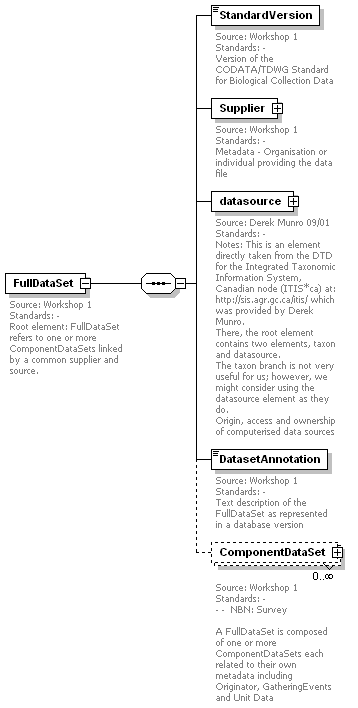 |
||
| children | StandardVersion Supplier datasource DatasetAnnotation ComponentDataSet | ||
| annotation |
|
||
| source | <xs:element name="FullDataSet"> <xs:annotation> <xs:documentation>Source: Workshop 1 Standards: - Root element: FullDataSet refers to one or more ComponentDataSets linked by a common supplier and source.</xs:documentation> </xs:annotation> <xs:complexType> <xs:sequence> <xs:element name="StandardVersion" type="xs:string"> <xs:annotation> <xs:documentation>Source: Workshop 1 Standards: - Version of the CODATA/TDWG Standard for Biological Collection Data</xs:documentation> </xs:annotation> </xs:element> <xs:element name="Supplier"> <xs:annotation> <xs:documentation>Source: Workshop 1 Standards: - Metadata - Organisation or individual providing the data file</xs:documentation> </xs:annotation> <xs:complexType> <xs:sequence> <xs:sequence> <xs:element name="name_ID" type="name_ID" minOccurs="0"/> <xs:choice> <xs:element name="Organisation" type="OrganisationType"> <xs:annotation> <xs:documentation>Added by CC Oct 2001Name (elements) for organisations</xs:documentation> </xs:annotation> </xs:element> <xs:element name="PersonName" type="PersonNameType"> <xs:annotation> <xs:documentation>Source: Workshop 1/ changed by CC from old Name Element Standards: - Group element for parts of a personal name - see also name_ID (ref to a database entry) and fullName (free text format)</xs:documentation> </xs:annotation> </xs:element> <xs:element name="AltText" type="AltText"> <xs:annotation> <xs:documentation>Source: Sydney CODATA workshopFree text field for informal recording of field contents</xs:documentation> </xs:annotation> </xs:element> </xs:choice> </xs:sequence> <xs:element name="URL" type="URL" minOccurs="0"> <xs:annotation> <xs:documentation>Source: Workshop 1 Standards: - The Internet URL (Uniform Resource Locator) of the Dataset Supplier</xs:documentation> </xs:annotation> </xs:element> <xs:element name="Address" type="AddressType" minOccurs="0"> <xs:annotation> <xs:documentation>Source: Workshop 1/ changed by CC Oct. 2001 Standards: - In Santa Barbara, I (WGB) insisted on a very basic address definition CC: A simpler but more flexible version would be to have Address line as a repeatable element Could even have Address (AddressLine*) with AddressLine being a text element with Attribute Type = (Line|Town|County|Country|zip|etc) </xs:documentation> </xs:annotation> </xs:element> <xs:element name="CommsNumbers" type="CommsNumbersType" minOccurs="0" maxOccurs="unbounded"> <xs:annotation> <xs:documentation>Added by CC Oct 2001 - - NBN : element Contact_Number Added to replace fax, email and telephone elements with a repeatable and more flexible structure where the element attribute CommType is enumnerated to include tel,fax,email Attribute Preferred marks the first choice where there are multiple numbers </xs:documentation> </xs:annotation> </xs:element> <xs:element name="SupplierText" type="SupplierText" minOccurs="0"> <xs:annotation> <xs:documentation>Source: Workshop 1 Standards: - Metadata - text notes relating to the supplier of the FullDataSet or subsets of the data</xs:documentation> </xs:annotation> </xs:element> </xs:sequence> </xs:complexType> </xs:element> <xs:element name="datasource"> <xs:annotation> <xs:documentation>Source: Derek Munro 09/01 Standards: - Notes: This is an element directly taken from the DTD for the Integrated Taxonomic Information System, Canadian node (ITIS*ca) at: http://sis.agr.gc.ca/itis/ which was provided by Derek Munro. There, the root element contains two elements, taxon and datasource. The taxon branch is not very useful for us; however, we might consider using the datasource element as they do. Origin, access and ownership of computerised data sources</xs:documentation> </xs:annotation> <xs:complexType> <xs:sequence> <xs:element name="dbsource" type="xs:string"> <xs:annotation> <xs:documentation>Source: Derek Munro 09/01 Standards: ITIS*ca draft metadata</xs:documentation> </xs:annotation> </xs:element> <xs:element name="dbserver" type="xs:string"> <xs:annotation> <xs:documentation>Source: Derek Munro 09/01 Standards: ITIS*ca draft metadata</xs:documentation> </xs:annotation> </xs:element> <xs:element name="dbwebaddress" type="xs:string"> <xs:annotation> <xs:documentation>Source: Derek Munro 09/01 Standards: ITIS*ca draft metadata</xs:documentation> </xs:annotation> </xs:element> <xs:element name="dbdatadate" type="DateType"> <xs:annotation> <xs:documentation>Source: Derek Munro 09/01 Standards: ITIS*ca draft metadata</xs:documentation> </xs:annotation> </xs:element> <xs:element name="dbcurrentdate" type="DateType"> <xs:annotation> <xs:documentation>Source: Derek Munro 09/01 Standards: ITIS*ca draft metadata</xs:documentation> </xs:annotation> </xs:element> <xs:element name="dbexpirydate" type="DateType" minOccurs="0"> <xs:annotation> <xs:documentation>Source: Derek Munro 09/01 Standards: ITIS*ca draft metadata</xs:documentation> </xs:annotation> </xs:element> <xs:element name="dbtermsofuse" type="xs:string"> <xs:annotation> <xs:documentation>Source: Derek Munro 09/01 Standards: ITIS*ca draft metadata</xs:documentation> </xs:annotation> </xs:element> </xs:sequence> </xs:complexType> </xs:element> <xs:element name="DatasetAnnotation" type="xs:string"> <xs:annotation> <xs:documentation>Source: Workshop 1 Standards: - Text description of the FullDataSet as represented in a database version</xs:documentation> </xs:annotation> </xs:element> <xs:element name="ComponentDataSet" minOccurs="0" maxOccurs="unbounded"> <xs:annotation> <xs:documentation>Source: Workshop 1 Standards: - - - NBN: Survey A FullDataSet is composed of one or more ComponentDataSets each related to their own metadata including Originator, GatheringEvents and Unit Data</xs:documentation> </xs:annotation> <xs:complexType> <xs:sequence> <xs:element name="DatasetOrCollectinOrSubcollectionName" type="xs:string" minOccurs="0"> <xs:annotation> <xs:documentation>Source: Workshop 1 Standards: - CC. The ComponentDataset may have a free text attribute defining its name Could be treated as an attribute of ComponentDataSet </xs:documentation> </xs:annotation> </xs:element> <xs:element name="Originator" type="OriginatorType" minOccurs="0"> <xs:annotation> <xs:documentation>Source: Workshop 1 Standards: - Uses the same structure as other contact elements (e.g. owner & supplier) therefore could be generalised via use of a Type Attribute(depositor, other bot. garden source, Originating Institution) CC. The orignator of the ComponentDataSet includes Elements for descriptive text, Organisation or individual name, address, URL and contact name </xs:documentation> </xs:annotation> </xs:element> <xs:element name="OwnerOrCustodian" type="OwnerOrCustodianType" minOccurs="0"> <xs:annotation> <xs:documentation>Source: Workshop 1 Standards: - Uses the same structure as other contact elements (e.g. originator & supplier) therefore could be generalised via use of a Type Attribute Individual or organisation with 'ownership' of a dataset</xs:documentation> </xs:annotation> </xs:element> <xs:element name="IPR" type="IPRType" minOccurs="0"> <xs:annotation> <xs:documentation>Source: Workshop 1 Standards: - Element referring to the Intellectual Property Rights apertaining to a dataset or unit data</xs:documentation> </xs:annotation> </xs:element> <xs:element name="NoURecsInResSet" type="xs:string" minOccurs="0"> <xs:annotation> <xs:documentation>Source: Workshop 1 Standards: - </xs:documentation> </xs:annotation> </xs:element> <xs:element name="NoURecsInDb" type="xs:string" minOccurs="0"> <xs:annotation> <xs:documentation>Source: Workshop 1 Standards: - </xs:documentation> </xs:annotation> </xs:element> <xs:element name="DateExtracted" type="xs:string" minOccurs="0"> <xs:annotation> <xs:documentation>Source: Workshop 1 Standards: - Date this dataset was extracted from a parent database or databases</xs:documentation> </xs:annotation> </xs:element> <xs:element name="DatabaseVersion" type="xs:string"> <xs:annotation> <xs:documentation>Source: Workshop 1 Standards: - Version control data for identifying source and version of a database</xs:documentation> </xs:annotation> </xs:element> <xs:element name="UnitDataset" minOccurs="0" maxOccurs="unbounded"> <xs:annotation> <xs:documentation>Source: Workshop 1 / modified by CC Oct 2001 Standards: - Taxon48: Unit (Gathering Unit) - see also Secimen Unit in this model (=Derived Unit) Element linking information to a Unit (e.g. biological record, specimen, subspecimen etc.) There may be many UnitDatasets within a ComponentDataSet. UnitDatasets may be related in a parent child fashion e.g. for derived units Units may have many identification and verification events attached to them the range of possible measurement attributes for a unit is vast and therefore a generalised measurement element is introduced. Measurable variables could be controlled by a look-up list. </xs:documentation> </xs:annotation> <xs:complexType> <xs:sequence> <xs:element name="Unit_ID" type="Unit_ID" maxOccurs="unbounded"> <xs:annotation> <xs:documentation>Source: Workshop 1 Standards: - Taxon48: Unit_ID / NBN: Sample_KeyUnit key or Identifying number - can be multiple</xs:documentation> </xs:annotation> </xs:element> <xs:element name="UnitIdentifiers" minOccurs="0" maxOccurs="unbounded"> <xs:annotation> <xs:documentation>Added by CC Oct 2001 includes HISPID4: cid NBN: specimen_number</xs:documentation> </xs:annotation> <xs:complexType> <xs:simpleContent> <xs:extension base="xs:string"> <xs:attribute name="identifierType" type="xs:string"/> </xs:extension> </xs:simpleContent> </xs:complexType> </xs:element> <xs:element name="SupplierText" type="SupplierText" minOccurs="0" maxOccurs="unbounded"> <xs:annotation> <xs:documentation>Source: Workshop 1 Standards: - Metadata - text notes relating to the supplier of the FullDataSet or subsets of the data</xs:documentation> </xs:annotation> </xs:element> <xs:element name="Originator" type="OriginatorType" minOccurs="0"> <xs:annotation> <xs:documentation>Source: Workshop 1 Standards: - Uses the same structure as other contact elements (e.g. owner & supplier) therefore could be generalised via use of a Type Attribute(depositor, other bot. garden source, Originating Institution) CC. The orignator of the ComponentDataSet includes Elements for descriptive text, Organisation or individual name, address, URL and contact name </xs:documentation> </xs:annotation> </xs:element> <xs:element name="IPR" type="IPRType" minOccurs="0"> <xs:annotation> <xs:documentation>Source: Workshop 1 Standards: - Element referring to the Intellectual Property Rights apertaining to a dataset or unit data</xs:documentation> </xs:annotation> </xs:element> <xs:element name="Surrogate" type="xs:string" minOccurs="0"> <xs:annotation> <xs:documentation>Source: Workshop 1 Standards: - </xs:documentation> </xs:annotation> </xs:element> <xs:element name="Substrate" type="SubstrateType" minOccurs="0"> <xs:annotation> <xs:documentation>Source: Workshop 1/ modified by CC Oct 2001 Standards: - HISPID4: sub Substrate is the surface or medium from which one or more specimens are recorded or collected e.g. in soft mud, on leaf surface, under rock, on granite etc.</xs:documentation> </xs:annotation> </xs:element> <xs:element name="Host" type="xs:string" minOccurs="0"> <xs:annotation> <xs:documentation>Source: Workshop 1 Standards: -</xs:documentation> </xs:annotation> </xs:element> <xs:element name="OwnerOrCustodian" type="OwnerOrCustodianType" minOccurs="0"> <xs:annotation> <xs:documentation>Source: Workshop 1 Standards: - Uses the same structure as other contact elements (e.g. originator & supplier) therefore could be generalised via use of a Type Attribute Individual or organisation with 'ownership' of a dataset</xs:documentation> </xs:annotation> </xs:element> <xs:element name="specimenUnit" minOccurs="0" maxOccurs="unbounded"> <xs:annotation> <xs:documentation>Added by CC Oct. 2001The specimen unit is a derived subtype of Unit representing physical specimens in collections The specimen can link to field obsevations and to named collections</xs:documentation> </xs:annotation> <xs:complexType> <xs:sequence> <xs:element name="Unit_ID" type="Unit_ID" maxOccurs="unbounded"> <xs:annotation> <xs:documentation>Source: Workshop 1 Standards: - Taxon48: Unit_ID / NBN: Sample_KeyUnit key or Identifying number - can be multiple</xs:documentation> </xs:annotation> </xs:element> <xs:element name="accession_number" minOccurs="0"> <xs:annotation> <xs:documentation>Added by CC Oct. 2001 - - Taxon48 AccCode_Pk LMNH The instutional number applied to an accession and recorded in the accessions register e.g. BRSMG:1999/1209. A structured view into acquisition information from accessions register as opposed to original gathering data. - helps link collections (e.g. several specimens may share one accession number).</xs:documentation> </xs:annotation> <xs:complexType> <xs:sequence> <xs:element name="accession_date"> <xs:annotation> <xs:documentation>Added by CC Oct 2001 - - Taxon48: AccDate The date on which an accession was recorded in the accessions register ( not the date of acquisition)</xs:documentation> </xs:annotation> <xs:complexType> <xs:sequence> <xs:element name="Date" type="DateType"/> </xs:sequence> </xs:complexType> </xs:element> <xs:element name="acquisition_date"> <xs:annotation> <xs:documentation>Added by CC Oct. 2001The date when specimens or collections were acquired by the institution</xs:documentation> </xs:annotation> <xs:complexType> <xs:sequence> <xs:element name="Date" type="DateType"/> </xs:sequence> </xs:complexType> </xs:element> <xs:choice> <xs:element name="AltText" type="AltText"> <xs:annotation> <xs:documentation>Source: Sydney CODATA workshopFree text field for informal recording of field contents</xs:documentation> </xs:annotation> </xs:element> <xs:element name="PersonName" type="PersonNameType"> <xs:annotation> <xs:documentation>Source: Workshop 1/ changed by CC from old Name Element Standards: - Group element for parts of a personal name - see also name_ID (ref to a database entry) and fullName (free text format)</xs:documentation> </xs:annotation> </xs:element> <xs:element name="organisationName" type="organisationName"> <xs:annotation> <xs:documentation>Added by CC Oct 2001Full organisation name e.g. Taxonomic Database Working Group</xs:documentation> </xs:annotation> </xs:element> </xs:choice> <xs:element name="Comment" type="Comment" minOccurs="0"> <xs:annotation> <xs:documentation>Added by CC Oct 2001Free text of formatted text (rtf) description of the feature - not controlled length e.g. often a memo field</xs:documentation> </xs:annotation> </xs:element> <xs:element name="Source" type="SourceType" minOccurs="0"> <xs:annotation> <xs:documentation>Added CC Oct 2001 NBN: Source Marker element for a link to a source module for dealing with structured literature and document rexcords </xs:documentation> </xs:annotation> </xs:element> </xs:sequence> <xs:attribute name="Acquisitiontype" type="xs:string"/> </xs:complexType> </xs:element> <xs:element name="specimenType"> <xs:complexType> <xs:choice> <xs:sequence> <xs:element name="ShortTermName" type="ShortTermName"> <xs:annotation> <xs:documentation>Source: CC - Oct 2001 Standards: ShortTernName is a code or shortened version of a term that might be used in a database or lookup table e.g. HOLO for Holotype </xs:documentation> </xs:annotation> </xs:element> <xs:element name="LongTermName" type="LongTermName" minOccurs="0"> <xs:annotation> <xs:documentation>Source: CC - Oct 2001 Standards: LongTermname is the full term that might appear in a lookup table e.g. in a list of types: Holotype</xs:documentation> </xs:annotation> </xs:element> <xs:element name="Description" type="Description" minOccurs="0"> <xs:annotation> <xs:documentation>Source: Workshop 1 Standards: - Used wherever a description field is needed. Free text and could be in rtf or html.</xs:documentation> </xs:annotation> </xs:element> </xs:sequence> <xs:element name="AltText" type="AltText"> <xs:annotation> <xs:documentation>Source: Sydney CODATA workshopFree text field for informal recording of field contents</xs:documentation> </xs:annotation> </xs:element> </xs:choice> <xs:attribute name="specimenTypeID" type="xs:string"/> </xs:complexType> </xs:element> <xs:element name="NatureOrPreservationMode"> <xs:annotation> <xs:documentation>Source: Workshop 1/ changed by CC Oct 2001Unit "nature" or preservation mode: virtual vs. object; preservation mode; part; creation process</xs:documentation> </xs:annotation> <xs:complexType> <xs:choice> <xs:element name="LookupTerm" type="LookupTermType"> <xs:annotation> <xs:documentation>Added by CC Oct 2001 NBN: Term Typical structure for a simple lookup list of term contents - structure consists of an attribute for the type e.g. name of the look up list together with long and short versions of the term</xs:documentation> </xs:annotation> </xs:element> <xs:element name="AltText" type="AltText"> <xs:annotation> <xs:documentation>Source: Sydney CODATA workshopFree text field for informal recording of field contents</xs:documentation> </xs:annotation> </xs:element> </xs:choice> <xs:attribute name="PreservationMode_ID" type="xs:string"/> </xs:complexType> </xs:element> <xs:element name="specimenUnit_part" type="xs:string" minOccurs="0"> <xs:annotation> <xs:documentation>Added by CC Oct 2001 LNHM specimen part: Part of the specimen rcord applies</xs:documentation> </xs:annotation> </xs:element> <xs:element name="accession_catalogue_ID" type="accession_catalogue_ID" minOccurs="0"> <xs:annotation> <xs:documentation>Added by CC Oct 2001Unique identifier for an accessions catalogue id in a computerised system</xs:documentation> </xs:annotation> </xs:element> <xs:choice minOccurs="0"> <xs:element name="namedCollection" type="namedCollectionType"> <xs:annotation> <xs:documentation> Source: Workshop 1/ subelements added by CC Oct. 2001A named Collection is an association of specimens (units) that have a common identity either through content, ownership or acquisition. This element is a special kind of Unit subType and is separated here for the purposes of clarity The element facilitates the recording of the history, ownership and content of named collections and also because named collections may be stored, moved. acquired or disposed of as a whole. </xs:documentation> </xs:annotation> </xs:element> <xs:element name="collection_ID" type="collection_ID"> <xs:annotation> <xs:documentation>Added by CC Oct. 2001 Syn: Unit_ID Unique identifier for collection in a computerised system this is a synonym of Unit_ID </xs:documentation> </xs:annotation> </xs:element> </xs:choice> <xs:element name="specimenUnitNumber" minOccurs="0" maxOccurs="unbounded"> <xs:annotation> <xs:documentation>Added by CC Oct. 2001Any numbers or other registration marks associated with a specimen unit (1 or more specimens)</xs:documentation> </xs:annotation> <xs:complexType> <xs:sequence> <xs:element name="specimenUnit_number_ID" type="xs:string" minOccurs="0"> <xs:annotation> <xs:documentation>Added by CC Oct 2001 LNHM</xs:documentation> </xs:annotation> </xs:element> <xs:element name="DistinguishingNumber" type="xs:string"> <xs:annotation> <xs:documentation>Added by CC Oct. 2001Text for number or other registration mark applied to a specimen or group of specimens e.g from registration book, collectors note book, auction catalogue, batch number etc.</xs:documentation> </xs:annotation> </xs:element> <xs:element name="Source" type="SourceType"> <xs:annotation> <xs:documentation>Added CC Oct 2001 NBN: Source Marker element for a link to a source module for dealing with structured literature and document rexcords</xs:documentation> </xs:annotation> </xs:element> </xs:sequence> <xs:attribute name="PreferredFlag"> <xs:simpleType> <xs:restriction base="xs:NMTOKEN"> <xs:enumeration value="Yes"/> <xs:enumeration value="No"/> </xs:restriction> </xs:simpleType> </xs:attribute> </xs:complexType> </xs:element> <xs:element name="specimenUnit_description" type="xs:string"> <xs:annotation> <xs:documentation>Added by CC Oct 2001 LNHM Free text description of a specimen or similar 'Unit'</xs:documentation> </xs:annotation> </xs:element> <xs:sequence minOccurs="0" maxOccurs="unbounded"> <xs:element name="Identification" type="IdentificationType"> <xs:annotation> <xs:documentation>Source: Workshop 1 Standards: - </xs:documentation> </xs:annotation> </xs:element> <xs:element name="specimenUnitStatus" minOccurs="0"> <xs:annotation> <xs:documentation>Taxonomic status linked to an identification of a specimen</xs:documentation> </xs:annotation> <xs:complexType> <xs:sequence> <xs:element name="Unit_status_ID" type="Unit_status_ID" minOccurs="0"/> <xs:element name="Unit_ID" type="Unit_ID" minOccurs="0" maxOccurs="unbounded"> <xs:annotation> <xs:documentation>Source: Workshop 1 Standards: - Taxon48: Unit_ID / NBN: Sample_KeyUnit key or Identifying number - can be multiple</xs:documentation> </xs:annotation> </xs:element> <xs:element name="Type"> <xs:annotation> <xs:documentation>Source: Workshop 1 / mod CC Oct 2001 Standards: - - - made qualifier an attribute of status - introduced qualifier to indicate preference or sort order of basionyms Composite element that links type status, a qualifying statement, original name and pertinent published references Making Type a repeatable element with a qualifier for sort order e.g. most recent, second most recent etc. covers multiple elements in HISPID (e.g. basnam1, basnam2, basnam3) </xs:documentation> </xs:annotation> <xs:complexType> <xs:sequence> <xs:element name="TypeStatus"> <xs:annotation> <xs:documentation>Source: Workshop 1/ modified CC Oct 2001 Standards: - - - includes HISPID4: tsta and tql The presumed nomenclatural status of specimens regarded as types - Note that Type Qualifier has been moved to an enumerated attribute of TypeStatus</xs:documentation> </xs:annotation> <xs:complexType> <xs:choice> <xs:sequence> <xs:element name="AltText" type="AltText"> <xs:annotation> <xs:documentation>Source: Sydney CODATA workshopFree text field for informal recording of field contents</xs:documentation> </xs:annotation> </xs:element> <xs:element name="Source" type="SourceType"> <xs:annotation> <xs:documentation>Added CC Oct 2001 NBN: Source Marker element for a link to a source module for dealing with structured literature and document rexcords </xs:documentation> </xs:annotation> </xs:element> </xs:sequence> <xs:element name="LookupTerm" type="LookupTermType"> <xs:annotation> <xs:documentation>Added by CC Oct 2001 NBN: Term Typical structure for a simple lookup list of term contents - structure consists of an attribute for the type e.g. name of the look up list together with long and short versions of the term</xs:documentation> </xs:annotation> </xs:element> </xs:choice> <xs:attribute name="TypeQualifier" use="required"> <xs:simpleType> <xs:restriction base="xs:NMTOKEN"> <xs:enumeration value="Confirmed"/> <xs:enumeration value="Probably"/> <xs:enumeration value="Possibly"/> <xs:enumeration value="Not"/> </xs:restriction> </xs:simpleType> </xs:attribute> </xs:complexType> </xs:element> <xs:element name="Basionym" minOccurs="0"> <xs:annotation> <xs:documentation>Source: Workshop 1 Standards: - HISPID4: basnam / TLR Baionym refers to the original name associated with a type specimen where the name has subsequently been revised especially where this has arisen from a change of rank the option here is to use plain name text or a fully atomised model for name parts.</xs:documentation> </xs:annotation> <xs:complexType> <xs:sequence> <xs:choice> <xs:element name="AltText" type="AltText"> <xs:annotation> <xs:documentation>Source: Sydney CODATA workshopFree text field for informal recording of field contents</xs:documentation> </xs:annotation> </xs:element> <xs:element name="BotanicalName" type="BotanicalNameType"/> <xs:element name="BacteriologicalName" type="BacteriologicalNameType"/> <xs:element name="ZoologicalName" type="ZoologicalNameType"/> </xs:choice> <xs:element name="Source" type="SourceType" minOccurs="0"> <xs:annotation> <xs:documentation>Added CC Oct 2001 NBN: Source Marker element for a link to a source module for dealing with structured literature and document rexcords</xs:documentation> </xs:annotation> </xs:element> </xs:sequence> </xs:complexType> </xs:element> <xs:element name="Source" type="SourceType" minOccurs="0" maxOccurs="unbounded"> <xs:annotation> <xs:documentation>Added CC Oct 2001 NBN: Source Marker element for a link to a source module for dealing with structured literature and document rexcords</xs:documentation> </xs:annotation> </xs:element> </xs:sequence> <xs:attribute name="BasionymOrder"> <xs:simpleType> <xs:restriction base="xs:NMTOKEN"> <xs:enumeration value="1"/> <xs:enumeration value="2"/> <xs:enumeration value="3"/> </xs:restriction> </xs:simpleType> </xs:attribute> </xs:complexType> </xs:element> <xs:element name="specimenUnitStatus_src"> <xs:complexType> <xs:sequence> <xs:element name="Unit_status_ID" type="Unit_status_ID" minOccurs="0"/> <xs:element name="Source" type="SourceType"> <xs:annotation> <xs:documentation>Added CC Oct 2001 NBN: Source Marker element for a link to a source module for dealing with structured literature and document rexcords </xs:documentation> </xs:annotation> </xs:element> </xs:sequence> <xs:attribute name="entered_by" type="xs:string" use="required"/> <xs:attribute name="entry_date" type="xs:string" use="required"/> <xs:attribute name="specimen_status_source_key" type="xs:string"/> </xs:complexType> </xs:element> </xs:sequence> <xs:attribute name="entered_by" type="xs:string" use="required"/> <xs:attribute name="entry_date" type="xs:string" use="required"/> </xs:complexType> </xs:element> </xs:sequence> <xs:element name="specimenUnitData" minOccurs="0" maxOccurs="unbounded"> <xs:annotation> <xs:documentation>Any measurable aspect of the specimen e.g. height, weight, number of specimens etc.</xs:documentation> </xs:annotation> <xs:complexType> <xs:sequence> <xs:element name="measurement" type="measurementType"> <xs:annotation> <xs:documentation>Added by CC Oct 2001 NBN: measurement (partim) measurement is the actiual measurement - measurement is qualigied by attributes: measurementType: what type of measurement e.g. count, area, linear measurement measurementUnits: units that measurement is recorded in e...g. hectares, kilometres, kilogrammes etc. measurementAccuracy: describes accuracy e.g. approximate or +/- 50</xs:documentation> </xs:annotation> </xs:element> </xs:sequence> <xs:attribute name="SpecimenUnitData_ID" type="xs:string"/> </xs:complexType> </xs:element> <xs:element name="UnitDataSetRelations" type="UnitDataSetRelationsType" minOccurs="0" maxOccurs="unbounded"> <xs:annotation> <xs:documentation>Added by CC Oct 2001 specimen relationships - can be used to link derived specimens, specimen parts or members of a specimen group</xs:documentation> </xs:annotation> </xs:element> <xs:element name="specimenUnit_label" minOccurs="0" maxOccurs="unbounded"> <xs:annotation> <xs:documentation>Added by CC Oct 2001 LNHM Specimens, cabinets and other units e.g. living horticultural specimens may have one or more labels attached or associated with them</xs:documentation> </xs:annotation> <xs:complexType> <xs:sequence> <xs:element name="specimenUnit_label_ID" type="xs:string" minOccurs="0"> <xs:annotation> <xs:documentation>Added by CC Oct 2001 LNHM Unique identifier within a database</xs:documentation> </xs:annotation> </xs:element> <xs:element name="Unit_ID" type="Unit_ID" minOccurs="0"> <xs:annotation> <xs:documentation>Source: Workshop 1 Standards: - Taxon48: Unit_ID / NBN: Sample_KeyUnit key or Identifying number - can be multiple</xs:documentation> </xs:annotation> </xs:element> <xs:element name="position_on_object" type="xs:string"/> <xs:element name="label_summary" type="xs:string"/> <xs:element name="Source" type="SourceType" minOccurs="0" maxOccurs="unbounded"> <xs:annotation> <xs:documentation>Added CC Oct 2001 NBN: Source Marker element for a link to a source module for dealing with structured literature and document rexcords</xs:documentation> </xs:annotation> </xs:element> </xs:sequence> <xs:attribute name="entered_by" type="xs:string" use="required"/> <xs:attribute name="entry_date" type="xs:string" use="required"/> </xs:complexType> </xs:element> <xs:element name="inscription" minOccurs="0" maxOccurs="unbounded"> <xs:annotation> <xs:documentation>Added by CC Oct 2001 LNHM writing or other inscription directly upon or carved into a unit (usually a specimen)</xs:documentation> </xs:annotation> <xs:complexType> <xs:sequence> <xs:element name="inscription_ID" minOccurs="0"> <xs:annotation> <xs:documentation>Added by CC Oct 2001Unique identifier within a database</xs:documentation> </xs:annotation> <xs:complexType> <xs:simpleContent> <xs:extension base="xs:string"> <xs:attribute name="type" use="required"> <xs:simpleType> <xs:restriction base="xs:NMTOKEN"> <xs:enumeration value="nbn"/> <xs:enumeration value="local"/> </xs:restriction> </xs:simpleType> </xs:attribute> </xs:extension> </xs:simpleContent> </xs:complexType> </xs:element> <xs:element name="Unit_ID" type="Unit_ID" minOccurs="0"> <xs:annotation> <xs:documentation>Source: Workshop 1 Standards: - Taxon48: Unit_ID / NBN: Sample_KeyUnit key or Identifying number - can be multiple</xs:documentation> </xs:annotation> </xs:element> <xs:element name="inscription_type" type="xs:string"> <xs:annotation> <xs:documentation>Added by CC Oct 2001 LNHM Type of inscription</xs:documentation> </xs:annotation> </xs:element> <xs:element name="inscriptionText" type="xs:string"> <xs:annotation> <xs:documentation>Added by CC Oct 2001Text transcription of an inscription</xs:documentation> </xs:annotation> </xs:element> </xs:sequence> <xs:attribute name="entered_by" type="xs:string" use="required"/> <xs:attribute name="entry_date" type="xs:string" use="required"/> </xs:complexType> </xs:element> <xs:element name="specimenUnitHistory" minOccurs="0" maxOccurs="unbounded"> <xs:annotation> <xs:documentation>Added by CC Oct 2001Allows recording of history of specimen e.g. changes of ownership and transfers between collections by sale, splitting or merging of collections</xs:documentation> </xs:annotation> <xs:complexType> <xs:sequence> <xs:element name="Unit_ID" type="Unit_ID" maxOccurs="unbounded"> <xs:annotation> <xs:documentation>Source: Workshop 1 Standards: - Taxon48: Unit_ID / NBN: Sample_KeyUnit key or Identifying number - can be multiple</xs:documentation> </xs:annotation> </xs:element> <xs:element name="previous_collection_name" type="xs:string"/> <xs:element name="Date" type="DateType" minOccurs="0" maxOccurs="unbounded"> <xs:annotation> <xs:documentation>Added CC Oct 2001 NBN: vaguedatestart, vaguedateend and vaguedatetype Date has a three part structure - two elements and an attribute VagueDateBegin = First date of a range or date for a single date VagueDateEnd = last date in a range DateType attribute can be enumerated to allow for various date formats (e.g. dd/mm/yyyy or to allow a parser to interpret terms such as summer 69 or 1974 etc) Note terms such as summer would be interpretted by standard begin and end dates.</xs:documentation> </xs:annotation> </xs:element> <xs:element name="Comment" type="Comment" minOccurs="0"> <xs:annotation> <xs:documentation>Added by CC Oct 2001Free text of formatted text (rtf) description of the feature - not controlled length e.g. often a memo field</xs:documentation> </xs:annotation> </xs:element> </xs:sequence> <xs:attribute name="entered_by" type="xs:string" use="required"/> <xs:attribute name="entry_date" type="xs:string" use="required"/> </xs:complexType> </xs:element> <xs:element name="specimenUnit_Fact" minOccurs="0" maxOccurs="unbounded"> <xs:annotation> <xs:documentation>Added by CC Oct 2001 LNHM any number of free text facts can be recorded about the specimen or unit. The structure allows for a title so that the facts could be assembled in an rtf or html page layout Facts can be of any sort e.g. comments on the historical importance of the specimen.</xs:documentation> </xs:annotation> <xs:complexType> <xs:sequence> <xs:element name="specimenUnit_fact_ID" type="xs:string"> <xs:annotation> <xs:documentation>Added by CC Oct 2001 LNHM Unique identifier within a database</xs:documentation> </xs:annotation> </xs:element> <xs:element name="title" type="title"/> <xs:element name="Comment" type="Comment"> <xs:annotation> <xs:documentation>Added by CC Oct 2001Free text of formatted text (rtf) description of the feature - not controlled length e.g. often a memo field</xs:documentation> </xs:annotation> </xs:element> <xs:element name="Date" type="DateType"> <xs:annotation> <xs:documentation>Added CC Oct 2001 NBN: vaguedatestart, vaguedateend and vaguedatetype Date has a three part structure - two elements and an attribute VagueDateBegin = First date of a range or date for a single date VagueDateEnd = last date in a range DateType attribute can be enumerated to allow for various date formats (e.g. dd/mm/yyyy or to allow a parser to interpret terms such as summer 69 or 1974 etc) Note terms such as summer would be interpretted by standard begin and end dates.</xs:documentation> </xs:annotation> </xs:element> <xs:element name="Source" type="SourceType"> <xs:annotation> <xs:documentation>Added CC Oct 2001 NBN: Source Marker element for a link to a source module for dealing with structured literature and document rexcords</xs:documentation> </xs:annotation> </xs:element> </xs:sequence> <xs:attribute name="entered_by" type="xs:string" use="required"/> <xs:attribute name="entry_date" type="xs:string" use="required"/> <xs:attribute name="changed_by" type="xs:string"/> <xs:attribute name="changed_date" type="xs:string"/> <xs:attribute name="system_supplied_data" default="No"> <xs:simpleType> <xs:restriction base="xs:NMTOKEN"> <xs:enumeration value="Yes"/> <xs:enumeration value="No"/> </xs:restriction> </xs:simpleType> </xs:attribute> <xs:attribute name="fact_type" type="xs:string"/> </xs:complexType> </xs:element> <xs:element name="specimenUnitImage" minOccurs="0" maxOccurs="unbounded"> <xs:complexType> <xs:sequence> <xs:element name="imageContext" type="xs:string"> <xs:annotation> <xs:documentation>Added by CC Oct. 2001The context of the image in relation to the specimen or other types of derived unit - could be many e.g. original valid publication image, front view of lectotype etc.</xs:documentation> </xs:annotation> </xs:element> <xs:element name="Image" type="ImageType"> <xs:annotation> <xs:documentation>added by CC Oct 2001 NBN: Image Compound element that can include any type of image including paintings, photographs, digital photographs and video</xs:documentation> </xs:annotation> </xs:element> </xs:sequence> </xs:complexType> </xs:element> <xs:element name="Source" type="SourceType" minOccurs="0" maxOccurs="unbounded"> <xs:annotation> <xs:documentation>Added CC Oct 2001 NBN: Source Marker element for a link to a source module for dealing with structured literature and document rexcords </xs:documentation> </xs:annotation> </xs:element> </xs:sequence> <xs:attribute name="entered_by" type="xs:string" use="required"/> <xs:attribute name="entry_date" type="xs:string" use="required"/> </xs:complexType> </xs:element> <xs:element name="namedCollection" type="namedCollectionType" minOccurs="0"> <xs:annotation> <xs:documentation> Source: Workshop 1/ subelements added by CC Oct. 2001A named Collection is an association of specimens (units) that have a common identity either through content, ownership or acquisition. This element is a special kind of Unit subType and is separated here for the purposes of clarity The element facilitates the recording of the history, ownership and content of named collections and also because named collections may be stored, moved. acquired or disposed of as a whole.</xs:documentation> </xs:annotation> </xs:element> <xs:element name="Description" type="Description" minOccurs="0"> <xs:annotation> <xs:documentation>Source: Workshop 1 Standards: - Used wherever a description field is needed. Free text and could be in rtf or html.</xs:documentation> </xs:annotation> </xs:element> <xs:element name="NoOfIndividuals"> <xs:annotation> <xs:documentation>Source: Workshop 1/ changed by Cc Oct 2001 Standards: - Element for holding counts - can be multiiple e.g. number of males, females and juveniles Could be replaced by general UnitDataMeasurement element</xs:documentation> </xs:annotation> <xs:complexType> <xs:sequence> <xs:element name="measurement" type="measurementType" minOccurs="0" maxOccurs="unbounded"> <xs:annotation> <xs:documentation>Added by CC Oct 2001 NBN: measurement (partim) measurement is the actiual measurement - measurement is qualigied by attributes: measurementType: what type of measurement e.g. count, area, linear measurement measurementUnits: units that measurement is recorded in e...g. hectares, kilometres, kilogrammes etc. measurementAccuracy: describes accuracy e.g. approximate or +/- 50</xs:documentation> </xs:annotation> </xs:element> <xs:element name="Comment" type="Comment" minOccurs="0"> <xs:annotation> <xs:documentation>Added by CC Oct 2001Free text of formatted text (rtf) description of the feature - not controlled length e.g. often a memo field</xs:documentation> </xs:annotation> </xs:element> </xs:sequence> </xs:complexType> </xs:element> <xs:element name="AbundanceOrDensity" minOccurs="0"> <xs:annotation> <xs:documentation>Source: Workshop 1 / changed by CC Oct 2001 Standards: - Abundance / Density at collection site, Qualifier , Method - can have several measures of abundance e.g. Domin and DAFOR values This element could be replaced by the more general UnitDataMeasurement element</xs:documentation> </xs:annotation> <xs:complexType> <xs:sequence> <xs:choice> <xs:element name="AltText" type="AltText"> <xs:annotation> <xs:documentation>Source: Sydney CODATA workshopFree text field for informal recording of field contents</xs:documentation> </xs:annotation> </xs:element> <xs:element name="measurement" type="measurementType" minOccurs="0" maxOccurs="unbounded"> <xs:annotation> <xs:documentation>Added by CC Oct 2001 NBN: measurement (partim) measurement is the actiual measurement - measurement is qualigied by attributes: measurementType: what type of measurement e.g. count, area, linear measurement measurementUnits: units that measurement is recorded in e...g. hectares, kilometres, kilogrammes etc. measurementAccuracy: describes accuracy e.g. approximate or +/- 50</xs:documentation> </xs:annotation> </xs:element> </xs:choice> <xs:element name="Comment" type="Comment" minOccurs="0"> <xs:annotation> <xs:documentation>Added by CC Oct 2001Free text of formatted text (rtf) description of the feature - not controlled length e.g. often a memo field</xs:documentation> </xs:annotation> </xs:element> </xs:sequence> </xs:complexType> </xs:element> <xs:element name="UnitDataMeasurement" minOccurs="0" maxOccurs="unbounded"> <xs:annotation> <xs:documentation>Added by CC Oct 2001 NBN: Taxon_Data This is a general purpose measurement element that can be used to store any kind of count or measurement related to a Unit e.g. length of bill, number of eggs, weight, pH , specific Gravity etc. Some measurements are so common e.g. abundance that they have separate elements in the current model - this is redundant but makes for easier reading!</xs:documentation> </xs:annotation> <xs:complexType> <xs:sequence> <xs:element name="measurement" type="measurementType"> <xs:annotation> <xs:documentation>Added by CC Oct 2001 NBN: measurement (partim) measurement is the actiual measurement - measurement is qualigied by attributes: measurementType: what type of measurement e.g. count, area, linear measurement measurementUnits: units that measurement is recorded in e...g. hectares, kilometres, kilogrammes etc. measurementAccuracy: describes accuracy e.g. approximate or +/- 50</xs:documentation> </xs:annotation> </xs:element> </xs:sequence> <xs:attribute name="UnitDataMeasurement_ID" type="xs:string"/> </xs:complexType> </xs:element> <xs:element name="Availability" type="xs:string" minOccurs="0"> <xs:annotation> <xs:documentation>Source: Workshop 1 Standards: - Text describing the availability of the data for use</xs:documentation> </xs:annotation> </xs:element> <xs:element name="UnitDomain"> <xs:annotation> <xs:documentation>Source: Workshop 1 Standards: - Allows the subtyping of Unit into various disciplines and codes of nomenclature</xs:documentation> </xs:annotation> <xs:complexType> <xs:choice> <xs:element name="GeologicalSpecimen" type="xs:string"> <xs:annotation> <xs:documentation>Added by CC Oct. 2001</xs:documentation> </xs:annotation> </xs:element> <xs:element name="PalaeontologicalSpecimen" type="xs:string"> <xs:annotation> <xs:documentation>Added by CC Oct. 2001</xs:documentation> </xs:annotation> </xs:element> <xs:element name="ZoologicalSpecimen"> <xs:annotation> <xs:documentation>Source: Workshop 1 Standards: - Unit subtype allowing the recording of zoological attributes</xs:documentation> </xs:annotation> <xs:complexType> <xs:sequence> <xs:element name="ZoologyAge" type="xs:string"> <xs:annotation> <xs:documentation>Source: Workshop 1 Standards: -</xs:documentation> </xs:annotation> </xs:element> <xs:element name="ZoologySex" type="xs:string"> <xs:annotation> <xs:documentation>Source: Workshop 1 Standards: -</xs:documentation> </xs:annotation> </xs:element> <xs:element name="ZoologyPhase" type="xs:string"> <xs:annotation> <xs:documentation>Source: Workshop 1 Standards: -</xs:documentation> </xs:annotation> </xs:element> </xs:sequence> </xs:complexType> </xs:element> <xs:element name="BotanicalUnit"> <xs:annotation> <xs:documentation>Source: Workshop 1 Standards: - Check for HISPID fields of specific botanical nature. Unit subtype allowing the recording of botanical attributes</xs:documentation> </xs:annotation> <xs:complexType> <xs:sequence> <xs:element name="Unit_ID" type="Unit_ID" minOccurs="0"> <xs:annotation> <xs:documentation>Source: Workshop 1 Standards: - Taxon48: Unit_ID / NBN: Sample_KeyUnit key or Identifying number - can be multiple</xs:documentation> </xs:annotation> </xs:element> </xs:sequence> </xs:complexType> </xs:element> <xs:element name="BotanicalGardenUnit"> <xs:annotation> <xs:documentation>Source: Workshop 1 Standards: - Quite a few elements from ITF go here. Unit subtype allowing the recording of horticultural attributes</xs:documentation> </xs:annotation> <xs:complexType> <xs:sequence> <xs:element name="Unit_ID" type="Unit_ID" minOccurs="0"> <xs:annotation> <xs:documentation>Source: Workshop 1 Standards: - Taxon48: Unit_ID / NBN: Sample_KeyUnit key or Identifying number - can be multiple</xs:documentation> </xs:annotation> </xs:element> <xs:element name="Hardiness" type="xs:string"> <xs:annotation> <xs:documentation>Source: Workshop 1 Standards: - </xs:documentation> </xs:annotation> </xs:element> </xs:sequence> </xs:complexType> </xs:element> <xs:element name="mycologicalUnit"> <xs:complexType> <xs:sequence> <xs:element name="LichenMorphotype" type="xs:string" minOccurs="0"> <xs:annotation> <xs:documentation>Source:Paul Kirk (in email) Standards: - Name of algal or cyanobacterial component of lichen</xs:documentation> </xs:annotation> </xs:element> <xs:element name="MycologicalLiveStage" type="xs:string" minOccurs="0"> <xs:annotation> <xs:documentation>Source:Paul Kirk (in email) Standards: -</xs:documentation> </xs:annotation> </xs:element> <xs:element name="MycologicalSexualStage" type="xs:string" minOccurs="0"> <xs:annotation> <xs:documentation>Source:Paul Kirk (in email) Standards: -</xs:documentation> </xs:annotation> </xs:element> </xs:sequence> </xs:complexType> </xs:element> <xs:element name="CultureCollection"> <xs:annotation> <xs:documentation>Source: Workshop 1 / modified by CC Oct 2001 Standards: - Unit subtype allowing the recording of microbial and similar culture method attributes</xs:documentation> </xs:annotation> <xs:complexType> <xs:sequence> <xs:sequence maxOccurs="unbounded"> <xs:element name="Unit_ID" type="Unit_ID" minOccurs="0"> <xs:annotation> <xs:documentation>Source: Workshop 1 Standards: - Taxon48: Unit_ID / NBN: Sample_KeyUnit key or Identifying number - can be multiple</xs:documentation> </xs:annotation> </xs:element> <xs:element name="CultureName" type="xs:string" minOccurs="0"> <xs:annotation> <xs:documentation>Added by CC Oct. 2001Reference or trade name for a microbial culture</xs:documentation> </xs:annotation> </xs:element> </xs:sequence> <xs:element name="GrowthConditions" type="xs:string" minOccurs="0"> <xs:annotation> <xs:documentation>Source: Workshop 1 Standards: - </xs:documentation> </xs:annotation> </xs:element> <xs:element name="CultureMedium" type="xs:string" minOccurs="0"> <xs:annotation> <xs:documentation>Source: Workshop 1 Standards: - The growth medium for a microbial or similar culture e.g. agar</xs:documentation> </xs:annotation> </xs:element> <xs:element name="Aerobicity" type="xs:string" minOccurs="0"> <xs:annotation> <xs:documentation>Source: Workshop 1 Standards: -</xs:documentation> </xs:annotation> </xs:element> <xs:element name="Temperature" minOccurs="0"> <xs:annotation> <xs:documentation>Source: Workshop 1 Standards: - Preferably a number - attribute gives temperature scale used</xs:documentation> </xs:annotation> <xs:complexType> <xs:simpleContent> <xs:extension base="xs:string"> <xs:attribute name="TempType"> <xs:simpleType> <xs:restriction base="xs:NMTOKEN"> <xs:enumeration value="Celsius"/> <xs:enumeration value="Fahrenheit"/> <xs:enumeration value="Absolute"/> </xs:restriction> </xs:simpleType> </xs:attribute> </xs:extension> </xs:simpleContent> </xs:complexType> </xs:element> <xs:element name="Applications" type="xs:string" minOccurs="0"> <xs:annotation> <xs:documentation>Source: Workshop 1 Standards: - </xs:documentation> </xs:annotation> </xs:element> <xs:element name="Source" type="SourceType" minOccurs="0" maxOccurs="unbounded"> <xs:annotation> <xs:documentation>Added CC Oct 2001 NBN: Source Marker element for a link to a source module for dealing with structured literature and document rexcords</xs:documentation> </xs:annotation> </xs:element> <xs:element name="Hazard" type="xs:string" minOccurs="0"> <xs:annotation> <xs:documentation>Source: Workshop 1 Standards: -</xs:documentation> </xs:annotation> </xs:element> </xs:sequence> </xs:complexType> </xs:element> </xs:choice> </xs:complexType> </xs:element> <xs:element name="GatheringEvent"> <xs:annotation> <xs:documentation>Source: Workshop 1 Standards: - </xs:documentation> </xs:annotation> <xs:complexType> <xs:sequence> <xs:element name="Project" minOccurs="0"> <xs:annotation> <xs:documentation>Source: Workshop 1 / modified by CC Oct 2001 Standards: - Taxon48: Project Proj_Pk </xs:documentation> </xs:annotation> <xs:complexType> <xs:sequence> <xs:element name="Proj_Pk" type="xs:string" minOccurs="0"> <xs:annotation> <xs:documentation>Source: Workshop 1 Standards: - - -Taxon48 Proj_Pk Unique identifier in database</xs:documentation> </xs:annotation> </xs:element> <xs:element name="ParProj_Fk" type="xs:string" minOccurs="0"> <xs:annotation> <xs:documentation>Source: Workshop 1 Standards: - Taxon48: ParProj_Pk Name or reference to a parent project where expedition is part of a bigger project</xs:documentation> </xs:annotation> </xs:element> <xs:element name="ProjTitle" type="xs:string"> <xs:annotation> <xs:documentation>Source: Workshop 1 Standards: - Taxon48: ProjTitle Main project title</xs:documentation> </xs:annotation> </xs:element> <xs:element name="ProjTitle2" type="xs:string" minOccurs="0"> <xs:annotation> <xs:documentation>Source: Workshop 1 Standards: - Taxon48: ProjTitle2 Project subtitle</xs:documentation> </xs:annotation> </xs:element> <xs:element name="PlatformNm" type="xs:string" minOccurs="0"> <xs:annotation> <xs:documentation>Source: Workshop 1 Standards: - - - Taxon48: PlatformNm ASC: PLATFORM-NAM CC. Free text element platform name - refers to the 'platform' from which observations where made e.g. the name of a research vessel or a remote operated vehicle.</xs:documentation> </xs:annotation> </xs:element> <xs:choice> <xs:element name="Duration" type="DurationType"> <xs:annotation> <xs:documentation>Source: Workshop 1/ modified by CC Oct 2001 Standards: - Taxon48: Duration measurement of time elapsed - decimal number</xs:documentation> </xs:annotation> </xs:element> <xs:sequence> <xs:element name="dateFrom"> <xs:annotation> <xs:documentation>Added by CC Oct. 2001Element for recording the starting date in a range</xs:documentation> </xs:annotation> <xs:complexType> <xs:sequence> <xs:element name="Date" type="DateType"/> </xs:sequence> </xs:complexType> </xs:element> <xs:element name="dateTo"> <xs:annotation> <xs:documentation>End date for use in date ranges</xs:documentation> </xs:annotation> <xs:complexType> <xs:sequence> <xs:element name="Date" type="DateType"/> </xs:sequence> </xs:complexType> </xs:element> </xs:sequence> </xs:choice> <xs:choice> <xs:element name="ProjAckn" type="xs:string" minOccurs="0"> <xs:annotation> <xs:documentation>Source: Workshop 1 Standards: - Taxon48: ProjAckn Project funding acknowledgements - free text</xs:documentation> </xs:annotation> </xs:element> </xs:choice> <xs:element name="ProjTxt" type="xs:string" minOccurs="0"> <xs:annotation> <xs:documentation>Source: Workshop 1 Standards: - Taxon48: ProjTxt Free text description of the project</xs:documentation> </xs:annotation> </xs:element> <xs:element name="Contact" type="ContactType" minOccurs="0"> <xs:annotation> <xs:documentation>Source: Workshop 1 modified by CC Oct 2001 Standards: - CC - should address also be part of contact detail? It could be different from the parent element</xs:documentation> </xs:annotation> </xs:element> </xs:sequence> </xs:complexType> </xs:element> <xs:element name="GatheringAgent"> <xs:annotation> <xs:documentation>Source: Workshop 1 / modified CC Oct 2001 Standards: - Taxon48: GatheringAgent incl. LegTm1_Fk,LegTmAl_Fk, LegTmPr_Fk/ NBN: Event_Recorder & Sample_Recorder Not grouped in HISPID The person team responsible for collecting or recording. The element contains a FirstCollector,e.g. the principle team member or organisation name, additional collectors who were part of the team and per Collectors who are other individuals who may have passed specimens or data onto the team. Probably better structured as a repeatable 'Recorder' element with a Type attribute to allow differentiation e.g. botanists and entomologists working on the same team and also a preferred flag for the team leader.</xs:documentation> </xs:annotation> <xs:complexType> <xs:sequence> <xs:element name="FirstCollector"> <xs:annotation> <xs:documentation>Source: Workshop 1 Standards: - ABIS, ITF, TLR NBN: Survey_Recorder & Sample_Recorder HISPID4: Primary Collector's Name (cnam) TDWG: Collector Normally a single person in charge of field book to which records are added or the team leader. May be the person whose collection number is cited. could be an organisation name where collector not known Could be handled by uniting all observers in one repeatable element name with an element attribute for first or preferred</xs:documentation> </xs:annotation> <xs:complexType> <xs:sequence> <xs:element name="name_ID" type="name_ID" minOccurs="0"/> <xs:choice> <xs:element name="Organisation" type="OrganisationType"> <xs:annotation> <xs:documentation>Added by CC Oct 2001Name (elements) for organisations</xs:documentation> </xs:annotation> </xs:element> <xs:element name="PersonName" type="PersonNameType"> <xs:annotation> <xs:documentation>Source: Workshop 1/ changed by CC from old Name Element Standards: - Group element for parts of a personal name - see also name_ID (ref to a database entry) and fullName (free text format)</xs:documentation> </xs:annotation> </xs:element> <xs:element name="AltText" type="AltText"> <xs:annotation> <xs:documentation>Source: Sydney CODATA workshopFree text field for informal recording of field contents</xs:documentation> </xs:annotation> </xs:element> </xs:choice> </xs:sequence> </xs:complexType> </xs:element> <xs:element name="AdditionalCollector" minOccurs="0" maxOccurs="unbounded"> <xs:annotation> <xs:documentation>Source: Workshop 1 Standards: - ITF Taxon48: Additional Collectors / NBN: Event_Recorder & Sample_Recorder / HISPID4: Secondary Collectors Name (cnam2) TDWG: Collteam Persons other than the primary collector responsible for collections or observations</xs:documentation> </xs:annotation> <xs:complexType> <xs:choice> <xs:element name="name_ID" type="name_ID"/> <xs:element name="PersonName" type="PersonNameType"> <xs:annotation> <xs:documentation>Source: Workshop 1/ changed by CC from old Name Element Standards: - Group element for parts of a personal name - see also name_ID (ref to a database entry) and fullName (free text format)</xs:documentation> </xs:annotation> </xs:element> <xs:element name="AltText" type="AltText"> <xs:annotation> <xs:documentation>Source: Sydney CODATA workshopFree text field for informal recording of field contents</xs:documentation> </xs:annotation> </xs:element> </xs:choice> </xs:complexType> </xs:element> <xs:element name="PerCollector" minOccurs="0" maxOccurs="unbounded"> <xs:annotation> <xs:documentation>Source: Workshop 1 Standards: - HISPID4: Per Collector (cper) / NBN: Event_Recorder & Sample_Recorder (Recorders are distinguished by an attribute: Role)'Per' collector - ie person who collected specimen on behalf of a primary collector Free text name but could have syntax rules</xs:documentation> </xs:annotation> <xs:complexType> <xs:sequence> <xs:element name="name_ID" type="name_ID" minOccurs="0"/> <xs:choice> <xs:element name="Organisation" type="OrganisationType"> <xs:annotation> <xs:documentation>Added by CC Oct 2001Name (elements) for organisations</xs:documentation> </xs:annotation> </xs:element> <xs:element name="PersonName" type="PersonNameType"> <xs:annotation> <xs:documentation>Source: Workshop 1/ changed by CC from old Name Element Standards: - Group element for parts of a personal name - see also name_ID (ref to a database entry) and fullName (free text format)</xs:documentation> </xs:annotation> </xs:element> <xs:element name="AltText" type="AltText"> <xs:annotation> <xs:documentation>Source: Sydney CODATA workshopFree text field for informal recording of field contents</xs:documentation> </xs:annotation> </xs:element> </xs:choice> </xs:sequence> </xs:complexType> </xs:element> </xs:sequence> </xs:complexType> </xs:element> <xs:element name="GatheringCode" type="xs:string"> <xs:annotation> <xs:documentation>Source: Workshop 1 Standards: - - - NBN: Sample_Reference Refers to FirstCollector's number or code for the gathering event</xs:documentation> </xs:annotation> </xs:element> <xs:element name="GatheringDateTime"> <xs:annotation> <xs:documentation>Source: Workshop 1 Standards: - HISPID4: cdat NBN: Survey_Event_Date (3 part vague date) Taxon48: GDate Gives date of the gathering or observation event which can be a range or qualified as a vague date (=HISPID4: cdat) can also be attached to GatheringEventSample as a means of adding greater precision to specific groups of observations within a range event (=cdat2 in part)</xs:documentation> </xs:annotation> <xs:complexType> <xs:sequence> <xs:element name="Calendar" type="xs:string" minOccurs="0"> <xs:annotation> <xs:documentation>Source: Workshop 1 Standards: - Which calendar a date pertains to e.g. Julian</xs:documentation> </xs:annotation> </xs:element> <xs:choice> <xs:element name="DateText" type="xs:string"> <xs:annotation> <xs:documentation>Source: Workshop 1 Standards: - includes HISPID4: texcdat NBN: Vague date structure covers this and standard dates in one tripartite element free text field for imprecise dates that do not conform to standard or parsable types</xs:documentation> </xs:annotation> </xs:element> <xs:sequence> <xs:element name="DateModifier" type="xs:string"> <xs:annotation> <xs:documentation>Source: Workshop 1 Standards: -</xs:documentation> </xs:annotation> </xs:element> <xs:element name="BeginYear" type="xs:string"> <xs:annotation> <xs:documentation>Source: Workshop 1 Standards: -</xs:documentation> </xs:annotation> </xs:element> <xs:element name="BeginMonth" type="xs:string"> <xs:annotation> <xs:documentation>Source: Workshop 1 Standards: -</xs:documentation> </xs:annotation> </xs:element> <xs:element name="BeginDay" type="xs:string"> <xs:annotation> <xs:documentation>Source: Workshop 1 Standards: -</xs:documentation> </xs:annotation> </xs:element> <xs:element name="EndYear" type="xs:string"> <xs:annotation> <xs:documentation>Source: Workshop 1 Standards: - Year date fragment for last day of a gathering event - probably unnecessary as could easily be parsed from a standard date type</xs:documentation> </xs:annotation> </xs:element> <xs:element name="EndMonth" type="xs:string"> <xs:annotation> <xs:documentation>Source: Workshop 1 Standards: - month date fragment for last day of a gathering event - probably unnecessary as could easily be parsed from a standard date type</xs:documentation> </xs:annotation> </xs:element> <xs:element name="EndDay" type="xs:string"> <xs:annotation> <xs:documentation>Source: Workshop 1 Standards: - Day date fragment for last day of a gathering event - probably unnecessary as could easily be parsed from a standard date type</xs:documentation> </xs:annotation> </xs:element> </xs:sequence> </xs:choice> </xs:sequence> </xs:complexType> </xs:element> <xs:element name="GatheringSite"> <xs:annotation> <xs:documentation>Source: Workshop 1 Standards: - ABIS, ITF Taxon48: StatedLoc HISPID4: Locality (loc) / TDWG: Locality, Stanloc(?) / ASC Locality-Nam Location at which a Gathering Event takes place Element contains both geospatial and descriptive elements</xs:documentation> </xs:annotation> <xs:complexType> <xs:sequence> <xs:element name="SiteText" type="xs:string"> <xs:annotation> <xs:documentation>Source: Workshop 1 Standards: -</xs:documentation> </xs:annotation> </xs:element> <xs:element name="Country" type="CountryType"> <xs:annotation> <xs:documentation>Source: Workshop 1 Standards: - At least one of Countryname|ISO2|ISO3 should be present but more are allowed This should be the political country having jurisdiction over the collection site. Historical country names and water bodies outside the coastal zone can be entered under named area. CC - There is conflict here between use as an address line (essentially text handy for sorting) and more structured use in collections (GatheringSite) where standardised terms linked to ISO country codes may be desirable </xs:documentation> </xs:annotation> </xs:element> <xs:element name="CountrySubdivision" minOccurs="0" maxOccurs="unbounded"> <xs:annotation> <xs:documentation>Added by CC Oct 2001 standards: Hollis & Brummitt 1992 & local administrative area standards (e.g. NBN Admin Dictionary) Includes HISPID4: pru & sru , could also be used for sgu / NBN: Admin_Area Allows specification of more detailed geographic and administrative area contextual info to a collecting locality Attributes: subdivSrc - enumerated list of standards ( at present just H&B and local) couldbe ref to a lookup list SubdivLevel: level number where that forms part of a classification (e.g. for HISPID pru and sru) AreaType: Allows recording of local or national subdiv. level e.g. county, district, state etc.</xs:documentation> </xs:annotation> <xs:complexType> <xs:sequence> <xs:element name="AreaName" type="xs:string"> <xs:annotation> <xs:documentation>Added by CC Oct 2001 standards: Hollis & Brummitt 1992 & local administrative area standards (e.g. NBN Admin Dictionary) Includes HISPID4: pru & sru / NBN: Admin_Area Free text name - hopefully from a standard list</xs:documentation> </xs:annotation> </xs:element> <xs:element name="AreaCode" type="xs:string"> <xs:annotation> <xs:documentation>Added by CC Oct 2001Allows use of abbreviations and codes for area names</xs:documentation> </xs:annotation> </xs:element> <xs:element name="Source" type="SourceType" minOccurs="0"> <xs:annotation> <xs:documentation>Added CC Oct 2001 NBN: Source Marker element for a link to a source module for dealing with structured literature and document rexcords </xs:documentation> </xs:annotation> </xs:element> </xs:sequence> <xs:attribute name="SubdivSrc"> <xs:simpleType> <xs:restriction base="xs:NMTOKEN"> <xs:enumeration value="local"/> <xs:enumeration value="HB92"/> </xs:restriction> </xs:simpleType> </xs:attribute> <xs:attribute name="SubdivLevel"> <xs:simpleType> <xs:restriction base="xs:NMTOKEN"> <xs:enumeration value="1"/> <xs:enumeration value="2"/> <xs:enumeration value="3"/> <xs:enumeration value="4"/> </xs:restriction> </xs:simpleType> </xs:attribute> <xs:attribute name="AreaType" type="xs:string"/> </xs:complexType> </xs:element> <xs:element name="WorldGeographicScheme" type="xs:string" minOccurs="0"> <xs:annotation> <xs:documentation>Added by CC Oct 2001 Standard: Hollis & Brummitt 1992 HISPID4: wgs Free text - Allows specimens to be allocated to a standard geographic area derived from H&B</xs:documentation> </xs:annotation> </xs:element> <xs:element name="NamedAreas" minOccurs="0" maxOccurs="unbounded"> <xs:annotation> <xs:documentation>Source: Workshop 1 Standards: -</xs:documentation> </xs:annotation> <xs:complexType> <xs:choice> <xs:sequence> <xs:element name="AltText" type="AltText" minOccurs="0"> <xs:annotation> <xs:documentation>Source: Sydney CODATA workshopFree text field for informal recording of field contents</xs:documentation> </xs:annotation> </xs:element> <xs:element name="Language" type="Language"> <xs:annotation> <xs:documentation>Source: Workshop 1 Standards: -</xs:documentation> </xs:annotation> </xs:element> </xs:sequence> <xs:choice> <xs:element name="NamedArea" minOccurs="0" maxOccurs="unbounded"> <xs:annotation> <xs:documentation>Source: Workshop 1 Standards: -</xs:documentation> </xs:annotation> <xs:complexType> <xs:sequence> <xs:element name="NamedAreaSequenceNo" type="xs:string" minOccurs="0"/> <xs:element name="NamedAreaClass" type="xs:string" minOccurs="0"/> <xs:element name="NamedAreaName" type="xs:string"/> <xs:element name="Language" type="Language" minOccurs="0"/> <xs:element name="DerivedFlag" type="DerivedFlag" minOccurs="0"/> </xs:sequence> </xs:complexType> </xs:element> </xs:choice> </xs:choice> </xs:complexType> </xs:element> <xs:element name="AreaDetail" type="xs:string" minOccurs="0"> <xs:annotation> <xs:documentation>Source: Workshop 1 Standards: - Free text description of detail pertaining to the observation, sampling or collection locality</xs:documentation> </xs:annotation> </xs:element> <xs:element name="NearestNamedPlace" type="xs:string" minOccurs="0"> <xs:annotation> <xs:documentation>Source: Workshop 1 Standards: - ABIS, AUSLIG HISPID4: nnp / TDWG: Stanloc The nearest named place to the collection or observation location e.g. on 1:100,000 map or better</xs:documentation> </xs:annotation> </xs:element> <xs:element name="RelationToNearestNamedPlace" type="xs:string" minOccurs="0"> <xs:annotation> <xs:documentation>Source: WGB 10/01 Standards: - </xs:documentation> </xs:annotation> </xs:element> <xs:element name="Shape" minOccurs="0"> <xs:annotation> <xs:documentation>Source: Workshop 1 Standards: -</xs:documentation> </xs:annotation> <xs:complexType> <xs:sequence> <xs:element name="ShapeCoordinateSystem" type="xs:string"> <xs:annotation> <xs:documentation>Source: Workshop 1 Standards: -</xs:documentation> </xs:annotation> </xs:element> <xs:element name="ShapeCoordinates" type="xs:string" minOccurs="0" maxOccurs="unbounded"> <xs:annotation> <xs:documentation>Source: Workshop 1 Standards: -</xs:documentation> </xs:annotation> </xs:element> </xs:sequence> </xs:complexType> </xs:element> <xs:element name="FootprintURL" type="xs:string" minOccurs="0"> <xs:annotation> <xs:documentation>Source: Workshop 1 Standards: - URL (e.g. web address) for thelocation of a boundary polygon or centroid spatial reference relating to a gathering site</xs:documentation> </xs:annotation> </xs:element> <xs:element name="SiteCoordinates" minOccurs="0" maxOccurs="unbounded"> <xs:annotation> <xs:documentation>Added by CC Oct 2001 Composite element to allow observations to record multiple coordinates or same coordinate in different systems</xs:documentation> </xs:annotation> <xs:complexType> <xs:choice> <xs:element name="CoordinatesGrid"> <xs:annotation> <xs:documentation>Source: Workshop 1 Standards: - Taxon48: Geospatial Coordinates GridSysNam, GridCode, GridPreQual,CrdMsmtMth Geospatial coordinates recorded using a grid system</xs:documentation> </xs:annotation> <xs:complexType> <xs:sequence> <xs:element name="GridCellSystem" type="xs:string"> <xs:annotation> <xs:documentation>Source: Workshop 1 Standards: - Taxon48: GrdSystTxt Grid system name e.g. "GB OS"</xs:documentation> </xs:annotation> </xs:element> <xs:element name="GridCellCode" type="xs:string"> <xs:annotation> <xs:documentation>Source: Workshop 1 Standards: - </xs:documentation> </xs:annotation> </xs:element> <xs:element name="GridQualifier" type="xs:string"> <xs:annotation> <xs:documentation>Source: Workshop 1 Standards: - Taxon48:GridPrecQual Grid reference precision qualifier</xs:documentation> </xs:annotation> </xs:element> <xs:element name="GridMethod" type="xs:string"> <xs:annotation> <xs:documentation>Source: Workshop 1 Standards: - HISPID4: geosou (part) / Taxon48: CrdMsmthMtd Coordinates measuring system e.g. GPS, field map reference, inferred map reference</xs:documentation> </xs:annotation> </xs:element> </xs:sequence> </xs:complexType> </xs:element> <xs:element name="CoordinatesLatLong"> <xs:annotation> <xs:documentation>Source: Workshop 1 Standards: - ABIS, ITF, AUSLIG Element that allows the recording of the latitude and longitude of a recording or collecting position Could be simplified by converting many of the sub-elements into attributes.</xs:documentation> </xs:annotation> <xs:complexType> <xs:sequence> <xs:choice> <xs:element name="LatLongDecimal"> <xs:annotation> <xs:documentation>Source: Workshop 1 Standards: -</xs:documentation> </xs:annotation> <xs:complexType> <xs:sequence> <xs:element name="LatitudeDecimal" type="xs:string"> <xs:annotation> <xs:documentation>Source: Workshop 1 Standards: - </xs:documentation> </xs:annotation> </xs:element> <xs:element name="LongitudeDecimal" type="xs:string"> <xs:annotation> <xs:documentation>Source: Workshop 1 Standards: - </xs:documentation> </xs:annotation> </xs:element> </xs:sequence> </xs:complexType> </xs:element> <xs:element name="LatLongDMS"> <xs:annotation> <xs:documentation>Source: Workshop 1 Standards: -</xs:documentation> </xs:annotation> <xs:complexType> <xs:sequence> <xs:element name="LatDegrees" type="xs:string"> <xs:annotation> <xs:documentation>Source: Workshop 1 Standards: - HISPID4: latdeg / TDWG: LatDegH, LatDegL Degrees of latitude for collecting site in range 0-90</xs:documentation> </xs:annotation> </xs:element> <xs:element name="LatMinutes" type="xs:string"> <xs:annotation> <xs:documentation>Source: Workshop 1 Standards: - HISPID4: latmin / TDWG LatMinH, LatMinL Minutes within the latitude reading - range 0 - 59</xs:documentation> </xs:annotation> </xs:element> <xs:element name="LatSeconds" type="xs:string"> <xs:annotation> <xs:documentation>Source: Workshop 1 Standards: - - - HISPID4: latsec / TDWG: LatSecH, LatSecL Seconds within the latitude reading range 0 - 59</xs:documentation> </xs:annotation> </xs:element> <xs:element name="LatNS" type="xs:string"> <xs:annotation> <xs:documentation>Source: Workshop 1 Standards: - HISPID4: latdir / TDWG: LatDirHigh, LatDirLow </xs:documentation> </xs:annotation> </xs:element> <xs:element name="LongDegrees" type="xs:string"> <xs:annotation> <xs:documentation>Source: Workshop 1 Standards: - HISPID4: londeg / TDWG : LongDegH, LonDegL Degrees of longitude of the collecting/recording site - range 0 - 90</xs:documentation> </xs:annotation> </xs:element> <xs:element name="LongMinutes" type="xs:string"> <xs:annotation> <xs:documentation>Source: Workshop 1 Standards: - - - HISPID4: lonmin / TDWG: LongMinH , LongMinL Minutes in the longitude reading range 0-59</xs:documentation> </xs:annotation> </xs:element> <xs:element name="LongSeconds" type="xs:string"> <xs:annotation> <xs:documentation>Source: Workshop 1 Standards: - - - HISPID4: lonsec / TDWG: LongSecH , LongSecL Seconds in the longitude reading - range 0 - 59</xs:documentation> </xs:annotation> </xs:element> <xs:element name="LongEW" type="xs:string"> <xs:annotation> <xs:documentation>Source: Workshop 1 Standards: - </xs:documentation> </xs:annotation> </xs:element> </xs:sequence> </xs:complexType> </xs:element> </xs:choice> <xs:sequence> <xs:element name="LatLongMethod" type="xs:string"> <xs:annotation> <xs:documentation>HISPID4: geosou (part)Method of establishing Lat/Long position</xs:documentation> </xs:annotation> </xs:element> <xs:element name="spatialdatum" type="xs:string"> <xs:annotation> <xs:documentation>Source: Workshop 1 Standards: - AS/NZS4270 spatial transfer standard, SDTS spatial transfer standard mathematical surface on which the mapping and coordinate system used for the geocodes of the record are based</xs:documentation> </xs:annotation> </xs:element> <xs:element name="ISOAccuracy" type="xs:string" minOccurs="0"> <xs:annotation> <xs:documentation>Source: Workshop 1 Standards: - </xs:documentation> </xs:annotation> </xs:element> <xs:element name="AccuracyStatement" type="xs:string" minOccurs="0"> <xs:annotation> <xs:documentation>Source: Workshop 1 Standards: - HISPID4: includes geoacy TDWG: LatAccurr, LongAccur Free text statement of degree of accuracy</xs:documentation> </xs:annotation> </xs:element> </xs:sequence> </xs:sequence> </xs:complexType> </xs:element> <xs:element name="CoordinatesUTM"> <xs:annotation> <xs:documentation>Source: Workshop 1 Standards: - </xs:documentation> </xs:annotation> <xs:complexType> <xs:sequence> <xs:element name="UTMZone" type="xs:string"> <xs:annotation> <xs:documentation>Source: Workshop 1 Standards: - HISPID4: sqz </xs:documentation> </xs:annotation> </xs:element> <xs:element name="UTMEW" type="xs:string"> <xs:annotation> <xs:documentation>Source: Workshop 1 Standards: - HISPID4: sge (part) </xs:documentation> </xs:annotation> </xs:element> <xs:element name="UTMNS" type="xs:string"> <xs:annotation> <xs:documentation>Source: Workshop 1 Standards: - HISPID4: sgn (part)</xs:documentation> </xs:annotation> </xs:element> <xs:element name="UTMMethod" type="xs:string"> <xs:annotation> <xs:documentation>Source: Workshop 1 Standards: -</xs:documentation> </xs:annotation> </xs:element> </xs:sequence> </xs:complexType> </xs:element> </xs:choice> <xs:attribute name="AppliesTo" use="required"> <xs:simpleType> <xs:restriction base="xs:NMTOKEN"> <xs:enumeration value="centroid"/> <xs:enumeration value="endPoint"/> <xs:enumeration value="boxSW"/> <xs:enumeration value="boxNE"/> </xs:restriction> </xs:simpleType> </xs:attribute> </xs:complexType> </xs:element> <xs:element name="DepthHeight" minOccurs="0"> <xs:annotation> <xs:documentation>Source: Workshop 1/ changed by CC Oct 2001 Standards: - SDTS, ITRF, AHD, ABIS, ITF HISPID4: dep,depacy, depx, depacyx NBN: Locality_data or Sample_Data (depending on use) with qualifier for measurement type Element that can be used to record both heights above ground and depths below ground or water (Attribute DHType) method, units of measurement and accuracy are also attributes. DepthHeightLowerValues and DepthHeightUpperValue give ability to record ranges.</xs:documentation> </xs:annotation> <xs:complexType> <xs:sequence> <xs:element name="DepthHeightLowerValue" type="xs:string"> <xs:annotation> <xs:documentation>Source: Workshop 1 Standards: - Lower value of range (ie that nearest to ground datum)</xs:documentation> </xs:annotation> </xs:element> <xs:element name="DepthHeightUpperValue" type="xs:string"> <xs:annotation> <xs:documentation>Source: Workshop 1 Standards: - Higher value in range (ie. measurement furthest from ground datum)</xs:documentation> </xs:annotation> </xs:element> </xs:sequence> <xs:attribute name="DHType"> <xs:simpleType> <xs:restriction base="xs:NMTOKEN"> <xs:enumeration value="water_depth"/> <xs:enumeration value="beneath_ground"/> <xs:enumeration value="height"/> </xs:restriction> </xs:simpleType> </xs:attribute> <xs:attribute name="DHMethod" type="xs:string"/> <xs:attribute name="DHUnits" use="required"> <xs:simpleType> <xs:restriction base="xs:NMTOKEN"> <xs:enumeration value="kilometres"/> <xs:enumeration value="metres"/> <xs:enumeration value="centimetres"/> <xs:enumeration value="millimetres"/> <xs:enumeration value="Miles"/> <xs:enumeration value="yards"/> <xs:enumeration value="feet"/> <xs:enumeration value="inches"/> <xs:enumeration value="fathoms"/> <xs:enumeration value="cables"/> </xs:restriction> </xs:simpleType> </xs:attribute> <xs:attribute name="DHAccuracy"> <xs:simpleType> <xs:restriction base="xs:NMTOKEN"> <xs:enumeration value="collector"/> <xs:enumeration value="compiled"/> <xs:enumeration value="autogenerated"/> </xs:restriction> </xs:simpleType> </xs:attribute> </xs:complexType> </xs:element> <xs:element name="Altitude" type="AltitudeType" minOccurs="0"> <xs:annotation> <xs:documentation>Source: Workshop 1/ changed by CC 2001 Standards: - ABIS, ITF, SDTS, IRTF, AHD71 HISPID4: alt ,altacy, altx, altxcy,altdet,altsou / TDWG: ElevationL, Elevelaccur, ElevationH,ElevHAccur / NBN variables recorded in Location_Data using qualifier and accuracy attributes Element for recording altitude of observation or recording area - ranges expressed by lower and Upper values Note that method, units, accuracy and source of accuracy are attributes which may be enumerated</xs:documentation> </xs:annotation> </xs:element> <xs:element name="Aspect" type="AspectType" minOccurs="0"> <xs:annotation> <xs:documentation>Added by CC Oct 2001 HISPID4: Aspect (asp) Measurement of Aspect (ie facing direction) of either whole site or sample point measured in either letters (e.g. NE, SW) or Degrees (e.g. 270)</xs:documentation> </xs:annotation> </xs:element> <xs:element name="Notes" type="xs:string" minOccurs="0"> <xs:annotation> <xs:documentation>Source: Workshop 1 Standards: - </xs:documentation> </xs:annotation> </xs:element> </xs:sequence> </xs:complexType> </xs:element> <xs:element name="GatheringEventData" minOccurs="0"> <xs:complexType> <xs:sequence> <xs:element name="PhysicalData" minOccurs="0" maxOccurs="unbounded"> <xs:annotation> <xs:documentation>Added by CC Oct 2001PhysicalFeatures brings together all items related to earthscience features of a site or sample location</xs:documentation> </xs:annotation> <xs:complexType> <xs:sequence> <xs:element name="Geomorphology" minOccurs="0" maxOccurs="unbounded"> <xs:annotation> <xs:documentation>Source: Workshop 1 Standards: - </xs:documentation> </xs:annotation> <xs:complexType> <xs:sequence> <xs:choice> <xs:element name="LookupTerm" type="LookupTermType"> <xs:annotation> <xs:documentation> Added by CC Oct 2001 NBN: Term Typical structure for a simple lookup list of term contents - structure consists of an attribute for the type e.g. name of the look up list together with long and short versions of the term</xs:documentation> </xs:annotation> </xs:element> <xs:sequence> <xs:element name="AltText" type="AltText"> <xs:annotation> <xs:documentation>Source: Sydney CODATA workshopFree text field for informal recording of field contents</xs:documentation> </xs:annotation> </xs:element> <xs:element name="Source" type="SourceType" minOccurs="0"> <xs:annotation> <xs:documentation>Added CC Oct 2001 NBN: Source Marker element for a link to a source module for dealing with structured literature and document rexcords </xs:documentation> </xs:annotation> </xs:element> </xs:sequence> </xs:choice> <xs:element name="Comment" type="Comment" minOccurs="0"> <xs:annotation> <xs:documentation>Added by CC Oct 2001Free text of formatted text (rtf) description of the feature - not controlled length e.g. often a memo field</xs:documentation> </xs:annotation> </xs:element> </xs:sequence> </xs:complexType> </xs:element> <xs:element name="Stratigraphy" type="StratigraphyType" minOccurs="0" maxOccurs="unbounded"> <xs:annotation> <xs:documentation>Source: Workshop 1/ changed by CC Oct. 2001 Standards: - LNHM model Allows the linking of geological dating and rock unit names to sites or sample locations Structure allows for full analysis of stratigraphy e.g. to allow fossils in collections to be sorted by period and zone Also allows for free text terms when their staus is unknown or for more full descriptions of stratigraphy of site.</xs:documentation> </xs:annotation> </xs:element> <xs:element name="Topography" minOccurs="0"> <xs:annotation> <xs:documentation>Added by CC Oct 2001 HISPID4: top Free text description of the topography either related to a site as a feature or recorded as part of a sample (i.e attaches info to recorders and date)</xs:documentation> </xs:annotation> <xs:complexType> <xs:sequence> <xs:choice> <xs:element name="LookupTerm" type="LookupTermType"> <xs:annotation> <xs:documentation>Added by CC Oct 2001 NBN: Term Typical structure for a simple lookup list of term contents - structure consists of an attribute for the type e.g. name of the look up list together with long and short versions of the term</xs:documentation> </xs:annotation> </xs:element> <xs:sequence> <xs:element name="AltText" type="AltText"> <xs:annotation> <xs:documentation>Source: Sydney CODATA workshopFree text field for informal recording of field contents</xs:documentation> </xs:annotation> </xs:element> <xs:element name="Source" type="SourceType" minOccurs="0"> <xs:annotation> <xs:documentation>Added CC Oct 2001 NBN: Source Marker element for a link to a source module for dealing with structured literature and document rexcords </xs:documentation> </xs:annotation> </xs:element> </xs:sequence> </xs:choice> <xs:element name="Comment" type="Comment" minOccurs="0"> <xs:annotation> <xs:documentation>Added by CC Oct 2001Free text of formatted text (rtf) description of the feature - not controlled length e.g. often a memo field</xs:documentation> </xs:annotation> </xs:element> </xs:sequence> </xs:complexType> </xs:element> <xs:element name="Hydrology" minOccurs="0"> <xs:annotation> <xs:documentation>Added by CC Oct 2001Hydrological features of the site or collection point</xs:documentation> </xs:annotation> <xs:complexType> <xs:sequence> <xs:choice> <xs:element name="LookupTerm" type="LookupTermType"> <xs:annotation> <xs:documentation>Added by CC Oct 2001 NBN: Term Typical structure for a simple lookup list of term contents - structure consists of an attribute for the type e.g. name of the look up list together with long and short versions of the term</xs:documentation> </xs:annotation> </xs:element> <xs:sequence> <xs:element name="AltText" type="AltText"> <xs:annotation> <xs:documentation>Source: Sydney CODATA workshopFree text field for informal recording of field contents</xs:documentation> </xs:annotation> </xs:element> <xs:element name="Source" type="SourceType" minOccurs="0"> <xs:annotation> <xs:documentation>Added CC Oct 2001 NBN: Source Marker element for a link to a source module for dealing with structured literature and document rexcords </xs:documentation> </xs:annotation> </xs:element> </xs:sequence> </xs:choice> <xs:element name="Comment" type="Comment" minOccurs="0"> <xs:annotation> <xs:documentation>Added by CC Oct 2001Free text of formatted text (rtf) description of the feature - not controlled length e.g. often a memo field</xs:documentation> </xs:annotation> </xs:element> </xs:sequence> </xs:complexType> </xs:element> </xs:sequence> </xs:complexType> </xs:element> <xs:element name="EcologicalData" minOccurs="0" maxOccurs="unbounded"> <xs:annotation> <xs:documentation>Source: Workshop 1/ modified by CC Oct 2001 Standards: - Group element used to delineate bio-ecological features of a gathering site</xs:documentation> </xs:annotation> <xs:complexType> <xs:sequence> <xs:element name="BiotopeRecord" minOccurs="0" maxOccurs="unbounded"> <xs:annotation> <xs:documentation>Added by CC Oct 2001 NBN: Biotope-occurrence HISPID4: hab (part) / TDWG: Habitat (part) Biotoperecord is an element for recording habitat and land type terms that can be associated either with taxon/specimen data or directly for recording habitat areas and other variables (e.g. vegetation height) in a gathering site or related to a specific gathering event Include </xs:documentation> </xs:annotation> <xs:complexType> <xs:sequence> <xs:element name="Biotope"> <xs:annotation> <xs:documentation>Source: Workshop 1/ modified by CC Oct 2001 Standards: - HISPID4: asspp Interpreted here as relationships with other taxa Note this can be recorded as a feature of a location (e.g. at this site the following species are known to grow together) or can be used to record relationships in an observation (e.g. caterpillar and observed food plant, parasite and host etc.) </xs:documentation> </xs:annotation> <xs:complexType> <xs:choice> <xs:sequence> <xs:element name="BiotopeKey" minOccurs="0"> <xs:annotation> <xs:documentation>Added by CC Oct 2001 - - NBN: Biotope_Key The Primary key for an entry in a standard dictionary or other database Could use attribute to record database source e.g. a URL for lookup or reference to Internal entity in DTD (supplied dictionary) </xs:documentation> </xs:annotation> <xs:complexType> <xs:simpleContent> <xs:extension base="xs:string"> <xs:attribute name="KeyType" type="xs:string"/> </xs:extension> </xs:simpleContent> </xs:complexType> </xs:element> <xs:element name="BiotopeCode" minOccurs="0"> <xs:annotation> <xs:documentation>Added by CC Oct 2001 NBN: Short_Name Short name or code for a Biotope e.g. in UK NVC mg5a (for a type of mesotrophic grassland) Attribute records the source or possibly URL for origianl dictionary source </xs:documentation> </xs:annotation> <xs:complexType> <xs:simpleContent> <xs:extension base="xs:string"> <xs:attribute name="ClassificationUsed" type="xs:string"/> </xs:extension> </xs:simpleContent> </xs:complexType> </xs:element> <xs:element name="BiotopeLongName" minOccurs="0"> <xs:annotation> <xs:documentation>Added by CC Oct 2001 NBN: Long_Name The full dictionary name of the habitat within a classification</xs:documentation> </xs:annotation> <xs:complexType> <xs:simpleContent> <xs:extension base="xs:string"> <xs:attribute name="ClassificationUsed" type="xs:string"/> </xs:extension> </xs:simpleContent> </xs:complexType> </xs:element> </xs:sequence> <xs:element name="AltText" type="AltText"> <xs:annotation> <xs:documentation>Source: Sydney CODATA workshopFree text field for informal recording of field contents</xs:documentation> </xs:annotation> </xs:element> </xs:choice> </xs:complexType> </xs:element> <xs:element name="BiotopeData" minOccurs="0" maxOccurs="unbounded"> <xs:annotation> <xs:documentation>Added by CC Oct 2001 NBN: biotope_occurrence_data BiotopeData allows the linkuing of any measurement (e.g. biotope area) to a biotope record</xs:documentation> </xs:annotation> <xs:complexType> <xs:sequence> <xs:choice> <xs:element name="AltText" type="AltText"> <xs:annotation> <xs:documentation>Source: Sydney CODATA workshopFree text field for informal recording of field contents</xs:documentation> </xs:annotation> </xs:element> <xs:sequence> <xs:element name="measurement" type="measurementType"> <xs:annotation> <xs:documentation>Added by CC Oct 2001 NBN: measurement (partim) measurement is the actiual measurement - measurement is qualigied by attributes: measurementType: what type of measurement e.g. count, area, linear measurement measurementUnits: units that measurement is recorded in e...g. hectares, kilometres, kilogrammes etc. measurementAccuracy: describes accuracy e.g. approximate or +/- 50 </xs:documentation> </xs:annotation> </xs:element> <xs:element name="measurementQualifier" type="measurementQualifier"> <xs:annotation> <xs:documentation>Added by CC Oct 2001 NBN: qualifier measurementQualifier is a freetext field that describes what is being measures e.g. biotope area It is supported by measurement Type attribute. e.g. measurementQualifier might be 'males' and measurementType might be 'count' </xs:documentation> </xs:annotation> </xs:element> </xs:sequence> </xs:choice> <xs:element name="Comment" type="Comment" minOccurs="0"> <xs:annotation> <xs:documentation>Added by CC Oct 2001Free text of formatted text (rtf) description of the feature - not controlled length e.g. often a memo field</xs:documentation> </xs:annotation> </xs:element> </xs:sequence> <xs:attribute name="BiotopeData_ID" type="xs:string"/> </xs:complexType> </xs:element> </xs:sequence> </xs:complexType> </xs:element> <xs:element name="Synecology" minOccurs="0" maxOccurs="unbounded"> <xs:annotation> <xs:documentation>Source: Workshop 1/ modified by CC Oct 2001 Standards: - HISPID4: asspp Interpreted here as relationships with other taxa Note this can be recorded as a feature of a location (e.g. at this site the following species are known to grow together) or can be used to record relationships in an observation (e.g. caterpillar and observed food plant, parasite and host etc.) </xs:documentation> </xs:annotation> <xs:complexType> <xs:sequence> <xs:element name="TaxonIdentified" type="TaxonIdentifiedType" maxOccurs="unbounded"> <xs:annotation> <xs:documentation>Source: Workshop 1 Standards: - </xs:documentation> </xs:annotation> </xs:element> <xs:element name="Comment" type="Comment" minOccurs="0"> <xs:annotation> <xs:documentation>Added by CC Oct 2001Free text of formatted text (rtf) description of the feature - not controlled length e.g. often a memo field</xs:documentation> </xs:annotation> </xs:element> </xs:sequence> </xs:complexType> </xs:element> </xs:sequence> </xs:complexType> </xs:element> </xs:sequence> </xs:complexType> </xs:element> <xs:element name="Substrate" type="SubstrateType" minOccurs="0"> <xs:annotation> <xs:documentation>Source: Workshop 1/ modified by CC Oct 2001 Standards: - HISPID4: sub Substrate is the surface or medium from which one or more specimens are recorded or collected e.g. in soft mud, on leaf surface, under rock, on granite etc.</xs:documentation> </xs:annotation> </xs:element> <xs:element name="Aspect" type="AspectType" minOccurs="0"> <xs:annotation> <xs:documentation>Added by CC Oct 2001 HISPID4: Aspect (asp) Measurement of Aspect (ie facing direction) of either whole site or sample point measured in either letters (e.g. NE, SW) or Degrees (e.g. 270)</xs:documentation> </xs:annotation> </xs:element> <xs:element name="Exposure" minOccurs="0"> <xs:annotation> <xs:documentation>Added by CC Oct 2001Measurement of the degree of exposure of a collecting or recording site - (often used with marine shore recording) e.g. sheltered </xs:documentation> </xs:annotation> <xs:complexType> <xs:choice> <xs:element name="AltText" type="AltText"> <xs:annotation> <xs:documentation>Source: Sydney CODATA workshopFree text field for informal recording of field contents</xs:documentation> </xs:annotation> </xs:element> <xs:sequence> <xs:element name="measurement" type="measurementType"> <xs:annotation> <xs:documentation>Added by CC Oct 2001 NBN: measurement (partim) measurement is the actiual measurement - measurement is qualigied by attributes: measurementType: what type of measurement e.g. count, area, linear measurement measurementUnits: units that measurement is recorded in e...g. hectares, kilometres, kilogrammes etc. measurementAccuracy: describes accuracy e.g. approximate or +/- 50 </xs:documentation> </xs:annotation> </xs:element> <xs:element name="measurementQualifier" type="measurementQualifier"> <xs:annotation> <xs:documentation>Added by CC Oct 2001 NBN: qualifier measurementQualifier is a freetext field that describes what is being measures e.g. biotope area It is supported by measurement Type attribute. e.g. measurementQualifier might be 'males' and measurementType might be 'count' </xs:documentation> </xs:annotation> </xs:element> </xs:sequence> </xs:choice> </xs:complexType> </xs:element> <xs:element name="Slope" minOccurs="0"> <xs:annotation> <xs:documentation>Added by CC Oct 2001Measurement of the angle of slope either as free text or in number of degress</xs:documentation> </xs:annotation> <xs:complexType> <xs:choice> <xs:element name="AltText" type="AltText"> <xs:annotation> <xs:documentation>Source: Sydney CODATA workshopFree text field for informal recording of field contents</xs:documentation> </xs:annotation> </xs:element> <xs:element name="measurement" type="measurementType"> <xs:annotation> <xs:documentation>Added by CC Oct 2001 NBN: measurement (partim) measurement is the actiual measurement - measurement is qualigied by attributes: measurementType: what type of measurement e.g. count, area, linear measurement measurementUnits: units that measurement is recorded in e...g. hectares, kilometres, kilogrammes etc. measurementAccuracy: describes accuracy e.g. approximate or +/- 50 </xs:documentation> </xs:annotation> </xs:element> </xs:choice> </xs:complexType> </xs:element> <xs:element name="Altitude" type="AltitudeType" minOccurs="0"> <xs:annotation> <xs:documentation>Source: Workshop 1/ changed by CC 2001 Standards: - ABIS, ITF, SDTS, IRTF, AHD71 HISPID4: alt ,altacy, altx, altxcy,altdet,altsou / TDWG: ElevationL, Elevelaccur, ElevationH,ElevHAccur / NBN variables recorded in Location_Data using qualifier and accuracy attributes Element for recording altitude of observation or recording area - ranges expressed by lower and Upper values Note that method, units, accuracy and source of accuracy are attributes which may be enumerated</xs:documentation> </xs:annotation> </xs:element> </xs:sequence> </xs:complexType> </xs:element> <xs:element name="Identification" type="IdentificationType" minOccurs="0" maxOccurs="unbounded"> <xs:annotation> <xs:documentation>Source: Workshop 1 Standards: - </xs:documentation> </xs:annotation> </xs:element> <xs:element name="UnitDataSetRelations" type="UnitDataSetRelationsType" minOccurs="0" maxOccurs="unbounded"> <xs:annotation> <xs:documentation>Added by CC Oct 2001 specimen relationships - can be used to link derived specimens, specimen parts or members of a specimen group</xs:documentation> </xs:annotation> </xs:element> </xs:sequence> <xs:attribute name="entered_by" type="xs:string" use="required"/> <xs:attribute name="entry_date" type="xs:string" use="required"/> <xs:attribute name="changed_by" type="xs:string"/> <xs:attribute name="changed_date" type="xs:string"/> </xs:complexType> </xs:element> </xs:sequence> </xs:complexType> </xs:element> </xs:sequence> </xs:complexType> </xs:element> |
| diagram |  |
||
| type | xs:string | ||
| annotation |
|
||
| source | <xs:element name="StandardVersion" type="xs:string"> <xs:annotation> <xs:documentation>Source: Workshop 1 Standards: - Version of the CODATA/TDWG Standard for Biological Collection Data</xs:documentation> </xs:annotation> </xs:element> |
| diagram | 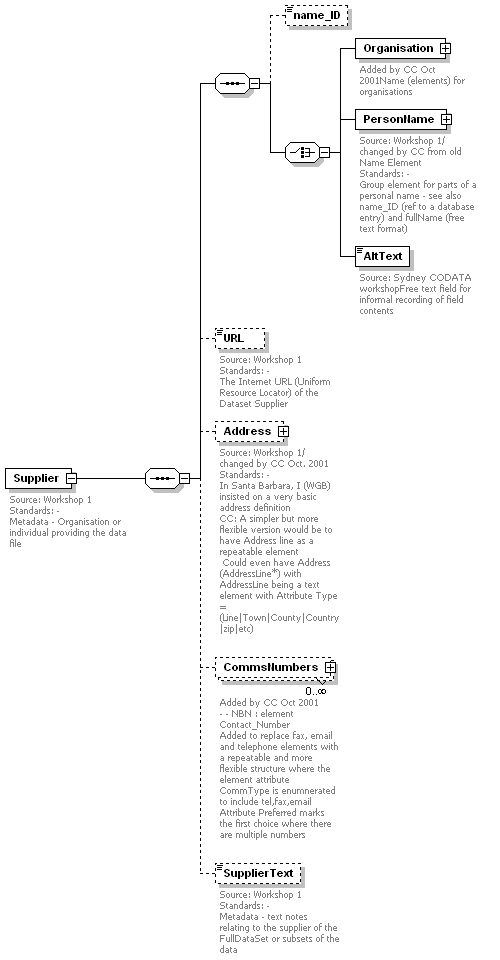 |
||
| children | name_ID Organisation PersonName AltText URL Address CommsNumbers SupplierText | ||
| annotation |
|
||
| source | <xs:element name="Supplier"> <xs:annotation> <xs:documentation>Source: Workshop 1 Standards: - Metadata - Organisation or individual providing the data file</xs:documentation> </xs:annotation> <xs:complexType> <xs:sequence> <xs:sequence> <xs:element name="name_ID" type="name_ID" minOccurs="0"/> <xs:choice> <xs:element name="Organisation" type="OrganisationType"> <xs:annotation> <xs:documentation>Added by CC Oct 2001Name (elements) for organisations</xs:documentation> </xs:annotation> </xs:element> <xs:element name="PersonName" type="PersonNameType"> <xs:annotation> <xs:documentation>Source: Workshop 1/ changed by CC from old Name Element Standards: - Group element for parts of a personal name - see also name_ID (ref to a database entry) and fullName (free text format)</xs:documentation> </xs:annotation> </xs:element> <xs:element name="AltText" type="AltText"> <xs:annotation> <xs:documentation>Source: Sydney CODATA workshopFree text field for informal recording of field contents</xs:documentation> </xs:annotation> </xs:element> </xs:choice> </xs:sequence> <xs:element name="URL" type="URL" minOccurs="0"> <xs:annotation> <xs:documentation>Source: Workshop 1 Standards: - The Internet URL (Uniform Resource Locator) of the Dataset Supplier</xs:documentation> </xs:annotation> </xs:element> <xs:element name="Address" type="AddressType" minOccurs="0"> <xs:annotation> <xs:documentation>Source: Workshop 1/ changed by CC Oct. 2001 Standards: - In Santa Barbara, I (WGB) insisted on a very basic address definition CC: A simpler but more flexible version would be to have Address line as a repeatable element Could even have Address (AddressLine*) with AddressLine being a text element with Attribute Type = (Line|Town|County|Country|zip|etc) </xs:documentation> </xs:annotation> </xs:element> <xs:element name="CommsNumbers" type="CommsNumbersType" minOccurs="0" maxOccurs="unbounded"> <xs:annotation> <xs:documentation>Added by CC Oct 2001 - - NBN : element Contact_Number Added to replace fax, email and telephone elements with a repeatable and more flexible structure where the element attribute CommType is enumnerated to include tel,fax,email Attribute Preferred marks the first choice where there are multiple numbers </xs:documentation> </xs:annotation> </xs:element> <xs:element name="SupplierText" type="SupplierText" minOccurs="0"> <xs:annotation> <xs:documentation>Source: Workshop 1 Standards: - Metadata - text notes relating to the supplier of the FullDataSet or subsets of the data</xs:documentation> </xs:annotation> </xs:element> </xs:sequence> </xs:complexType> </xs:element> |
| diagram |  |
| type | name_ID |
| source | <xs:element name="name_ID" type="name_ID" minOccurs="0"/> |
| diagram | 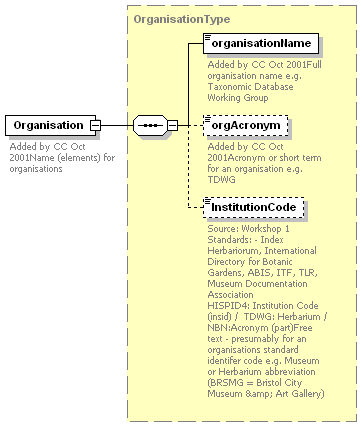 |
||
| type | OrganisationType | ||
| children | organisationName orgAcronym InstitutionCode | ||
| annotation |
|
||
| source | <xs:element name="Organisation" type="OrganisationType"> <xs:annotation> <xs:documentation>Added by CC Oct 2001Name (elements) for organisations</xs:documentation> </xs:annotation> </xs:element> |
| diagram | 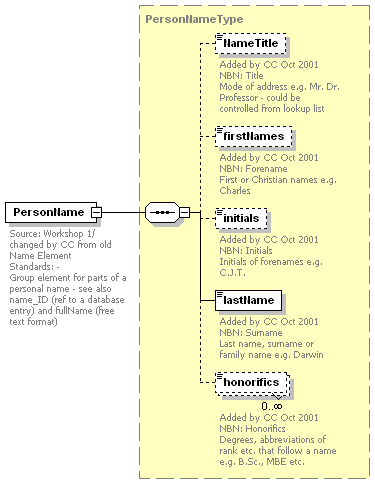 |
||
| type | PersonNameType | ||
| children | NameTitle firstNames initials lastName honorifics | ||
| annotation |
|
||
| source | <xs:element name="PersonName" type="PersonNameType"> <xs:annotation> <xs:documentation>Source: Workshop 1/ changed by CC from old Name Element Standards: - Group element for parts of a personal name - see also name_ID (ref to a database entry) and fullName (free text format)</xs:documentation> </xs:annotation> </xs:element> |
| diagram |  |
||
| type | AltText | ||
| annotation |
|
||
| source | <xs:element name="AltText" type="AltText"> <xs:annotation> <xs:documentation>Source: Sydney CODATA workshopFree text field for informal recording of field contents</xs:documentation> </xs:annotation> </xs:element> |
| diagram |  |
||
| type | URL | ||
| annotation |
|
||
| source | <xs:element name="URL" type="URL" minOccurs="0"> <xs:annotation> <xs:documentation>Source: Workshop 1 Standards: - The Internet URL (Uniform Resource Locator) of the Dataset Supplier</xs:documentation> </xs:annotation> </xs:element> |
| diagram | 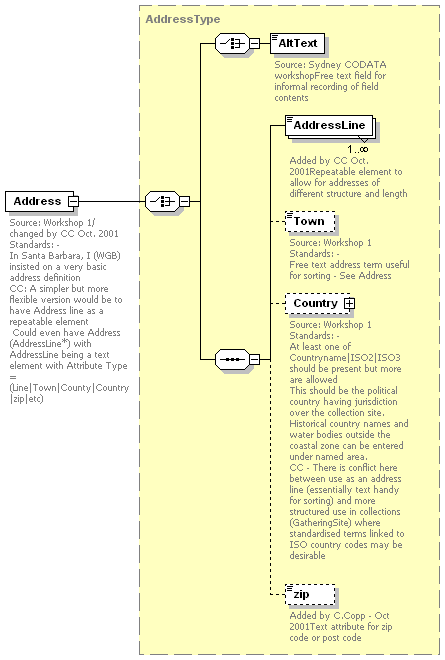 |
||
| type | AddressType | ||
| children | AltText AddressLine Town Country zip | ||
| annotation |
|
||
| source | <xs:element name="Address" type="AddressType" minOccurs="0"> <xs:annotation> <xs:documentation>Source: Workshop 1/ changed by CC Oct. 2001 Standards: - In Santa Barbara, I (WGB) insisted on a very basic address definition CC: A simpler but more flexible version would be to have Address line as a repeatable element Could even have Address (AddressLine*) with AddressLine being a text element with Attribute Type = (Line|Town|County|Country|zip|etc) </xs:documentation> </xs:annotation> </xs:element> |
| diagram | 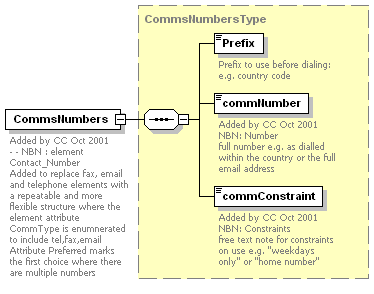 |
||||||||||||||||||
| type | CommsNumbersType | ||||||||||||||||||
| children | Prefix commNumber commConstraint | ||||||||||||||||||
| attributes |
|
||||||||||||||||||
| annotation |
|
||||||||||||||||||
| source | <xs:element name="CommsNumbers" type="CommsNumbersType" minOccurs="0" maxOccurs="unbounded"> <xs:annotation> <xs:documentation>Added by CC Oct 2001 - - NBN : element Contact_Number Added to replace fax, email and telephone elements with a repeatable and more flexible structure where the element attribute CommType is enumnerated to include tel,fax,email Attribute Preferred marks the first choice where there are multiple numbers </xs:documentation> </xs:annotation> </xs:element> |
| diagram | 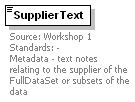 |
||
| type | SupplierText | ||
| annotation |
|
||
| source | <xs:element name="SupplierText" type="SupplierText" minOccurs="0"> <xs:annotation> <xs:documentation>Source: Workshop 1 Standards: - Metadata - text notes relating to the supplier of the FullDataSet or subsets of the data</xs:documentation> </xs:annotation> </xs:element> |
| diagram | 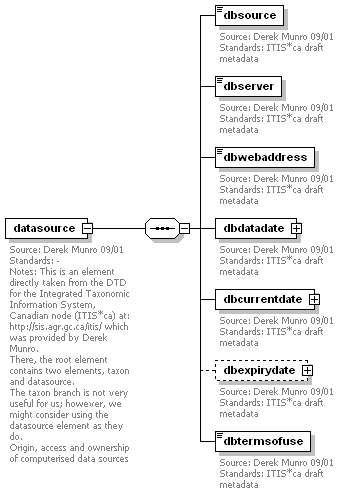 |
||
| children | dbsource dbserver dbwebaddress dbdatadate dbcurrentdate dbexpirydate dbtermsofuse | ||
| annotation |
|
||
| source | <xs:element name="datasource"> <xs:annotation> <xs:documentation>Source: Derek Munro 09/01 Standards: - Notes: This is an element directly taken from the DTD for the Integrated Taxonomic Information System, Canadian node (ITIS*ca) at: http://sis.agr.gc.ca/itis/ which was provided by Derek Munro. There, the root element contains two elements, taxon and datasource. The taxon branch is not very useful for us; however, we might consider using the datasource element as they do. Origin, access and ownership of computerised data sources</xs:documentation> </xs:annotation> <xs:complexType> <xs:sequence> <xs:element name="dbsource" type="xs:string"> <xs:annotation> <xs:documentation>Source: Derek Munro 09/01 Standards: ITIS*ca draft metadata</xs:documentation> </xs:annotation> </xs:element> <xs:element name="dbserver" type="xs:string"> <xs:annotation> <xs:documentation>Source: Derek Munro 09/01 Standards: ITIS*ca draft metadata</xs:documentation> </xs:annotation> </xs:element> <xs:element name="dbwebaddress" type="xs:string"> <xs:annotation> <xs:documentation>Source: Derek Munro 09/01 Standards: ITIS*ca draft metadata</xs:documentation> </xs:annotation> </xs:element> <xs:element name="dbdatadate" type="DateType"> <xs:annotation> <xs:documentation>Source: Derek Munro 09/01 Standards: ITIS*ca draft metadata</xs:documentation> </xs:annotation> </xs:element> <xs:element name="dbcurrentdate" type="DateType"> <xs:annotation> <xs:documentation>Source: Derek Munro 09/01 Standards: ITIS*ca draft metadata</xs:documentation> </xs:annotation> </xs:element> <xs:element name="dbexpirydate" type="DateType" minOccurs="0"> <xs:annotation> <xs:documentation>Source: Derek Munro 09/01 Standards: ITIS*ca draft metadata</xs:documentation> </xs:annotation> </xs:element> <xs:element name="dbtermsofuse" type="xs:string"> <xs:annotation> <xs:documentation>Source: Derek Munro 09/01 Standards: ITIS*ca draft metadata</xs:documentation> </xs:annotation> </xs:element> </xs:sequence> </xs:complexType> </xs:element> |
| diagram |  |
||
| type | xs:string | ||
| annotation |
|
||
| source | <xs:element name="dbsource" type="xs:string"> <xs:annotation> <xs:documentation>Source: Derek Munro 09/01 Standards: ITIS*ca draft metadata</xs:documentation> </xs:annotation> </xs:element> |
| diagram |  |
||
| type | xs:string | ||
| annotation |
|
||
| source | <xs:element name="dbserver" type="xs:string"> <xs:annotation> <xs:documentation>Source: Derek Munro 09/01 Standards: ITIS*ca draft metadata</xs:documentation> </xs:annotation> </xs:element> |
| diagram |  |
||
| type | xs:string | ||
| annotation |
|
||
| source | <xs:element name="dbwebaddress" type="xs:string"> <xs:annotation> <xs:documentation>Source: Derek Munro 09/01 Standards: ITIS*ca draft metadata</xs:documentation> </xs:annotation> </xs:element> |
| diagram | 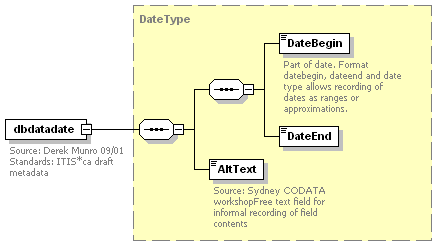 |
||||||||||||
| type | DateType | ||||||||||||
| children | DateBegin DateEnd AltText | ||||||||||||
| attributes |
|
||||||||||||
| annotation |
|
||||||||||||
| source | <xs:element name="dbdatadate" type="DateType"> <xs:annotation> <xs:documentation>Source: Derek Munro 09/01 Standards: ITIS*ca draft metadata</xs:documentation> </xs:annotation> </xs:element> |
| diagram | 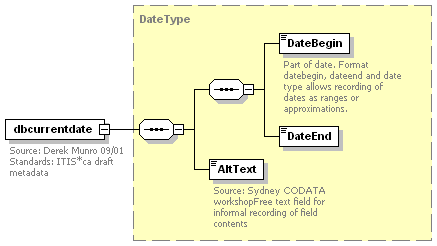 |
||||||||||||
| type | DateType | ||||||||||||
| children | DateBegin DateEnd AltText | ||||||||||||
| attributes |
|
||||||||||||
| annotation |
|
||||||||||||
| source | <xs:element name="dbcurrentdate" type="DateType"> <xs:annotation> <xs:documentation>Source: Derek Munro 09/01 Standards: ITIS*ca draft metadata</xs:documentation> </xs:annotation> </xs:element> |
| diagram | 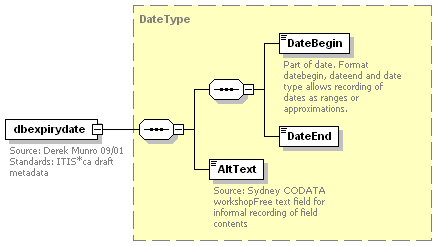 |
||||||||||||
| type | DateType | ||||||||||||
| children | DateBegin DateEnd AltText | ||||||||||||
| attributes |
|
||||||||||||
| annotation |
|
||||||||||||
| source | <xs:element name="dbexpirydate" type="DateType" minOccurs="0"> <xs:annotation> <xs:documentation>Source: Derek Munro 09/01 Standards: ITIS*ca draft metadata</xs:documentation> </xs:annotation> </xs:element> |
| diagram |  |
||
| type | xs:string | ||
| annotation |
|
||
| source | <xs:element name="dbtermsofuse" type="xs:string"> <xs:annotation> <xs:documentation>Source: Derek Munro 09/01 Standards: ITIS*ca draft metadata</xs:documentation> </xs:annotation> </xs:element> |
| diagram |  |
||
| type | xs:string | ||
| annotation |
|
||
| source | <xs:element name="DatasetAnnotation" type="xs:string"> <xs:annotation> <xs:documentation>Source: Workshop 1 Standards: - Text description of the FullDataSet as represented in a database version</xs:documentation> </xs:annotation> </xs:element> |
| diagram | 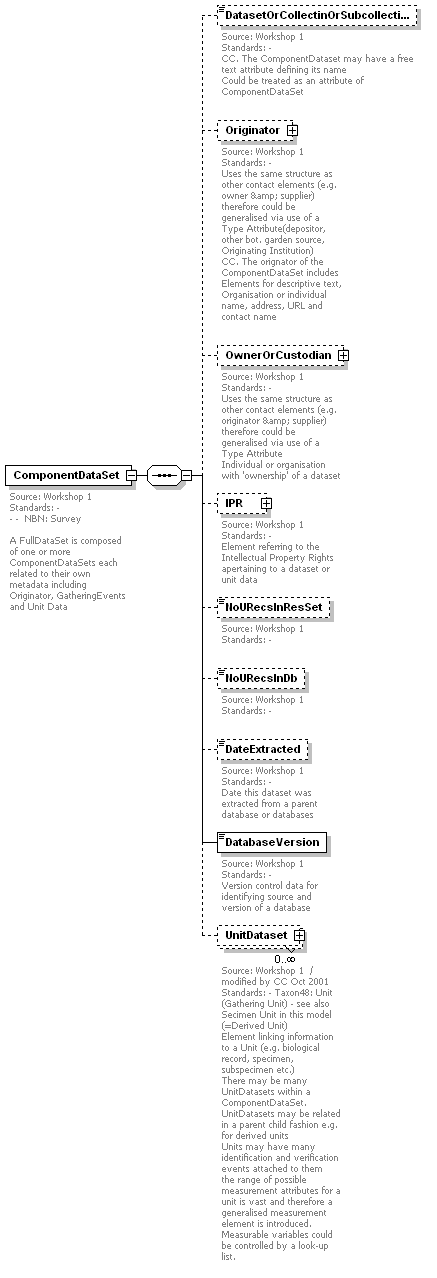 |
||
| children | DatasetOrCollectinOrSubcollectionName Originator OwnerOrCustodian IPR NoURecsInResSet NoURecsInDb DateExtracted DatabaseVersion UnitDataset | ||
| annotation |
|
||
| source | <xs:element name="ComponentDataSet" minOccurs="0" maxOccurs="unbounded"> <xs:annotation> <xs:documentation>Source: Workshop 1 Standards: - - - NBN: Survey A FullDataSet is composed of one or more ComponentDataSets each related to their own metadata including Originator, GatheringEvents and Unit Data</xs:documentation> </xs:annotation> <xs:complexType> <xs:sequence> <xs:element name="DatasetOrCollectinOrSubcollectionName" type="xs:string" minOccurs="0"> <xs:annotation> <xs:documentation>Source: Workshop 1 Standards: - CC. The ComponentDataset may have a free text attribute defining its name Could be treated as an attribute of ComponentDataSet </xs:documentation> </xs:annotation> </xs:element> <xs:element name="Originator" type="OriginatorType" minOccurs="0"> <xs:annotation> <xs:documentation>Source: Workshop 1 Standards: - Uses the same structure as other contact elements (e.g. owner & supplier) therefore could be generalised via use of a Type Attribute(depositor, other bot. garden source, Originating Institution) CC. The orignator of the ComponentDataSet includes Elements for descriptive text, Organisation or individual name, address, URL and contact name </xs:documentation> </xs:annotation> </xs:element> <xs:element name="OwnerOrCustodian" type="OwnerOrCustodianType" minOccurs="0"> <xs:annotation> <xs:documentation>Source: Workshop 1 Standards: - Uses the same structure as other contact elements (e.g. originator & supplier) therefore could be generalised via use of a Type Attribute Individual or organisation with 'ownership' of a dataset</xs:documentation> </xs:annotation> </xs:element> <xs:element name="IPR" type="IPRType" minOccurs="0"> <xs:annotation> <xs:documentation>Source: Workshop 1 Standards: - Element referring to the Intellectual Property Rights apertaining to a dataset or unit data</xs:documentation> </xs:annotation> </xs:element> <xs:element name="NoURecsInResSet" type="xs:string" minOccurs="0"> <xs:annotation> <xs:documentation>Source: Workshop 1 Standards: - </xs:documentation> </xs:annotation> </xs:element> <xs:element name="NoURecsInDb" type="xs:string" minOccurs="0"> <xs:annotation> <xs:documentation>Source: Workshop 1 Standards: - </xs:documentation> </xs:annotation> </xs:element> <xs:element name="DateExtracted" type="xs:string" minOccurs="0"> <xs:annotation> <xs:documentation>Source: Workshop 1 Standards: - Date this dataset was extracted from a parent database or databases</xs:documentation> </xs:annotation> </xs:element> <xs:element name="DatabaseVersion" type="xs:string"> <xs:annotation> <xs:documentation>Source: Workshop 1 Standards: - Version control data for identifying source and version of a database</xs:documentation> </xs:annotation> </xs:element> <xs:element name="UnitDataset" minOccurs="0" maxOccurs="unbounded"> <xs:annotation> <xs:documentation>Source: Workshop 1 / modified by CC Oct 2001 Standards: - Taxon48: Unit (Gathering Unit) - see also Secimen Unit in this model (=Derived Unit) Element linking information to a Unit (e.g. biological record, specimen, subspecimen etc.) There may be many UnitDatasets within a ComponentDataSet. UnitDatasets may be related in a parent child fashion e.g. for derived units Units may have many identification and verification events attached to them the range of possible measurement attributes for a unit is vast and therefore a generalised measurement element is introduced. Measurable variables could be controlled by a look-up list. </xs:documentation> </xs:annotation> <xs:complexType> <xs:sequence> <xs:element name="Unit_ID" type="Unit_ID" maxOccurs="unbounded"> <xs:annotation> <xs:documentation>Source: Workshop 1 Standards: - Taxon48: Unit_ID / NBN: Sample_KeyUnit key or Identifying number - can be multiple</xs:documentation> </xs:annotation> </xs:element> <xs:element name="UnitIdentifiers" minOccurs="0" maxOccurs="unbounded"> <xs:annotation> <xs:documentation>Added by CC Oct 2001 includes HISPID4: cid NBN: specimen_number</xs:documentation> </xs:annotation> <xs:complexType> <xs:simpleContent> <xs:extension base="xs:string"> <xs:attribute name="identifierType" type="xs:string"/> </xs:extension> </xs:simpleContent> </xs:complexType> </xs:element> <xs:element name="SupplierText" type="SupplierText" minOccurs="0" maxOccurs="unbounded"> <xs:annotation> <xs:documentation>Source: Workshop 1 Standards: - Metadata - text notes relating to the supplier of the FullDataSet or subsets of the data</xs:documentation> </xs:annotation> </xs:element> <xs:element name="Originator" type="OriginatorType" minOccurs="0"> <xs:annotation> <xs:documentation>Source: Workshop 1 Standards: - Uses the same structure as other contact elements (e.g. owner & supplier) therefore could be generalised via use of a Type Attribute(depositor, other bot. garden source, Originating Institution) CC. The orignator of the ComponentDataSet includes Elements for descriptive text, Organisation or individual name, address, URL and contact name </xs:documentation> </xs:annotation> </xs:element> <xs:element name="IPR" type="IPRType" minOccurs="0"> <xs:annotation> <xs:documentation>Source: Workshop 1 Standards: - Element referring to the Intellectual Property Rights apertaining to a dataset or unit data</xs:documentation> </xs:annotation> </xs:element> <xs:element name="Surrogate" type="xs:string" minOccurs="0"> <xs:annotation> <xs:documentation>Source: Workshop 1 Standards: - </xs:documentation> </xs:annotation> </xs:element> <xs:element name="Substrate" type="SubstrateType" minOccurs="0"> <xs:annotation> <xs:documentation>Source: Workshop 1/ modified by CC Oct 2001 Standards: - HISPID4: sub Substrate is the surface or medium from which one or more specimens are recorded or collected e.g. in soft mud, on leaf surface, under rock, on granite etc.</xs:documentation> </xs:annotation> </xs:element> <xs:element name="Host" type="xs:string" minOccurs="0"> <xs:annotation> <xs:documentation>Source: Workshop 1 Standards: -</xs:documentation> </xs:annotation> </xs:element> <xs:element name="OwnerOrCustodian" type="OwnerOrCustodianType" minOccurs="0"> <xs:annotation> <xs:documentation>Source: Workshop 1 Standards: - Uses the same structure as other contact elements (e.g. originator & supplier) therefore could be generalised via use of a Type Attribute Individual or organisation with 'ownership' of a dataset</xs:documentation> </xs:annotation> </xs:element> <xs:element name="specimenUnit" minOccurs="0" maxOccurs="unbounded"> <xs:annotation> <xs:documentation>Added by CC Oct. 2001The specimen unit is a derived subtype of Unit representing physical specimens in collections The specimen can link to field obsevations and to named collections</xs:documentation> </xs:annotation> <xs:complexType> <xs:sequence> <xs:element name="Unit_ID" type="Unit_ID" maxOccurs="unbounded"> <xs:annotation> <xs:documentation>Source: Workshop 1 Standards: - Taxon48: Unit_ID / NBN: Sample_KeyUnit key or Identifying number - can be multiple</xs:documentation> </xs:annotation> </xs:element> <xs:element name="accession_number" minOccurs="0"> <xs:annotation> <xs:documentation>Added by CC Oct. 2001 - - Taxon48 AccCode_Pk LMNH The instutional number applied to an accession and recorded in the accessions register e.g. BRSMG:1999/1209. A structured view into acquisition information from accessions register as opposed to original gathering data. - helps link collections (e.g. several specimens may share one accession number).</xs:documentation> </xs:annotation> <xs:complexType> <xs:sequence> <xs:element name="accession_date"> <xs:annotation> <xs:documentation>Added by CC Oct 2001 - - Taxon48: AccDate The date on which an accession was recorded in the accessions register ( not the date of acquisition)</xs:documentation> </xs:annotation> <xs:complexType> <xs:sequence> <xs:element name="Date" type="DateType"/> </xs:sequence> </xs:complexType> </xs:element> <xs:element name="acquisition_date"> <xs:annotation> <xs:documentation>Added by CC Oct. 2001The date when specimens or collections were acquired by the institution</xs:documentation> </xs:annotation> <xs:complexType> <xs:sequence> <xs:element name="Date" type="DateType"/> </xs:sequence> </xs:complexType> </xs:element> <xs:choice> <xs:element name="AltText" type="AltText"> <xs:annotation> <xs:documentation>Source: Sydney CODATA workshopFree text field for informal recording of field contents</xs:documentation> </xs:annotation> </xs:element> <xs:element name="PersonName" type="PersonNameType"> <xs:annotation> <xs:documentation>Source: Workshop 1/ changed by CC from old Name Element Standards: - Group element for parts of a personal name - see also name_ID (ref to a database entry) and fullName (free text format)</xs:documentation> </xs:annotation> </xs:element> <xs:element name="organisationName" type="organisationName"> <xs:annotation> <xs:documentation>Added by CC Oct 2001Full organisation name e.g. Taxonomic Database Working Group</xs:documentation> </xs:annotation> </xs:element> </xs:choice> <xs:element name="Comment" type="Comment" minOccurs="0"> <xs:annotation> <xs:documentation>Added by CC Oct 2001Free text of formatted text (rtf) description of the feature - not controlled length e.g. often a memo field</xs:documentation> </xs:annotation> </xs:element> <xs:element name="Source" type="SourceType" minOccurs="0"> <xs:annotation> <xs:documentation>Added CC Oct 2001 NBN: Source Marker element for a link to a source module for dealing with structured literature and document rexcords </xs:documentation> </xs:annotation> </xs:element> </xs:sequence> <xs:attribute name="Acquisitiontype" type="xs:string"/> </xs:complexType> </xs:element> <xs:element name="specimenType"> <xs:complexType> <xs:choice> <xs:sequence> <xs:element name="ShortTermName" type="ShortTermName"> <xs:annotation> <xs:documentation>Source: CC - Oct 2001 Standards: ShortTernName is a code or shortened version of a term that might be used in a database or lookup table e.g. HOLO for Holotype </xs:documentation> </xs:annotation> </xs:element> <xs:element name="LongTermName" type="LongTermName" minOccurs="0"> <xs:annotation> <xs:documentation>Source: CC - Oct 2001 Standards: LongTermname is the full term that might appear in a lookup table e.g. in a list of types: Holotype</xs:documentation> </xs:annotation> </xs:element> <xs:element name="Description" type="Description" minOccurs="0"> <xs:annotation> <xs:documentation>Source: Workshop 1 Standards: - Used wherever a description field is needed. Free text and could be in rtf or html.</xs:documentation> </xs:annotation> </xs:element> </xs:sequence> <xs:element name="AltText" type="AltText"> <xs:annotation> <xs:documentation>Source: Sydney CODATA workshopFree text field for informal recording of field contents</xs:documentation> </xs:annotation> </xs:element> </xs:choice> <xs:attribute name="specimenTypeID" type="xs:string"/> </xs:complexType> </xs:element> <xs:element name="NatureOrPreservationMode"> <xs:annotation> <xs:documentation>Source: Workshop 1/ changed by CC Oct 2001Unit "nature" or preservation mode: virtual vs. object; preservation mode; part; creation process</xs:documentation> </xs:annotation> <xs:complexType> <xs:choice> <xs:element name="LookupTerm" type="LookupTermType"> <xs:annotation> <xs:documentation>Added by CC Oct 2001 NBN: Term Typical structure for a simple lookup list of term contents - structure consists of an attribute for the type e.g. name of the look up list together with long and short versions of the term</xs:documentation> </xs:annotation> </xs:element> <xs:element name="AltText" type="AltText"> <xs:annotation> <xs:documentation>Source: Sydney CODATA workshopFree text field for informal recording of field contents</xs:documentation> </xs:annotation> </xs:element> </xs:choice> <xs:attribute name="PreservationMode_ID" type="xs:string"/> </xs:complexType> </xs:element> <xs:element name="specimenUnit_part" type="xs:string" minOccurs="0"> <xs:annotation> <xs:documentation>Added by CC Oct 2001 LNHM specimen part: Part of the specimen rcord applies</xs:documentation> </xs:annotation> </xs:element> <xs:element name="accession_catalogue_ID" type="accession_catalogue_ID" minOccurs="0"> <xs:annotation> <xs:documentation>Added by CC Oct 2001Unique identifier for an accessions catalogue id in a computerised system</xs:documentation> </xs:annotation> </xs:element> <xs:choice minOccurs="0"> <xs:element name="namedCollection" type="namedCollectionType"> <xs:annotation> <xs:documentation> Source: Workshop 1/ subelements added by CC Oct. 2001A named Collection is an association of specimens (units) that have a common identity either through content, ownership or acquisition. This element is a special kind of Unit subType and is separated here for the purposes of clarity The element facilitates the recording of the history, ownership and content of named collections and also because named collections may be stored, moved. acquired or disposed of as a whole. </xs:documentation> </xs:annotation> </xs:element> <xs:element name="collection_ID" type="collection_ID"> <xs:annotation> <xs:documentation>Added by CC Oct. 2001 Syn: Unit_ID Unique identifier for collection in a computerised system this is a synonym of Unit_ID </xs:documentation> </xs:annotation> </xs:element> </xs:choice> <xs:element name="specimenUnitNumber" minOccurs="0" maxOccurs="unbounded"> <xs:annotation> <xs:documentation>Added by CC Oct. 2001Any numbers or other registration marks associated with a specimen unit (1 or more specimens)</xs:documentation> </xs:annotation> <xs:complexType> <xs:sequence> <xs:element name="specimenUnit_number_ID" type="xs:string" minOccurs="0"> <xs:annotation> <xs:documentation>Added by CC Oct 2001 LNHM</xs:documentation> </xs:annotation> </xs:element> <xs:element name="DistinguishingNumber" type="xs:string"> <xs:annotation> <xs:documentation>Added by CC Oct. 2001Text for number or other registration mark applied to a specimen or group of specimens e.g from registration book, collectors note book, auction catalogue, batch number etc.</xs:documentation> </xs:annotation> </xs:element> <xs:element name="Source" type="SourceType"> <xs:annotation> <xs:documentation>Added CC Oct 2001 NBN: Source Marker element for a link to a source module for dealing with structured literature and document rexcords</xs:documentation> </xs:annotation> </xs:element> </xs:sequence> <xs:attribute name="PreferredFlag"> <xs:simpleType> <xs:restriction base="xs:NMTOKEN"> <xs:enumeration value="Yes"/> <xs:enumeration value="No"/> </xs:restriction> </xs:simpleType> </xs:attribute> </xs:complexType> </xs:element> <xs:element name="specimenUnit_description" type="xs:string"> <xs:annotation> <xs:documentation>Added by CC Oct 2001 LNHM Free text description of a specimen or similar 'Unit'</xs:documentation> </xs:annotation> </xs:element> <xs:sequence minOccurs="0" maxOccurs="unbounded"> <xs:element name="Identification" type="IdentificationType"> <xs:annotation> <xs:documentation>Source: Workshop 1 Standards: - </xs:documentation> </xs:annotation> </xs:element> <xs:element name="specimenUnitStatus" minOccurs="0"> <xs:annotation> <xs:documentation>Taxonomic status linked to an identification of a specimen</xs:documentation> </xs:annotation> <xs:complexType> <xs:sequence> <xs:element name="Unit_status_ID" type="Unit_status_ID" minOccurs="0"/> <xs:element name="Unit_ID" type="Unit_ID" minOccurs="0" maxOccurs="unbounded"> <xs:annotation> <xs:documentation>Source: Workshop 1 Standards: - Taxon48: Unit_ID / NBN: Sample_KeyUnit key or Identifying number - can be multiple</xs:documentation> </xs:annotation> </xs:element> <xs:element name="Type"> <xs:annotation> <xs:documentation>Source: Workshop 1 / mod CC Oct 2001 Standards: - - - made qualifier an attribute of status - introduced qualifier to indicate preference or sort order of basionyms Composite element that links type status, a qualifying statement, original name and pertinent published references Making Type a repeatable element with a qualifier for sort order e.g. most recent, second most recent etc. covers multiple elements in HISPID (e.g. basnam1, basnam2, basnam3) </xs:documentation> </xs:annotation> <xs:complexType> <xs:sequence> <xs:element name="TypeStatus"> <xs:annotation> <xs:documentation>Source: Workshop 1/ modified CC Oct 2001 Standards: - - - includes HISPID4: tsta and tql The presumed nomenclatural status of specimens regarded as types - Note that Type Qualifier has been moved to an enumerated attribute of TypeStatus</xs:documentation> </xs:annotation> <xs:complexType> <xs:choice> <xs:sequence> <xs:element name="AltText" type="AltText"> <xs:annotation> <xs:documentation>Source: Sydney CODATA workshopFree text field for informal recording of field contents</xs:documentation> </xs:annotation> </xs:element> <xs:element name="Source" type="SourceType"> <xs:annotation> <xs:documentation>Added CC Oct 2001 NBN: Source Marker element for a link to a source module for dealing with structured literature and document rexcords </xs:documentation> </xs:annotation> </xs:element> </xs:sequence> <xs:element name="LookupTerm" type="LookupTermType"> <xs:annotation> <xs:documentation>Added by CC Oct 2001 NBN: Term Typical structure for a simple lookup list of term contents - structure consists of an attribute for the type e.g. name of the look up list together with long and short versions of the term</xs:documentation> </xs:annotation> </xs:element> </xs:choice> <xs:attribute name="TypeQualifier" use="required"> <xs:simpleType> <xs:restriction base="xs:NMTOKEN"> <xs:enumeration value="Confirmed"/> <xs:enumeration value="Probably"/> <xs:enumeration value="Possibly"/> <xs:enumeration value="Not"/> </xs:restriction> </xs:simpleType> </xs:attribute> </xs:complexType> </xs:element> <xs:element name="Basionym" minOccurs="0"> <xs:annotation> <xs:documentation>Source: Workshop 1 Standards: - HISPID4: basnam / TLR Baionym refers to the original name associated with a type specimen where the name has subsequently been revised especially where this has arisen from a change of rank the option here is to use plain name text or a fully atomised model for name parts.</xs:documentation> </xs:annotation> <xs:complexType> <xs:sequence> <xs:choice> <xs:element name="AltText" type="AltText"> <xs:annotation> <xs:documentation>Source: Sydney CODATA workshopFree text field for informal recording of field contents</xs:documentation> </xs:annotation> </xs:element> <xs:element name="BotanicalName" type="BotanicalNameType"/> <xs:element name="BacteriologicalName" type="BacteriologicalNameType"/> <xs:element name="ZoologicalName" type="ZoologicalNameType"/> </xs:choice> <xs:element name="Source" type="SourceType" minOccurs="0"> <xs:annotation> <xs:documentation>Added CC Oct 2001 NBN: Source Marker element for a link to a source module for dealing with structured literature and document rexcords</xs:documentation> </xs:annotation> </xs:element> </xs:sequence> </xs:complexType> </xs:element> <xs:element name="Source" type="SourceType" minOccurs="0" maxOccurs="unbounded"> <xs:annotation> <xs:documentation>Added CC Oct 2001 NBN: Source Marker element for a link to a source module for dealing with structured literature and document rexcords</xs:documentation> </xs:annotation> </xs:element> </xs:sequence> <xs:attribute name="BasionymOrder"> <xs:simpleType> <xs:restriction base="xs:NMTOKEN"> <xs:enumeration value="1"/> <xs:enumeration value="2"/> <xs:enumeration value="3"/> </xs:restriction> </xs:simpleType> </xs:attribute> </xs:complexType> </xs:element> <xs:element name="specimenUnitStatus_src"> <xs:complexType> <xs:sequence> <xs:element name="Unit_status_ID" type="Unit_status_ID" minOccurs="0"/> <xs:element name="Source" type="SourceType"> <xs:annotation> <xs:documentation>Added CC Oct 2001 NBN: Source Marker element for a link to a source module for dealing with structured literature and document rexcords </xs:documentation> </xs:annotation> </xs:element> </xs:sequence> <xs:attribute name="entered_by" type="xs:string" use="required"/> <xs:attribute name="entry_date" type="xs:string" use="required"/> <xs:attribute name="specimen_status_source_key" type="xs:string"/> </xs:complexType> </xs:element> </xs:sequence> <xs:attribute name="entered_by" type="xs:string" use="required"/> <xs:attribute name="entry_date" type="xs:string" use="required"/> </xs:complexType> </xs:element> </xs:sequence> <xs:element name="specimenUnitData" minOccurs="0" maxOccurs="unbounded"> <xs:annotation> <xs:documentation>Any measurable aspect of the specimen e.g. height, weight, number of specimens etc.</xs:documentation> </xs:annotation> <xs:complexType> <xs:sequence> <xs:element name="measurement" type="measurementType"> <xs:annotation> <xs:documentation>Added by CC Oct 2001 NBN: measurement (partim) measurement is the actiual measurement - measurement is qualigied by attributes: measurementType: what type of measurement e.g. count, area, linear measurement measurementUnits: units that measurement is recorded in e...g. hectares, kilometres, kilogrammes etc. measurementAccuracy: describes accuracy e.g. approximate or +/- 50</xs:documentation> </xs:annotation> </xs:element> </xs:sequence> <xs:attribute name="SpecimenUnitData_ID" type="xs:string"/> </xs:complexType> </xs:element> <xs:element name="UnitDataSetRelations" type="UnitDataSetRelationsType" minOccurs="0" maxOccurs="unbounded"> <xs:annotation> <xs:documentation>Added by CC Oct 2001 specimen relationships - can be used to link derived specimens, specimen parts or members of a specimen group</xs:documentation> </xs:annotation> </xs:element> <xs:element name="specimenUnit_label" minOccurs="0" maxOccurs="unbounded"> <xs:annotation> <xs:documentation>Added by CC Oct 2001 LNHM Specimens, cabinets and other units e.g. living horticultural specimens may have one or more labels attached or associated with them</xs:documentation> </xs:annotation> <xs:complexType> <xs:sequence> <xs:element name="specimenUnit_label_ID" type="xs:string" minOccurs="0"> <xs:annotation> <xs:documentation>Added by CC Oct 2001 LNHM Unique identifier within a database</xs:documentation> </xs:annotation> </xs:element> <xs:element name="Unit_ID" type="Unit_ID" minOccurs="0"> <xs:annotation> <xs:documentation>Source: Workshop 1 Standards: - Taxon48: Unit_ID / NBN: Sample_KeyUnit key or Identifying number - can be multiple</xs:documentation> </xs:annotation> </xs:element> <xs:element name="position_on_object" type="xs:string"/> <xs:element name="label_summary" type="xs:string"/> <xs:element name="Source" type="SourceType" minOccurs="0" maxOccurs="unbounded"> <xs:annotation> <xs:documentation>Added CC Oct 2001 NBN: Source Marker element for a link to a source module for dealing with structured literature and document rexcords</xs:documentation> </xs:annotation> </xs:element> </xs:sequence> <xs:attribute name="entered_by" type="xs:string" use="required"/> <xs:attribute name="entry_date" type="xs:string" use="required"/> </xs:complexType> </xs:element> <xs:element name="inscription" minOccurs="0" maxOccurs="unbounded"> <xs:annotation> <xs:documentation>Added by CC Oct 2001 LNHM writing or other inscription directly upon or carved into a unit (usually a specimen)</xs:documentation> </xs:annotation> <xs:complexType> <xs:sequence> <xs:element name="inscription_ID" minOccurs="0"> <xs:annotation> <xs:documentation>Added by CC Oct 2001Unique identifier within a database</xs:documentation> </xs:annotation> <xs:complexType> <xs:simpleContent> <xs:extension base="xs:string"> <xs:attribute name="type" use="required"> <xs:simpleType> <xs:restriction base="xs:NMTOKEN"> <xs:enumeration value="nbn"/> <xs:enumeration value="local"/> </xs:restriction> </xs:simpleType> </xs:attribute> </xs:extension> </xs:simpleContent> </xs:complexType> </xs:element> <xs:element name="Unit_ID" type="Unit_ID" minOccurs="0"> <xs:annotation> <xs:documentation>Source: Workshop 1 Standards: - Taxon48: Unit_ID / NBN: Sample_KeyUnit key or Identifying number - can be multiple</xs:documentation> </xs:annotation> </xs:element> <xs:element name="inscription_type" type="xs:string"> <xs:annotation> <xs:documentation>Added by CC Oct 2001 LNHM Type of inscription</xs:documentation> </xs:annotation> </xs:element> <xs:element name="inscriptionText" type="xs:string"> <xs:annotation> <xs:documentation>Added by CC Oct 2001Text transcription of an inscription</xs:documentation> </xs:annotation> </xs:element> </xs:sequence> <xs:attribute name="entered_by" type="xs:string" use="required"/> <xs:attribute name="entry_date" type="xs:string" use="required"/> </xs:complexType> </xs:element> <xs:element name="specimenUnitHistory" minOccurs="0" maxOccurs="unbounded"> <xs:annotation> <xs:documentation>Added by CC Oct 2001Allows recording of history of specimen e.g. changes of ownership and transfers between collections by sale, splitting or merging of collections</xs:documentation> </xs:annotation> <xs:complexType> <xs:sequence> <xs:element name="Unit_ID" type="Unit_ID" maxOccurs="unbounded"> <xs:annotation> <xs:documentation>Source: Workshop 1 Standards: - Taxon48: Unit_ID / NBN: Sample_KeyUnit key or Identifying number - can be multiple</xs:documentation> </xs:annotation> </xs:element> <xs:element name="previous_collection_name" type="xs:string"/> <xs:element name="Date" type="DateType" minOccurs="0" maxOccurs="unbounded"> <xs:annotation> <xs:documentation>Added CC Oct 2001 NBN: vaguedatestart, vaguedateend and vaguedatetype Date has a three part structure - two elements and an attribute VagueDateBegin = First date of a range or date for a single date VagueDateEnd = last date in a range DateType attribute can be enumerated to allow for various date formats (e.g. dd/mm/yyyy or to allow a parser to interpret terms such as summer 69 or 1974 etc) Note terms such as summer would be interpretted by standard begin and end dates.</xs:documentation> </xs:annotation> </xs:element> <xs:element name="Comment" type="Comment" minOccurs="0"> <xs:annotation> <xs:documentation>Added by CC Oct 2001Free text of formatted text (rtf) description of the feature - not controlled length e.g. often a memo field</xs:documentation> </xs:annotation> </xs:element> </xs:sequence> <xs:attribute name="entered_by" type="xs:string" use="required"/> <xs:attribute name="entry_date" type="xs:string" use="required"/> </xs:complexType> </xs:element> <xs:element name="specimenUnit_Fact" minOccurs="0" maxOccurs="unbounded"> <xs:annotation> <xs:documentation>Added by CC Oct 2001 LNHM any number of free text facts can be recorded about the specimen or unit. The structure allows for a title so that the facts could be assembled in an rtf or html page layout Facts can be of any sort e.g. comments on the historical importance of the specimen.</xs:documentation> </xs:annotation> <xs:complexType> <xs:sequence> <xs:element name="specimenUnit_fact_ID" type="xs:string"> <xs:annotation> <xs:documentation>Added by CC Oct 2001 LNHM Unique identifier within a database</xs:documentation> </xs:annotation> </xs:element> <xs:element name="title" type="title"/> <xs:element name="Comment" type="Comment"> <xs:annotation> <xs:documentation>Added by CC Oct 2001Free text of formatted text (rtf) description of the feature - not controlled length e.g. often a memo field</xs:documentation> </xs:annotation> </xs:element> <xs:element name="Date" type="DateType"> <xs:annotation> <xs:documentation>Added CC Oct 2001 NBN: vaguedatestart, vaguedateend and vaguedatetype Date has a three part structure - two elements and an attribute VagueDateBegin = First date of a range or date for a single date VagueDateEnd = last date in a range DateType attribute can be enumerated to allow for various date formats (e.g. dd/mm/yyyy or to allow a parser to interpret terms such as summer 69 or 1974 etc) Note terms such as summer would be interpretted by standard begin and end dates.</xs:documentation> </xs:annotation> </xs:element> <xs:element name="Source" type="SourceType"> <xs:annotation> <xs:documentation>Added CC Oct 2001 NBN: Source Marker element for a link to a source module for dealing with structured literature and document rexcords</xs:documentation> </xs:annotation> </xs:element> </xs:sequence> <xs:attribute name="entered_by" type="xs:string" use="required"/> <xs:attribute name="entry_date" type="xs:string" use="required"/> <xs:attribute name="changed_by" type="xs:string"/> <xs:attribute name="changed_date" type="xs:string"/> <xs:attribute name="system_supplied_data" default="No"> <xs:simpleType> <xs:restriction base="xs:NMTOKEN"> <xs:enumeration value="Yes"/> <xs:enumeration value="No"/> </xs:restriction> </xs:simpleType> </xs:attribute> <xs:attribute name="fact_type" type="xs:string"/> </xs:complexType> </xs:element> <xs:element name="specimenUnitImage" minOccurs="0" maxOccurs="unbounded"> <xs:complexType> <xs:sequence> <xs:element name="imageContext" type="xs:string"> <xs:annotation> <xs:documentation>Added by CC Oct. 2001The context of the image in relation to the specimen or other types of derived unit - could be many e.g. original valid publication image, front view of lectotype etc.</xs:documentation> </xs:annotation> </xs:element> <xs:element name="Image" type="ImageType"> <xs:annotation> <xs:documentation>added by CC Oct 2001 NBN: Image Compound element that can include any type of image including paintings, photographs, digital photographs and video</xs:documentation> </xs:annotation> </xs:element> </xs:sequence> </xs:complexType> </xs:element> <xs:element name="Source" type="SourceType" minOccurs="0" maxOccurs="unbounded"> <xs:annotation> <xs:documentation>Added CC Oct 2001 NBN: Source Marker element for a link to a source module for dealing with structured literature and document rexcords </xs:documentation> </xs:annotation> </xs:element> </xs:sequence> <xs:attribute name="entered_by" type="xs:string" use="required"/> <xs:attribute name="entry_date" type="xs:string" use="required"/> </xs:complexType> </xs:element> <xs:element name="namedCollection" type="namedCollectionType" minOccurs="0"> <xs:annotation> <xs:documentation> Source: Workshop 1/ subelements added by CC Oct. 2001A named Collection is an association of specimens (units) that have a common identity either through content, ownership or acquisition. This element is a special kind of Unit subType and is separated here for the purposes of clarity The element facilitates the recording of the history, ownership and content of named collections and also because named collections may be stored, moved. acquired or disposed of as a whole.</xs:documentation> </xs:annotation> </xs:element> <xs:element name="Description" type="Description" minOccurs="0"> <xs:annotation> <xs:documentation>Source: Workshop 1 Standards: - Used wherever a description field is needed. Free text and could be in rtf or html.</xs:documentation> </xs:annotation> </xs:element> <xs:element name="NoOfIndividuals"> <xs:annotation> <xs:documentation>Source: Workshop 1/ changed by Cc Oct 2001 Standards: - Element for holding counts - can be multiiple e.g. number of males, females and juveniles Could be replaced by general UnitDataMeasurement element</xs:documentation> </xs:annotation> <xs:complexType> <xs:sequence> <xs:element name="measurement" type="measurementType" minOccurs="0" maxOccurs="unbounded"> <xs:annotation> <xs:documentation>Added by CC Oct 2001 NBN: measurement (partim) measurement is the actiual measurement - measurement is qualigied by attributes: measurementType: what type of measurement e.g. count, area, linear measurement measurementUnits: units that measurement is recorded in e...g. hectares, kilometres, kilogrammes etc. measurementAccuracy: describes accuracy e.g. approximate or +/- 50</xs:documentation> </xs:annotation> </xs:element> <xs:element name="Comment" type="Comment" minOccurs="0"> <xs:annotation> <xs:documentation>Added by CC Oct 2001Free text of formatted text (rtf) description of the feature - not controlled length e.g. often a memo field</xs:documentation> </xs:annotation> </xs:element> </xs:sequence> </xs:complexType> </xs:element> <xs:element name="AbundanceOrDensity" minOccurs="0"> <xs:annotation> <xs:documentation>Source: Workshop 1 / changed by CC Oct 2001 Standards: - Abundance / Density at collection site, Qualifier , Method - can have several measures of abundance e.g. Domin and DAFOR values This element could be replaced by the more general UnitDataMeasurement element</xs:documentation> </xs:annotation> <xs:complexType> <xs:sequence> <xs:choice> <xs:element name="AltText" type="AltText"> <xs:annotation> <xs:documentation>Source: Sydney CODATA workshopFree text field for informal recording of field contents</xs:documentation> </xs:annotation> </xs:element> <xs:element name="measurement" type="measurementType" minOccurs="0" maxOccurs="unbounded"> <xs:annotation> <xs:documentation>Added by CC Oct 2001 NBN: measurement (partim) measurement is the actiual measurement - measurement is qualigied by attributes: measurementType: what type of measurement e.g. count, area, linear measurement measurementUnits: units that measurement is recorded in e...g. hectares, kilometres, kilogrammes etc. measurementAccuracy: describes accuracy e.g. approximate or +/- 50</xs:documentation> </xs:annotation> </xs:element> </xs:choice> <xs:element name="Comment" type="Comment" minOccurs="0"> <xs:annotation> <xs:documentation>Added by CC Oct 2001Free text of formatted text (rtf) description of the feature - not controlled length e.g. often a memo field</xs:documentation> </xs:annotation> </xs:element> </xs:sequence> </xs:complexType> </xs:element> <xs:element name="UnitDataMeasurement" minOccurs="0" maxOccurs="unbounded"> <xs:annotation> <xs:documentation>Added by CC Oct 2001 NBN: Taxon_Data This is a general purpose measurement element that can be used to store any kind of count or measurement related to a Unit e.g. length of bill, number of eggs, weight, pH , specific Gravity etc. Some measurements are so common e.g. abundance that they have separate elements in the current model - this is redundant but makes for easier reading!</xs:documentation> </xs:annotation> <xs:complexType> <xs:sequence> <xs:element name="measurement" type="measurementType"> <xs:annotation> <xs:documentation>Added by CC Oct 2001 NBN: measurement (partim) measurement is the actiual measurement - measurement is qualigied by attributes: measurementType: what type of measurement e.g. count, area, linear measurement measurementUnits: units that measurement is recorded in e...g. hectares, kilometres, kilogrammes etc. measurementAccuracy: describes accuracy e.g. approximate or +/- 50</xs:documentation> </xs:annotation> </xs:element> </xs:sequence> <xs:attribute name="UnitDataMeasurement_ID" type="xs:string"/> </xs:complexType> </xs:element> <xs:element name="Availability" type="xs:string" minOccurs="0"> <xs:annotation> <xs:documentation>Source: Workshop 1 Standards: - Text describing the availability of the data for use</xs:documentation> </xs:annotation> </xs:element> <xs:element name="UnitDomain"> <xs:annotation> <xs:documentation>Source: Workshop 1 Standards: - Allows the subtyping of Unit into various disciplines and codes of nomenclature</xs:documentation> </xs:annotation> <xs:complexType> <xs:choice> <xs:element name="GeologicalSpecimen" type="xs:string"> <xs:annotation> <xs:documentation>Added by CC Oct. 2001</xs:documentation> </xs:annotation> </xs:element> <xs:element name="PalaeontologicalSpecimen" type="xs:string"> <xs:annotation> <xs:documentation>Added by CC Oct. 2001</xs:documentation> </xs:annotation> </xs:element> <xs:element name="ZoologicalSpecimen"> <xs:annotation> <xs:documentation>Source: Workshop 1 Standards: - Unit subtype allowing the recording of zoological attributes</xs:documentation> </xs:annotation> <xs:complexType> <xs:sequence> <xs:element name="ZoologyAge" type="xs:string"> <xs:annotation> <xs:documentation>Source: Workshop 1 Standards: -</xs:documentation> </xs:annotation> </xs:element> <xs:element name="ZoologySex" type="xs:string"> <xs:annotation> <xs:documentation>Source: Workshop 1 Standards: -</xs:documentation> </xs:annotation> </xs:element> <xs:element name="ZoologyPhase" type="xs:string"> <xs:annotation> <xs:documentation>Source: Workshop 1 Standards: -</xs:documentation> </xs:annotation> </xs:element> </xs:sequence> </xs:complexType> </xs:element> <xs:element name="BotanicalUnit"> <xs:annotation> <xs:documentation>Source: Workshop 1 Standards: - Check for HISPID fields of specific botanical nature. Unit subtype allowing the recording of botanical attributes</xs:documentation> </xs:annotation> <xs:complexType> <xs:sequence> <xs:element name="Unit_ID" type="Unit_ID" minOccurs="0"> <xs:annotation> <xs:documentation>Source: Workshop 1 Standards: - Taxon48: Unit_ID / NBN: Sample_KeyUnit key or Identifying number - can be multiple</xs:documentation> </xs:annotation> </xs:element> </xs:sequence> </xs:complexType> </xs:element> <xs:element name="BotanicalGardenUnit"> <xs:annotation> <xs:documentation>Source: Workshop 1 Standards: - Quite a few elements from ITF go here. Unit subtype allowing the recording of horticultural attributes</xs:documentation> </xs:annotation> <xs:complexType> <xs:sequence> <xs:element name="Unit_ID" type="Unit_ID" minOccurs="0"> <xs:annotation> <xs:documentation>Source: Workshop 1 Standards: - Taxon48: Unit_ID / NBN: Sample_KeyUnit key or Identifying number - can be multiple</xs:documentation> </xs:annotation> </xs:element> <xs:element name="Hardiness" type="xs:string"> <xs:annotation> <xs:documentation>Source: Workshop 1 Standards: - </xs:documentation> </xs:annotation> </xs:element> </xs:sequence> </xs:complexType> </xs:element> <xs:element name="mycologicalUnit"> <xs:complexType> <xs:sequence> <xs:element name="LichenMorphotype" type="xs:string" minOccurs="0"> <xs:annotation> <xs:documentation>Source:Paul Kirk (in email) Standards: - Name of algal or cyanobacterial component of lichen</xs:documentation> </xs:annotation> </xs:element> <xs:element name="MycologicalLiveStage" type="xs:string" minOccurs="0"> <xs:annotation> <xs:documentation>Source:Paul Kirk (in email) Standards: -</xs:documentation> </xs:annotation> </xs:element> <xs:element name="MycologicalSexualStage" type="xs:string" minOccurs="0"> <xs:annotation> <xs:documentation>Source:Paul Kirk (in email) Standards: -</xs:documentation> </xs:annotation> </xs:element> </xs:sequence> </xs:complexType> </xs:element> <xs:element name="CultureCollection"> <xs:annotation> <xs:documentation>Source: Workshop 1 / modified by CC Oct 2001 Standards: - Unit subtype allowing the recording of microbial and similar culture method attributes</xs:documentation> </xs:annotation> <xs:complexType> <xs:sequence> <xs:sequence maxOccurs="unbounded"> <xs:element name="Unit_ID" type="Unit_ID" minOccurs="0"> <xs:annotation> <xs:documentation>Source: Workshop 1 Standards: - Taxon48: Unit_ID / NBN: Sample_KeyUnit key or Identifying number - can be multiple</xs:documentation> </xs:annotation> </xs:element> <xs:element name="CultureName" type="xs:string" minOccurs="0"> <xs:annotation> <xs:documentation>Added by CC Oct. 2001Reference or trade name for a microbial culture</xs:documentation> </xs:annotation> </xs:element> </xs:sequence> <xs:element name="GrowthConditions" type="xs:string" minOccurs="0"> <xs:annotation> <xs:documentation>Source: Workshop 1 Standards: - </xs:documentation> </xs:annotation> </xs:element> <xs:element name="CultureMedium" type="xs:string" minOccurs="0"> <xs:annotation> <xs:documentation>Source: Workshop 1 Standards: - The growth medium for a microbial or similar culture e.g. agar</xs:documentation> </xs:annotation> </xs:element> <xs:element name="Aerobicity" type="xs:string" minOccurs="0"> <xs:annotation> <xs:documentation>Source: Workshop 1 Standards: -</xs:documentation> </xs:annotation> </xs:element> <xs:element name="Temperature" minOccurs="0"> <xs:annotation> <xs:documentation>Source: Workshop 1 Standards: - Preferably a number - attribute gives temperature scale used</xs:documentation> </xs:annotation> <xs:complexType> <xs:simpleContent> <xs:extension base="xs:string"> <xs:attribute name="TempType"> <xs:simpleType> <xs:restriction base="xs:NMTOKEN"> <xs:enumeration value="Celsius"/> <xs:enumeration value="Fahrenheit"/> <xs:enumeration value="Absolute"/> </xs:restriction> </xs:simpleType> </xs:attribute> </xs:extension> </xs:simpleContent> </xs:complexType> </xs:element> <xs:element name="Applications" type="xs:string" minOccurs="0"> <xs:annotation> <xs:documentation>Source: Workshop 1 Standards: - </xs:documentation> </xs:annotation> </xs:element> <xs:element name="Source" type="SourceType" minOccurs="0" maxOccurs="unbounded"> <xs:annotation> <xs:documentation>Added CC Oct 2001 NBN: Source Marker element for a link to a source module for dealing with structured literature and document rexcords</xs:documentation> </xs:annotation> </xs:element> <xs:element name="Hazard" type="xs:string" minOccurs="0"> <xs:annotation> <xs:documentation>Source: Workshop 1 Standards: -</xs:documentation> </xs:annotation> </xs:element> </xs:sequence> </xs:complexType> </xs:element> </xs:choice> </xs:complexType> </xs:element> <xs:element name="GatheringEvent"> <xs:annotation> <xs:documentation>Source: Workshop 1 Standards: - </xs:documentation> </xs:annotation> <xs:complexType> <xs:sequence> <xs:element name="Project" minOccurs="0"> <xs:annotation> <xs:documentation>Source: Workshop 1 / modified by CC Oct 2001 Standards: - Taxon48: Project Proj_Pk </xs:documentation> </xs:annotation> <xs:complexType> <xs:sequence> <xs:element name="Proj_Pk" type="xs:string" minOccurs="0"> <xs:annotation> <xs:documentation>Source: Workshop 1 Standards: - - -Taxon48 Proj_Pk Unique identifier in database</xs:documentation> </xs:annotation> </xs:element> <xs:element name="ParProj_Fk" type="xs:string" minOccurs="0"> <xs:annotation> <xs:documentation>Source: Workshop 1 Standards: - Taxon48: ParProj_Pk Name or reference to a parent project where expedition is part of a bigger project</xs:documentation> </xs:annotation> </xs:element> <xs:element name="ProjTitle" type="xs:string"> <xs:annotation> <xs:documentation>Source: Workshop 1 Standards: - Taxon48: ProjTitle Main project title</xs:documentation> </xs:annotation> </xs:element> <xs:element name="ProjTitle2" type="xs:string" minOccurs="0"> <xs:annotation> <xs:documentation>Source: Workshop 1 Standards: - Taxon48: ProjTitle2 Project subtitle</xs:documentation> </xs:annotation> </xs:element> <xs:element name="PlatformNm" type="xs:string" minOccurs="0"> <xs:annotation> <xs:documentation>Source: Workshop 1 Standards: - - - Taxon48: PlatformNm ASC: PLATFORM-NAM CC. Free text element platform name - refers to the 'platform' from which observations where made e.g. the name of a research vessel or a remote operated vehicle.</xs:documentation> </xs:annotation> </xs:element> <xs:choice> <xs:element name="Duration" type="DurationType"> <xs:annotation> <xs:documentation>Source: Workshop 1/ modified by CC Oct 2001 Standards: - Taxon48: Duration measurement of time elapsed - decimal number</xs:documentation> </xs:annotation> </xs:element> <xs:sequence> <xs:element name="dateFrom"> <xs:annotation> <xs:documentation>Added by CC Oct. 2001Element for recording the starting date in a range</xs:documentation> </xs:annotation> <xs:complexType> <xs:sequence> <xs:element name="Date" type="DateType"/> </xs:sequence> </xs:complexType> </xs:element> <xs:element name="dateTo"> <xs:annotation> <xs:documentation>End date for use in date ranges</xs:documentation> </xs:annotation> <xs:complexType> <xs:sequence> <xs:element name="Date" type="DateType"/> </xs:sequence> </xs:complexType> </xs:element> </xs:sequence> </xs:choice> <xs:choice> <xs:element name="ProjAckn" type="xs:string" minOccurs="0"> <xs:annotation> <xs:documentation>Source: Workshop 1 Standards: - Taxon48: ProjAckn Project funding acknowledgements - free text</xs:documentation> </xs:annotation> </xs:element> </xs:choice> <xs:element name="ProjTxt" type="xs:string" minOccurs="0"> <xs:annotation> <xs:documentation>Source: Workshop 1 Standards: - Taxon48: ProjTxt Free text description of the project</xs:documentation> </xs:annotation> </xs:element> <xs:element name="Contact" type="ContactType" minOccurs="0"> <xs:annotation> <xs:documentation>Source: Workshop 1 modified by CC Oct 2001 Standards: - CC - should address also be part of contact detail? It could be different from the parent element</xs:documentation> </xs:annotation> </xs:element> </xs:sequence> </xs:complexType> </xs:element> <xs:element name="GatheringAgent"> <xs:annotation> <xs:documentation>Source: Workshop 1 / modified CC Oct 2001 Standards: - Taxon48: GatheringAgent incl. LegTm1_Fk,LegTmAl_Fk, LegTmPr_Fk/ NBN: Event_Recorder & Sample_Recorder Not grouped in HISPID The person team responsible for collecting or recording. The element contains a FirstCollector,e.g. the principle team member or organisation name, additional collectors who were part of the team and per Collectors who are other individuals who may have passed specimens or data onto the team. Probably better structured as a repeatable 'Recorder' element with a Type attribute to allow differentiation e.g. botanists and entomologists working on the same team and also a preferred flag for the team leader.</xs:documentation> </xs:annotation> <xs:complexType> <xs:sequence> <xs:element name="FirstCollector"> <xs:annotation> <xs:documentation>Source: Workshop 1 Standards: - ABIS, ITF, TLR NBN: Survey_Recorder & Sample_Recorder HISPID4: Primary Collector's Name (cnam) TDWG: Collector Normally a single person in charge of field book to which records are added or the team leader. May be the person whose collection number is cited. could be an organisation name where collector not known Could be handled by uniting all observers in one repeatable element name with an element attribute for first or preferred</xs:documentation> </xs:annotation> <xs:complexType> <xs:sequence> <xs:element name="name_ID" type="name_ID" minOccurs="0"/> <xs:choice> <xs:element name="Organisation" type="OrganisationType"> <xs:annotation> <xs:documentation>Added by CC Oct 2001Name (elements) for organisations</xs:documentation> </xs:annotation> </xs:element> <xs:element name="PersonName" type="PersonNameType"> <xs:annotation> <xs:documentation>Source: Workshop 1/ changed by CC from old Name Element Standards: - Group element for parts of a personal name - see also name_ID (ref to a database entry) and fullName (free text format)</xs:documentation> </xs:annotation> </xs:element> <xs:element name="AltText" type="AltText"> <xs:annotation> <xs:documentation>Source: Sydney CODATA workshopFree text field for informal recording of field contents</xs:documentation> </xs:annotation> </xs:element> </xs:choice> </xs:sequence> </xs:complexType> </xs:element> <xs:element name="AdditionalCollector" minOccurs="0" maxOccurs="unbounded"> <xs:annotation> <xs:documentation>Source: Workshop 1 Standards: - ITF Taxon48: Additional Collectors / NBN: Event_Recorder & Sample_Recorder / HISPID4: Secondary Collectors Name (cnam2) TDWG: Collteam Persons other than the primary collector responsible for collections or observations</xs:documentation> </xs:annotation> <xs:complexType> <xs:choice> <xs:element name="name_ID" type="name_ID"/> <xs:element name="PersonName" type="PersonNameType"> <xs:annotation> <xs:documentation>Source: Workshop 1/ changed by CC from old Name Element Standards: - Group element for parts of a personal name - see also name_ID (ref to a database entry) and fullName (free text format)</xs:documentation> </xs:annotation> </xs:element> <xs:element name="AltText" type="AltText"> <xs:annotation> <xs:documentation>Source: Sydney CODATA workshopFree text field for informal recording of field contents</xs:documentation> </xs:annotation> </xs:element> </xs:choice> </xs:complexType> </xs:element> <xs:element name="PerCollector" minOccurs="0" maxOccurs="unbounded"> <xs:annotation> <xs:documentation>Source: Workshop 1 Standards: - HISPID4: Per Collector (cper) / NBN: Event_Recorder & Sample_Recorder (Recorders are distinguished by an attribute: Role)'Per' collector - ie person who collected specimen on behalf of a primary collector Free text name but could have syntax rules</xs:documentation> </xs:annotation> <xs:complexType> <xs:sequence> <xs:element name="name_ID" type="name_ID" minOccurs="0"/> <xs:choice> <xs:element name="Organisation" type="OrganisationType"> <xs:annotation> <xs:documentation>Added by CC Oct 2001Name (elements) for organisations</xs:documentation> </xs:annotation> </xs:element> <xs:element name="PersonName" type="PersonNameType"> <xs:annotation> <xs:documentation>Source: Workshop 1/ changed by CC from old Name Element Standards: - Group element for parts of a personal name - see also name_ID (ref to a database entry) and fullName (free text format)</xs:documentation> </xs:annotation> </xs:element> <xs:element name="AltText" type="AltText"> <xs:annotation> <xs:documentation>Source: Sydney CODATA workshopFree text field for informal recording of field contents</xs:documentation> </xs:annotation> </xs:element> </xs:choice> </xs:sequence> </xs:complexType> </xs:element> </xs:sequence> </xs:complexType> </xs:element> <xs:element name="GatheringCode" type="xs:string"> <xs:annotation> <xs:documentation>Source: Workshop 1 Standards: - - - NBN: Sample_Reference Refers to FirstCollector's number or code for the gathering event</xs:documentation> </xs:annotation> </xs:element> <xs:element name="GatheringDateTime"> <xs:annotation> <xs:documentation>Source: Workshop 1 Standards: - HISPID4: cdat NBN: Survey_Event_Date (3 part vague date) Taxon48: GDate Gives date of the gathering or observation event which can be a range or qualified as a vague date (=HISPID4: cdat) can also be attached to GatheringEventSample as a means of adding greater precision to specific groups of observations within a range event (=cdat2 in part)</xs:documentation> </xs:annotation> <xs:complexType> <xs:sequence> <xs:element name="Calendar" type="xs:string" minOccurs="0"> <xs:annotation> <xs:documentation>Source: Workshop 1 Standards: - Which calendar a date pertains to e.g. Julian</xs:documentation> </xs:annotation> </xs:element> <xs:choice> <xs:element name="DateText" type="xs:string"> <xs:annotation> <xs:documentation>Source: Workshop 1 Standards: - includes HISPID4: texcdat NBN: Vague date structure covers this and standard dates in one tripartite element free text field for imprecise dates that do not conform to standard or parsable types</xs:documentation> </xs:annotation> </xs:element> <xs:sequence> <xs:element name="DateModifier" type="xs:string"> <xs:annotation> <xs:documentation>Source: Workshop 1 Standards: -</xs:documentation> </xs:annotation> </xs:element> <xs:element name="BeginYear" type="xs:string"> <xs:annotation> <xs:documentation>Source: Workshop 1 Standards: -</xs:documentation> </xs:annotation> </xs:element> <xs:element name="BeginMonth" type="xs:string"> <xs:annotation> <xs:documentation>Source: Workshop 1 Standards: -</xs:documentation> </xs:annotation> </xs:element> <xs:element name="BeginDay" type="xs:string"> <xs:annotation> <xs:documentation>Source: Workshop 1 Standards: -</xs:documentation> </xs:annotation> </xs:element> <xs:element name="EndYear" type="xs:string"> <xs:annotation> <xs:documentation>Source: Workshop 1 Standards: - Year date fragment for last day of a gathering event - probably unnecessary as could easily be parsed from a standard date type</xs:documentation> </xs:annotation> </xs:element> <xs:element name="EndMonth" type="xs:string"> <xs:annotation> <xs:documentation>Source: Workshop 1 Standards: - month date fragment for last day of a gathering event - probably unnecessary as could easily be parsed from a standard date type</xs:documentation> </xs:annotation> </xs:element> <xs:element name="EndDay" type="xs:string"> <xs:annotation> <xs:documentation>Source: Workshop 1 Standards: - Day date fragment for last day of a gathering event - probably unnecessary as could easily be parsed from a standard date type</xs:documentation> </xs:annotation> </xs:element> </xs:sequence> </xs:choice> </xs:sequence> </xs:complexType> </xs:element> <xs:element name="GatheringSite"> <xs:annotation> <xs:documentation>Source: Workshop 1 Standards: - ABIS, ITF Taxon48: StatedLoc HISPID4: Locality (loc) / TDWG: Locality, Stanloc(?) / ASC Locality-Nam Location at which a Gathering Event takes place Element contains both geospatial and descriptive elements</xs:documentation> </xs:annotation> <xs:complexType> <xs:sequence> <xs:element name="SiteText" type="xs:string"> <xs:annotation> <xs:documentation>Source: Workshop 1 Standards: -</xs:documentation> </xs:annotation> </xs:element> <xs:element name="Country" type="CountryType"> <xs:annotation> <xs:documentation>Source: Workshop 1 Standards: - At least one of Countryname|ISO2|ISO3 should be present but more are allowed This should be the political country having jurisdiction over the collection site. Historical country names and water bodies outside the coastal zone can be entered under named area. CC - There is conflict here between use as an address line (essentially text handy for sorting) and more structured use in collections (GatheringSite) where standardised terms linked to ISO country codes may be desirable </xs:documentation> </xs:annotation> </xs:element> <xs:element name="CountrySubdivision" minOccurs="0" maxOccurs="unbounded"> <xs:annotation> <xs:documentation>Added by CC Oct 2001 standards: Hollis & Brummitt 1992 & local administrative area standards (e.g. NBN Admin Dictionary) Includes HISPID4: pru & sru , could also be used for sgu / NBN: Admin_Area Allows specification of more detailed geographic and administrative area contextual info to a collecting locality Attributes: subdivSrc - enumerated list of standards ( at present just H&B and local) couldbe ref to a lookup list SubdivLevel: level number where that forms part of a classification (e.g. for HISPID pru and sru) AreaType: Allows recording of local or national subdiv. level e.g. county, district, state etc.</xs:documentation> </xs:annotation> <xs:complexType> <xs:sequence> <xs:element name="AreaName" type="xs:string"> <xs:annotation> <xs:documentation>Added by CC Oct 2001 standards: Hollis & Brummitt 1992 & local administrative area standards (e.g. NBN Admin Dictionary) Includes HISPID4: pru & sru / NBN: Admin_Area Free text name - hopefully from a standard list</xs:documentation> </xs:annotation> </xs:element> <xs:element name="AreaCode" type="xs:string"> <xs:annotation> <xs:documentation>Added by CC Oct 2001Allows use of abbreviations and codes for area names</xs:documentation> </xs:annotation> </xs:element> <xs:element name="Source" type="SourceType" minOccurs="0"> <xs:annotation> <xs:documentation>Added CC Oct 2001 NBN: Source Marker element for a link to a source module for dealing with structured literature and document rexcords </xs:documentation> </xs:annotation> </xs:element> </xs:sequence> <xs:attribute name="SubdivSrc"> <xs:simpleType> <xs:restriction base="xs:NMTOKEN"> <xs:enumeration value="local"/> <xs:enumeration value="HB92"/> </xs:restriction> </xs:simpleType> </xs:attribute> <xs:attribute name="SubdivLevel"> <xs:simpleType> <xs:restriction base="xs:NMTOKEN"> <xs:enumeration value="1"/> <xs:enumeration value="2"/> <xs:enumeration value="3"/> <xs:enumeration value="4"/> </xs:restriction> </xs:simpleType> </xs:attribute> <xs:attribute name="AreaType" type="xs:string"/> </xs:complexType> </xs:element> <xs:element name="WorldGeographicScheme" type="xs:string" minOccurs="0"> <xs:annotation> <xs:documentation>Added by CC Oct 2001 Standard: Hollis & Brummitt 1992 HISPID4: wgs Free text - Allows specimens to be allocated to a standard geographic area derived from H&B</xs:documentation> </xs:annotation> </xs:element> <xs:element name="NamedAreas" minOccurs="0" maxOccurs="unbounded"> <xs:annotation> <xs:documentation>Source: Workshop 1 Standards: -</xs:documentation> </xs:annotation> <xs:complexType> <xs:choice> <xs:sequence> <xs:element name="AltText" type="AltText" minOccurs="0"> <xs:annotation> <xs:documentation>Source: Sydney CODATA workshopFree text field for informal recording of field contents</xs:documentation> </xs:annotation> </xs:element> <xs:element name="Language" type="Language"> <xs:annotation> <xs:documentation>Source: Workshop 1 Standards: -</xs:documentation> </xs:annotation> </xs:element> </xs:sequence> <xs:choice> <xs:element name="NamedArea" minOccurs="0" maxOccurs="unbounded"> <xs:annotation> <xs:documentation>Source: Workshop 1 Standards: -</xs:documentation> </xs:annotation> <xs:complexType> <xs:sequence> <xs:element name="NamedAreaSequenceNo" type="xs:string" minOccurs="0"/> <xs:element name="NamedAreaClass" type="xs:string" minOccurs="0"/> <xs:element name="NamedAreaName" type="xs:string"/> <xs:element name="Language" type="Language" minOccurs="0"/> <xs:element name="DerivedFlag" type="DerivedFlag" minOccurs="0"/> </xs:sequence> </xs:complexType> </xs:element> </xs:choice> </xs:choice> </xs:complexType> </xs:element> <xs:element name="AreaDetail" type="xs:string" minOccurs="0"> <xs:annotation> <xs:documentation>Source: Workshop 1 Standards: - Free text description of detail pertaining to the observation, sampling or collection locality</xs:documentation> </xs:annotation> </xs:element> <xs:element name="NearestNamedPlace" type="xs:string" minOccurs="0"> <xs:annotation> <xs:documentation>Source: Workshop 1 Standards: - ABIS, AUSLIG HISPID4: nnp / TDWG: Stanloc The nearest named place to the collection or observation location e.g. on 1:100,000 map or better</xs:documentation> </xs:annotation> </xs:element> <xs:element name="RelationToNearestNamedPlace" type="xs:string" minOccurs="0"> <xs:annotation> <xs:documentation>Source: WGB 10/01 Standards: - </xs:documentation> </xs:annotation> </xs:element> <xs:element name="Shape" minOccurs="0"> <xs:annotation> <xs:documentation>Source: Workshop 1 Standards: -</xs:documentation> </xs:annotation> <xs:complexType> <xs:sequence> <xs:element name="ShapeCoordinateSystem" type="xs:string"> <xs:annotation> <xs:documentation>Source: Workshop 1 Standards: -</xs:documentation> </xs:annotation> </xs:element> <xs:element name="ShapeCoordinates" type="xs:string" minOccurs="0" maxOccurs="unbounded"> <xs:annotation> <xs:documentation>Source: Workshop 1 Standards: -</xs:documentation> </xs:annotation> </xs:element> </xs:sequence> </xs:complexType> </xs:element> <xs:element name="FootprintURL" type="xs:string" minOccurs="0"> <xs:annotation> <xs:documentation>Source: Workshop 1 Standards: - URL (e.g. web address) for thelocation of a boundary polygon or centroid spatial reference relating to a gathering site</xs:documentation> </xs:annotation> </xs:element> <xs:element name="SiteCoordinates" minOccurs="0" maxOccurs="unbounded"> <xs:annotation> <xs:documentation>Added by CC Oct 2001 Composite element to allow observations to record multiple coordinates or same coordinate in different systems</xs:documentation> </xs:annotation> <xs:complexType> <xs:choice> <xs:element name="CoordinatesGrid"> <xs:annotation> <xs:documentation>Source: Workshop 1 Standards: - Taxon48: Geospatial Coordinates GridSysNam, GridCode, GridPreQual,CrdMsmtMth Geospatial coordinates recorded using a grid system</xs:documentation> </xs:annotation> <xs:complexType> <xs:sequence> <xs:element name="GridCellSystem" type="xs:string"> <xs:annotation> <xs:documentation>Source: Workshop 1 Standards: - Taxon48: GrdSystTxt Grid system name e.g. "GB OS"</xs:documentation> </xs:annotation> </xs:element> <xs:element name="GridCellCode" type="xs:string"> <xs:annotation> <xs:documentation>Source: Workshop 1 Standards: - </xs:documentation> </xs:annotation> </xs:element> <xs:element name="GridQualifier" type="xs:string"> <xs:annotation> <xs:documentation>Source: Workshop 1 Standards: - Taxon48:GridPrecQual Grid reference precision qualifier</xs:documentation> </xs:annotation> </xs:element> <xs:element name="GridMethod" type="xs:string"> <xs:annotation> <xs:documentation>Source: Workshop 1 Standards: - HISPID4: geosou (part) / Taxon48: CrdMsmthMtd Coordinates measuring system e.g. GPS, field map reference, inferred map reference</xs:documentation> </xs:annotation> </xs:element> </xs:sequence> </xs:complexType> </xs:element> <xs:element name="CoordinatesLatLong"> <xs:annotation> <xs:documentation>Source: Workshop 1 Standards: - ABIS, ITF, AUSLIG Element that allows the recording of the latitude and longitude of a recording or collecting position Could be simplified by converting many of the sub-elements into attributes.</xs:documentation> </xs:annotation> <xs:complexType> <xs:sequence> <xs:choice> <xs:element name="LatLongDecimal"> <xs:annotation> <xs:documentation>Source: Workshop 1 Standards: -</xs:documentation> </xs:annotation> <xs:complexType> <xs:sequence> <xs:element name="LatitudeDecimal" type="xs:string"> <xs:annotation> <xs:documentation>Source: Workshop 1 Standards: - </xs:documentation> </xs:annotation> </xs:element> <xs:element name="LongitudeDecimal" type="xs:string"> <xs:annotation> <xs:documentation>Source: Workshop 1 Standards: - </xs:documentation> </xs:annotation> </xs:element> </xs:sequence> </xs:complexType> </xs:element> <xs:element name="LatLongDMS"> <xs:annotation> <xs:documentation>Source: Workshop 1 Standards: -</xs:documentation> </xs:annotation> <xs:complexType> <xs:sequence> <xs:element name="LatDegrees" type="xs:string"> <xs:annotation> <xs:documentation>Source: Workshop 1 Standards: - HISPID4: latdeg / TDWG: LatDegH, LatDegL Degrees of latitude for collecting site in range 0-90</xs:documentation> </xs:annotation> </xs:element> <xs:element name="LatMinutes" type="xs:string"> <xs:annotation> <xs:documentation>Source: Workshop 1 Standards: - HISPID4: latmin / TDWG LatMinH, LatMinL Minutes within the latitude reading - range 0 - 59</xs:documentation> </xs:annotation> </xs:element> <xs:element name="LatSeconds" type="xs:string"> <xs:annotation> <xs:documentation>Source: Workshop 1 Standards: - - - HISPID4: latsec / TDWG: LatSecH, LatSecL Seconds within the latitude reading range 0 - 59</xs:documentation> </xs:annotation> </xs:element> <xs:element name="LatNS" type="xs:string"> <xs:annotation> <xs:documentation>Source: Workshop 1 Standards: - HISPID4: latdir / TDWG: LatDirHigh, LatDirLow </xs:documentation> </xs:annotation> </xs:element> <xs:element name="LongDegrees" type="xs:string"> <xs:annotation> <xs:documentation>Source: Workshop 1 Standards: - HISPID4: londeg / TDWG : LongDegH, LonDegL Degrees of longitude of the collecting/recording site - range 0 - 90</xs:documentation> </xs:annotation> </xs:element> <xs:element name="LongMinutes" type="xs:string"> <xs:annotation> <xs:documentation>Source: Workshop 1 Standards: - - - HISPID4: lonmin / TDWG: LongMinH , LongMinL Minutes in the longitude reading range 0-59</xs:documentation> </xs:annotation> </xs:element> <xs:element name="LongSeconds" type="xs:string"> <xs:annotation> <xs:documentation>Source: Workshop 1 Standards: - - - HISPID4: lonsec / TDWG: LongSecH , LongSecL Seconds in the longitude reading - range 0 - 59</xs:documentation> </xs:annotation> </xs:element> <xs:element name="LongEW" type="xs:string"> <xs:annotation> <xs:documentation>Source: Workshop 1 Standards: - </xs:documentation> </xs:annotation> </xs:element> </xs:sequence> </xs:complexType> </xs:element> </xs:choice> <xs:sequence> <xs:element name="LatLongMethod" type="xs:string"> <xs:annotation> <xs:documentation>HISPID4: geosou (part)Method of establishing Lat/Long position</xs:documentation> </xs:annotation> </xs:element> <xs:element name="spatialdatum" type="xs:string"> <xs:annotation> <xs:documentation>Source: Workshop 1 Standards: - AS/NZS4270 spatial transfer standard, SDTS spatial transfer standard mathematical surface on which the mapping and coordinate system used for the geocodes of the record are based</xs:documentation> </xs:annotation> </xs:element> <xs:element name="ISOAccuracy" type="xs:string" minOccurs="0"> <xs:annotation> <xs:documentation>Source: Workshop 1 Standards: - </xs:documentation> </xs:annotation> </xs:element> <xs:element name="AccuracyStatement" type="xs:string" minOccurs="0"> <xs:annotation> <xs:documentation>Source: Workshop 1 Standards: - HISPID4: includes geoacy TDWG: LatAccurr, LongAccur Free text statement of degree of accuracy</xs:documentation> </xs:annotation> </xs:element> </xs:sequence> </xs:sequence> </xs:complexType> </xs:element> <xs:element name="CoordinatesUTM"> <xs:annotation> <xs:documentation>Source: Workshop 1 Standards: - </xs:documentation> </xs:annotation> <xs:complexType> <xs:sequence> <xs:element name="UTMZone" type="xs:string"> <xs:annotation> <xs:documentation>Source: Workshop 1 Standards: - HISPID4: sqz </xs:documentation> </xs:annotation> </xs:element> <xs:element name="UTMEW" type="xs:string"> <xs:annotation> <xs:documentation>Source: Workshop 1 Standards: - HISPID4: sge (part) </xs:documentation> </xs:annotation> </xs:element> <xs:element name="UTMNS" type="xs:string"> <xs:annotation> <xs:documentation>Source: Workshop 1 Standards: - HISPID4: sgn (part)</xs:documentation> </xs:annotation> </xs:element> <xs:element name="UTMMethod" type="xs:string"> <xs:annotation> <xs:documentation>Source: Workshop 1 Standards: -</xs:documentation> </xs:annotation> </xs:element> </xs:sequence> </xs:complexType> </xs:element> </xs:choice> <xs:attribute name="AppliesTo" use="required"> <xs:simpleType> <xs:restriction base="xs:NMTOKEN"> <xs:enumeration value="centroid"/> <xs:enumeration value="endPoint"/> <xs:enumeration value="boxSW"/> <xs:enumeration value="boxNE"/> </xs:restriction> </xs:simpleType> </xs:attribute> </xs:complexType> </xs:element> <xs:element name="DepthHeight" minOccurs="0"> <xs:annotation> <xs:documentation>Source: Workshop 1/ changed by CC Oct 2001 Standards: - SDTS, ITRF, AHD, ABIS, ITF HISPID4: dep,depacy, depx, depacyx NBN: Locality_data or Sample_Data (depending on use) with qualifier for measurement type Element that can be used to record both heights above ground and depths below ground or water (Attribute DHType) method, units of measurement and accuracy are also attributes. DepthHeightLowerValues and DepthHeightUpperValue give ability to record ranges.</xs:documentation> </xs:annotation> <xs:complexType> <xs:sequence> <xs:element name="DepthHeightLowerValue" type="xs:string"> <xs:annotation> <xs:documentation>Source: Workshop 1 Standards: - Lower value of range (ie that nearest to ground datum)</xs:documentation> </xs:annotation> </xs:element> <xs:element name="DepthHeightUpperValue" type="xs:string"> <xs:annotation> <xs:documentation>Source: Workshop 1 Standards: - Higher value in range (ie. measurement furthest from ground datum)</xs:documentation> </xs:annotation> </xs:element> </xs:sequence> <xs:attribute name="DHType"> <xs:simpleType> <xs:restriction base="xs:NMTOKEN"> <xs:enumeration value="water_depth"/> <xs:enumeration value="beneath_ground"/> <xs:enumeration value="height"/> </xs:restriction> </xs:simpleType> </xs:attribute> <xs:attribute name="DHMethod" type="xs:string"/> <xs:attribute name="DHUnits" use="required"> <xs:simpleType> <xs:restriction base="xs:NMTOKEN"> <xs:enumeration value="kilometres"/> <xs:enumeration value="metres"/> <xs:enumeration value="centimetres"/> <xs:enumeration value="millimetres"/> <xs:enumeration value="Miles"/> <xs:enumeration value="yards"/> <xs:enumeration value="feet"/> <xs:enumeration value="inches"/> <xs:enumeration value="fathoms"/> <xs:enumeration value="cables"/> </xs:restriction> </xs:simpleType> </xs:attribute> <xs:attribute name="DHAccuracy"> <xs:simpleType> <xs:restriction base="xs:NMTOKEN"> <xs:enumeration value="collector"/> <xs:enumeration value="compiled"/> <xs:enumeration value="autogenerated"/> </xs:restriction> </xs:simpleType> </xs:attribute> </xs:complexType> </xs:element> <xs:element name="Altitude" type="AltitudeType" minOccurs="0"> <xs:annotation> <xs:documentation>Source: Workshop 1/ changed by CC 2001 Standards: - ABIS, ITF, SDTS, IRTF, AHD71 HISPID4: alt ,altacy, altx, altxcy,altdet,altsou / TDWG: ElevationL, Elevelaccur, ElevationH,ElevHAccur / NBN variables recorded in Location_Data using qualifier and accuracy attributes Element for recording altitude of observation or recording area - ranges expressed by lower and Upper values Note that method, units, accuracy and source of accuracy are attributes which may be enumerated</xs:documentation> </xs:annotation> </xs:element> <xs:element name="Aspect" type="AspectType" minOccurs="0"> <xs:annotation> <xs:documentation>Added by CC Oct 2001 HISPID4: Aspect (asp) Measurement of Aspect (ie facing direction) of either whole site or sample point measured in either letters (e.g. NE, SW) or Degrees (e.g. 270)</xs:documentation> </xs:annotation> </xs:element> <xs:element name="Notes" type="xs:string" minOccurs="0"> <xs:annotation> <xs:documentation>Source: Workshop 1 Standards: - </xs:documentation> </xs:annotation> </xs:element> </xs:sequence> </xs:complexType> </xs:element> <xs:element name="GatheringEventData" minOccurs="0"> <xs:complexType> <xs:sequence> <xs:element name="PhysicalData" minOccurs="0" maxOccurs="unbounded"> <xs:annotation> <xs:documentation>Added by CC Oct 2001PhysicalFeatures brings together all items related to earthscience features of a site or sample location</xs:documentation> </xs:annotation> <xs:complexType> <xs:sequence> <xs:element name="Geomorphology" minOccurs="0" maxOccurs="unbounded"> <xs:annotation> <xs:documentation>Source: Workshop 1 Standards: - </xs:documentation> </xs:annotation> <xs:complexType> <xs:sequence> <xs:choice> <xs:element name="LookupTerm" type="LookupTermType"> <xs:annotation> <xs:documentation> Added by CC Oct 2001 NBN: Term Typical structure for a simple lookup list of term contents - structure consists of an attribute for the type e.g. name of the look up list together with long and short versions of the term</xs:documentation> </xs:annotation> </xs:element> <xs:sequence> <xs:element name="AltText" type="AltText"> <xs:annotation> <xs:documentation>Source: Sydney CODATA workshopFree text field for informal recording of field contents</xs:documentation> </xs:annotation> </xs:element> <xs:element name="Source" type="SourceType" minOccurs="0"> <xs:annotation> <xs:documentation>Added CC Oct 2001 NBN: Source Marker element for a link to a source module for dealing with structured literature and document rexcords </xs:documentation> </xs:annotation> </xs:element> </xs:sequence> </xs:choice> <xs:element name="Comment" type="Comment" minOccurs="0"> <xs:annotation> <xs:documentation>Added by CC Oct 2001Free text of formatted text (rtf) description of the feature - not controlled length e.g. often a memo field</xs:documentation> </xs:annotation> </xs:element> </xs:sequence> </xs:complexType> </xs:element> <xs:element name="Stratigraphy" type="StratigraphyType" minOccurs="0" maxOccurs="unbounded"> <xs:annotation> <xs:documentation>Source: Workshop 1/ changed by CC Oct. 2001 Standards: - LNHM model Allows the linking of geological dating and rock unit names to sites or sample locations Structure allows for full analysis of stratigraphy e.g. to allow fossils in collections to be sorted by period and zone Also allows for free text terms when their staus is unknown or for more full descriptions of stratigraphy of site.</xs:documentation> </xs:annotation> </xs:element> <xs:element name="Topography" minOccurs="0"> <xs:annotation> <xs:documentation>Added by CC Oct 2001 HISPID4: top Free text description of the topography either related to a site as a feature or recorded as part of a sample (i.e attaches info to recorders and date)</xs:documentation> </xs:annotation> <xs:complexType> <xs:sequence> <xs:choice> <xs:element name="LookupTerm" type="LookupTermType"> <xs:annotation> <xs:documentation>Added by CC Oct 2001 NBN: Term Typical structure for a simple lookup list of term contents - structure consists of an attribute for the type e.g. name of the look up list together with long and short versions of the term</xs:documentation> </xs:annotation> </xs:element> <xs:sequence> <xs:element name="AltText" type="AltText"> <xs:annotation> <xs:documentation>Source: Sydney CODATA workshopFree text field for informal recording of field contents</xs:documentation> </xs:annotation> </xs:element> <xs:element name="Source" type="SourceType" minOccurs="0"> <xs:annotation> <xs:documentation>Added CC Oct 2001 NBN: Source Marker element for a link to a source module for dealing with structured literature and document rexcords </xs:documentation> </xs:annotation> </xs:element> </xs:sequence> </xs:choice> <xs:element name="Comment" type="Comment" minOccurs="0"> <xs:annotation> <xs:documentation>Added by CC Oct 2001Free text of formatted text (rtf) description of the feature - not controlled length e.g. often a memo field</xs:documentation> </xs:annotation> </xs:element> </xs:sequence> </xs:complexType> </xs:element> <xs:element name="Hydrology" minOccurs="0"> <xs:annotation> <xs:documentation>Added by CC Oct 2001Hydrological features of the site or collection point</xs:documentation> </xs:annotation> <xs:complexType> <xs:sequence> <xs:choice> <xs:element name="LookupTerm" type="LookupTermType"> <xs:annotation> <xs:documentation>Added by CC Oct 2001 NBN: Term Typical structure for a simple lookup list of term contents - structure consists of an attribute for the type e.g. name of the look up list together with long and short versions of the term</xs:documentation> </xs:annotation> </xs:element> <xs:sequence> <xs:element name="AltText" type="AltText"> <xs:annotation> <xs:documentation>Source: Sydney CODATA workshopFree text field for informal recording of field contents</xs:documentation> </xs:annotation> </xs:element> <xs:element name="Source" type="SourceType" minOccurs="0"> <xs:annotation> <xs:documentation>Added CC Oct 2001 NBN: Source Marker element for a link to a source module for dealing with structured literature and document rexcords </xs:documentation> </xs:annotation> </xs:element> </xs:sequence> </xs:choice> <xs:element name="Comment" type="Comment" minOccurs="0"> <xs:annotation> <xs:documentation>Added by CC Oct 2001Free text of formatted text (rtf) description of the feature - not controlled length e.g. often a memo field</xs:documentation> </xs:annotation> </xs:element> </xs:sequence> </xs:complexType> </xs:element> </xs:sequence> </xs:complexType> </xs:element> <xs:element name="EcologicalData" minOccurs="0" maxOccurs="unbounded"> <xs:annotation> <xs:documentation>Source: Workshop 1/ modified by CC Oct 2001 Standards: - Group element used to delineate bio-ecological features of a gathering site</xs:documentation> </xs:annotation> <xs:complexType> <xs:sequence> <xs:element name="BiotopeRecord" minOccurs="0" maxOccurs="unbounded"> <xs:annotation> <xs:documentation>Added by CC Oct 2001 NBN: Biotope-occurrence HISPID4: hab (part) / TDWG: Habitat (part) Biotoperecord is an element for recording habitat and land type terms that can be associated either with taxon/specimen data or directly for recording habitat areas and other variables (e.g. vegetation height) in a gathering site or related to a specific gathering event Include </xs:documentation> </xs:annotation> <xs:complexType> <xs:sequence> <xs:element name="Biotope"> <xs:annotation> <xs:documentation>Source: Workshop 1/ modified by CC Oct 2001 Standards: - HISPID4: asspp Interpreted here as relationships with other taxa Note this can be recorded as a feature of a location (e.g. at this site the following species are known to grow together) or can be used to record relationships in an observation (e.g. caterpillar and observed food plant, parasite and host etc.) </xs:documentation> </xs:annotation> <xs:complexType> <xs:choice> <xs:sequence> <xs:element name="BiotopeKey" minOccurs="0"> <xs:annotation> <xs:documentation>Added by CC Oct 2001 - - NBN: Biotope_Key The Primary key for an entry in a standard dictionary or other database Could use attribute to record database source e.g. a URL for lookup or reference to Internal entity in DTD (supplied dictionary) </xs:documentation> </xs:annotation> <xs:complexType> <xs:simpleContent> <xs:extension base="xs:string"> <xs:attribute name="KeyType" type="xs:string"/> </xs:extension> </xs:simpleContent> </xs:complexType> </xs:element> <xs:element name="BiotopeCode" minOccurs="0"> <xs:annotation> <xs:documentation>Added by CC Oct 2001 NBN: Short_Name Short name or code for a Biotope e.g. in UK NVC mg5a (for a type of mesotrophic grassland) Attribute records the source or possibly URL for origianl dictionary source </xs:documentation> </xs:annotation> <xs:complexType> <xs:simpleContent> <xs:extension base="xs:string"> <xs:attribute name="ClassificationUsed" type="xs:string"/> </xs:extension> </xs:simpleContent> </xs:complexType> </xs:element> <xs:element name="BiotopeLongName" minOccurs="0"> <xs:annotation> <xs:documentation>Added by CC Oct 2001 NBN: Long_Name The full dictionary name of the habitat within a classification</xs:documentation> </xs:annotation> <xs:complexType> <xs:simpleContent> <xs:extension base="xs:string"> <xs:attribute name="ClassificationUsed" type="xs:string"/> </xs:extension> </xs:simpleContent> </xs:complexType> </xs:element> </xs:sequence> <xs:element name="AltText" type="AltText"> <xs:annotation> <xs:documentation>Source: Sydney CODATA workshopFree text field for informal recording of field contents</xs:documentation> </xs:annotation> </xs:element> </xs:choice> </xs:complexType> </xs:element> <xs:element name="BiotopeData" minOccurs="0" maxOccurs="unbounded"> <xs:annotation> <xs:documentation>Added by CC Oct 2001 NBN: biotope_occurrence_data BiotopeData allows the linkuing of any measurement (e.g. biotope area) to a biotope record</xs:documentation> </xs:annotation> <xs:complexType> <xs:sequence> <xs:choice> <xs:element name="AltText" type="AltText"> <xs:annotation> <xs:documentation>Source: Sydney CODATA workshopFree text field for informal recording of field contents</xs:documentation> </xs:annotation> </xs:element> <xs:sequence> <xs:element name="measurement" type="measurementType"> <xs:annotation> <xs:documentation>Added by CC Oct 2001 NBN: measurement (partim) measurement is the actiual measurement - measurement is qualigied by attributes: measurementType: what type of measurement e.g. count, area, linear measurement measurementUnits: units that measurement is recorded in e...g. hectares, kilometres, kilogrammes etc. measurementAccuracy: describes accuracy e.g. approximate or +/- 50 </xs:documentation> </xs:annotation> </xs:element> <xs:element name="measurementQualifier" type="measurementQualifier"> <xs:annotation> <xs:documentation>Added by CC Oct 2001 NBN: qualifier measurementQualifier is a freetext field that describes what is being measures e.g. biotope area It is supported by measurement Type attribute. e.g. measurementQualifier might be 'males' and measurementType might be 'count' </xs:documentation> </xs:annotation> </xs:element> </xs:sequence> </xs:choice> <xs:element name="Comment" type="Comment" minOccurs="0"> <xs:annotation> <xs:documentation>Added by CC Oct 2001Free text of formatted text (rtf) description of the feature - not controlled length e.g. often a memo field</xs:documentation> </xs:annotation> </xs:element> </xs:sequence> <xs:attribute name="BiotopeData_ID" type="xs:string"/> </xs:complexType> </xs:element> </xs:sequence> </xs:complexType> </xs:element> <xs:element name="Synecology" minOccurs="0" maxOccurs="unbounded"> <xs:annotation> <xs:documentation>Source: Workshop 1/ modified by CC Oct 2001 Standards: - HISPID4: asspp Interpreted here as relationships with other taxa Note this can be recorded as a feature of a location (e.g. at this site the following species are known to grow together) or can be used to record relationships in an observation (e.g. caterpillar and observed food plant, parasite and host etc.) </xs:documentation> </xs:annotation> <xs:complexType> <xs:sequence> <xs:element name="TaxonIdentified" type="TaxonIdentifiedType" maxOccurs="unbounded"> <xs:annotation> <xs:documentation>Source: Workshop 1 Standards: - </xs:documentation> </xs:annotation> </xs:element> <xs:element name="Comment" type="Comment" minOccurs="0"> <xs:annotation> <xs:documentation>Added by CC Oct 2001Free text of formatted text (rtf) description of the feature - not controlled length e.g. often a memo field</xs:documentation> </xs:annotation> </xs:element> </xs:sequence> </xs:complexType> </xs:element> </xs:sequence> </xs:complexType> </xs:element> </xs:sequence> </xs:complexType> </xs:element> <xs:element name="Substrate" type="SubstrateType" minOccurs="0"> <xs:annotation> <xs:documentation>Source: Workshop 1/ modified by CC Oct 2001 Standards: - HISPID4: sub Substrate is the surface or medium from which one or more specimens are recorded or collected e.g. in soft mud, on leaf surface, under rock, on granite etc.</xs:documentation> </xs:annotation> </xs:element> <xs:element name="Aspect" type="AspectType" minOccurs="0"> <xs:annotation> <xs:documentation>Added by CC Oct 2001 HISPID4: Aspect (asp) Measurement of Aspect (ie facing direction) of either whole site or sample point measured in either letters (e.g. NE, SW) or Degrees (e.g. 270)</xs:documentation> </xs:annotation> </xs:element> <xs:element name="Exposure" minOccurs="0"> <xs:annotation> <xs:documentation>Added by CC Oct 2001Measurement of the degree of exposure of a collecting or recording site - (often used with marine shore recording) e.g. sheltered </xs:documentation> </xs:annotation> <xs:complexType> <xs:choice> <xs:element name="AltText" type="AltText"> <xs:annotation> <xs:documentation>Source: Sydney CODATA workshopFree text field for informal recording of field contents</xs:documentation> </xs:annotation> </xs:element> <xs:sequence> <xs:element name="measurement" type="measurementType"> <xs:annotation> <xs:documentation>Added by CC Oct 2001 NBN: measurement (partim) measurement is the actiual measurement - measurement is qualigied by attributes: measurementType: what type of measurement e.g. count, area, linear measurement measurementUnits: units that measurement is recorded in e...g. hectares, kilometres, kilogrammes etc. measurementAccuracy: describes accuracy e.g. approximate or +/- 50 </xs:documentation> </xs:annotation> </xs:element> <xs:element name="measurementQualifier" type="measurementQualifier"> <xs:annotation> <xs:documentation>Added by CC Oct 2001 NBN: qualifier measurementQualifier is a freetext field that describes what is being measures e.g. biotope area It is supported by measurement Type attribute. e.g. measurementQualifier might be 'males' and measurementType might be 'count' </xs:documentation> </xs:annotation> </xs:element> </xs:sequence> </xs:choice> </xs:complexType> </xs:element> <xs:element name="Slope" minOccurs="0"> <xs:annotation> <xs:documentation>Added by CC Oct 2001Measurement of the angle of slope either as free text or in number of degress</xs:documentation> </xs:annotation> <xs:complexType> <xs:choice> <xs:element name="AltText" type="AltText"> <xs:annotation> <xs:documentation>Source: Sydney CODATA workshopFree text field for informal recording of field contents</xs:documentation> </xs:annotation> </xs:element> <xs:element name="measurement" type="measurementType"> <xs:annotation> <xs:documentation>Added by CC Oct 2001 NBN: measurement (partim) measurement is the actiual measurement - measurement is qualigied by attributes: measurementType: what type of measurement e.g. count, area, linear measurement measurementUnits: units that measurement is recorded in e...g. hectares, kilometres, kilogrammes etc. measurementAccuracy: describes accuracy e.g. approximate or +/- 50 </xs:documentation> </xs:annotation> </xs:element> </xs:choice> </xs:complexType> </xs:element> <xs:element name="Altitude" type="AltitudeType" minOccurs="0"> <xs:annotation> <xs:documentation>Source: Workshop 1/ changed by CC 2001 Standards: - ABIS, ITF, SDTS, IRTF, AHD71 HISPID4: alt ,altacy, altx, altxcy,altdet,altsou / TDWG: ElevationL, Elevelaccur, ElevationH,ElevHAccur / NBN variables recorded in Location_Data using qualifier and accuracy attributes Element for recording altitude of observation or recording area - ranges expressed by lower and Upper values Note that method, units, accuracy and source of accuracy are attributes which may be enumerated</xs:documentation> </xs:annotation> </xs:element> </xs:sequence> </xs:complexType> </xs:element> <xs:element name="Identification" type="IdentificationType" minOccurs="0" maxOccurs="unbounded"> <xs:annotation> <xs:documentation>Source: Workshop 1 Standards: - </xs:documentation> </xs:annotation> </xs:element> <xs:element name="UnitDataSetRelations" type="UnitDataSetRelationsType" minOccurs="0" maxOccurs="unbounded"> <xs:annotation> <xs:documentation>Added by CC Oct 2001 specimen relationships - can be used to link derived specimens, specimen parts or members of a specimen group</xs:documentation> </xs:annotation> </xs:element> </xs:sequence> <xs:attribute name="entered_by" type="xs:string" use="required"/> <xs:attribute name="entry_date" type="xs:string" use="required"/> <xs:attribute name="changed_by" type="xs:string"/> <xs:attribute name="changed_date" type="xs:string"/> </xs:complexType> </xs:element> </xs:sequence> </xs:complexType> </xs:element> |
| diagram |  |
||
| type | xs:string | ||
| annotation |
|
||
| source | <xs:element name="DatasetOrCollectinOrSubcollectionName" type="xs:string" minOccurs="0"> <xs:annotation> <xs:documentation>Source: Workshop 1 Standards: - CC. The ComponentDataset may have a free text attribute defining its name Could be treated as an attribute of ComponentDataSet </xs:documentation> </xs:annotation> </xs:element> |
| diagram | 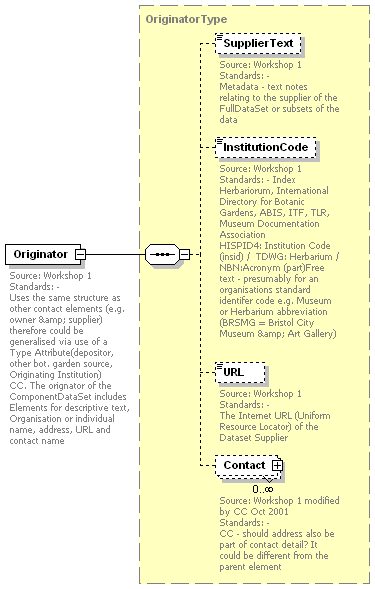 |
||
| type | OriginatorType | ||
| children | SupplierText InstitutionCode URL Contact | ||
| annotation |
|
||
| source | <xs:element name="Originator" type="OriginatorType" minOccurs="0"> <xs:annotation> <xs:documentation>Source: Workshop 1 Standards: - Uses the same structure as other contact elements (e.g. owner & supplier) therefore could be generalised via use of a Type Attribute(depositor, other bot. garden source, Originating Institution) CC. The orignator of the ComponentDataSet includes Elements for descriptive text, Organisation or individual name, address, URL and contact name </xs:documentation> </xs:annotation> </xs:element> |
| diagram | 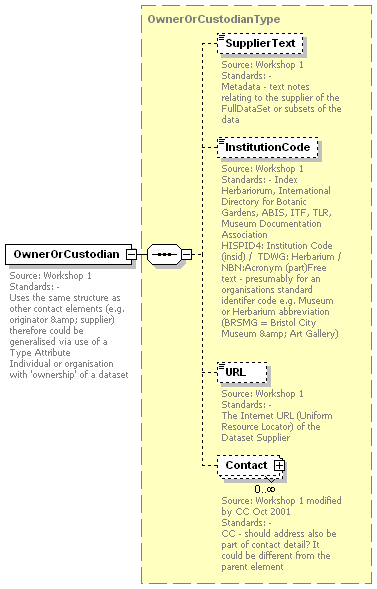 |
||
| type | OwnerOrCustodianType | ||
| children | SupplierText InstitutionCode URL Contact | ||
| annotation |
|
||
| source | <xs:element name="OwnerOrCustodian" type="OwnerOrCustodianType" minOccurs="0"> <xs:annotation> <xs:documentation>Source: Workshop 1 Standards: - Uses the same structure as other contact elements (e.g. originator & supplier) therefore could be generalised via use of a Type Attribute Individual or organisation with 'ownership' of a dataset</xs:documentation> </xs:annotation> </xs:element> |
| diagram | 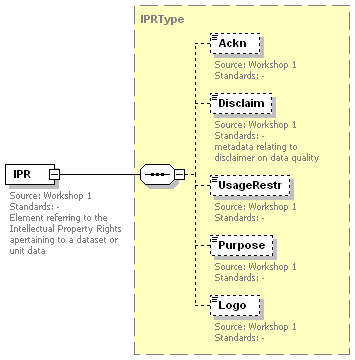 |
||
| type | IPRType | ||
| children | Ackn Disclaim UsageRestr Purpose Logo | ||
| annotation |
|
||
| source | <xs:element name="IPR" type="IPRType" minOccurs="0"> <xs:annotation> <xs:documentation>Source: Workshop 1 Standards: - Element referring to the Intellectual Property Rights apertaining to a dataset or unit data</xs:documentation> </xs:annotation> </xs:element> |
| diagram |  |
||
| type | xs:string | ||
| annotation |
|
||
| source | <xs:element name="NoURecsInResSet" type="xs:string" minOccurs="0"> <xs:annotation> <xs:documentation>Source: Workshop 1 Standards: - </xs:documentation> </xs:annotation> </xs:element> |
| diagram |  |
||
| type | xs:string | ||
| annotation |
|
||
| source | <xs:element name="NoURecsInDb" type="xs:string" minOccurs="0"> <xs:annotation> <xs:documentation>Source: Workshop 1 Standards: - </xs:documentation> </xs:annotation> </xs:element> |
| diagram | 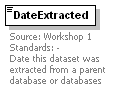 |
||
| type | xs:string | ||
| annotation |
|
||
| source | <xs:element name="DateExtracted" type="xs:string" minOccurs="0"> <xs:annotation> <xs:documentation>Source: Workshop 1 Standards: - Date this dataset was extracted from a parent database or databases</xs:documentation> </xs:annotation> </xs:element> |
| diagram | 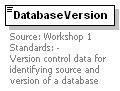 |
||
| type | xs:string | ||
| annotation |
|
||
| source | <xs:element name="DatabaseVersion" type="xs:string"> <xs:annotation> <xs:documentation>Source: Workshop 1 Standards: - Version control data for identifying source and version of a database</xs:documentation> </xs:annotation> </xs:element> |
| diagram |  |
||||||||||||||||||||||||||||||
| children | Unit_ID UnitIdentifiers SupplierText Originator IPR Surrogate Substrate Host OwnerOrCustodian specimenUnit namedCollection Description NoOfIndividuals AbundanceOrDensity UnitDataMeasurement Availability UnitDomain GatheringEvent Identification UnitDataSetRelations | ||||||||||||||||||||||||||||||
| attributes |
|
||||||||||||||||||||||||||||||
| annotation |
|
||||||||||||||||||||||||||||||
| source | <xs:element name="UnitDataset" minOccurs="0" maxOccurs="unbounded"> <xs:annotation> <xs:documentation>Source: Workshop 1 / modified by CC Oct 2001 Standards: - Taxon48: Unit (Gathering Unit) - see also Secimen Unit in this model (=Derived Unit) Element linking information to a Unit (e.g. biological record, specimen, subspecimen etc.) There may be many UnitDatasets within a ComponentDataSet. UnitDatasets may be related in a parent child fashion e.g. for derived units Units may have many identification and verification events attached to them the range of possible measurement attributes for a unit is vast and therefore a generalised measurement element is introduced. Measurable variables could be controlled by a look-up list. </xs:documentation> </xs:annotation> <xs:complexType> <xs:sequence> <xs:element name="Unit_ID" type="Unit_ID" maxOccurs="unbounded"> <xs:annotation> <xs:documentation>Source: Workshop 1 Standards: - Taxon48: Unit_ID / NBN: Sample_KeyUnit key or Identifying number - can be multiple</xs:documentation> </xs:annotation> </xs:element> <xs:element name="UnitIdentifiers" minOccurs="0" maxOccurs="unbounded"> <xs:annotation> <xs:documentation>Added by CC Oct 2001 includes HISPID4: cid NBN: specimen_number</xs:documentation> </xs:annotation> <xs:complexType> <xs:simpleContent> <xs:extension base="xs:string"> <xs:attribute name="identifierType" type="xs:string"/> </xs:extension> </xs:simpleContent> </xs:complexType> </xs:element> <xs:element name="SupplierText" type="SupplierText" minOccurs="0" maxOccurs="unbounded"> <xs:annotation> <xs:documentation>Source: Workshop 1 Standards: - Metadata - text notes relating to the supplier of the FullDataSet or subsets of the data</xs:documentation> </xs:annotation> </xs:element> <xs:element name="Originator" type="OriginatorType" minOccurs="0"> <xs:annotation> <xs:documentation>Source: Workshop 1 Standards: - Uses the same structure as other contact elements (e.g. owner & supplier) therefore could be generalised via use of a Type Attribute(depositor, other bot. garden source, Originating Institution) CC. The orignator of the ComponentDataSet includes Elements for descriptive text, Organisation or individual name, address, URL and contact name </xs:documentation> </xs:annotation> </xs:element> <xs:element name="IPR" type="IPRType" minOccurs="0"> <xs:annotation> <xs:documentation>Source: Workshop 1 Standards: - Element referring to the Intellectual Property Rights apertaining to a dataset or unit data</xs:documentation> </xs:annotation> </xs:element> <xs:element name="Surrogate" type="xs:string" minOccurs="0"> <xs:annotation> <xs:documentation>Source: Workshop 1 Standards: - </xs:documentation> </xs:annotation> </xs:element> <xs:element name="Substrate" type="SubstrateType" minOccurs="0"> <xs:annotation> <xs:documentation>Source: Workshop 1/ modified by CC Oct 2001 Standards: - HISPID4: sub Substrate is the surface or medium from which one or more specimens are recorded or collected e.g. in soft mud, on leaf surface, under rock, on granite etc.</xs:documentation> </xs:annotation> </xs:element> <xs:element name="Host" type="xs:string" minOccurs="0"> <xs:annotation> <xs:documentation>Source: Workshop 1 Standards: -</xs:documentation> </xs:annotation> </xs:element> <xs:element name="OwnerOrCustodian" type="OwnerOrCustodianType" minOccurs="0"> <xs:annotation> <xs:documentation>Source: Workshop 1 Standards: - Uses the same structure as other contact elements (e.g. originator & supplier) therefore could be generalised via use of a Type Attribute Individual or organisation with 'ownership' of a dataset</xs:documentation> </xs:annotation> </xs:element> <xs:element name="specimenUnit" minOccurs="0" maxOccurs="unbounded"> <xs:annotation> <xs:documentation>Added by CC Oct. 2001The specimen unit is a derived subtype of Unit representing physical specimens in collections The specimen can link to field obsevations and to named collections</xs:documentation> </xs:annotation> <xs:complexType> <xs:sequence> <xs:element name="Unit_ID" type="Unit_ID" maxOccurs="unbounded"> <xs:annotation> <xs:documentation>Source: Workshop 1 Standards: - Taxon48: Unit_ID / NBN: Sample_KeyUnit key or Identifying number - can be multiple</xs:documentation> </xs:annotation> </xs:element> <xs:element name="accession_number" minOccurs="0"> <xs:annotation> <xs:documentation>Added by CC Oct. 2001 - - Taxon48 AccCode_Pk LMNH The instutional number applied to an accession and recorded in the accessions register e.g. BRSMG:1999/1209. A structured view into acquisition information from accessions register as opposed to original gathering data. - helps link collections (e.g. several specimens may share one accession number).</xs:documentation> </xs:annotation> <xs:complexType> <xs:sequence> <xs:element name="accession_date"> <xs:annotation> <xs:documentation>Added by CC Oct 2001 - - Taxon48: AccDate The date on which an accession was recorded in the accessions register ( not the date of acquisition)</xs:documentation> </xs:annotation> <xs:complexType> <xs:sequence> <xs:element name="Date" type="DateType"/> </xs:sequence> </xs:complexType> </xs:element> <xs:element name="acquisition_date"> <xs:annotation> <xs:documentation>Added by CC Oct. 2001The date when specimens or collections were acquired by the institution</xs:documentation> </xs:annotation> <xs:complexType> <xs:sequence> <xs:element name="Date" type="DateType"/> </xs:sequence> </xs:complexType> </xs:element> <xs:choice> <xs:element name="AltText" type="AltText"> <xs:annotation> <xs:documentation>Source: Sydney CODATA workshopFree text field for informal recording of field contents</xs:documentation> </xs:annotation> </xs:element> <xs:element name="PersonName" type="PersonNameType"> <xs:annotation> <xs:documentation>Source: Workshop 1/ changed by CC from old Name Element Standards: - Group element for parts of a personal name - see also name_ID (ref to a database entry) and fullName (free text format)</xs:documentation> </xs:annotation> </xs:element> <xs:element name="organisationName" type="organisationName"> <xs:annotation> <xs:documentation>Added by CC Oct 2001Full organisation name e.g. Taxonomic Database Working Group</xs:documentation> </xs:annotation> </xs:element> </xs:choice> <xs:element name="Comment" type="Comment" minOccurs="0"> <xs:annotation> <xs:documentation>Added by CC Oct 2001Free text of formatted text (rtf) description of the feature - not controlled length e.g. often a memo field</xs:documentation> </xs:annotation> </xs:element> <xs:element name="Source" type="SourceType" minOccurs="0"> <xs:annotation> <xs:documentation>Added CC Oct 2001 NBN: Source Marker element for a link to a source module for dealing with structured literature and document rexcords </xs:documentation> </xs:annotation> </xs:element> </xs:sequence> <xs:attribute name="Acquisitiontype" type="xs:string"/> </xs:complexType> </xs:element> <xs:element name="specimenType"> <xs:complexType> <xs:choice> <xs:sequence> <xs:element name="ShortTermName" type="ShortTermName"> <xs:annotation> <xs:documentation>Source: CC - Oct 2001 Standards: ShortTernName is a code or shortened version of a term that might be used in a database or lookup table e.g. HOLO for Holotype </xs:documentation> </xs:annotation> </xs:element> <xs:element name="LongTermName" type="LongTermName" minOccurs="0"> <xs:annotation> <xs:documentation>Source: CC - Oct 2001 Standards: LongTermname is the full term that might appear in a lookup table e.g. in a list of types: Holotype</xs:documentation> </xs:annotation> </xs:element> <xs:element name="Description" type="Description" minOccurs="0"> <xs:annotation> <xs:documentation>Source: Workshop 1 Standards: - Used wherever a description field is needed. Free text and could be in rtf or html.</xs:documentation> </xs:annotation> </xs:element> </xs:sequence> <xs:element name="AltText" type="AltText"> <xs:annotation> <xs:documentation>Source: Sydney CODATA workshopFree text field for informal recording of field contents</xs:documentation> </xs:annotation> </xs:element> </xs:choice> <xs:attribute name="specimenTypeID" type="xs:string"/> </xs:complexType> </xs:element> <xs:element name="NatureOrPreservationMode"> <xs:annotation> <xs:documentation>Source: Workshop 1/ changed by CC Oct 2001Unit "nature" or preservation mode: virtual vs. object; preservation mode; part; creation process</xs:documentation> </xs:annotation> <xs:complexType> <xs:choice> <xs:element name="LookupTerm" type="LookupTermType"> <xs:annotation> <xs:documentation>Added by CC Oct 2001 NBN: Term Typical structure for a simple lookup list of term contents - structure consists of an attribute for the type e.g. name of the look up list together with long and short versions of the term</xs:documentation> </xs:annotation> </xs:element> <xs:element name="AltText" type="AltText"> <xs:annotation> <xs:documentation>Source: Sydney CODATA workshopFree text field for informal recording of field contents</xs:documentation> </xs:annotation> </xs:element> </xs:choice> <xs:attribute name="PreservationMode_ID" type="xs:string"/> </xs:complexType> </xs:element> <xs:element name="specimenUnit_part" type="xs:string" minOccurs="0"> <xs:annotation> <xs:documentation>Added by CC Oct 2001 LNHM specimen part: Part of the specimen rcord applies</xs:documentation> </xs:annotation> </xs:element> <xs:element name="accession_catalogue_ID" type="accession_catalogue_ID" minOccurs="0"> <xs:annotation> <xs:documentation>Added by CC Oct 2001Unique identifier for an accessions catalogue id in a computerised system</xs:documentation> </xs:annotation> </xs:element> <xs:choice minOccurs="0"> <xs:element name="namedCollection" type="namedCollectionType"> <xs:annotation> <xs:documentation> Source: Workshop 1/ subelements added by CC Oct. 2001A named Collection is an association of specimens (units) that have a common identity either through content, ownership or acquisition. This element is a special kind of Unit subType and is separated here for the purposes of clarity The element facilitates the recording of the history, ownership and content of named collections and also because named collections may be stored, moved. acquired or disposed of as a whole. </xs:documentation> </xs:annotation> </xs:element> <xs:element name="collection_ID" type="collection_ID"> <xs:annotation> <xs:documentation>Added by CC Oct. 2001 Syn: Unit_ID Unique identifier for collection in a computerised system this is a synonym of Unit_ID </xs:documentation> </xs:annotation> </xs:element> </xs:choice> <xs:element name="specimenUnitNumber" minOccurs="0" maxOccurs="unbounded"> <xs:annotation> <xs:documentation>Added by CC Oct. 2001Any numbers or other registration marks associated with a specimen unit (1 or more specimens)</xs:documentation> </xs:annotation> <xs:complexType> <xs:sequence> <xs:element name="specimenUnit_number_ID" type="xs:string" minOccurs="0"> <xs:annotation> <xs:documentation>Added by CC Oct 2001 LNHM</xs:documentation> </xs:annotation> </xs:element> <xs:element name="DistinguishingNumber" type="xs:string"> <xs:annotation> <xs:documentation>Added by CC Oct. 2001Text for number or other registration mark applied to a specimen or group of specimens e.g from registration book, collectors note book, auction catalogue, batch number etc.</xs:documentation> </xs:annotation> </xs:element> <xs:element name="Source" type="SourceType"> <xs:annotation> <xs:documentation>Added CC Oct 2001 NBN: Source Marker element for a link to a source module for dealing with structured literature and document rexcords</xs:documentation> </xs:annotation> </xs:element> </xs:sequence> <xs:attribute name="PreferredFlag"> <xs:simpleType> <xs:restriction base="xs:NMTOKEN"> <xs:enumeration value="Yes"/> <xs:enumeration value="No"/> </xs:restriction> </xs:simpleType> </xs:attribute> </xs:complexType> </xs:element> <xs:element name="specimenUnit_description" type="xs:string"> <xs:annotation> <xs:documentation>Added by CC Oct 2001 LNHM Free text description of a specimen or similar 'Unit'</xs:documentation> </xs:annotation> </xs:element> <xs:sequence minOccurs="0" maxOccurs="unbounded"> <xs:element name="Identification" type="IdentificationType"> <xs:annotation> <xs:documentation>Source: Workshop 1 Standards: - </xs:documentation> </xs:annotation> </xs:element> <xs:element name="specimenUnitStatus" minOccurs="0"> <xs:annotation> <xs:documentation>Taxonomic status linked to an identification of a specimen</xs:documentation> </xs:annotation> <xs:complexType> <xs:sequence> <xs:element name="Unit_status_ID" type="Unit_status_ID" minOccurs="0"/> <xs:element name="Unit_ID" type="Unit_ID" minOccurs="0" maxOccurs="unbounded"> <xs:annotation> <xs:documentation>Source: Workshop 1 Standards: - Taxon48: Unit_ID / NBN: Sample_KeyUnit key or Identifying number - can be multiple</xs:documentation> </xs:annotation> </xs:element> <xs:element name="Type"> <xs:annotation> <xs:documentation>Source: Workshop 1 / mod CC Oct 2001 Standards: - - - made qualifier an attribute of status - introduced qualifier to indicate preference or sort order of basionyms Composite element that links type status, a qualifying statement, original name and pertinent published references Making Type a repeatable element with a qualifier for sort order e.g. most recent, second most recent etc. covers multiple elements in HISPID (e.g. basnam1, basnam2, basnam3) </xs:documentation> </xs:annotation> <xs:complexType> <xs:sequence> <xs:element name="TypeStatus"> <xs:annotation> <xs:documentation>Source: Workshop 1/ modified CC Oct 2001 Standards: - - - includes HISPID4: tsta and tql The presumed nomenclatural status of specimens regarded as types - Note that Type Qualifier has been moved to an enumerated attribute of TypeStatus</xs:documentation> </xs:annotation> <xs:complexType> <xs:choice> <xs:sequence> <xs:element name="AltText" type="AltText"> <xs:annotation> <xs:documentation>Source: Sydney CODATA workshopFree text field for informal recording of field contents</xs:documentation> </xs:annotation> </xs:element> <xs:element name="Source" type="SourceType"> <xs:annotation> <xs:documentation>Added CC Oct 2001 NBN: Source Marker element for a link to a source module for dealing with structured literature and document rexcords </xs:documentation> </xs:annotation> </xs:element> </xs:sequence> <xs:element name="LookupTerm" type="LookupTermType"> <xs:annotation> <xs:documentation>Added by CC Oct 2001 NBN: Term Typical structure for a simple lookup list of term contents - structure consists of an attribute for the type e.g. name of the look up list together with long and short versions of the term</xs:documentation> </xs:annotation> </xs:element> </xs:choice> <xs:attribute name="TypeQualifier" use="required"> <xs:simpleType> <xs:restriction base="xs:NMTOKEN"> <xs:enumeration value="Confirmed"/> <xs:enumeration value="Probably"/> <xs:enumeration value="Possibly"/> <xs:enumeration value="Not"/> </xs:restriction> </xs:simpleType> </xs:attribute> </xs:complexType> </xs:element> <xs:element name="Basionym" minOccurs="0"> <xs:annotation> <xs:documentation>Source: Workshop 1 Standards: - HISPID4: basnam / TLR Baionym refers to the original name associated with a type specimen where the name has subsequently been revised especially where this has arisen from a change of rank the option here is to use plain name text or a fully atomised model for name parts.</xs:documentation> </xs:annotation> <xs:complexType> <xs:sequence> <xs:choice> <xs:element name="AltText" type="AltText"> <xs:annotation> <xs:documentation>Source: Sydney CODATA workshopFree text field for informal recording of field contents</xs:documentation> </xs:annotation> </xs:element> <xs:element name="BotanicalName" type="BotanicalNameType"/> <xs:element name="BacteriologicalName" type="BacteriologicalNameType"/> <xs:element name="ZoologicalName" type="ZoologicalNameType"/> </xs:choice> <xs:element name="Source" type="SourceType" minOccurs="0"> <xs:annotation> <xs:documentation>Added CC Oct 2001 NBN: Source Marker element for a link to a source module for dealing with structured literature and document rexcords</xs:documentation> </xs:annotation> </xs:element> </xs:sequence> </xs:complexType> </xs:element> <xs:element name="Source" type="SourceType" minOccurs="0" maxOccurs="unbounded"> <xs:annotation> <xs:documentation>Added CC Oct 2001 NBN: Source Marker element for a link to a source module for dealing with structured literature and document rexcords</xs:documentation> </xs:annotation> </xs:element> </xs:sequence> <xs:attribute name="BasionymOrder"> <xs:simpleType> <xs:restriction base="xs:NMTOKEN"> <xs:enumeration value="1"/> <xs:enumeration value="2"/> <xs:enumeration value="3"/> </xs:restriction> </xs:simpleType> </xs:attribute> </xs:complexType> </xs:element> <xs:element name="specimenUnitStatus_src"> <xs:complexType> <xs:sequence> <xs:element name="Unit_status_ID" type="Unit_status_ID" minOccurs="0"/> <xs:element name="Source" type="SourceType"> <xs:annotation> <xs:documentation>Added CC Oct 2001 NBN: Source Marker element for a link to a source module for dealing with structured literature and document rexcords </xs:documentation> </xs:annotation> </xs:element> </xs:sequence> <xs:attribute name="entered_by" type="xs:string" use="required"/> <xs:attribute name="entry_date" type="xs:string" use="required"/> <xs:attribute name="specimen_status_source_key" type="xs:string"/> </xs:complexType> </xs:element> </xs:sequence> <xs:attribute name="entered_by" type="xs:string" use="required"/> <xs:attribute name="entry_date" type="xs:string" use="required"/> </xs:complexType> </xs:element> </xs:sequence> <xs:element name="specimenUnitData" minOccurs="0" maxOccurs="unbounded"> <xs:annotation> <xs:documentation>Any measurable aspect of the specimen e.g. height, weight, number of specimens etc.</xs:documentation> </xs:annotation> <xs:complexType> <xs:sequence> <xs:element name="measurement" type="measurementType"> <xs:annotation> <xs:documentation>Added by CC Oct 2001 NBN: measurement (partim) measurement is the actiual measurement - measurement is qualigied by attributes: measurementType: what type of measurement e.g. count, area, linear measurement measurementUnits: units that measurement is recorded in e...g. hectares, kilometres, kilogrammes etc. measurementAccuracy: describes accuracy e.g. approximate or +/- 50</xs:documentation> </xs:annotation> </xs:element> </xs:sequence> <xs:attribute name="SpecimenUnitData_ID" type="xs:string"/> </xs:complexType> </xs:element> <xs:element name="UnitDataSetRelations" type="UnitDataSetRelationsType" minOccurs="0" maxOccurs="unbounded"> <xs:annotation> <xs:documentation>Added by CC Oct 2001 specimen relationships - can be used to link derived specimens, specimen parts or members of a specimen group</xs:documentation> </xs:annotation> </xs:element> <xs:element name="specimenUnit_label" minOccurs="0" maxOccurs="unbounded"> <xs:annotation> <xs:documentation>Added by CC Oct 2001 LNHM Specimens, cabinets and other units e.g. living horticultural specimens may have one or more labels attached or associated with them</xs:documentation> </xs:annotation> <xs:complexType> <xs:sequence> <xs:element name="specimenUnit_label_ID" type="xs:string" minOccurs="0"> <xs:annotation> <xs:documentation>Added by CC Oct 2001 LNHM Unique identifier within a database</xs:documentation> </xs:annotation> </xs:element> <xs:element name="Unit_ID" type="Unit_ID" minOccurs="0"> <xs:annotation> <xs:documentation>Source: Workshop 1 Standards: - Taxon48: Unit_ID / NBN: Sample_KeyUnit key or Identifying number - can be multiple</xs:documentation> </xs:annotation> </xs:element> <xs:element name="position_on_object" type="xs:string"/> <xs:element name="label_summary" type="xs:string"/> <xs:element name="Source" type="SourceType" minOccurs="0" maxOccurs="unbounded"> <xs:annotation> <xs:documentation>Added CC Oct 2001 NBN: Source Marker element for a link to a source module for dealing with structured literature and document rexcords</xs:documentation> </xs:annotation> </xs:element> </xs:sequence> <xs:attribute name="entered_by" type="xs:string" use="required"/> <xs:attribute name="entry_date" type="xs:string" use="required"/> </xs:complexType> </xs:element> <xs:element name="inscription" minOccurs="0" maxOccurs="unbounded"> <xs:annotation> <xs:documentation>Added by CC Oct 2001 LNHM writing or other inscription directly upon or carved into a unit (usually a specimen)</xs:documentation> </xs:annotation> <xs:complexType> <xs:sequence> <xs:element name="inscription_ID" minOccurs="0"> <xs:annotation> <xs:documentation>Added by CC Oct 2001Unique identifier within a database</xs:documentation> </xs:annotation> <xs:complexType> <xs:simpleContent> <xs:extension base="xs:string"> <xs:attribute name="type" use="required"> <xs:simpleType> <xs:restriction base="xs:NMTOKEN"> <xs:enumeration value="nbn"/> <xs:enumeration value="local"/> </xs:restriction> </xs:simpleType> </xs:attribute> </xs:extension> </xs:simpleContent> </xs:complexType> </xs:element> <xs:element name="Unit_ID" type="Unit_ID" minOccurs="0"> <xs:annotation> <xs:documentation>Source: Workshop 1 Standards: - Taxon48: Unit_ID / NBN: Sample_KeyUnit key or Identifying number - can be multiple</xs:documentation> </xs:annotation> </xs:element> <xs:element name="inscription_type" type="xs:string"> <xs:annotation> <xs:documentation>Added by CC Oct 2001 LNHM Type of inscription</xs:documentation> </xs:annotation> </xs:element> <xs:element name="inscriptionText" type="xs:string"> <xs:annotation> <xs:documentation>Added by CC Oct 2001Text transcription of an inscription</xs:documentation> </xs:annotation> </xs:element> </xs:sequence> <xs:attribute name="entered_by" type="xs:string" use="required"/> <xs:attribute name="entry_date" type="xs:string" use="required"/> </xs:complexType> </xs:element> <xs:element name="specimenUnitHistory" minOccurs="0" maxOccurs="unbounded"> <xs:annotation> <xs:documentation>Added by CC Oct 2001Allows recording of history of specimen e.g. changes of ownership and transfers between collections by sale, splitting or merging of collections</xs:documentation> </xs:annotation> <xs:complexType> <xs:sequence> <xs:element name="Unit_ID" type="Unit_ID" maxOccurs="unbounded"> <xs:annotation> <xs:documentation>Source: Workshop 1 Standards: - Taxon48: Unit_ID / NBN: Sample_KeyUnit key or Identifying number - can be multiple</xs:documentation> </xs:annotation> </xs:element> <xs:element name="previous_collection_name" type="xs:string"/> <xs:element name="Date" type="DateType" minOccurs="0" maxOccurs="unbounded"> <xs:annotation> <xs:documentation>Added CC Oct 2001 NBN: vaguedatestart, vaguedateend and vaguedatetype Date has a three part structure - two elements and an attribute VagueDateBegin = First date of a range or date for a single date VagueDateEnd = last date in a range DateType attribute can be enumerated to allow for various date formats (e.g. dd/mm/yyyy or to allow a parser to interpret terms such as summer 69 or 1974 etc) Note terms such as summer would be interpretted by standard begin and end dates.</xs:documentation> </xs:annotation> </xs:element> <xs:element name="Comment" type="Comment" minOccurs="0"> <xs:annotation> <xs:documentation>Added by CC Oct 2001Free text of formatted text (rtf) description of the feature - not controlled length e.g. often a memo field</xs:documentation> </xs:annotation> </xs:element> </xs:sequence> <xs:attribute name="entered_by" type="xs:string" use="required"/> <xs:attribute name="entry_date" type="xs:string" use="required"/> </xs:complexType> </xs:element> <xs:element name="specimenUnit_Fact" minOccurs="0" maxOccurs="unbounded"> <xs:annotation> <xs:documentation>Added by CC Oct 2001 LNHM any number of free text facts can be recorded about the specimen or unit. The structure allows for a title so that the facts could be assembled in an rtf or html page layout Facts can be of any sort e.g. comments on the historical importance of the specimen.</xs:documentation> </xs:annotation> <xs:complexType> <xs:sequence> <xs:element name="specimenUnit_fact_ID" type="xs:string"> <xs:annotation> <xs:documentation>Added by CC Oct 2001 LNHM Unique identifier within a database</xs:documentation> </xs:annotation> </xs:element> <xs:element name="title" type="title"/> <xs:element name="Comment" type="Comment"> <xs:annotation> <xs:documentation>Added by CC Oct 2001Free text of formatted text (rtf) description of the feature - not controlled length e.g. often a memo field</xs:documentation> </xs:annotation> </xs:element> <xs:element name="Date" type="DateType"> <xs:annotation> <xs:documentation>Added CC Oct 2001 NBN: vaguedatestart, vaguedateend and vaguedatetype Date has a three part structure - two elements and an attribute VagueDateBegin = First date of a range or date for a single date VagueDateEnd = last date in a range DateType attribute can be enumerated to allow for various date formats (e.g. dd/mm/yyyy or to allow a parser to interpret terms such as summer 69 or 1974 etc) Note terms such as summer would be interpretted by standard begin and end dates.</xs:documentation> </xs:annotation> </xs:element> <xs:element name="Source" type="SourceType"> <xs:annotation> <xs:documentation>Added CC Oct 2001 NBN: Source Marker element for a link to a source module for dealing with structured literature and document rexcords</xs:documentation> </xs:annotation> </xs:element> </xs:sequence> <xs:attribute name="entered_by" type="xs:string" use="required"/> <xs:attribute name="entry_date" type="xs:string" use="required"/> <xs:attribute name="changed_by" type="xs:string"/> <xs:attribute name="changed_date" type="xs:string"/> <xs:attribute name="system_supplied_data" default="No"> <xs:simpleType> <xs:restriction base="xs:NMTOKEN"> <xs:enumeration value="Yes"/> <xs:enumeration value="No"/> </xs:restriction> </xs:simpleType> </xs:attribute> <xs:attribute name="fact_type" type="xs:string"/> </xs:complexType> </xs:element> <xs:element name="specimenUnitImage" minOccurs="0" maxOccurs="unbounded"> <xs:complexType> <xs:sequence> <xs:element name="imageContext" type="xs:string"> <xs:annotation> <xs:documentation>Added by CC Oct. 2001The context of the image in relation to the specimen or other types of derived unit - could be many e.g. original valid publication image, front view of lectotype etc.</xs:documentation> </xs:annotation> </xs:element> <xs:element name="Image" type="ImageType"> <xs:annotation> <xs:documentation>added by CC Oct 2001 NBN: Image Compound element that can include any type of image including paintings, photographs, digital photographs and video</xs:documentation> </xs:annotation> </xs:element> </xs:sequence> </xs:complexType> </xs:element> <xs:element name="Source" type="SourceType" minOccurs="0" maxOccurs="unbounded"> <xs:annotation> <xs:documentation>Added CC Oct 2001 NBN: Source Marker element for a link to a source module for dealing with structured literature and document rexcords </xs:documentation> </xs:annotation> </xs:element> </xs:sequence> <xs:attribute name="entered_by" type="xs:string" use="required"/> <xs:attribute name="entry_date" type="xs:string" use="required"/> </xs:complexType> </xs:element> <xs:element name="namedCollection" type="namedCollectionType" minOccurs="0"> <xs:annotation> <xs:documentation> Source: Workshop 1/ subelements added by CC Oct. 2001A named Collection is an association of specimens (units) that have a common identity either through content, ownership or acquisition. This element is a special kind of Unit subType and is separated here for the purposes of clarity The element facilitates the recording of the history, ownership and content of named collections and also because named collections may be stored, moved. acquired or disposed of as a whole.</xs:documentation> </xs:annotation> </xs:element> <xs:element name="Description" type="Description" minOccurs="0"> <xs:annotation> <xs:documentation>Source: Workshop 1 Standards: - Used wherever a description field is needed. Free text and could be in rtf or html.</xs:documentation> </xs:annotation> </xs:element> <xs:element name="NoOfIndividuals"> <xs:annotation> <xs:documentation>Source: Workshop 1/ changed by Cc Oct 2001 Standards: - Element for holding counts - can be multiiple e.g. number of males, females and juveniles Could be replaced by general UnitDataMeasurement element</xs:documentation> </xs:annotation> <xs:complexType> <xs:sequence> <xs:element name="measurement" type="measurementType" minOccurs="0" maxOccurs="unbounded"> <xs:annotation> <xs:documentation>Added by CC Oct 2001 NBN: measurement (partim) measurement is the actiual measurement - measurement is qualigied by attributes: measurementType: what type of measurement e.g. count, area, linear measurement measurementUnits: units that measurement is recorded in e...g. hectares, kilometres, kilogrammes etc. measurementAccuracy: describes accuracy e.g. approximate or +/- 50</xs:documentation> </xs:annotation> </xs:element> <xs:element name="Comment" type="Comment" minOccurs="0"> <xs:annotation> <xs:documentation>Added by CC Oct 2001Free text of formatted text (rtf) description of the feature - not controlled length e.g. often a memo field</xs:documentation> </xs:annotation> </xs:element> </xs:sequence> </xs:complexType> </xs:element> <xs:element name="AbundanceOrDensity" minOccurs="0"> <xs:annotation> <xs:documentation>Source: Workshop 1 / changed by CC Oct 2001 Standards: - Abundance / Density at collection site, Qualifier , Method - can have several measures of abundance e.g. Domin and DAFOR values This element could be replaced by the more general UnitDataMeasurement element</xs:documentation> </xs:annotation> <xs:complexType> <xs:sequence> <xs:choice> <xs:element name="AltText" type="AltText"> <xs:annotation> <xs:documentation>Source: Sydney CODATA workshopFree text field for informal recording of field contents</xs:documentation> </xs:annotation> </xs:element> <xs:element name="measurement" type="measurementType" minOccurs="0" maxOccurs="unbounded"> <xs:annotation> <xs:documentation>Added by CC Oct 2001 NBN: measurement (partim) measurement is the actiual measurement - measurement is qualigied by attributes: measurementType: what type of measurement e.g. count, area, linear measurement measurementUnits: units that measurement is recorded in e...g. hectares, kilometres, kilogrammes etc. measurementAccuracy: describes accuracy e.g. approximate or +/- 50</xs:documentation> </xs:annotation> </xs:element> </xs:choice> <xs:element name="Comment" type="Comment" minOccurs="0"> <xs:annotation> <xs:documentation>Added by CC Oct 2001Free text of formatted text (rtf) description of the feature - not controlled length e.g. often a memo field</xs:documentation> </xs:annotation> </xs:element> </xs:sequence> </xs:complexType> </xs:element> <xs:element name="UnitDataMeasurement" minOccurs="0" maxOccurs="unbounded"> <xs:annotation> <xs:documentation>Added by CC Oct 2001 NBN: Taxon_Data This is a general purpose measurement element that can be used to store any kind of count or measurement related to a Unit e.g. length of bill, number of eggs, weight, pH , specific Gravity etc. Some measurements are so common e.g. abundance that they have separate elements in the current model - this is redundant but makes for easier reading!</xs:documentation> </xs:annotation> <xs:complexType> <xs:sequence> <xs:element name="measurement" type="measurementType"> <xs:annotation> <xs:documentation>Added by CC Oct 2001 NBN: measurement (partim) measurement is the actiual measurement - measurement is qualigied by attributes: measurementType: what type of measurement e.g. count, area, linear measurement measurementUnits: units that measurement is recorded in e...g. hectares, kilometres, kilogrammes etc. measurementAccuracy: describes accuracy e.g. approximate or +/- 50</xs:documentation> </xs:annotation> </xs:element> </xs:sequence> <xs:attribute name="UnitDataMeasurement_ID" type="xs:string"/> </xs:complexType> </xs:element> <xs:element name="Availability" type="xs:string" minOccurs="0"> <xs:annotation> <xs:documentation>Source: Workshop 1 Standards: - Text describing the availability of the data for use</xs:documentation> </xs:annotation> </xs:element> <xs:element name="UnitDomain"> <xs:annotation> <xs:documentation>Source: Workshop 1 Standards: - Allows the subtyping of Unit into various disciplines and codes of nomenclature</xs:documentation> </xs:annotation> <xs:complexType> <xs:choice> <xs:element name="GeologicalSpecimen" type="xs:string"> <xs:annotation> <xs:documentation>Added by CC Oct. 2001</xs:documentation> </xs:annotation> </xs:element> <xs:element name="PalaeontologicalSpecimen" type="xs:string"> <xs:annotation> <xs:documentation>Added by CC Oct. 2001</xs:documentation> </xs:annotation> </xs:element> <xs:element name="ZoologicalSpecimen"> <xs:annotation> <xs:documentation>Source: Workshop 1 Standards: - Unit subtype allowing the recording of zoological attributes</xs:documentation> </xs:annotation> <xs:complexType> <xs:sequence> <xs:element name="ZoologyAge" type="xs:string"> <xs:annotation> <xs:documentation>Source: Workshop 1 Standards: -</xs:documentation> </xs:annotation> </xs:element> <xs:element name="ZoologySex" type="xs:string"> <xs:annotation> <xs:documentation>Source: Workshop 1 Standards: -</xs:documentation> </xs:annotation> </xs:element> <xs:element name="ZoologyPhase" type="xs:string"> <xs:annotation> <xs:documentation>Source: Workshop 1 Standards: -</xs:documentation> </xs:annotation> </xs:element> </xs:sequence> </xs:complexType> </xs:element> <xs:element name="BotanicalUnit"> <xs:annotation> <xs:documentation>Source: Workshop 1 Standards: - Check for HISPID fields of specific botanical nature. Unit subtype allowing the recording of botanical attributes</xs:documentation> </xs:annotation> <xs:complexType> <xs:sequence> <xs:element name="Unit_ID" type="Unit_ID" minOccurs="0"> <xs:annotation> <xs:documentation>Source: Workshop 1 Standards: - Taxon48: Unit_ID / NBN: Sample_KeyUnit key or Identifying number - can be multiple</xs:documentation> </xs:annotation> </xs:element> </xs:sequence> </xs:complexType> </xs:element> <xs:element name="BotanicalGardenUnit"> <xs:annotation> <xs:documentation>Source: Workshop 1 Standards: - Quite a few elements from ITF go here. Unit subtype allowing the recording of horticultural attributes</xs:documentation> </xs:annotation> <xs:complexType> <xs:sequence> <xs:element name="Unit_ID" type="Unit_ID" minOccurs="0"> <xs:annotation> <xs:documentation>Source: Workshop 1 Standards: - Taxon48: Unit_ID / NBN: Sample_KeyUnit key or Identifying number - can be multiple</xs:documentation> </xs:annotation> </xs:element> <xs:element name="Hardiness" type="xs:string"> <xs:annotation> <xs:documentation>Source: Workshop 1 Standards: - </xs:documentation> </xs:annotation> </xs:element> </xs:sequence> </xs:complexType> </xs:element> <xs:element name="mycologicalUnit"> <xs:complexType> <xs:sequence> <xs:element name="LichenMorphotype" type="xs:string" minOccurs="0"> <xs:annotation> <xs:documentation>Source:Paul Kirk (in email) Standards: - Name of algal or cyanobacterial component of lichen</xs:documentation> </xs:annotation> </xs:element> <xs:element name="MycologicalLiveStage" type="xs:string" minOccurs="0"> <xs:annotation> <xs:documentation>Source:Paul Kirk (in email) Standards: -</xs:documentation> </xs:annotation> </xs:element> <xs:element name="MycologicalSexualStage" type="xs:string" minOccurs="0"> <xs:annotation> <xs:documentation>Source:Paul Kirk (in email) Standards: -</xs:documentation> </xs:annotation> </xs:element> </xs:sequence> </xs:complexType> </xs:element> <xs:element name="CultureCollection"> <xs:annotation> <xs:documentation>Source: Workshop 1 / modified by CC Oct 2001 Standards: - Unit subtype allowing the recording of microbial and similar culture method attributes</xs:documentation> </xs:annotation> <xs:complexType> <xs:sequence> <xs:sequence maxOccurs="unbounded"> <xs:element name="Unit_ID" type="Unit_ID" minOccurs="0"> <xs:annotation> <xs:documentation>Source: Workshop 1 Standards: - Taxon48: Unit_ID / NBN: Sample_KeyUnit key or Identifying number - can be multiple</xs:documentation> </xs:annotation> </xs:element> <xs:element name="CultureName" type="xs:string" minOccurs="0"> <xs:annotation> <xs:documentation>Added by CC Oct. 2001Reference or trade name for a microbial culture</xs:documentation> </xs:annotation> </xs:element> </xs:sequence> <xs:element name="GrowthConditions" type="xs:string" minOccurs="0"> <xs:annotation> <xs:documentation>Source: Workshop 1 Standards: - </xs:documentation> </xs:annotation> </xs:element> <xs:element name="CultureMedium" type="xs:string" minOccurs="0"> <xs:annotation> <xs:documentation>Source: Workshop 1 Standards: - The growth medium for a microbial or similar culture e.g. agar</xs:documentation> </xs:annotation> </xs:element> <xs:element name="Aerobicity" type="xs:string" minOccurs="0"> <xs:annotation> <xs:documentation>Source: Workshop 1 Standards: -</xs:documentation> </xs:annotation> </xs:element> <xs:element name="Temperature" minOccurs="0"> <xs:annotation> <xs:documentation>Source: Workshop 1 Standards: - Preferably a number - attribute gives temperature scale used</xs:documentation> </xs:annotation> <xs:complexType> <xs:simpleContent> <xs:extension base="xs:string"> <xs:attribute name="TempType"> <xs:simpleType> <xs:restriction base="xs:NMTOKEN"> <xs:enumeration value="Celsius"/> <xs:enumeration value="Fahrenheit"/> <xs:enumeration value="Absolute"/> </xs:restriction> </xs:simpleType> </xs:attribute> </xs:extension> </xs:simpleContent> </xs:complexType> </xs:element> <xs:element name="Applications" type="xs:string" minOccurs="0"> <xs:annotation> <xs:documentation>Source: Workshop 1 Standards: - </xs:documentation> </xs:annotation> </xs:element> <xs:element name="Source" type="SourceType" minOccurs="0" maxOccurs="unbounded"> <xs:annotation> <xs:documentation>Added CC Oct 2001 NBN: Source Marker element for a link to a source module for dealing with structured literature and document rexcords</xs:documentation> </xs:annotation> </xs:element> <xs:element name="Hazard" type="xs:string" minOccurs="0"> <xs:annotation> <xs:documentation>Source: Workshop 1 Standards: -</xs:documentation> </xs:annotation> </xs:element> </xs:sequence> </xs:complexType> </xs:element> </xs:choice> </xs:complexType> </xs:element> <xs:element name="GatheringEvent"> <xs:annotation> <xs:documentation>Source: Workshop 1 Standards: - </xs:documentation> </xs:annotation> <xs:complexType> <xs:sequence> <xs:element name="Project" minOccurs="0"> <xs:annotation> <xs:documentation>Source: Workshop 1 / modified by CC Oct 2001 Standards: - Taxon48: Project Proj_Pk </xs:documentation> </xs:annotation> <xs:complexType> <xs:sequence> <xs:element name="Proj_Pk" type="xs:string" minOccurs="0"> <xs:annotation> <xs:documentation>Source: Workshop 1 Standards: - - -Taxon48 Proj_Pk Unique identifier in database</xs:documentation> </xs:annotation> </xs:element> <xs:element name="ParProj_Fk" type="xs:string" minOccurs="0"> <xs:annotation> <xs:documentation>Source: Workshop 1 Standards: - Taxon48: ParProj_Pk Name or reference to a parent project where expedition is part of a bigger project</xs:documentation> </xs:annotation> </xs:element> <xs:element name="ProjTitle" type="xs:string"> <xs:annotation> <xs:documentation>Source: Workshop 1 Standards: - Taxon48: ProjTitle Main project title</xs:documentation> </xs:annotation> </xs:element> <xs:element name="ProjTitle2" type="xs:string" minOccurs="0"> <xs:annotation> <xs:documentation>Source: Workshop 1 Standards: - Taxon48: ProjTitle2 Project subtitle</xs:documentation> </xs:annotation> </xs:element> <xs:element name="PlatformNm" type="xs:string" minOccurs="0"> <xs:annotation> <xs:documentation>Source: Workshop 1 Standards: - - - Taxon48: PlatformNm ASC: PLATFORM-NAM CC. Free text element platform name - refers to the 'platform' from which observations where made e.g. the name of a research vessel or a remote operated vehicle.</xs:documentation> </xs:annotation> </xs:element> <xs:choice> <xs:element name="Duration" type="DurationType"> <xs:annotation> <xs:documentation>Source: Workshop 1/ modified by CC Oct 2001 Standards: - Taxon48: Duration measurement of time elapsed - decimal number</xs:documentation> </xs:annotation> </xs:element> <xs:sequence> <xs:element name="dateFrom"> <xs:annotation> <xs:documentation>Added by CC Oct. 2001Element for recording the starting date in a range</xs:documentation> </xs:annotation> <xs:complexType> <xs:sequence> <xs:element name="Date" type="DateType"/> </xs:sequence> </xs:complexType> </xs:element> <xs:element name="dateTo"> <xs:annotation> <xs:documentation>End date for use in date ranges</xs:documentation> </xs:annotation> <xs:complexType> <xs:sequence> <xs:element name="Date" type="DateType"/> </xs:sequence> </xs:complexType> </xs:element> </xs:sequence> </xs:choice> <xs:choice> <xs:element name="ProjAckn" type="xs:string" minOccurs="0"> <xs:annotation> <xs:documentation>Source: Workshop 1 Standards: - Taxon48: ProjAckn Project funding acknowledgements - free text</xs:documentation> </xs:annotation> </xs:element> </xs:choice> <xs:element name="ProjTxt" type="xs:string" minOccurs="0"> <xs:annotation> <xs:documentation>Source: Workshop 1 Standards: - Taxon48: ProjTxt Free text description of the project</xs:documentation> </xs:annotation> </xs:element> <xs:element name="Contact" type="ContactType" minOccurs="0"> <xs:annotation> <xs:documentation>Source: Workshop 1 modified by CC Oct 2001 Standards: - CC - should address also be part of contact detail? It could be different from the parent element</xs:documentation> </xs:annotation> </xs:element> </xs:sequence> </xs:complexType> </xs:element> <xs:element name="GatheringAgent"> <xs:annotation> <xs:documentation>Source: Workshop 1 / modified CC Oct 2001 Standards: - Taxon48: GatheringAgent incl. LegTm1_Fk,LegTmAl_Fk, LegTmPr_Fk/ NBN: Event_Recorder & Sample_Recorder Not grouped in HISPID The person team responsible for collecting or recording. The element contains a FirstCollector,e.g. the principle team member or organisation name, additional collectors who were part of the team and per Collectors who are other individuals who may have passed specimens or data onto the team. Probably better structured as a repeatable 'Recorder' element with a Type attribute to allow differentiation e.g. botanists and entomologists working on the same team and also a preferred flag for the team leader.</xs:documentation> </xs:annotation> <xs:complexType> <xs:sequence> <xs:element name="FirstCollector"> <xs:annotation> <xs:documentation>Source: Workshop 1 Standards: - ABIS, ITF, TLR NBN: Survey_Recorder & Sample_Recorder HISPID4: Primary Collector's Name (cnam) TDWG: Collector Normally a single person in charge of field book to which records are added or the team leader. May be the person whose collection number is cited. could be an organisation name where collector not known Could be handled by uniting all observers in one repeatable element name with an element attribute for first or preferred</xs:documentation> </xs:annotation> <xs:complexType> <xs:sequence> <xs:element name="name_ID" type="name_ID" minOccurs="0"/> <xs:choice> <xs:element name="Organisation" type="OrganisationType"> <xs:annotation> <xs:documentation>Added by CC Oct 2001Name (elements) for organisations</xs:documentation> </xs:annotation> </xs:element> <xs:element name="PersonName" type="PersonNameType"> <xs:annotation> <xs:documentation>Source: Workshop 1/ changed by CC from old Name Element Standards: - Group element for parts of a personal name - see also name_ID (ref to a database entry) and fullName (free text format)</xs:documentation> </xs:annotation> </xs:element> <xs:element name="AltText" type="AltText"> <xs:annotation> <xs:documentation>Source: Sydney CODATA workshopFree text field for informal recording of field contents</xs:documentation> </xs:annotation> </xs:element> </xs:choice> </xs:sequence> </xs:complexType> </xs:element> <xs:element name="AdditionalCollector" minOccurs="0" maxOccurs="unbounded"> <xs:annotation> <xs:documentation>Source: Workshop 1 Standards: - ITF Taxon48: Additional Collectors / NBN: Event_Recorder & Sample_Recorder / HISPID4: Secondary Collectors Name (cnam2) TDWG: Collteam Persons other than the primary collector responsible for collections or observations</xs:documentation> </xs:annotation> <xs:complexType> <xs:choice> <xs:element name="name_ID" type="name_ID"/> <xs:element name="PersonName" type="PersonNameType"> <xs:annotation> <xs:documentation>Source: Workshop 1/ changed by CC from old Name Element Standards: - Group element for parts of a personal name - see also name_ID (ref to a database entry) and fullName (free text format)</xs:documentation> </xs:annotation> </xs:element> <xs:element name="AltText" type="AltText"> <xs:annotation> <xs:documentation>Source: Sydney CODATA workshopFree text field for informal recording of field contents</xs:documentation> </xs:annotation> </xs:element> </xs:choice> </xs:complexType> </xs:element> <xs:element name="PerCollector" minOccurs="0" maxOccurs="unbounded"> <xs:annotation> <xs:documentation>Source: Workshop 1 Standards: - HISPID4: Per Collector (cper) / NBN: Event_Recorder & Sample_Recorder (Recorders are distinguished by an attribute: Role)'Per' collector - ie person who collected specimen on behalf of a primary collector Free text name but could have syntax rules</xs:documentation> </xs:annotation> <xs:complexType> <xs:sequence> <xs:element name="name_ID" type="name_ID" minOccurs="0"/> <xs:choice> <xs:element name="Organisation" type="OrganisationType"> <xs:annotation> <xs:documentation>Added by CC Oct 2001Name (elements) for organisations</xs:documentation> </xs:annotation> </xs:element> <xs:element name="PersonName" type="PersonNameType"> <xs:annotation> <xs:documentation>Source: Workshop 1/ changed by CC from old Name Element Standards: - Group element for parts of a personal name - see also name_ID (ref to a database entry) and fullName (free text format)</xs:documentation> </xs:annotation> </xs:element> <xs:element name="AltText" type="AltText"> <xs:annotation> <xs:documentation>Source: Sydney CODATA workshopFree text field for informal recording of field contents</xs:documentation> </xs:annotation> </xs:element> </xs:choice> </xs:sequence> </xs:complexType> </xs:element> </xs:sequence> </xs:complexType> </xs:element> <xs:element name="GatheringCode" type="xs:string"> <xs:annotation> <xs:documentation>Source: Workshop 1 Standards: - - - NBN: Sample_Reference Refers to FirstCollector's number or code for the gathering event</xs:documentation> </xs:annotation> </xs:element> <xs:element name="GatheringDateTime"> <xs:annotation> <xs:documentation>Source: Workshop 1 Standards: - HISPID4: cdat NBN: Survey_Event_Date (3 part vague date) Taxon48: GDate Gives date of the gathering or observation event which can be a range or qualified as a vague date (=HISPID4: cdat) can also be attached to GatheringEventSample as a means of adding greater precision to specific groups of observations within a range event (=cdat2 in part)</xs:documentation> </xs:annotation> <xs:complexType> <xs:sequence> <xs:element name="Calendar" type="xs:string" minOccurs="0"> <xs:annotation> <xs:documentation>Source: Workshop 1 Standards: - Which calendar a date pertains to e.g. Julian</xs:documentation> </xs:annotation> </xs:element> <xs:choice> <xs:element name="DateText" type="xs:string"> <xs:annotation> <xs:documentation>Source: Workshop 1 Standards: - includes HISPID4: texcdat NBN: Vague date structure covers this and standard dates in one tripartite element free text field for imprecise dates that do not conform to standard or parsable types</xs:documentation> </xs:annotation> </xs:element> <xs:sequence> <xs:element name="DateModifier" type="xs:string"> <xs:annotation> <xs:documentation>Source: Workshop 1 Standards: -</xs:documentation> </xs:annotation> </xs:element> <xs:element name="BeginYear" type="xs:string"> <xs:annotation> <xs:documentation>Source: Workshop 1 Standards: -</xs:documentation> </xs:annotation> </xs:element> <xs:element name="BeginMonth" type="xs:string"> <xs:annotation> <xs:documentation>Source: Workshop 1 Standards: -</xs:documentation> </xs:annotation> </xs:element> <xs:element name="BeginDay" type="xs:string"> <xs:annotation> <xs:documentation>Source: Workshop 1 Standards: -</xs:documentation> </xs:annotation> </xs:element> <xs:element name="EndYear" type="xs:string"> <xs:annotation> <xs:documentation>Source: Workshop 1 Standards: - Year date fragment for last day of a gathering event - probably unnecessary as could easily be parsed from a standard date type</xs:documentation> </xs:annotation> </xs:element> <xs:element name="EndMonth" type="xs:string"> <xs:annotation> <xs:documentation>Source: Workshop 1 Standards: - month date fragment for last day of a gathering event - probably unnecessary as could easily be parsed from a standard date type</xs:documentation> </xs:annotation> </xs:element> <xs:element name="EndDay" type="xs:string"> <xs:annotation> <xs:documentation>Source: Workshop 1 Standards: - Day date fragment for last day of a gathering event - probably unnecessary as could easily be parsed from a standard date type</xs:documentation> </xs:annotation> </xs:element> </xs:sequence> </xs:choice> </xs:sequence> </xs:complexType> </xs:element> <xs:element name="GatheringSite"> <xs:annotation> <xs:documentation>Source: Workshop 1 Standards: - ABIS, ITF Taxon48: StatedLoc HISPID4: Locality (loc) / TDWG: Locality, Stanloc(?) / ASC Locality-Nam Location at which a Gathering Event takes place Element contains both geospatial and descriptive elements</xs:documentation> </xs:annotation> <xs:complexType> <xs:sequence> <xs:element name="SiteText" type="xs:string"> <xs:annotation> <xs:documentation>Source: Workshop 1 Standards: -</xs:documentation> </xs:annotation> </xs:element> <xs:element name="Country" type="CountryType"> <xs:annotation> <xs:documentation>Source: Workshop 1 Standards: - At least one of Countryname|ISO2|ISO3 should be present but more are allowed This should be the political country having jurisdiction over the collection site. Historical country names and water bodies outside the coastal zone can be entered under named area. CC - There is conflict here between use as an address line (essentially text handy for sorting) and more structured use in collections (GatheringSite) where standardised terms linked to ISO country codes may be desirable </xs:documentation> </xs:annotation> </xs:element> <xs:element name="CountrySubdivision" minOccurs="0" maxOccurs="unbounded"> <xs:annotation> <xs:documentation>Added by CC Oct 2001 standards: Hollis & Brummitt 1992 & local administrative area standards (e.g. NBN Admin Dictionary) Includes HISPID4: pru & sru , could also be used for sgu / NBN: Admin_Area Allows specification of more detailed geographic and administrative area contextual info to a collecting locality Attributes: subdivSrc - enumerated list of standards ( at present just H&B and local) couldbe ref to a lookup list SubdivLevel: level number where that forms part of a classification (e.g. for HISPID pru and sru) AreaType: Allows recording of local or national subdiv. level e.g. county, district, state etc.</xs:documentation> </xs:annotation> <xs:complexType> <xs:sequence> <xs:element name="AreaName" type="xs:string"> <xs:annotation> <xs:documentation>Added by CC Oct 2001 standards: Hollis & Brummitt 1992 & local administrative area standards (e.g. NBN Admin Dictionary) Includes HISPID4: pru & sru / NBN: Admin_Area Free text name - hopefully from a standard list</xs:documentation> </xs:annotation> </xs:element> <xs:element name="AreaCode" type="xs:string"> <xs:annotation> <xs:documentation>Added by CC Oct 2001Allows use of abbreviations and codes for area names</xs:documentation> </xs:annotation> </xs:element> <xs:element name="Source" type="SourceType" minOccurs="0"> <xs:annotation> <xs:documentation>Added CC Oct 2001 NBN: Source Marker element for a link to a source module for dealing with structured literature and document rexcords </xs:documentation> </xs:annotation> </xs:element> </xs:sequence> <xs:attribute name="SubdivSrc"> <xs:simpleType> <xs:restriction base="xs:NMTOKEN"> <xs:enumeration value="local"/> <xs:enumeration value="HB92"/> </xs:restriction> </xs:simpleType> </xs:attribute> <xs:attribute name="SubdivLevel"> <xs:simpleType> <xs:restriction base="xs:NMTOKEN"> <xs:enumeration value="1"/> <xs:enumeration value="2"/> <xs:enumeration value="3"/> <xs:enumeration value="4"/> </xs:restriction> </xs:simpleType> </xs:attribute> <xs:attribute name="AreaType" type="xs:string"/> </xs:complexType> </xs:element> <xs:element name="WorldGeographicScheme" type="xs:string" minOccurs="0"> <xs:annotation> <xs:documentation>Added by CC Oct 2001 Standard: Hollis & Brummitt 1992 HISPID4: wgs Free text - Allows specimens to be allocated to a standard geographic area derived from H&B</xs:documentation> </xs:annotation> </xs:element> <xs:element name="NamedAreas" minOccurs="0" maxOccurs="unbounded"> <xs:annotation> <xs:documentation>Source: Workshop 1 Standards: -</xs:documentation> </xs:annotation> <xs:complexType> <xs:choice> <xs:sequence> <xs:element name="AltText" type="AltText" minOccurs="0"> <xs:annotation> <xs:documentation>Source: Sydney CODATA workshopFree text field for informal recording of field contents</xs:documentation> </xs:annotation> </xs:element> <xs:element name="Language" type="Language"> <xs:annotation> <xs:documentation>Source: Workshop 1 Standards: -</xs:documentation> </xs:annotation> </xs:element> </xs:sequence> <xs:choice> <xs:element name="NamedArea" minOccurs="0" maxOccurs="unbounded"> <xs:annotation> <xs:documentation>Source: Workshop 1 Standards: -</xs:documentation> </xs:annotation> <xs:complexType> <xs:sequence> <xs:element name="NamedAreaSequenceNo" type="xs:string" minOccurs="0"/> <xs:element name="NamedAreaClass" type="xs:string" minOccurs="0"/> <xs:element name="NamedAreaName" type="xs:string"/> <xs:element name="Language" type="Language" minOccurs="0"/> <xs:element name="DerivedFlag" type="DerivedFlag" minOccurs="0"/> </xs:sequence> </xs:complexType> </xs:element> </xs:choice> </xs:choice> </xs:complexType> </xs:element> <xs:element name="AreaDetail" type="xs:string" minOccurs="0"> <xs:annotation> <xs:documentation>Source: Workshop 1 Standards: - Free text description of detail pertaining to the observation, sampling or collection locality</xs:documentation> </xs:annotation> </xs:element> <xs:element name="NearestNamedPlace" type="xs:string" minOccurs="0"> <xs:annotation> <xs:documentation>Source: Workshop 1 Standards: - ABIS, AUSLIG HISPID4: nnp / TDWG: Stanloc The nearest named place to the collection or observation location e.g. on 1:100,000 map or better</xs:documentation> </xs:annotation> </xs:element> <xs:element name="RelationToNearestNamedPlace" type="xs:string" minOccurs="0"> <xs:annotation> <xs:documentation>Source: WGB 10/01 Standards: - </xs:documentation> </xs:annotation> </xs:element> <xs:element name="Shape" minOccurs="0"> <xs:annotation> <xs:documentation>Source: Workshop 1 Standards: -</xs:documentation> </xs:annotation> <xs:complexType> <xs:sequence> <xs:element name="ShapeCoordinateSystem" type="xs:string"> <xs:annotation> <xs:documentation>Source: Workshop 1 Standards: -</xs:documentation> </xs:annotation> </xs:element> <xs:element name="ShapeCoordinates" type="xs:string" minOccurs="0" maxOccurs="unbounded"> <xs:annotation> <xs:documentation>Source: Workshop 1 Standards: -</xs:documentation> </xs:annotation> </xs:element> </xs:sequence> </xs:complexType> </xs:element> <xs:element name="FootprintURL" type="xs:string" minOccurs="0"> <xs:annotation> <xs:documentation>Source: Workshop 1 Standards: - URL (e.g. web address) for thelocation of a boundary polygon or centroid spatial reference relating to a gathering site</xs:documentation> </xs:annotation> </xs:element> <xs:element name="SiteCoordinates" minOccurs="0" maxOccurs="unbounded"> <xs:annotation> <xs:documentation>Added by CC Oct 2001 Composite element to allow observations to record multiple coordinates or same coordinate in different systems</xs:documentation> </xs:annotation> <xs:complexType> <xs:choice> <xs:element name="CoordinatesGrid"> <xs:annotation> <xs:documentation>Source: Workshop 1 Standards: - Taxon48: Geospatial Coordinates GridSysNam, GridCode, GridPreQual,CrdMsmtMth Geospatial coordinates recorded using a grid system</xs:documentation> </xs:annotation> <xs:complexType> <xs:sequence> <xs:element name="GridCellSystem" type="xs:string"> <xs:annotation> <xs:documentation>Source: Workshop 1 Standards: - Taxon48: GrdSystTxt Grid system name e.g. "GB OS"</xs:documentation> </xs:annotation> </xs:element> <xs:element name="GridCellCode" type="xs:string"> <xs:annotation> <xs:documentation>Source: Workshop 1 Standards: - </xs:documentation> </xs:annotation> </xs:element> <xs:element name="GridQualifier" type="xs:string"> <xs:annotation> <xs:documentation>Source: Workshop 1 Standards: - Taxon48:GridPrecQual Grid reference precision qualifier</xs:documentation> </xs:annotation> </xs:element> <xs:element name="GridMethod" type="xs:string"> <xs:annotation> <xs:documentation>Source: Workshop 1 Standards: - HISPID4: geosou (part) / Taxon48: CrdMsmthMtd Coordinates measuring system e.g. GPS, field map reference, inferred map reference</xs:documentation> </xs:annotation> </xs:element> </xs:sequence> </xs:complexType> </xs:element> <xs:element name="CoordinatesLatLong"> <xs:annotation> <xs:documentation>Source: Workshop 1 Standards: - ABIS, ITF, AUSLIG Element that allows the recording of the latitude and longitude of a recording or collecting position Could be simplified by converting many of the sub-elements into attributes.</xs:documentation> </xs:annotation> <xs:complexType> <xs:sequence> <xs:choice> <xs:element name="LatLongDecimal"> <xs:annotation> <xs:documentation>Source: Workshop 1 Standards: -</xs:documentation> </xs:annotation> <xs:complexType> <xs:sequence> <xs:element name="LatitudeDecimal" type="xs:string"> <xs:annotation> <xs:documentation>Source: Workshop 1 Standards: - </xs:documentation> </xs:annotation> </xs:element> <xs:element name="LongitudeDecimal" type="xs:string"> <xs:annotation> <xs:documentation>Source: Workshop 1 Standards: - </xs:documentation> </xs:annotation> </xs:element> </xs:sequence> </xs:complexType> </xs:element> <xs:element name="LatLongDMS"> <xs:annotation> <xs:documentation>Source: Workshop 1 Standards: -</xs:documentation> </xs:annotation> <xs:complexType> <xs:sequence> <xs:element name="LatDegrees" type="xs:string"> <xs:annotation> <xs:documentation>Source: Workshop 1 Standards: - HISPID4: latdeg / TDWG: LatDegH, LatDegL Degrees of latitude for collecting site in range 0-90</xs:documentation> </xs:annotation> </xs:element> <xs:element name="LatMinutes" type="xs:string"> <xs:annotation> <xs:documentation>Source: Workshop 1 Standards: - HISPID4: latmin / TDWG LatMinH, LatMinL Minutes within the latitude reading - range 0 - 59</xs:documentation> </xs:annotation> </xs:element> <xs:element name="LatSeconds" type="xs:string"> <xs:annotation> <xs:documentation>Source: Workshop 1 Standards: - - - HISPID4: latsec / TDWG: LatSecH, LatSecL Seconds within the latitude reading range 0 - 59</xs:documentation> </xs:annotation> </xs:element> <xs:element name="LatNS" type="xs:string"> <xs:annotation> <xs:documentation>Source: Workshop 1 Standards: - HISPID4: latdir / TDWG: LatDirHigh, LatDirLow </xs:documentation> </xs:annotation> </xs:element> <xs:element name="LongDegrees" type="xs:string"> <xs:annotation> <xs:documentation>Source: Workshop 1 Standards: - HISPID4: londeg / TDWG : LongDegH, LonDegL Degrees of longitude of the collecting/recording site - range 0 - 90</xs:documentation> </xs:annotation> </xs:element> <xs:element name="LongMinutes" type="xs:string"> <xs:annotation> <xs:documentation>Source: Workshop 1 Standards: - - - HISPID4: lonmin / TDWG: LongMinH , LongMinL Minutes in the longitude reading range 0-59</xs:documentation> </xs:annotation> </xs:element> <xs:element name="LongSeconds" type="xs:string"> <xs:annotation> <xs:documentation>Source: Workshop 1 Standards: - - - HISPID4: lonsec / TDWG: LongSecH , LongSecL Seconds in the longitude reading - range 0 - 59</xs:documentation> </xs:annotation> </xs:element> <xs:element name="LongEW" type="xs:string"> <xs:annotation> <xs:documentation>Source: Workshop 1 Standards: - </xs:documentation> </xs:annotation> </xs:element> </xs:sequence> </xs:complexType> </xs:element> </xs:choice> <xs:sequence> <xs:element name="LatLongMethod" type="xs:string"> <xs:annotation> <xs:documentation>HISPID4: geosou (part)Method of establishing Lat/Long position</xs:documentation> </xs:annotation> </xs:element> <xs:element name="spatialdatum" type="xs:string"> <xs:annotation> <xs:documentation>Source: Workshop 1 Standards: - AS/NZS4270 spatial transfer standard, SDTS spatial transfer standard mathematical surface on which the mapping and coordinate system used for the geocodes of the record are based</xs:documentation> </xs:annotation> </xs:element> <xs:element name="ISOAccuracy" type="xs:string" minOccurs="0"> <xs:annotation> <xs:documentation>Source: Workshop 1 Standards: - </xs:documentation> </xs:annotation> </xs:element> <xs:element name="AccuracyStatement" type="xs:string" minOccurs="0"> <xs:annotation> <xs:documentation>Source: Workshop 1 Standards: - HISPID4: includes geoacy TDWG: LatAccurr, LongAccur Free text statement of degree of accuracy</xs:documentation> </xs:annotation> </xs:element> </xs:sequence> </xs:sequence> </xs:complexType> </xs:element> <xs:element name="CoordinatesUTM"> <xs:annotation> <xs:documentation>Source: Workshop 1 Standards: - </xs:documentation> </xs:annotation> <xs:complexType> <xs:sequence> <xs:element name="UTMZone" type="xs:string"> <xs:annotation> <xs:documentation>Source: Workshop 1 Standards: - HISPID4: sqz </xs:documentation> </xs:annotation> </xs:element> <xs:element name="UTMEW" type="xs:string"> <xs:annotation> <xs:documentation>Source: Workshop 1 Standards: - HISPID4: sge (part) </xs:documentation> </xs:annotation> </xs:element> <xs:element name="UTMNS" type="xs:string"> <xs:annotation> <xs:documentation>Source: Workshop 1 Standards: - HISPID4: sgn (part)</xs:documentation> </xs:annotation> </xs:element> <xs:element name="UTMMethod" type="xs:string"> <xs:annotation> <xs:documentation>Source: Workshop 1 Standards: -</xs:documentation> </xs:annotation> </xs:element> </xs:sequence> </xs:complexType> </xs:element> </xs:choice> <xs:attribute name="AppliesTo" use="required"> <xs:simpleType> <xs:restriction base="xs:NMTOKEN"> <xs:enumeration value="centroid"/> <xs:enumeration value="endPoint"/> <xs:enumeration value="boxSW"/> <xs:enumeration value="boxNE"/> </xs:restriction> </xs:simpleType> </xs:attribute> </xs:complexType> </xs:element> <xs:element name="DepthHeight" minOccurs="0"> <xs:annotation> <xs:documentation>Source: Workshop 1/ changed by CC Oct 2001 Standards: - SDTS, ITRF, AHD, ABIS, ITF HISPID4: dep,depacy, depx, depacyx NBN: Locality_data or Sample_Data (depending on use) with qualifier for measurement type Element that can be used to record both heights above ground and depths below ground or water (Attribute DHType) method, units of measurement and accuracy are also attributes. DepthHeightLowerValues and DepthHeightUpperValue give ability to record ranges.</xs:documentation> </xs:annotation> <xs:complexType> <xs:sequence> <xs:element name="DepthHeightLowerValue" type="xs:string"> <xs:annotation> <xs:documentation>Source: Workshop 1 Standards: - Lower value of range (ie that nearest to ground datum)</xs:documentation> </xs:annotation> </xs:element> <xs:element name="DepthHeightUpperValue" type="xs:string"> <xs:annotation> <xs:documentation>Source: Workshop 1 Standards: - Higher value in range (ie. measurement furthest from ground datum)</xs:documentation> </xs:annotation> </xs:element> </xs:sequence> <xs:attribute name="DHType"> <xs:simpleType> <xs:restriction base="xs:NMTOKEN"> <xs:enumeration value="water_depth"/> <xs:enumeration value="beneath_ground"/> <xs:enumeration value="height"/> </xs:restriction> </xs:simpleType> </xs:attribute> <xs:attribute name="DHMethod" type="xs:string"/> <xs:attribute name="DHUnits" use="required"> <xs:simpleType> <xs:restriction base="xs:NMTOKEN"> <xs:enumeration value="kilometres"/> <xs:enumeration value="metres"/> <xs:enumeration value="centimetres"/> <xs:enumeration value="millimetres"/> <xs:enumeration value="Miles"/> <xs:enumeration value="yards"/> <xs:enumeration value="feet"/> <xs:enumeration value="inches"/> <xs:enumeration value="fathoms"/> <xs:enumeration value="cables"/> </xs:restriction> </xs:simpleType> </xs:attribute> <xs:attribute name="DHAccuracy"> <xs:simpleType> <xs:restriction base="xs:NMTOKEN"> <xs:enumeration value="collector"/> <xs:enumeration value="compiled"/> <xs:enumeration value="autogenerated"/> </xs:restriction> </xs:simpleType> </xs:attribute> </xs:complexType> </xs:element> <xs:element name="Altitude" type="AltitudeType" minOccurs="0"> <xs:annotation> <xs:documentation>Source: Workshop 1/ changed by CC 2001 Standards: - ABIS, ITF, SDTS, IRTF, AHD71 HISPID4: alt ,altacy, altx, altxcy,altdet,altsou / TDWG: ElevationL, Elevelaccur, ElevationH,ElevHAccur / NBN variables recorded in Location_Data using qualifier and accuracy attributes Element for recording altitude of observation or recording area - ranges expressed by lower and Upper values Note that method, units, accuracy and source of accuracy are attributes which may be enumerated</xs:documentation> </xs:annotation> </xs:element> <xs:element name="Aspect" type="AspectType" minOccurs="0"> <xs:annotation> <xs:documentation>Added by CC Oct 2001 HISPID4: Aspect (asp) Measurement of Aspect (ie facing direction) of either whole site or sample point measured in either letters (e.g. NE, SW) or Degrees (e.g. 270)</xs:documentation> </xs:annotation> </xs:element> <xs:element name="Notes" type="xs:string" minOccurs="0"> <xs:annotation> <xs:documentation>Source: Workshop 1 Standards: - </xs:documentation> </xs:annotation> </xs:element> </xs:sequence> </xs:complexType> </xs:element> <xs:element name="GatheringEventData" minOccurs="0"> <xs:complexType> <xs:sequence> <xs:element name="PhysicalData" minOccurs="0" maxOccurs="unbounded"> <xs:annotation> <xs:documentation>Added by CC Oct 2001PhysicalFeatures brings together all items related to earthscience features of a site or sample location</xs:documentation> </xs:annotation> <xs:complexType> <xs:sequence> <xs:element name="Geomorphology" minOccurs="0" maxOccurs="unbounded"> <xs:annotation> <xs:documentation>Source: Workshop 1 Standards: - </xs:documentation> </xs:annotation> <xs:complexType> <xs:sequence> <xs:choice> <xs:element name="LookupTerm" type="LookupTermType"> <xs:annotation> <xs:documentation> Added by CC Oct 2001 NBN: Term Typical structure for a simple lookup list of term contents - structure consists of an attribute for the type e.g. name of the look up list together with long and short versions of the term</xs:documentation> </xs:annotation> </xs:element> <xs:sequence> <xs:element name="AltText" type="AltText"> <xs:annotation> <xs:documentation>Source: Sydney CODATA workshopFree text field for informal recording of field contents</xs:documentation> </xs:annotation> </xs:element> <xs:element name="Source" type="SourceType" minOccurs="0"> <xs:annotation> <xs:documentation>Added CC Oct 2001 NBN: Source Marker element for a link to a source module for dealing with structured literature and document rexcords </xs:documentation> </xs:annotation> </xs:element> </xs:sequence> </xs:choice> <xs:element name="Comment" type="Comment" minOccurs="0"> <xs:annotation> <xs:documentation>Added by CC Oct 2001Free text of formatted text (rtf) description of the feature - not controlled length e.g. often a memo field</xs:documentation> </xs:annotation> </xs:element> </xs:sequence> </xs:complexType> </xs:element> <xs:element name="Stratigraphy" type="StratigraphyType" minOccurs="0" maxOccurs="unbounded"> <xs:annotation> <xs:documentation>Source: Workshop 1/ changed by CC Oct. 2001 Standards: - LNHM model Allows the linking of geological dating and rock unit names to sites or sample locations Structure allows for full analysis of stratigraphy e.g. to allow fossils in collections to be sorted by period and zone Also allows for free text terms when their staus is unknown or for more full descriptions of stratigraphy of site.</xs:documentation> </xs:annotation> </xs:element> <xs:element name="Topography" minOccurs="0"> <xs:annotation> <xs:documentation>Added by CC Oct 2001 HISPID4: top Free text description of the topography either related to a site as a feature or recorded as part of a sample (i.e attaches info to recorders and date)</xs:documentation> </xs:annotation> <xs:complexType> <xs:sequence> <xs:choice> <xs:element name="LookupTerm" type="LookupTermType"> <xs:annotation> <xs:documentation>Added by CC Oct 2001 NBN: Term Typical structure for a simple lookup list of term contents - structure consists of an attribute for the type e.g. name of the look up list together with long and short versions of the term</xs:documentation> </xs:annotation> </xs:element> <xs:sequence> <xs:element name="AltText" type="AltText"> <xs:annotation> <xs:documentation>Source: Sydney CODATA workshopFree text field for informal recording of field contents</xs:documentation> </xs:annotation> </xs:element> <xs:element name="Source" type="SourceType" minOccurs="0"> <xs:annotation> <xs:documentation>Added CC Oct 2001 NBN: Source Marker element for a link to a source module for dealing with structured literature and document rexcords </xs:documentation> </xs:annotation> </xs:element> </xs:sequence> </xs:choice> <xs:element name="Comment" type="Comment" minOccurs="0"> <xs:annotation> <xs:documentation>Added by CC Oct 2001Free text of formatted text (rtf) description of the feature - not controlled length e.g. often a memo field</xs:documentation> </xs:annotation> </xs:element> </xs:sequence> </xs:complexType> </xs:element> <xs:element name="Hydrology" minOccurs="0"> <xs:annotation> <xs:documentation>Added by CC Oct 2001Hydrological features of the site or collection point</xs:documentation> </xs:annotation> <xs:complexType> <xs:sequence> <xs:choice> <xs:element name="LookupTerm" type="LookupTermType"> <xs:annotation> <xs:documentation>Added by CC Oct 2001 NBN: Term Typical structure for a simple lookup list of term contents - structure consists of an attribute for the type e.g. name of the look up list together with long and short versions of the term</xs:documentation> </xs:annotation> </xs:element> <xs:sequence> <xs:element name="AltText" type="AltText"> <xs:annotation> <xs:documentation>Source: Sydney CODATA workshopFree text field for informal recording of field contents</xs:documentation> </xs:annotation> </xs:element> <xs:element name="Source" type="SourceType" minOccurs="0"> <xs:annotation> <xs:documentation>Added CC Oct 2001 NBN: Source Marker element for a link to a source module for dealing with structured literature and document rexcords </xs:documentation> </xs:annotation> </xs:element> </xs:sequence> </xs:choice> <xs:element name="Comment" type="Comment" minOccurs="0"> <xs:annotation> <xs:documentation>Added by CC Oct 2001Free text of formatted text (rtf) description of the feature - not controlled length e.g. often a memo field</xs:documentation> </xs:annotation> </xs:element> </xs:sequence> </xs:complexType> </xs:element> </xs:sequence> </xs:complexType> </xs:element> <xs:element name="EcologicalData" minOccurs="0" maxOccurs="unbounded"> <xs:annotation> <xs:documentation>Source: Workshop 1/ modified by CC Oct 2001 Standards: - Group element used to delineate bio-ecological features of a gathering site</xs:documentation> </xs:annotation> <xs:complexType> <xs:sequence> <xs:element name="BiotopeRecord" minOccurs="0" maxOccurs="unbounded"> <xs:annotation> <xs:documentation>Added by CC Oct 2001 NBN: Biotope-occurrence HISPID4: hab (part) / TDWG: Habitat (part) Biotoperecord is an element for recording habitat and land type terms that can be associated either with taxon/specimen data or directly for recording habitat areas and other variables (e.g. vegetation height) in a gathering site or related to a specific gathering event Include </xs:documentation> </xs:annotation> <xs:complexType> <xs:sequence> <xs:element name="Biotope"> <xs:annotation> <xs:documentation>Source: Workshop 1/ modified by CC Oct 2001 Standards: - HISPID4: asspp Interpreted here as relationships with other taxa Note this can be recorded as a feature of a location (e.g. at this site the following species are known to grow together) or can be used to record relationships in an observation (e.g. caterpillar and observed food plant, parasite and host etc.) </xs:documentation> </xs:annotation> <xs:complexType> <xs:choice> <xs:sequence> <xs:element name="BiotopeKey" minOccurs="0"> <xs:annotation> <xs:documentation>Added by CC Oct 2001 - - NBN: Biotope_Key The Primary key for an entry in a standard dictionary or other database Could use attribute to record database source e.g. a URL for lookup or reference to Internal entity in DTD (supplied dictionary) </xs:documentation> </xs:annotation> <xs:complexType> <xs:simpleContent> <xs:extension base="xs:string"> <xs:attribute name="KeyType" type="xs:string"/> </xs:extension> </xs:simpleContent> </xs:complexType> </xs:element> <xs:element name="BiotopeCode" minOccurs="0"> <xs:annotation> <xs:documentation>Added by CC Oct 2001 NBN: Short_Name Short name or code for a Biotope e.g. in UK NVC mg5a (for a type of mesotrophic grassland) Attribute records the source or possibly URL for origianl dictionary source </xs:documentation> </xs:annotation> <xs:complexType> <xs:simpleContent> <xs:extension base="xs:string"> <xs:attribute name="ClassificationUsed" type="xs:string"/> </xs:extension> </xs:simpleContent> </xs:complexType> </xs:element> <xs:element name="BiotopeLongName" minOccurs="0"> <xs:annotation> <xs:documentation>Added by CC Oct 2001 NBN: Long_Name The full dictionary name of the habitat within a classification</xs:documentation> </xs:annotation> <xs:complexType> <xs:simpleContent> <xs:extension base="xs:string"> <xs:attribute name="ClassificationUsed" type="xs:string"/> </xs:extension> </xs:simpleContent> </xs:complexType> </xs:element> </xs:sequence> <xs:element name="AltText" type="AltText"> <xs:annotation> <xs:documentation>Source: Sydney CODATA workshopFree text field for informal recording of field contents</xs:documentation> </xs:annotation> </xs:element> </xs:choice> </xs:complexType> </xs:element> <xs:element name="BiotopeData" minOccurs="0" maxOccurs="unbounded"> <xs:annotation> <xs:documentation>Added by CC Oct 2001 NBN: biotope_occurrence_data BiotopeData allows the linkuing of any measurement (e.g. biotope area) to a biotope record</xs:documentation> </xs:annotation> <xs:complexType> <xs:sequence> <xs:choice> <xs:element name="AltText" type="AltText"> <xs:annotation> <xs:documentation>Source: Sydney CODATA workshopFree text field for informal recording of field contents</xs:documentation> </xs:annotation> </xs:element> <xs:sequence> <xs:element name="measurement" type="measurementType"> <xs:annotation> <xs:documentation>Added by CC Oct 2001 NBN: measurement (partim) measurement is the actiual measurement - measurement is qualigied by attributes: measurementType: what type of measurement e.g. count, area, linear measurement measurementUnits: units that measurement is recorded in e...g. hectares, kilometres, kilogrammes etc. measurementAccuracy: describes accuracy e.g. approximate or +/- 50 </xs:documentation> </xs:annotation> </xs:element> <xs:element name="measurementQualifier" type="measurementQualifier"> <xs:annotation> <xs:documentation>Added by CC Oct 2001 NBN: qualifier measurementQualifier is a freetext field that describes what is being measures e.g. biotope area It is supported by measurement Type attribute. e.g. measurementQualifier might be 'males' and measurementType might be 'count' </xs:documentation> </xs:annotation> </xs:element> </xs:sequence> </xs:choice> <xs:element name="Comment" type="Comment" minOccurs="0"> <xs:annotation> <xs:documentation>Added by CC Oct 2001Free text of formatted text (rtf) description of the feature - not controlled length e.g. often a memo field</xs:documentation> </xs:annotation> </xs:element> </xs:sequence> <xs:attribute name="BiotopeData_ID" type="xs:string"/> </xs:complexType> </xs:element> </xs:sequence> </xs:complexType> </xs:element> <xs:element name="Synecology" minOccurs="0" maxOccurs="unbounded"> <xs:annotation> <xs:documentation>Source: Workshop 1/ modified by CC Oct 2001 Standards: - HISPID4: asspp Interpreted here as relationships with other taxa Note this can be recorded as a feature of a location (e.g. at this site the following species are known to grow together) or can be used to record relationships in an observation (e.g. caterpillar and observed food plant, parasite and host etc.) </xs:documentation> </xs:annotation> <xs:complexType> <xs:sequence> <xs:element name="TaxonIdentified" type="TaxonIdentifiedType" maxOccurs="unbounded"> <xs:annotation> <xs:documentation>Source: Workshop 1 Standards: - </xs:documentation> </xs:annotation> </xs:element> <xs:element name="Comment" type="Comment" minOccurs="0"> <xs:annotation> <xs:documentation>Added by CC Oct 2001Free text of formatted text (rtf) description of the feature - not controlled length e.g. often a memo field</xs:documentation> </xs:annotation> </xs:element> </xs:sequence> </xs:complexType> </xs:element> </xs:sequence> </xs:complexType> </xs:element> </xs:sequence> </xs:complexType> </xs:element> <xs:element name="Substrate" type="SubstrateType" minOccurs="0"> <xs:annotation> <xs:documentation>Source: Workshop 1/ modified by CC Oct 2001 Standards: - HISPID4: sub Substrate is the surface or medium from which one or more specimens are recorded or collected e.g. in soft mud, on leaf surface, under rock, on granite etc.</xs:documentation> </xs:annotation> </xs:element> <xs:element name="Aspect" type="AspectType" minOccurs="0"> <xs:annotation> <xs:documentation>Added by CC Oct 2001 HISPID4: Aspect (asp) Measurement of Aspect (ie facing direction) of either whole site or sample point measured in either letters (e.g. NE, SW) or Degrees (e.g. 270)</xs:documentation> </xs:annotation> </xs:element> <xs:element name="Exposure" minOccurs="0"> <xs:annotation> <xs:documentation>Added by CC Oct 2001Measurement of the degree of exposure of a collecting or recording site - (often used with marine shore recording) e.g. sheltered </xs:documentation> </xs:annotation> <xs:complexType> <xs:choice> <xs:element name="AltText" type="AltText"> <xs:annotation> <xs:documentation>Source: Sydney CODATA workshopFree text field for informal recording of field contents</xs:documentation> </xs:annotation> </xs:element> <xs:sequence> <xs:element name="measurement" type="measurementType"> <xs:annotation> <xs:documentation>Added by CC Oct 2001 NBN: measurement (partim) measurement is the actiual measurement - measurement is qualigied by attributes: measurementType: what type of measurement e.g. count, area, linear measurement measurementUnits: units that measurement is recorded in e...g. hectares, kilometres, kilogrammes etc. measurementAccuracy: describes accuracy e.g. approximate or +/- 50 </xs:documentation> </xs:annotation> </xs:element> <xs:element name="measurementQualifier" type="measurementQualifier"> <xs:annotation> <xs:documentation>Added by CC Oct 2001 NBN: qualifier measurementQualifier is a freetext field that describes what is being measures e.g. biotope area It is supported by measurement Type attribute. e.g. measurementQualifier might be 'males' and measurementType might be 'count' </xs:documentation> </xs:annotation> </xs:element> </xs:sequence> </xs:choice> </xs:complexType> </xs:element> <xs:element name="Slope" minOccurs="0"> <xs:annotation> <xs:documentation>Added by CC Oct 2001Measurement of the angle of slope either as free text or in number of degress</xs:documentation> </xs:annotation> <xs:complexType> <xs:choice> <xs:element name="AltText" type="AltText"> <xs:annotation> <xs:documentation>Source: Sydney CODATA workshopFree text field for informal recording of field contents</xs:documentation> </xs:annotation> </xs:element> <xs:element name="measurement" type="measurementType"> <xs:annotation> <xs:documentation>Added by CC Oct 2001 NBN: measurement (partim) measurement is the actiual measurement - measurement is qualigied by attributes: measurementType: what type of measurement e.g. count, area, linear measurement measurementUnits: units that measurement is recorded in e...g. hectares, kilometres, kilogrammes etc. measurementAccuracy: describes accuracy e.g. approximate or +/- 50 </xs:documentation> </xs:annotation> </xs:element> </xs:choice> </xs:complexType> </xs:element> <xs:element name="Altitude" type="AltitudeType" minOccurs="0"> <xs:annotation> <xs:documentation>Source: Workshop 1/ changed by CC 2001 Standards: - ABIS, ITF, SDTS, IRTF, AHD71 HISPID4: alt ,altacy, altx, altxcy,altdet,altsou / TDWG: ElevationL, Elevelaccur, ElevationH,ElevHAccur / NBN variables recorded in Location_Data using qualifier and accuracy attributes Element for recording altitude of observation or recording area - ranges expressed by lower and Upper values Note that method, units, accuracy and source of accuracy are attributes which may be enumerated</xs:documentation> </xs:annotation> </xs:element> </xs:sequence> </xs:complexType> </xs:element> <xs:element name="Identification" type="IdentificationType" minOccurs="0" maxOccurs="unbounded"> <xs:annotation> <xs:documentation>Source: Workshop 1 Standards: - </xs:documentation> </xs:annotation> </xs:element> <xs:element name="UnitDataSetRelations" type="UnitDataSetRelationsType" minOccurs="0" maxOccurs="unbounded"> <xs:annotation> <xs:documentation>Added by CC Oct 2001 specimen relationships - can be used to link derived specimens, specimen parts or members of a specimen group</xs:documentation> </xs:annotation> </xs:element> </xs:sequence> <xs:attribute name="entered_by" type="xs:string" use="required"/> <xs:attribute name="entry_date" type="xs:string" use="required"/> <xs:attribute name="changed_by" type="xs:string"/> <xs:attribute name="changed_date" type="xs:string"/> </xs:complexType> </xs:element> |
| diagram |  |
||
| type | Unit_ID | ||
| annotation |
|
||
| source | <xs:element name="Unit_ID" type="Unit_ID" maxOccurs="unbounded"> <xs:annotation> <xs:documentation>Source: Workshop 1 Standards: - Taxon48: Unit_ID / NBN: Sample_KeyUnit key or Identifying number - can be multiple</xs:documentation> </xs:annotation> </xs:element> |
| diagram |  |
||
| type | SupplierText | ||
| annotation |
|
||
| source | <xs:element name="SupplierText" type="SupplierText" minOccurs="0" maxOccurs="unbounded"> <xs:annotation> <xs:documentation>Source: Workshop 1 Standards: - Metadata - text notes relating to the supplier of the FullDataSet or subsets of the data</xs:documentation> </xs:annotation> </xs:element> |
| diagram | 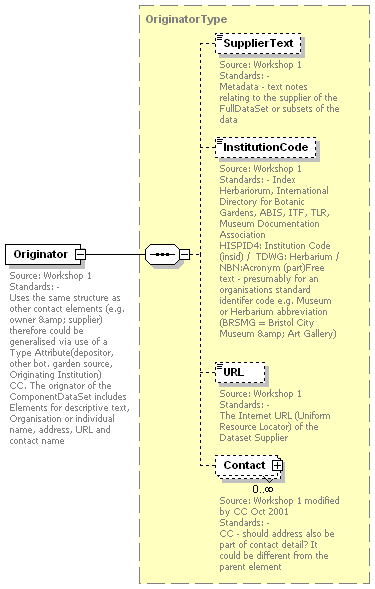 |
||
| type | OriginatorType | ||
| children | SupplierText InstitutionCode URL Contact | ||
| annotation |
|
||
| source | <xs:element name="Originator" type="OriginatorType" minOccurs="0"> <xs:annotation> <xs:documentation>Source: Workshop 1 Standards: - Uses the same structure as other contact elements (e.g. owner & supplier) therefore could be generalised via use of a Type Attribute(depositor, other bot. garden source, Originating Institution) CC. The orignator of the ComponentDataSet includes Elements for descriptive text, Organisation or individual name, address, URL and contact name </xs:documentation> </xs:annotation> </xs:element> |
| diagram | 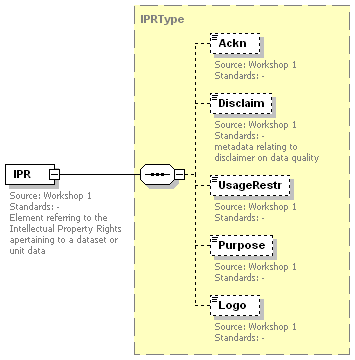 |
||
| type | IPRType | ||
| children | Ackn Disclaim UsageRestr Purpose Logo | ||
| annotation |
|
||
| source | <xs:element name="IPR" type="IPRType" minOccurs="0"> <xs:annotation> <xs:documentation>Source: Workshop 1 Standards: - Element referring to the Intellectual Property Rights apertaining to a dataset or unit data</xs:documentation> </xs:annotation> </xs:element> |
| diagram |  |
||
| type | xs:string | ||
| annotation |
|
||
| source | <xs:element name="Surrogate" type="xs:string" minOccurs="0"> <xs:annotation> <xs:documentation>Source: Workshop 1 Standards: - </xs:documentation> </xs:annotation> </xs:element> |
| diagram | 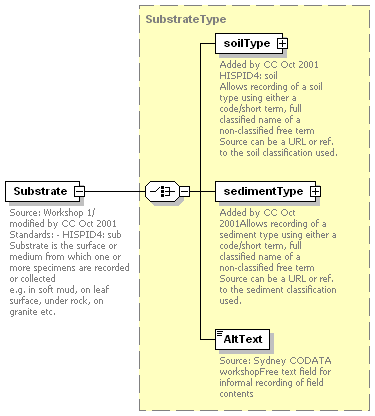 |
||
| type | SubstrateType | ||
| children | soilType sedimentType AltText | ||
| annotation |
|
||
| source | <xs:element name="Substrate" type="SubstrateType" minOccurs="0"> <xs:annotation> <xs:documentation>Source: Workshop 1/ modified by CC Oct 2001 Standards: - HISPID4: sub Substrate is the surface or medium from which one or more specimens are recorded or collected e.g. in soft mud, on leaf surface, under rock, on granite etc.</xs:documentation> </xs:annotation> </xs:element> |
| diagram |  |
||
| type | xs:string | ||
| annotation |
|
||
| source | <xs:element name="Host" type="xs:string" minOccurs="0"> <xs:annotation> <xs:documentation>Source: Workshop 1 Standards: -</xs:documentation> </xs:annotation> </xs:element> |
| diagram | 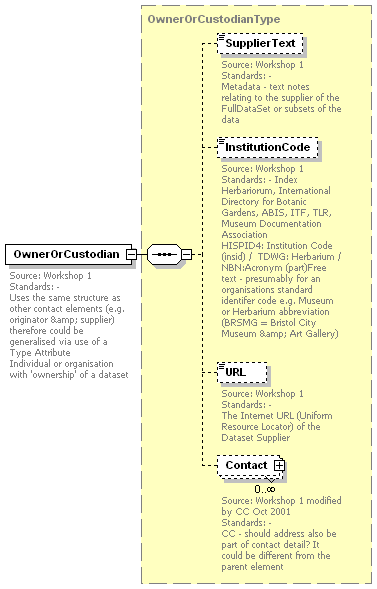 |
||
| type | OwnerOrCustodianType | ||
| children | SupplierText InstitutionCode URL Contact | ||
| annotation |
|
||
| source | <xs:element name="OwnerOrCustodian" type="OwnerOrCustodianType" minOccurs="0"> <xs:annotation> <xs:documentation>Source: Workshop 1 Standards: - Uses the same structure as other contact elements (e.g. originator & supplier) therefore could be generalised via use of a Type Attribute Individual or organisation with 'ownership' of a dataset</xs:documentation> </xs:annotation> </xs:element> |
| diagram |  |
||||||||||||||||||
| children | Unit_ID accession_number specimenType NatureOrPreservationMode specimenUnit_part accession_catalogue_ID namedCollection collection_ID specimenUnitNumber specimenUnit_description Identification specimenUnitStatus specimenUnitData UnitDataSetRelations specimenUnit_label inscription specimenUnitHistory specimenUnit_Fact specimenUnitImage Source | ||||||||||||||||||
| attributes |
|
||||||||||||||||||
| annotation |
|
||||||||||||||||||
| source | <xs:element name="specimenUnit" minOccurs="0" maxOccurs="unbounded"> <xs:annotation> <xs:documentation>Added by CC Oct. 2001The specimen unit is a derived subtype of Unit representing physical specimens in collections The specimen can link to field obsevations and to named collections</xs:documentation> </xs:annotation> <xs:complexType> <xs:sequence> <xs:element name="Unit_ID" type="Unit_ID" maxOccurs="unbounded"> <xs:annotation> <xs:documentation>Source: Workshop 1 Standards: - Taxon48: Unit_ID / NBN: Sample_KeyUnit key or Identifying number - can be multiple</xs:documentation> </xs:annotation> </xs:element> <xs:element name="accession_number" minOccurs="0"> <xs:annotation> <xs:documentation>Added by CC Oct. 2001 - - Taxon48 AccCode_Pk LMNH The instutional number applied to an accession and recorded in the accessions register e.g. BRSMG:1999/1209. A structured view into acquisition information from accessions register as opposed to original gathering data. - helps link collections (e.g. several specimens may share one accession number).</xs:documentation> </xs:annotation> <xs:complexType> <xs:sequence> <xs:element name="accession_date"> <xs:annotation> <xs:documentation>Added by CC Oct 2001 - - Taxon48: AccDate The date on which an accession was recorded in the accessions register ( not the date of acquisition)</xs:documentation> </xs:annotation> <xs:complexType> <xs:sequence> <xs:element name="Date" type="DateType"/> </xs:sequence> </xs:complexType> </xs:element> <xs:element name="acquisition_date"> <xs:annotation> <xs:documentation>Added by CC Oct. 2001The date when specimens or collections were acquired by the institution</xs:documentation> </xs:annotation> <xs:complexType> <xs:sequence> <xs:element name="Date" type="DateType"/> </xs:sequence> </xs:complexType> </xs:element> <xs:choice> <xs:element name="AltText" type="AltText"> <xs:annotation> <xs:documentation>Source: Sydney CODATA workshopFree text field for informal recording of field contents</xs:documentation> </xs:annotation> </xs:element> <xs:element name="PersonName" type="PersonNameType"> <xs:annotation> <xs:documentation>Source: Workshop 1/ changed by CC from old Name Element Standards: - Group element for parts of a personal name - see also name_ID (ref to a database entry) and fullName (free text format)</xs:documentation> </xs:annotation> </xs:element> <xs:element name="organisationName" type="organisationName"> <xs:annotation> <xs:documentation>Added by CC Oct 2001Full organisation name e.g. Taxonomic Database Working Group</xs:documentation> </xs:annotation> </xs:element> </xs:choice> <xs:element name="Comment" type="Comment" minOccurs="0"> <xs:annotation> <xs:documentation>Added by CC Oct 2001Free text of formatted text (rtf) description of the feature - not controlled length e.g. often a memo field</xs:documentation> </xs:annotation> </xs:element> <xs:element name="Source" type="SourceType" minOccurs="0"> <xs:annotation> <xs:documentation>Added CC Oct 2001 NBN: Source Marker element for a link to a source module for dealing with structured literature and document rexcords </xs:documentation> </xs:annotation> </xs:element> </xs:sequence> <xs:attribute name="Acquisitiontype" type="xs:string"/> </xs:complexType> </xs:element> <xs:element name="specimenType"> <xs:complexType> <xs:choice> <xs:sequence> <xs:element name="ShortTermName" type="ShortTermName"> <xs:annotation> <xs:documentation>Source: CC - Oct 2001 Standards: ShortTernName is a code or shortened version of a term that might be used in a database or lookup table e.g. HOLO for Holotype </xs:documentation> </xs:annotation> </xs:element> <xs:element name="LongTermName" type="LongTermName" minOccurs="0"> <xs:annotation> <xs:documentation>Source: CC - Oct 2001 Standards: LongTermname is the full term that might appear in a lookup table e.g. in a list of types: Holotype</xs:documentation> </xs:annotation> </xs:element> <xs:element name="Description" type="Description" minOccurs="0"> <xs:annotation> <xs:documentation>Source: Workshop 1 Standards: - Used wherever a description field is needed. Free text and could be in rtf or html.</xs:documentation> </xs:annotation> </xs:element> </xs:sequence> <xs:element name="AltText" type="AltText"> <xs:annotation> <xs:documentation>Source: Sydney CODATA workshopFree text field for informal recording of field contents</xs:documentation> </xs:annotation> </xs:element> </xs:choice> <xs:attribute name="specimenTypeID" type="xs:string"/> </xs:complexType> </xs:element> <xs:element name="NatureOrPreservationMode"> <xs:annotation> <xs:documentation>Source: Workshop 1/ changed by CC Oct 2001Unit "nature" or preservation mode: virtual vs. object; preservation mode; part; creation process</xs:documentation> </xs:annotation> <xs:complexType> <xs:choice> <xs:element name="LookupTerm" type="LookupTermType"> <xs:annotation> <xs:documentation>Added by CC Oct 2001 NBN: Term Typical structure for a simple lookup list of term contents - structure consists of an attribute for the type e.g. name of the look up list together with long and short versions of the term</xs:documentation> </xs:annotation> </xs:element> <xs:element name="AltText" type="AltText"> <xs:annotation> <xs:documentation>Source: Sydney CODATA workshopFree text field for informal recording of field contents</xs:documentation> </xs:annotation> </xs:element> </xs:choice> <xs:attribute name="PreservationMode_ID" type="xs:string"/> </xs:complexType> </xs:element> <xs:element name="specimenUnit_part" type="xs:string" minOccurs="0"> <xs:annotation> <xs:documentation>Added by CC Oct 2001 LNHM specimen part: Part of the specimen rcord applies</xs:documentation> </xs:annotation> </xs:element> <xs:element name="accession_catalogue_ID" type="accession_catalogue_ID" minOccurs="0"> <xs:annotation> <xs:documentation>Added by CC Oct 2001Unique identifier for an accessions catalogue id in a computerised system</xs:documentation> </xs:annotation> </xs:element> <xs:choice minOccurs="0"> <xs:element name="namedCollection" type="namedCollectionType"> <xs:annotation> <xs:documentation> Source: Workshop 1/ subelements added by CC Oct. 2001A named Collection is an association of specimens (units) that have a common identity either through content, ownership or acquisition. This element is a special kind of Unit subType and is separated here for the purposes of clarity The element facilitates the recording of the history, ownership and content of named collections and also because named collections may be stored, moved. acquired or disposed of as a whole. </xs:documentation> </xs:annotation> </xs:element> <xs:element name="collection_ID" type="collection_ID"> <xs:annotation> <xs:documentation>Added by CC Oct. 2001 Syn: Unit_ID Unique identifier for collection in a computerised system this is a synonym of Unit_ID </xs:documentation> </xs:annotation> </xs:element> </xs:choice> <xs:element name="specimenUnitNumber" minOccurs="0" maxOccurs="unbounded"> <xs:annotation> <xs:documentation>Added by CC Oct. 2001Any numbers or other registration marks associated with a specimen unit (1 or more specimens)</xs:documentation> </xs:annotation> <xs:complexType> <xs:sequence> <xs:element name="specimenUnit_number_ID" type="xs:string" minOccurs="0"> <xs:annotation> <xs:documentation>Added by CC Oct 2001 LNHM</xs:documentation> </xs:annotation> </xs:element> <xs:element name="DistinguishingNumber" type="xs:string"> <xs:annotation> <xs:documentation>Added by CC Oct. 2001Text for number or other registration mark applied to a specimen or group of specimens e.g from registration book, collectors note book, auction catalogue, batch number etc.</xs:documentation> </xs:annotation> </xs:element> <xs:element name="Source" type="SourceType"> <xs:annotation> <xs:documentation>Added CC Oct 2001 NBN: Source Marker element for a link to a source module for dealing with structured literature and document rexcords</xs:documentation> </xs:annotation> </xs:element> </xs:sequence> <xs:attribute name="PreferredFlag"> <xs:simpleType> <xs:restriction base="xs:NMTOKEN"> <xs:enumeration value="Yes"/> <xs:enumeration value="No"/> </xs:restriction> </xs:simpleType> </xs:attribute> </xs:complexType> </xs:element> <xs:element name="specimenUnit_description" type="xs:string"> <xs:annotation> <xs:documentation>Added by CC Oct 2001 LNHM Free text description of a specimen or similar 'Unit'</xs:documentation> </xs:annotation> </xs:element> <xs:sequence minOccurs="0" maxOccurs="unbounded"> <xs:element name="Identification" type="IdentificationType"> <xs:annotation> <xs:documentation>Source: Workshop 1 Standards: - </xs:documentation> </xs:annotation> </xs:element> <xs:element name="specimenUnitStatus" minOccurs="0"> <xs:annotation> <xs:documentation>Taxonomic status linked to an identification of a specimen</xs:documentation> </xs:annotation> <xs:complexType> <xs:sequence> <xs:element name="Unit_status_ID" type="Unit_status_ID" minOccurs="0"/> <xs:element name="Unit_ID" type="Unit_ID" minOccurs="0" maxOccurs="unbounded"> <xs:annotation> <xs:documentation>Source: Workshop 1 Standards: - Taxon48: Unit_ID / NBN: Sample_KeyUnit key or Identifying number - can be multiple</xs:documentation> </xs:annotation> </xs:element> <xs:element name="Type"> <xs:annotation> <xs:documentation>Source: Workshop 1 / mod CC Oct 2001 Standards: - - - made qualifier an attribute of status - introduced qualifier to indicate preference or sort order of basionyms Composite element that links type status, a qualifying statement, original name and pertinent published references Making Type a repeatable element with a qualifier for sort order e.g. most recent, second most recent etc. covers multiple elements in HISPID (e.g. basnam1, basnam2, basnam3) </xs:documentation> </xs:annotation> <xs:complexType> <xs:sequence> <xs:element name="TypeStatus"> <xs:annotation> <xs:documentation>Source: Workshop 1/ modified CC Oct 2001 Standards: - - - includes HISPID4: tsta and tql The presumed nomenclatural status of specimens regarded as types - Note that Type Qualifier has been moved to an enumerated attribute of TypeStatus</xs:documentation> </xs:annotation> <xs:complexType> <xs:choice> <xs:sequence> <xs:element name="AltText" type="AltText"> <xs:annotation> <xs:documentation>Source: Sydney CODATA workshopFree text field for informal recording of field contents</xs:documentation> </xs:annotation> </xs:element> <xs:element name="Source" type="SourceType"> <xs:annotation> <xs:documentation>Added CC Oct 2001 NBN: Source Marker element for a link to a source module for dealing with structured literature and document rexcords </xs:documentation> </xs:annotation> </xs:element> </xs:sequence> <xs:element name="LookupTerm" type="LookupTermType"> <xs:annotation> <xs:documentation>Added by CC Oct 2001 NBN: Term Typical structure for a simple lookup list of term contents - structure consists of an attribute for the type e.g. name of the look up list together with long and short versions of the term</xs:documentation> </xs:annotation> </xs:element> </xs:choice> <xs:attribute name="TypeQualifier" use="required"> <xs:simpleType> <xs:restriction base="xs:NMTOKEN"> <xs:enumeration value="Confirmed"/> <xs:enumeration value="Probably"/> <xs:enumeration value="Possibly"/> <xs:enumeration value="Not"/> </xs:restriction> </xs:simpleType> </xs:attribute> </xs:complexType> </xs:element> <xs:element name="Basionym" minOccurs="0"> <xs:annotation> <xs:documentation>Source: Workshop 1 Standards: - HISPID4: basnam / TLR Baionym refers to the original name associated with a type specimen where the name has subsequently been revised especially where this has arisen from a change of rank the option here is to use plain name text or a fully atomised model for name parts.</xs:documentation> </xs:annotation> <xs:complexType> <xs:sequence> <xs:choice> <xs:element name="AltText" type="AltText"> <xs:annotation> <xs:documentation>Source: Sydney CODATA workshopFree text field for informal recording of field contents</xs:documentation> </xs:annotation> </xs:element> <xs:element name="BotanicalName" type="BotanicalNameType"/> <xs:element name="BacteriologicalName" type="BacteriologicalNameType"/> <xs:element name="ZoologicalName" type="ZoologicalNameType"/> </xs:choice> <xs:element name="Source" type="SourceType" minOccurs="0"> <xs:annotation> <xs:documentation>Added CC Oct 2001 NBN: Source Marker element for a link to a source module for dealing with structured literature and document rexcords</xs:documentation> </xs:annotation> </xs:element> </xs:sequence> </xs:complexType> </xs:element> <xs:element name="Source" type="SourceType" minOccurs="0" maxOccurs="unbounded"> <xs:annotation> <xs:documentation>Added CC Oct 2001 NBN: Source Marker element for a link to a source module for dealing with structured literature and document rexcords</xs:documentation> </xs:annotation> </xs:element> </xs:sequence> <xs:attribute name="BasionymOrder"> <xs:simpleType> <xs:restriction base="xs:NMTOKEN"> <xs:enumeration value="1"/> <xs:enumeration value="2"/> <xs:enumeration value="3"/> </xs:restriction> </xs:simpleType> </xs:attribute> </xs:complexType> </xs:element> <xs:element name="specimenUnitStatus_src"> <xs:complexType> <xs:sequence> <xs:element name="Unit_status_ID" type="Unit_status_ID" minOccurs="0"/> <xs:element name="Source" type="SourceType"> <xs:annotation> <xs:documentation>Added CC Oct 2001 NBN: Source Marker element for a link to a source module for dealing with structured literature and document rexcords </xs:documentation> </xs:annotation> </xs:element> </xs:sequence> <xs:attribute name="entered_by" type="xs:string" use="required"/> <xs:attribute name="entry_date" type="xs:string" use="required"/> <xs:attribute name="specimen_status_source_key" type="xs:string"/> </xs:complexType> </xs:element> </xs:sequence> <xs:attribute name="entered_by" type="xs:string" use="required"/> <xs:attribute name="entry_date" type="xs:string" use="required"/> </xs:complexType> </xs:element> </xs:sequence> <xs:element name="specimenUnitData" minOccurs="0" maxOccurs="unbounded"> <xs:annotation> <xs:documentation>Any measurable aspect of the specimen e.g. height, weight, number of specimens etc.</xs:documentation> </xs:annotation> <xs:complexType> <xs:sequence> <xs:element name="measurement" type="measurementType"> <xs:annotation> <xs:documentation>Added by CC Oct 2001 NBN: measurement (partim) measurement is the actiual measurement - measurement is qualigied by attributes: measurementType: what type of measurement e.g. count, area, linear measurement measurementUnits: units that measurement is recorded in e...g. hectares, kilometres, kilogrammes etc. measurementAccuracy: describes accuracy e.g. approximate or +/- 50</xs:documentation> </xs:annotation> </xs:element> </xs:sequence> <xs:attribute name="SpecimenUnitData_ID" type="xs:string"/> </xs:complexType> </xs:element> <xs:element name="UnitDataSetRelations" type="UnitDataSetRelationsType" minOccurs="0" maxOccurs="unbounded"> <xs:annotation> <xs:documentation>Added by CC Oct 2001 specimen relationships - can be used to link derived specimens, specimen parts or members of a specimen group</xs:documentation> </xs:annotation> </xs:element> <xs:element name="specimenUnit_label" minOccurs="0" maxOccurs="unbounded"> <xs:annotation> <xs:documentation>Added by CC Oct 2001 LNHM Specimens, cabinets and other units e.g. living horticultural specimens may have one or more labels attached or associated with them</xs:documentation> </xs:annotation> <xs:complexType> <xs:sequence> <xs:element name="specimenUnit_label_ID" type="xs:string" minOccurs="0"> <xs:annotation> <xs:documentation>Added by CC Oct 2001 LNHM Unique identifier within a database</xs:documentation> </xs:annotation> </xs:element> <xs:element name="Unit_ID" type="Unit_ID" minOccurs="0"> <xs:annotation> <xs:documentation>Source: Workshop 1 Standards: - Taxon48: Unit_ID / NBN: Sample_KeyUnit key or Identifying number - can be multiple</xs:documentation> </xs:annotation> </xs:element> <xs:element name="position_on_object" type="xs:string"/> <xs:element name="label_summary" type="xs:string"/> <xs:element name="Source" type="SourceType" minOccurs="0" maxOccurs="unbounded"> <xs:annotation> <xs:documentation>Added CC Oct 2001 NBN: Source Marker element for a link to a source module for dealing with structured literature and document rexcords</xs:documentation> </xs:annotation> </xs:element> </xs:sequence> <xs:attribute name="entered_by" type="xs:string" use="required"/> <xs:attribute name="entry_date" type="xs:string" use="required"/> </xs:complexType> </xs:element> <xs:element name="inscription" minOccurs="0" maxOccurs="unbounded"> <xs:annotation> <xs:documentation>Added by CC Oct 2001 LNHM writing or other inscription directly upon or carved into a unit (usually a specimen)</xs:documentation> </xs:annotation> <xs:complexType> <xs:sequence> <xs:element name="inscription_ID" minOccurs="0"> <xs:annotation> <xs:documentation>Added by CC Oct 2001Unique identifier within a database</xs:documentation> </xs:annotation> <xs:complexType> <xs:simpleContent> <xs:extension base="xs:string"> <xs:attribute name="type" use="required"> <xs:simpleType> <xs:restriction base="xs:NMTOKEN"> <xs:enumeration value="nbn"/> <xs:enumeration value="local"/> </xs:restriction> </xs:simpleType> </xs:attribute> </xs:extension> </xs:simpleContent> </xs:complexType> </xs:element> <xs:element name="Unit_ID" type="Unit_ID" minOccurs="0"> <xs:annotation> <xs:documentation>Source: Workshop 1 Standards: - Taxon48: Unit_ID / NBN: Sample_KeyUnit key or Identifying number - can be multiple</xs:documentation> </xs:annotation> </xs:element> <xs:element name="inscription_type" type="xs:string"> <xs:annotation> <xs:documentation>Added by CC Oct 2001 LNHM Type of inscription</xs:documentation> </xs:annotation> </xs:element> <xs:element name="inscriptionText" type="xs:string"> <xs:annotation> <xs:documentation>Added by CC Oct 2001Text transcription of an inscription</xs:documentation> </xs:annotation> </xs:element> </xs:sequence> <xs:attribute name="entered_by" type="xs:string" use="required"/> <xs:attribute name="entry_date" type="xs:string" use="required"/> </xs:complexType> </xs:element> <xs:element name="specimenUnitHistory" minOccurs="0" maxOccurs="unbounded"> <xs:annotation> <xs:documentation>Added by CC Oct 2001Allows recording of history of specimen e.g. changes of ownership and transfers between collections by sale, splitting or merging of collections</xs:documentation> </xs:annotation> <xs:complexType> <xs:sequence> <xs:element name="Unit_ID" type="Unit_ID" maxOccurs="unbounded"> <xs:annotation> <xs:documentation>Source: Workshop 1 Standards: - Taxon48: Unit_ID / NBN: Sample_KeyUnit key or Identifying number - can be multiple</xs:documentation> </xs:annotation> </xs:element> <xs:element name="previous_collection_name" type="xs:string"/> <xs:element name="Date" type="DateType" minOccurs="0" maxOccurs="unbounded"> <xs:annotation> <xs:documentation>Added CC Oct 2001 NBN: vaguedatestart, vaguedateend and vaguedatetype Date has a three part structure - two elements and an attribute VagueDateBegin = First date of a range or date for a single date VagueDateEnd = last date in a range DateType attribute can be enumerated to allow for various date formats (e.g. dd/mm/yyyy or to allow a parser to interpret terms such as summer 69 or 1974 etc) Note terms such as summer would be interpretted by standard begin and end dates.</xs:documentation> </xs:annotation> </xs:element> <xs:element name="Comment" type="Comment" minOccurs="0"> <xs:annotation> <xs:documentation>Added by CC Oct 2001Free text of formatted text (rtf) description of the feature - not controlled length e.g. often a memo field</xs:documentation> </xs:annotation> </xs:element> </xs:sequence> <xs:attribute name="entered_by" type="xs:string" use="required"/> <xs:attribute name="entry_date" type="xs:string" use="required"/> </xs:complexType> </xs:element> <xs:element name="specimenUnit_Fact" minOccurs="0" maxOccurs="unbounded"> <xs:annotation> <xs:documentation>Added by CC Oct 2001 LNHM any number of free text facts can be recorded about the specimen or unit. The structure allows for a title so that the facts could be assembled in an rtf or html page layout Facts can be of any sort e.g. comments on the historical importance of the specimen.</xs:documentation> </xs:annotation> <xs:complexType> <xs:sequence> <xs:element name="specimenUnit_fact_ID" type="xs:string"> <xs:annotation> <xs:documentation>Added by CC Oct 2001 LNHM Unique identifier within a database</xs:documentation> </xs:annotation> </xs:element> <xs:element name="title" type="title"/> <xs:element name="Comment" type="Comment"> <xs:annotation> <xs:documentation>Added by CC Oct 2001Free text of formatted text (rtf) description of the feature - not controlled length e.g. often a memo field</xs:documentation> </xs:annotation> </xs:element> <xs:element name="Date" type="DateType"> <xs:annotation> <xs:documentation>Added CC Oct 2001 NBN: vaguedatestart, vaguedateend and vaguedatetype Date has a three part structure - two elements and an attribute VagueDateBegin = First date of a range or date for a single date VagueDateEnd = last date in a range DateType attribute can be enumerated to allow for various date formats (e.g. dd/mm/yyyy or to allow a parser to interpret terms such as summer 69 or 1974 etc) Note terms such as summer would be interpretted by standard begin and end dates.</xs:documentation> </xs:annotation> </xs:element> <xs:element name="Source" type="SourceType"> <xs:annotation> <xs:documentation>Added CC Oct 2001 NBN: Source Marker element for a link to a source module for dealing with structured literature and document rexcords</xs:documentation> </xs:annotation> </xs:element> </xs:sequence> <xs:attribute name="entered_by" type="xs:string" use="required"/> <xs:attribute name="entry_date" type="xs:string" use="required"/> <xs:attribute name="changed_by" type="xs:string"/> <xs:attribute name="changed_date" type="xs:string"/> <xs:attribute name="system_supplied_data" default="No"> <xs:simpleType> <xs:restriction base="xs:NMTOKEN"> <xs:enumeration value="Yes"/> <xs:enumeration value="No"/> </xs:restriction> </xs:simpleType> </xs:attribute> <xs:attribute name="fact_type" type="xs:string"/> </xs:complexType> </xs:element> <xs:element name="specimenUnitImage" minOccurs="0" maxOccurs="unbounded"> <xs:complexType> <xs:sequence> <xs:element name="imageContext" type="xs:string"> <xs:annotation> <xs:documentation>Added by CC Oct. 2001The context of the image in relation to the specimen or other types of derived unit - could be many e.g. original valid publication image, front view of lectotype etc.</xs:documentation> </xs:annotation> </xs:element> <xs:element name="Image" type="ImageType"> <xs:annotation> <xs:documentation>added by CC Oct 2001 NBN: Image Compound element that can include any type of image including paintings, photographs, digital photographs and video</xs:documentation> </xs:annotation> </xs:element> </xs:sequence> </xs:complexType> </xs:element> <xs:element name="Source" type="SourceType" minOccurs="0" maxOccurs="unbounded"> <xs:annotation> <xs:documentation>Added CC Oct 2001 NBN: Source Marker element for a link to a source module for dealing with structured literature and document rexcords </xs:documentation> </xs:annotation> </xs:element> </xs:sequence> <xs:attribute name="entered_by" type="xs:string" use="required"/> <xs:attribute name="entry_date" type="xs:string" use="required"/> </xs:complexType> </xs:element> |
| diagram | 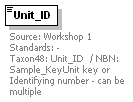 |
||
| type | Unit_ID | ||
| annotation |
|
||
| source | <xs:element name="Unit_ID" type="Unit_ID" maxOccurs="unbounded"> <xs:annotation> <xs:documentation>Source: Workshop 1 Standards: - Taxon48: Unit_ID / NBN: Sample_KeyUnit key or Identifying number - can be multiple</xs:documentation> </xs:annotation> </xs:element> |
| diagram | 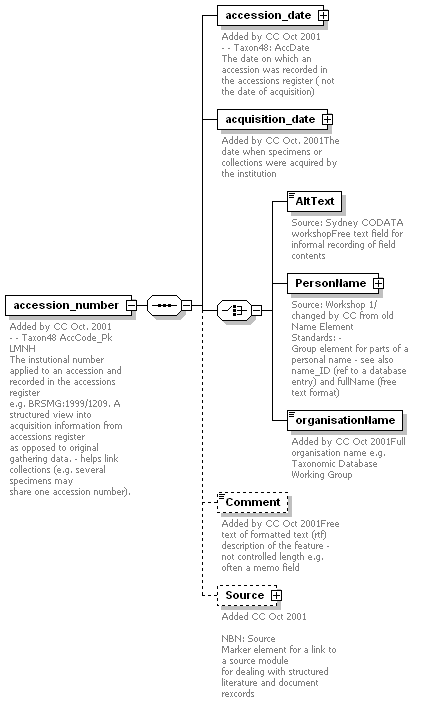 |
||||||||||||
| children | accession_date acquisition_date AltText PersonName organisationName Comment Source | ||||||||||||
| attributes |
|
||||||||||||
| annotation |
|
||||||||||||
| source | <xs:element name="accession_number" minOccurs="0"> <xs:annotation> <xs:documentation>Added by CC Oct. 2001 - - Taxon48 AccCode_Pk LMNH The instutional number applied to an accession and recorded in the accessions register e.g. BRSMG:1999/1209. A structured view into acquisition information from accessions register as opposed to original gathering data. - helps link collections (e.g. several specimens may share one accession number).</xs:documentation> </xs:annotation> <xs:complexType> <xs:sequence> <xs:element name="accession_date"> <xs:annotation> <xs:documentation>Added by CC Oct 2001 - - Taxon48: AccDate The date on which an accession was recorded in the accessions register ( not the date of acquisition)</xs:documentation> </xs:annotation> <xs:complexType> <xs:sequence> <xs:element name="Date" type="DateType"/> </xs:sequence> </xs:complexType> </xs:element> <xs:element name="acquisition_date"> <xs:annotation> <xs:documentation>Added by CC Oct. 2001The date when specimens or collections were acquired by the institution</xs:documentation> </xs:annotation> <xs:complexType> <xs:sequence> <xs:element name="Date" type="DateType"/> </xs:sequence> </xs:complexType> </xs:element> <xs:choice> <xs:element name="AltText" type="AltText"> <xs:annotation> <xs:documentation>Source: Sydney CODATA workshopFree text field for informal recording of field contents</xs:documentation> </xs:annotation> </xs:element> <xs:element name="PersonName" type="PersonNameType"> <xs:annotation> <xs:documentation>Source: Workshop 1/ changed by CC from old Name Element Standards: - Group element for parts of a personal name - see also name_ID (ref to a database entry) and fullName (free text format)</xs:documentation> </xs:annotation> </xs:element> <xs:element name="organisationName" type="organisationName"> <xs:annotation> <xs:documentation>Added by CC Oct 2001Full organisation name e.g. Taxonomic Database Working Group</xs:documentation> </xs:annotation> </xs:element> </xs:choice> <xs:element name="Comment" type="Comment" minOccurs="0"> <xs:annotation> <xs:documentation>Added by CC Oct 2001Free text of formatted text (rtf) description of the feature - not controlled length e.g. often a memo field</xs:documentation> </xs:annotation> </xs:element> <xs:element name="Source" type="SourceType" minOccurs="0"> <xs:annotation> <xs:documentation>Added CC Oct 2001 NBN: Source Marker element for a link to a source module for dealing with structured literature and document rexcords </xs:documentation> </xs:annotation> </xs:element> </xs:sequence> <xs:attribute name="Acquisitiontype" type="xs:string"/> </xs:complexType> </xs:element> |
| diagram | 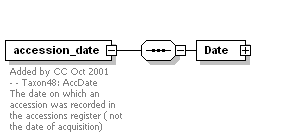 |
||
| children | Date | ||
| annotation |
|
||
| source | <xs:element name="accession_date"> <xs:annotation> <xs:documentation>Added by CC Oct 2001 - - Taxon48: AccDate The date on which an accession was recorded in the accessions register ( not the date of acquisition)</xs:documentation> </xs:annotation> <xs:complexType> <xs:sequence> <xs:element name="Date" type="DateType"/> </xs:sequence> </xs:complexType> </xs:element> |
| diagram | 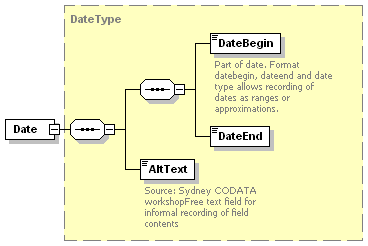 |
||||||||||||
| type | DateType | ||||||||||||
| children | DateBegin DateEnd AltText | ||||||||||||
| attributes |
|
||||||||||||
| source | <xs:element name="Date" type="DateType"/> |
| diagram | 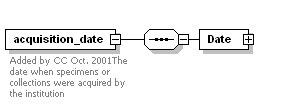 |
||
| children | Date | ||
| annotation |
|
||
| source | <xs:element name="acquisition_date"> <xs:annotation> <xs:documentation>Added by CC Oct. 2001The date when specimens or collections were acquired by the institution</xs:documentation> </xs:annotation> <xs:complexType> <xs:sequence> <xs:element name="Date" type="DateType"/> </xs:sequence> </xs:complexType> </xs:element> |
| diagram | 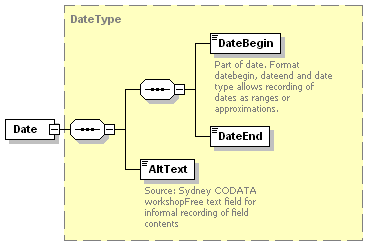 |
||||||||||||
| type | DateType | ||||||||||||
| children | DateBegin DateEnd AltText | ||||||||||||
| attributes |
|
||||||||||||
| source | <xs:element name="Date" type="DateType"/> |
| diagram |  |
||
| type | AltText | ||
| annotation |
|
||
| source | <xs:element name="AltText" type="AltText"> <xs:annotation> <xs:documentation>Source: Sydney CODATA workshopFree text field for informal recording of field contents</xs:documentation> </xs:annotation> </xs:element> |
| diagram | 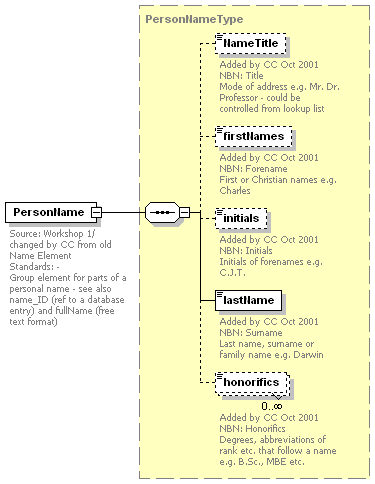 |
||
| type | PersonNameType | ||
| children | NameTitle firstNames initials lastName honorifics | ||
| annotation |
|
||
| source | <xs:element name="PersonName" type="PersonNameType"> <xs:annotation> <xs:documentation>Source: Workshop 1/ changed by CC from old Name Element Standards: - Group element for parts of a personal name - see also name_ID (ref to a database entry) and fullName (free text format)</xs:documentation> </xs:annotation> </xs:element> |
| diagram |  |
||
| type | organisationName | ||
| annotation |
|
||
| source | <xs:element name="organisationName" type="organisationName"> <xs:annotation> <xs:documentation>Added by CC Oct 2001Full organisation name e.g. Taxonomic Database Working Group</xs:documentation> </xs:annotation> </xs:element> |
| diagram |  |
||
| type | Comment | ||
| annotation |
|
||
| source | <xs:element name="Comment" type="Comment" minOccurs="0"> <xs:annotation> <xs:documentation>Added by CC Oct 2001Free text of formatted text (rtf) description of the feature - not controlled length e.g. often a memo field</xs:documentation> </xs:annotation> </xs:element> |
| diagram | 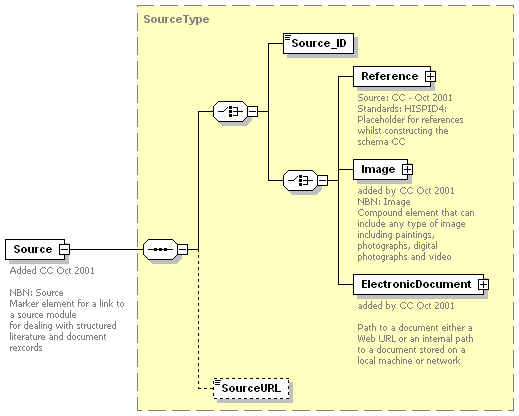 |
||||||||||||
| type | SourceType | ||||||||||||
| children | Source_ID Reference Image ElectronicDocument SourceURL | ||||||||||||
| attributes |
|
||||||||||||
| annotation |
|
||||||||||||
| source | <xs:element name="Source" type="SourceType" minOccurs="0"> <xs:annotation> <xs:documentation>Added CC Oct 2001 NBN: Source Marker element for a link to a source module for dealing with structured literature and document rexcords </xs:documentation> </xs:annotation> </xs:element> |
| diagram | 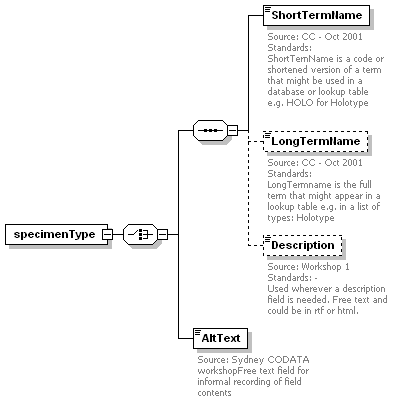 |
||||||||||||
| children | ShortTermName LongTermName Description AltText | ||||||||||||
| attributes |
|
||||||||||||
| source | <xs:element name="specimenType"> <xs:complexType> <xs:choice> <xs:sequence> <xs:element name="ShortTermName" type="ShortTermName"> <xs:annotation> <xs:documentation>Source: CC - Oct 2001 Standards: ShortTernName is a code or shortened version of a term that might be used in a database or lookup table e.g. HOLO for Holotype </xs:documentation> </xs:annotation> </xs:element> <xs:element name="LongTermName" type="LongTermName" minOccurs="0"> <xs:annotation> <xs:documentation>Source: CC - Oct 2001 Standards: LongTermname is the full term that might appear in a lookup table e.g. in a list of types: Holotype</xs:documentation> </xs:annotation> </xs:element> <xs:element name="Description" type="Description" minOccurs="0"> <xs:annotation> <xs:documentation>Source: Workshop 1 Standards: - Used wherever a description field is needed. Free text and could be in rtf or html.</xs:documentation> </xs:annotation> </xs:element> </xs:sequence> <xs:element name="AltText" type="AltText"> <xs:annotation> <xs:documentation>Source: Sydney CODATA workshopFree text field for informal recording of field contents</xs:documentation> </xs:annotation> </xs:element> </xs:choice> <xs:attribute name="specimenTypeID" type="xs:string"/> </xs:complexType> </xs:element> |
| diagram | 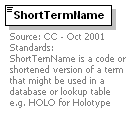 |
||
| type | ShortTermName | ||
| annotation |
|
||
| source | <xs:element name="ShortTermName" type="ShortTermName"> <xs:annotation> <xs:documentation>Source: CC - Oct 2001 Standards: ShortTernName is a code or shortened version of a term that might be used in a database or lookup table e.g. HOLO for Holotype </xs:documentation> </xs:annotation> </xs:element> |
| diagram | 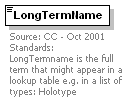 |
||
| type | LongTermName | ||
| annotation |
|
||
| source | <xs:element name="LongTermName" type="LongTermName" minOccurs="0"> <xs:annotation> <xs:documentation>Source: CC - Oct 2001 Standards: LongTermname is the full term that might appear in a lookup table e.g. in a list of types: Holotype</xs:documentation> </xs:annotation> </xs:element> |
| diagram |  |
||
| type | Description | ||
| annotation |
|
||
| source | <xs:element name="Description" type="Description" minOccurs="0"> <xs:annotation> <xs:documentation>Source: Workshop 1 Standards: - Used wherever a description field is needed. Free text and could be in rtf or html.</xs:documentation> </xs:annotation> </xs:element> |
| diagram |  |
||
| type | AltText | ||
| annotation |
|
||
| source | <xs:element name="AltText" type="AltText"> <xs:annotation> <xs:documentation>Source: Sydney CODATA workshopFree text field for informal recording of field contents</xs:documentation> </xs:annotation> </xs:element> |
| diagram | 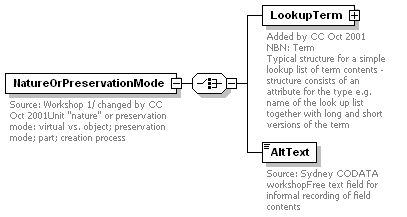 |
||||||||||||
| children | LookupTerm AltText | ||||||||||||
| attributes |
|
||||||||||||
| annotation |
|
||||||||||||
| source | <xs:element name="NatureOrPreservationMode"> <xs:annotation> <xs:documentation>Source: Workshop 1/ changed by CC Oct 2001Unit "nature" or preservation mode: virtual vs. object; preservation mode; part; creation process</xs:documentation> </xs:annotation> <xs:complexType> <xs:choice> <xs:element name="LookupTerm" type="LookupTermType"> <xs:annotation> <xs:documentation>Added by CC Oct 2001 NBN: Term Typical structure for a simple lookup list of term contents - structure consists of an attribute for the type e.g. name of the look up list together with long and short versions of the term</xs:documentation> </xs:annotation> </xs:element> <xs:element name="AltText" type="AltText"> <xs:annotation> <xs:documentation>Source: Sydney CODATA workshopFree text field for informal recording of field contents</xs:documentation> </xs:annotation> </xs:element> </xs:choice> <xs:attribute name="PreservationMode_ID" type="xs:string"/> </xs:complexType> </xs:element> |
| diagram | 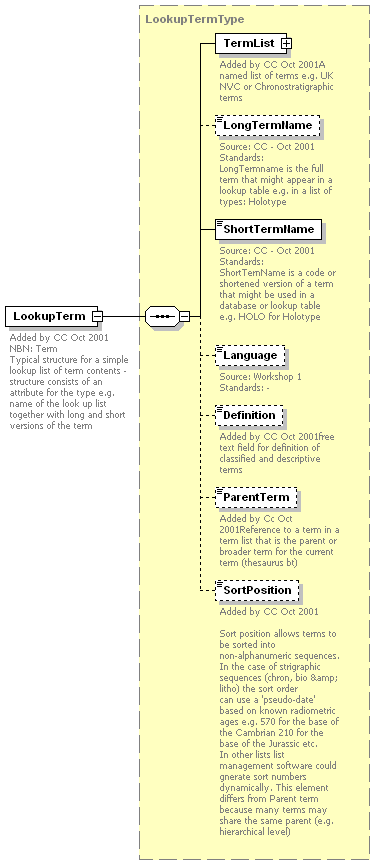 |
||||||||||||||||||
| type | LookupTermType | ||||||||||||||||||
| children | TermList LongTermName ShortTermName Language Definition ParentTerm SortPosition | ||||||||||||||||||
| attributes |
|
||||||||||||||||||
| annotation |
|
||||||||||||||||||
| source | <xs:element name="LookupTerm" type="LookupTermType"> <xs:annotation> <xs:documentation>Added by CC Oct 2001 NBN: Term Typical structure for a simple lookup list of term contents - structure consists of an attribute for the type e.g. name of the look up list together with long and short versions of the term</xs:documentation> </xs:annotation> </xs:element> |
| diagram |  |
||
| type | AltText | ||
| annotation |
|
||
| source | <xs:element name="AltText" type="AltText"> <xs:annotation> <xs:documentation>Source: Sydney CODATA workshopFree text field for informal recording of field contents</xs:documentation> </xs:annotation> </xs:element> |
| diagram |  |
||
| type | xs:string | ||
| annotation |
|
||
| source | <xs:element name="specimenUnit_part" type="xs:string" minOccurs="0"> <xs:annotation> <xs:documentation>Added by CC Oct 2001 LNHM specimen part: Part of the specimen rcord applies</xs:documentation> </xs:annotation> </xs:element> |
| diagram |  |
||
| type | accession_catalogue_ID | ||
| annotation |
|
||
| source | <xs:element name="accession_catalogue_ID" type="accession_catalogue_ID" minOccurs="0"> <xs:annotation> <xs:documentation>Added by CC Oct 2001Unique identifier for an accessions catalogue id in a computerised system</xs:documentation> </xs:annotation> </xs:element> |
| diagram | 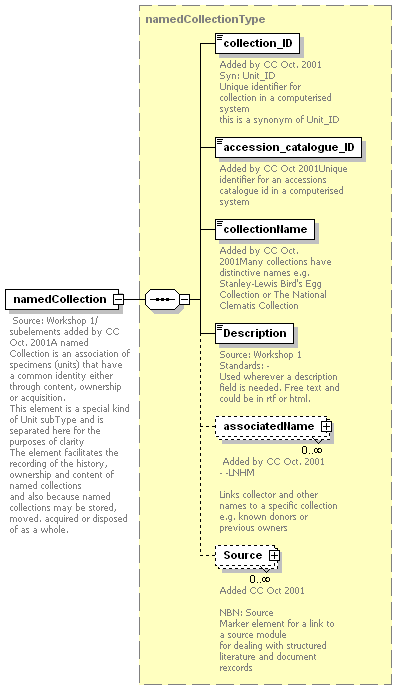 |
||||||||||||||||||
| type | namedCollectionType | ||||||||||||||||||
| children | collection_ID accession_catalogue_ID collectionName Description associatedName Source | ||||||||||||||||||
| attributes |
|
||||||||||||||||||
| annotation |
|
||||||||||||||||||
| source | <xs:element name="namedCollection" type="namedCollectionType"> <xs:annotation> <xs:documentation> Source: Workshop 1/ subelements added by CC Oct. 2001A named Collection is an association of specimens (units) that have a common identity either through content, ownership or acquisition. This element is a special kind of Unit subType and is separated here for the purposes of clarity The element facilitates the recording of the history, ownership and content of named collections and also because named collections may be stored, moved. acquired or disposed of as a whole. </xs:documentation> </xs:annotation> </xs:element> |
| diagram |  |
||
| type | collection_ID | ||
| annotation |
|
||
| source | <xs:element name="collection_ID" type="collection_ID"> <xs:annotation> <xs:documentation>Added by CC Oct. 2001 Syn: Unit_ID Unique identifier for collection in a computerised system this is a synonym of Unit_ID </xs:documentation> </xs:annotation> </xs:element> |
| diagram | 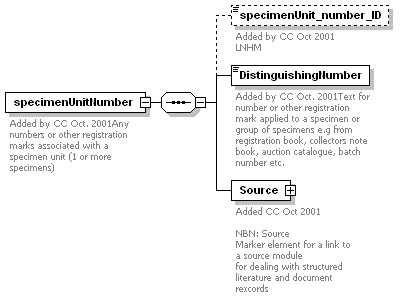 |
||||||||||||
| children | specimenUnit_number_ID DistinguishingNumber Source | ||||||||||||
| attributes |
|
||||||||||||
| annotation |
|
||||||||||||
| source | <xs:element name="specimenUnitNumber" minOccurs="0" maxOccurs="unbounded"> <xs:annotation> <xs:documentation>Added by CC Oct. 2001Any numbers or other registration marks associated with a specimen unit (1 or more specimens)</xs:documentation> </xs:annotation> <xs:complexType> <xs:sequence> <xs:element name="specimenUnit_number_ID" type="xs:string" minOccurs="0"> <xs:annotation> <xs:documentation>Added by CC Oct 2001 LNHM</xs:documentation> </xs:annotation> </xs:element> <xs:element name="DistinguishingNumber" type="xs:string"> <xs:annotation> <xs:documentation>Added by CC Oct. 2001Text for number or other registration mark applied to a specimen or group of specimens e.g from registration book, collectors note book, auction catalogue, batch number etc.</xs:documentation> </xs:annotation> </xs:element> <xs:element name="Source" type="SourceType"> <xs:annotation> <xs:documentation>Added CC Oct 2001 NBN: Source Marker element for a link to a source module for dealing with structured literature and document rexcords</xs:documentation> </xs:annotation> </xs:element> </xs:sequence> <xs:attribute name="PreferredFlag"> <xs:simpleType> <xs:restriction base="xs:NMTOKEN"> <xs:enumeration value="Yes"/> <xs:enumeration value="No"/> </xs:restriction> </xs:simpleType> </xs:attribute> </xs:complexType> </xs:element> |
| diagram |  |
||
| type | xs:string | ||
| annotation |
|
||
| source | <xs:element name="specimenUnit_number_ID" type="xs:string" minOccurs="0"> <xs:annotation> <xs:documentation>Added by CC Oct 2001 LNHM</xs:documentation> </xs:annotation> </xs:element> |
| diagram |  |
||
| type | xs:string | ||
| annotation |
|
||
| source | <xs:element name="DistinguishingNumber" type="xs:string"> <xs:annotation> <xs:documentation>Added by CC Oct. 2001Text for number or other registration mark applied to a specimen or group of specimens e.g from registration book, collectors note book, auction catalogue, batch number etc.</xs:documentation> </xs:annotation> </xs:element> |
| diagram | 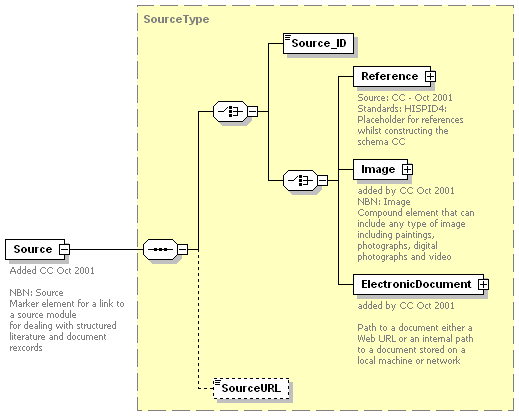 |
||||||||||||
| type | SourceType | ||||||||||||
| children | Source_ID Reference Image ElectronicDocument SourceURL | ||||||||||||
| attributes |
|
||||||||||||
| annotation |
|
||||||||||||
| source | <xs:element name="Source" type="SourceType"> <xs:annotation> <xs:documentation>Added CC Oct 2001 NBN: Source Marker element for a link to a source module for dealing with structured literature and document rexcords</xs:documentation> </xs:annotation> </xs:element> |
| diagram |  |
||
| type | xs:string | ||
| annotation |
|
||
| source | <xs:element name="specimenUnit_description" type="xs:string"> <xs:annotation> <xs:documentation>Added by CC Oct 2001 LNHM Free text description of a specimen or similar 'Unit'</xs:documentation> </xs:annotation> </xs:element> |
| diagram | 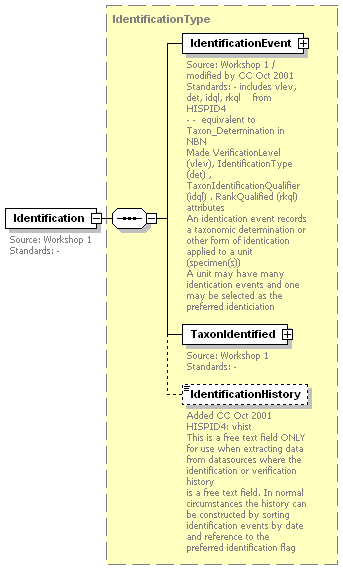 |
||||||||||||
| type | IdentificationType | ||||||||||||
| children | IdentificationEvent TaxonIdentified IdentificationHistory | ||||||||||||
| attributes |
|
||||||||||||
| annotation |
|
||||||||||||
| source | <xs:element name="Identification" type="IdentificationType"> <xs:annotation> <xs:documentation>Source: Workshop 1 Standards: - </xs:documentation> </xs:annotation> </xs:element> |
| diagram | 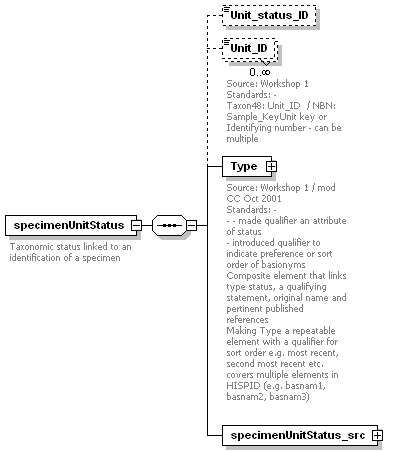 |
||||||||||||||||||
| children | Unit_status_ID Unit_ID Type specimenUnitStatus_src | ||||||||||||||||||
| attributes |
|
||||||||||||||||||
| annotation |
|
||||||||||||||||||
| source | <xs:element name="specimenUnitStatus" minOccurs="0"> <xs:annotation> <xs:documentation>Taxonomic status linked to an identification of a specimen</xs:documentation> </xs:annotation> <xs:complexType> <xs:sequence> <xs:element name="Unit_status_ID" type="Unit_status_ID" minOccurs="0"/> <xs:element name="Unit_ID" type="Unit_ID" minOccurs="0" maxOccurs="unbounded"> <xs:annotation> <xs:documentation>Source: Workshop 1 Standards: - Taxon48: Unit_ID / NBN: Sample_KeyUnit key or Identifying number - can be multiple</xs:documentation> </xs:annotation> </xs:element> <xs:element name="Type"> <xs:annotation> <xs:documentation>Source: Workshop 1 / mod CC Oct 2001 Standards: - - - made qualifier an attribute of status - introduced qualifier to indicate preference or sort order of basionyms Composite element that links type status, a qualifying statement, original name and pertinent published references Making Type a repeatable element with a qualifier for sort order e.g. most recent, second most recent etc. covers multiple elements in HISPID (e.g. basnam1, basnam2, basnam3) </xs:documentation> </xs:annotation> <xs:complexType> <xs:sequence> <xs:element name="TypeStatus"> <xs:annotation> <xs:documentation>Source: Workshop 1/ modified CC Oct 2001 Standards: - - - includes HISPID4: tsta and tql The presumed nomenclatural status of specimens regarded as types - Note that Type Qualifier has been moved to an enumerated attribute of TypeStatus</xs:documentation> </xs:annotation> <xs:complexType> <xs:choice> <xs:sequence> <xs:element name="AltText" type="AltText"> <xs:annotation> <xs:documentation>Source: Sydney CODATA workshopFree text field for informal recording of field contents</xs:documentation> </xs:annotation> </xs:element> <xs:element name="Source" type="SourceType"> <xs:annotation> <xs:documentation>Added CC Oct 2001 NBN: Source Marker element for a link to a source module for dealing with structured literature and document rexcords </xs:documentation> </xs:annotation> </xs:element> </xs:sequence> <xs:element name="LookupTerm" type="LookupTermType"> <xs:annotation> <xs:documentation>Added by CC Oct 2001 NBN: Term Typical structure for a simple lookup list of term contents - structure consists of an attribute for the type e.g. name of the look up list together with long and short versions of the term</xs:documentation> </xs:annotation> </xs:element> </xs:choice> <xs:attribute name="TypeQualifier" use="required"> <xs:simpleType> <xs:restriction base="xs:NMTOKEN"> <xs:enumeration value="Confirmed"/> <xs:enumeration value="Probably"/> <xs:enumeration value="Possibly"/> <xs:enumeration value="Not"/> </xs:restriction> </xs:simpleType> </xs:attribute> </xs:complexType> </xs:element> <xs:element name="Basionym" minOccurs="0"> <xs:annotation> <xs:documentation>Source: Workshop 1 Standards: - HISPID4: basnam / TLR Baionym refers to the original name associated with a type specimen where the name has subsequently been revised especially where this has arisen from a change of rank the option here is to use plain name text or a fully atomised model for name parts.</xs:documentation> </xs:annotation> <xs:complexType> <xs:sequence> <xs:choice> <xs:element name="AltText" type="AltText"> <xs:annotation> <xs:documentation>Source: Sydney CODATA workshopFree text field for informal recording of field contents</xs:documentation> </xs:annotation> </xs:element> <xs:element name="BotanicalName" type="BotanicalNameType"/> <xs:element name="BacteriologicalName" type="BacteriologicalNameType"/> <xs:element name="ZoologicalName" type="ZoologicalNameType"/> </xs:choice> <xs:element name="Source" type="SourceType" minOccurs="0"> <xs:annotation> <xs:documentation>Added CC Oct 2001 NBN: Source Marker element for a link to a source module for dealing with structured literature and document rexcords</xs:documentation> </xs:annotation> </xs:element> </xs:sequence> </xs:complexType> </xs:element> <xs:element name="Source" type="SourceType" minOccurs="0" maxOccurs="unbounded"> <xs:annotation> <xs:documentation>Added CC Oct 2001 NBN: Source Marker element for a link to a source module for dealing with structured literature and document rexcords</xs:documentation> </xs:annotation> </xs:element> </xs:sequence> <xs:attribute name="BasionymOrder"> <xs:simpleType> <xs:restriction base="xs:NMTOKEN"> <xs:enumeration value="1"/> <xs:enumeration value="2"/> <xs:enumeration value="3"/> </xs:restriction> </xs:simpleType> </xs:attribute> </xs:complexType> </xs:element> <xs:element name="specimenUnitStatus_src"> <xs:complexType> <xs:sequence> <xs:element name="Unit_status_ID" type="Unit_status_ID" minOccurs="0"/> <xs:element name="Source" type="SourceType"> <xs:annotation> <xs:documentation>Added CC Oct 2001 NBN: Source Marker element for a link to a source module for dealing with structured literature and document rexcords </xs:documentation> </xs:annotation> </xs:element> </xs:sequence> <xs:attribute name="entered_by" type="xs:string" use="required"/> <xs:attribute name="entry_date" type="xs:string" use="required"/> <xs:attribute name="specimen_status_source_key" type="xs:string"/> </xs:complexType> </xs:element> </xs:sequence> <xs:attribute name="entered_by" type="xs:string" use="required"/> <xs:attribute name="entry_date" type="xs:string" use="required"/> </xs:complexType> </xs:element> |
| diagram |  |
| type | Unit_status_ID |
| source | <xs:element name="Unit_status_ID" type="Unit_status_ID" minOccurs="0"/> |
| diagram | 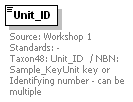 |
||
| type | Unit_ID | ||
| annotation |
|
||
| source | <xs:element name="Unit_ID" type="Unit_ID" minOccurs="0" maxOccurs="unbounded"> <xs:annotation> <xs:documentation>Source: Workshop 1 Standards: - Taxon48: Unit_ID / NBN: Sample_KeyUnit key or Identifying number - can be multiple</xs:documentation> </xs:annotation> </xs:element> |
| diagram | 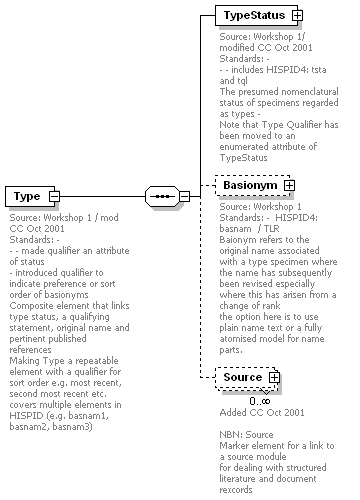 |
||||||||||||
| children | TypeStatus Basionym Source | ||||||||||||
| attributes |
|
||||||||||||
| annotation |
|
||||||||||||
| source | <xs:element name="Type"> <xs:annotation> <xs:documentation>Source: Workshop 1 / mod CC Oct 2001 Standards: - - - made qualifier an attribute of status - introduced qualifier to indicate preference or sort order of basionyms Composite element that links type status, a qualifying statement, original name and pertinent published references Making Type a repeatable element with a qualifier for sort order e.g. most recent, second most recent etc. covers multiple elements in HISPID (e.g. basnam1, basnam2, basnam3) </xs:documentation> </xs:annotation> <xs:complexType> <xs:sequence> <xs:element name="TypeStatus"> <xs:annotation> <xs:documentation>Source: Workshop 1/ modified CC Oct 2001 Standards: - - - includes HISPID4: tsta and tql The presumed nomenclatural status of specimens regarded as types - Note that Type Qualifier has been moved to an enumerated attribute of TypeStatus</xs:documentation> </xs:annotation> <xs:complexType> <xs:choice> <xs:sequence> <xs:element name="AltText" type="AltText"> <xs:annotation> <xs:documentation>Source: Sydney CODATA workshopFree text field for informal recording of field contents</xs:documentation> </xs:annotation> </xs:element> <xs:element name="Source" type="SourceType"> <xs:annotation> <xs:documentation>Added CC Oct 2001 NBN: Source Marker element for a link to a source module for dealing with structured literature and document rexcords </xs:documentation> </xs:annotation> </xs:element> </xs:sequence> <xs:element name="LookupTerm" type="LookupTermType"> <xs:annotation> <xs:documentation>Added by CC Oct 2001 NBN: Term Typical structure for a simple lookup list of term contents - structure consists of an attribute for the type e.g. name of the look up list together with long and short versions of the term</xs:documentation> </xs:annotation> </xs:element> </xs:choice> <xs:attribute name="TypeQualifier" use="required"> <xs:simpleType> <xs:restriction base="xs:NMTOKEN"> <xs:enumeration value="Confirmed"/> <xs:enumeration value="Probably"/> <xs:enumeration value="Possibly"/> <xs:enumeration value="Not"/> </xs:restriction> </xs:simpleType> </xs:attribute> </xs:complexType> </xs:element> <xs:element name="Basionym" minOccurs="0"> <xs:annotation> <xs:documentation>Source: Workshop 1 Standards: - HISPID4: basnam / TLR Baionym refers to the original name associated with a type specimen where the name has subsequently been revised especially where this has arisen from a change of rank the option here is to use plain name text or a fully atomised model for name parts.</xs:documentation> </xs:annotation> <xs:complexType> <xs:sequence> <xs:choice> <xs:element name="AltText" type="AltText"> <xs:annotation> <xs:documentation>Source: Sydney CODATA workshopFree text field for informal recording of field contents</xs:documentation> </xs:annotation> </xs:element> <xs:element name="BotanicalName" type="BotanicalNameType"/> <xs:element name="BacteriologicalName" type="BacteriologicalNameType"/> <xs:element name="ZoologicalName" type="ZoologicalNameType"/> </xs:choice> <xs:element name="Source" type="SourceType" minOccurs="0"> <xs:annotation> <xs:documentation>Added CC Oct 2001 NBN: Source Marker element for a link to a source module for dealing with structured literature and document rexcords</xs:documentation> </xs:annotation> </xs:element> </xs:sequence> </xs:complexType> </xs:element> <xs:element name="Source" type="SourceType" minOccurs="0" maxOccurs="unbounded"> <xs:annotation> <xs:documentation>Added CC Oct 2001 NBN: Source Marker element for a link to a source module for dealing with structured literature and document rexcords</xs:documentation> </xs:annotation> </xs:element> </xs:sequence> <xs:attribute name="BasionymOrder"> <xs:simpleType> <xs:restriction base="xs:NMTOKEN"> <xs:enumeration value="1"/> <xs:enumeration value="2"/> <xs:enumeration value="3"/> </xs:restriction> </xs:simpleType> </xs:attribute> </xs:complexType> </xs:element> |
| diagram | 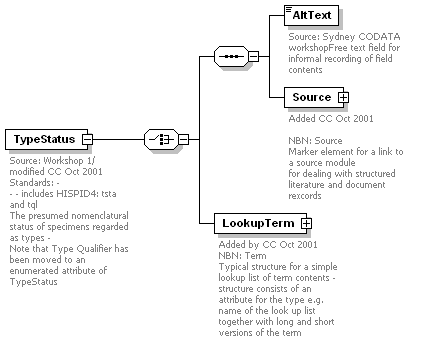 |
||||||||||||
| children | AltText Source LookupTerm | ||||||||||||
| attributes |
|
||||||||||||
| annotation |
|
||||||||||||
| source | <xs:element name="TypeStatus"> <xs:annotation> <xs:documentation>Source: Workshop 1/ modified CC Oct 2001 Standards: - - - includes HISPID4: tsta and tql The presumed nomenclatural status of specimens regarded as types - Note that Type Qualifier has been moved to an enumerated attribute of TypeStatus</xs:documentation> </xs:annotation> <xs:complexType> <xs:choice> <xs:sequence> <xs:element name="AltText" type="AltText"> <xs:annotation> <xs:documentation>Source: Sydney CODATA workshopFree text field for informal recording of field contents</xs:documentation> </xs:annotation> </xs:element> <xs:element name="Source" type="SourceType"> <xs:annotation> <xs:documentation>Added CC Oct 2001 NBN: Source Marker element for a link to a source module for dealing with structured literature and document rexcords </xs:documentation> </xs:annotation> </xs:element> </xs:sequence> <xs:element name="LookupTerm" type="LookupTermType"> <xs:annotation> <xs:documentation>Added by CC Oct 2001 NBN: Term Typical structure for a simple lookup list of term contents - structure consists of an attribute for the type e.g. name of the look up list together with long and short versions of the term</xs:documentation> </xs:annotation> </xs:element> </xs:choice> <xs:attribute name="TypeQualifier" use="required"> <xs:simpleType> <xs:restriction base="xs:NMTOKEN"> <xs:enumeration value="Confirmed"/> <xs:enumeration value="Probably"/> <xs:enumeration value="Possibly"/> <xs:enumeration value="Not"/> </xs:restriction> </xs:simpleType> </xs:attribute> </xs:complexType> </xs:element> |
| diagram |  |
||
| type | AltText | ||
| annotation |
|
||
| source | <xs:element name="AltText" type="AltText"> <xs:annotation> <xs:documentation>Source: Sydney CODATA workshopFree text field for informal recording of field contents</xs:documentation> </xs:annotation> </xs:element> |
| diagram | 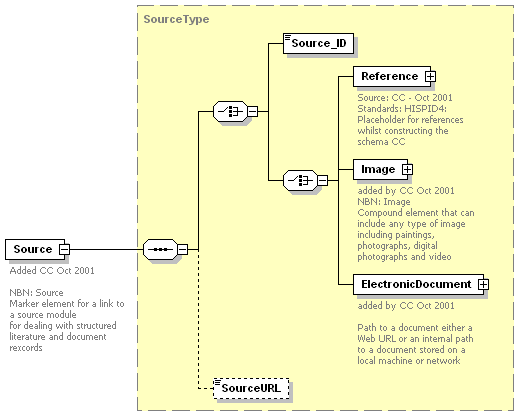 |
||||||||||||
| type | SourceType | ||||||||||||
| children | Source_ID Reference Image ElectronicDocument SourceURL | ||||||||||||
| attributes |
|
||||||||||||
| annotation |
|
||||||||||||
| source | <xs:element name="Source" type="SourceType"> <xs:annotation> <xs:documentation>Added CC Oct 2001 NBN: Source Marker element for a link to a source module for dealing with structured literature and document rexcords </xs:documentation> </xs:annotation> </xs:element> |
| diagram | 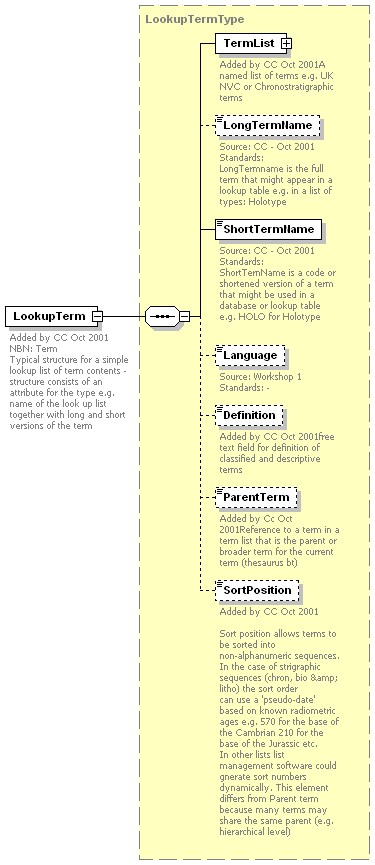 |
||||||||||||||||||
| type | LookupTermType | ||||||||||||||||||
| children | TermList LongTermName ShortTermName Language Definition ParentTerm SortPosition | ||||||||||||||||||
| attributes |
|
||||||||||||||||||
| annotation |
|
||||||||||||||||||
| source | <xs:element name="LookupTerm" type="LookupTermType"> <xs:annotation> <xs:documentation>Added by CC Oct 2001 NBN: Term Typical structure for a simple lookup list of term contents - structure consists of an attribute for the type e.g. name of the look up list together with long and short versions of the term</xs:documentation> </xs:annotation> </xs:element> |
| diagram | 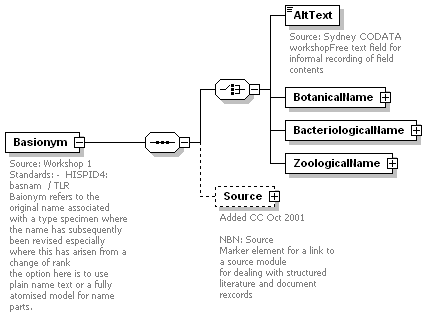 |
||
| children | AltText BotanicalName BacteriologicalName ZoologicalName Source | ||
| annotation |
|
||
| source | <xs:element name="Basionym" minOccurs="0"> <xs:annotation> <xs:documentation>Source: Workshop 1 Standards: - HISPID4: basnam / TLR Baionym refers to the original name associated with a type specimen where the name has subsequently been revised especially where this has arisen from a change of rank the option here is to use plain name text or a fully atomised model for name parts.</xs:documentation> </xs:annotation> <xs:complexType> <xs:sequence> <xs:choice> <xs:element name="AltText" type="AltText"> <xs:annotation> <xs:documentation>Source: Sydney CODATA workshopFree text field for informal recording of field contents</xs:documentation> </xs:annotation> </xs:element> <xs:element name="BotanicalName" type="BotanicalNameType"/> <xs:element name="BacteriologicalName" type="BacteriologicalNameType"/> <xs:element name="ZoologicalName" type="ZoologicalNameType"/> </xs:choice> <xs:element name="Source" type="SourceType" minOccurs="0"> <xs:annotation> <xs:documentation>Added CC Oct 2001 NBN: Source Marker element for a link to a source module for dealing with structured literature and document rexcords</xs:documentation> </xs:annotation> </xs:element> </xs:sequence> </xs:complexType> </xs:element> |
| diagram |  |
||
| type | AltText | ||
| annotation |
|
||
| source | <xs:element name="AltText" type="AltText"> <xs:annotation> <xs:documentation>Source: Sydney CODATA workshopFree text field for informal recording of field contents</xs:documentation> </xs:annotation> </xs:element> |
| diagram |  |
| type | BotanicalNameType |
| children | HigherTaxon NameText NamedHybridFlag Genus FirstEpithet SpeciesQualifier SecondEpithet Rank NameAuthorCitation BasionymAuthorTeam CombinationAuthorTeam ExAuthorTeam VernacularNames CultivatedPlantNameElements MycologicalNameElements LichenNameElements NameComments |
| source | <xs:element name="BotanicalName" type="BotanicalNameType"/> |
| diagram | 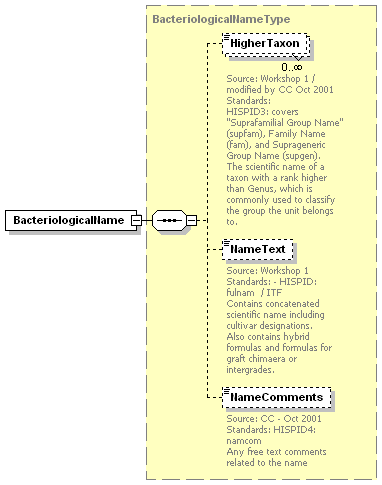 |
| type | BacteriologicalNameType |
| children | HigherTaxon NameText NameComments |
| source | <xs:element name="BacteriologicalName" type="BacteriologicalNameType"/> |
| diagram | 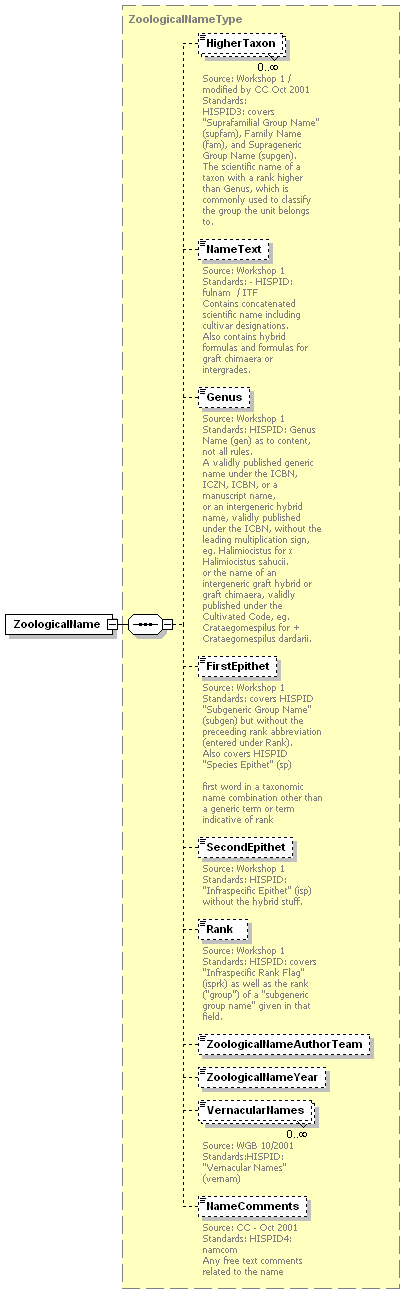 |
| type | ZoologicalNameType |
| children | HigherTaxon NameText Genus FirstEpithet SecondEpithet Rank ZoologicalNameAuthorTeam ZoologicalNameYear VernacularNames NameComments |
| source | <xs:element name="ZoologicalName" type="ZoologicalNameType"/> |
| diagram | 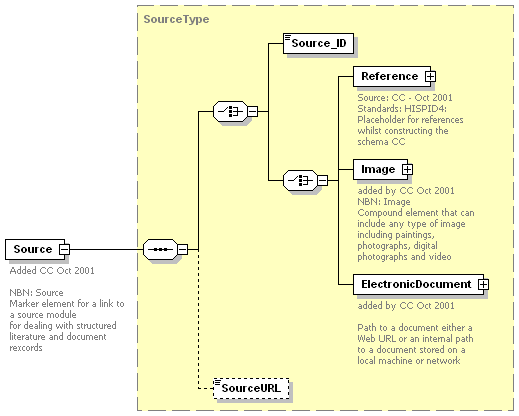 |
||||||||||||
| type | SourceType | ||||||||||||
| children | Source_ID Reference Image ElectronicDocument SourceURL | ||||||||||||
| attributes |
|
||||||||||||
| annotation |
|
||||||||||||
| source | <xs:element name="Source" type="SourceType" minOccurs="0"> <xs:annotation> <xs:documentation>Added CC Oct 2001 NBN: Source Marker element for a link to a source module for dealing with structured literature and document rexcords</xs:documentation> </xs:annotation> </xs:element> |
| diagram | 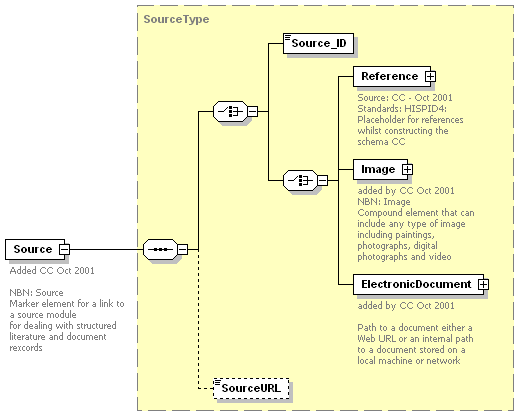 |
||||||||||||
| type | SourceType | ||||||||||||
| children | Source_ID Reference Image ElectronicDocument SourceURL | ||||||||||||
| attributes |
|
||||||||||||
| annotation |
|
||||||||||||
| source | <xs:element name="Source" type="SourceType" minOccurs="0" maxOccurs="unbounded"> <xs:annotation> <xs:documentation>Added CC Oct 2001 NBN: Source Marker element for a link to a source module for dealing with structured literature and document rexcords</xs:documentation> </xs:annotation> </xs:element> |
| diagram | 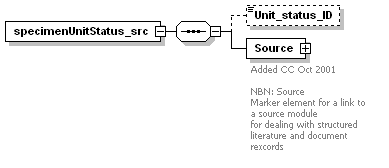 |
||||||||||||||||||||||||
| children | Unit_status_ID Source | ||||||||||||||||||||||||
| attributes |
|
||||||||||||||||||||||||
| source | <xs:element name="specimenUnitStatus_src"> <xs:complexType> <xs:sequence> <xs:element name="Unit_status_ID" type="Unit_status_ID" minOccurs="0"/> <xs:element name="Source" type="SourceType"> <xs:annotation> <xs:documentation>Added CC Oct 2001 NBN: Source Marker element for a link to a source module for dealing with structured literature and document rexcords </xs:documentation> </xs:annotation> </xs:element> </xs:sequence> <xs:attribute name="entered_by" type="xs:string" use="required"/> <xs:attribute name="entry_date" type="xs:string" use="required"/> <xs:attribute name="specimen_status_source_key" type="xs:string"/> </xs:complexType> </xs:element> |
| diagram |  |
| type | Unit_status_ID |
| source | <xs:element name="Unit_status_ID" type="Unit_status_ID" minOccurs="0"/> |
| diagram | 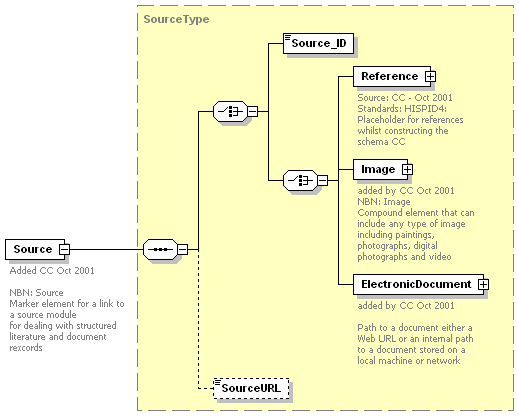 |
||||||||||||
| type | SourceType | ||||||||||||
| children | Source_ID Reference Image ElectronicDocument SourceURL | ||||||||||||
| attributes |
|
||||||||||||
| annotation |
|
||||||||||||
| source | <xs:element name="Source" type="SourceType"> <xs:annotation> <xs:documentation>Added CC Oct 2001 NBN: Source Marker element for a link to a source module for dealing with structured literature and document rexcords </xs:documentation> </xs:annotation> </xs:element> |
| diagram | 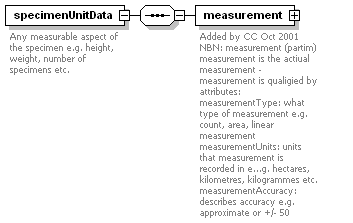 |
||||||||||||
| children | measurement | ||||||||||||
| attributes |
|
||||||||||||
| annotation |
|
||||||||||||
| source | <xs:element name="specimenUnitData" minOccurs="0" maxOccurs="unbounded"> <xs:annotation> <xs:documentation>Any measurable aspect of the specimen e.g. height, weight, number of specimens etc.</xs:documentation> </xs:annotation> <xs:complexType> <xs:sequence> <xs:element name="measurement" type="measurementType"> <xs:annotation> <xs:documentation>Added by CC Oct 2001 NBN: measurement (partim) measurement is the actiual measurement - measurement is qualigied by attributes: measurementType: what type of measurement e.g. count, area, linear measurement measurementUnits: units that measurement is recorded in e...g. hectares, kilometres, kilogrammes etc. measurementAccuracy: describes accuracy e.g. approximate or +/- 50</xs:documentation> </xs:annotation> </xs:element> </xs:sequence> <xs:attribute name="SpecimenUnitData_ID" type="xs:string"/> </xs:complexType> </xs:element> |
| diagram | 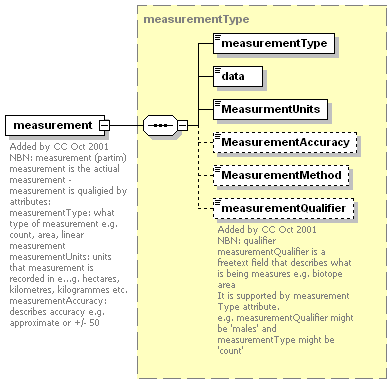 |
||
| type | measurementType | ||
| children | measurementType data MeasurmentUnits MeasurementAccuracy MeasurementMethod measurementQualifier | ||
| annotation |
|
||
| source | <xs:element name="measurement" type="measurementType"> <xs:annotation> <xs:documentation>Added by CC Oct 2001 NBN: measurement (partim) measurement is the actiual measurement - measurement is qualigied by attributes: measurementType: what type of measurement e.g. count, area, linear measurement measurementUnits: units that measurement is recorded in e...g. hectares, kilometres, kilogrammes etc. measurementAccuracy: describes accuracy e.g. approximate or +/- 50</xs:documentation> </xs:annotation> </xs:element> |
| diagram | 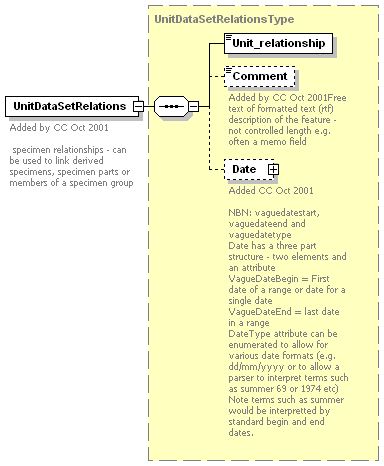 |
||||||||||||||||||||||||||||||
| type | UnitDataSetRelationsType | ||||||||||||||||||||||||||||||
| children | Unit_relationship Comment Date | ||||||||||||||||||||||||||||||
| attributes |
|
||||||||||||||||||||||||||||||
| annotation |
|
||||||||||||||||||||||||||||||
| source | <xs:element name="UnitDataSetRelations" type="UnitDataSetRelationsType" minOccurs="0" maxOccurs="unbounded"> <xs:annotation> <xs:documentation>Added by CC Oct 2001 specimen relationships - can be used to link derived specimens, specimen parts or members of a specimen group</xs:documentation> </xs:annotation> </xs:element> |
| diagram | 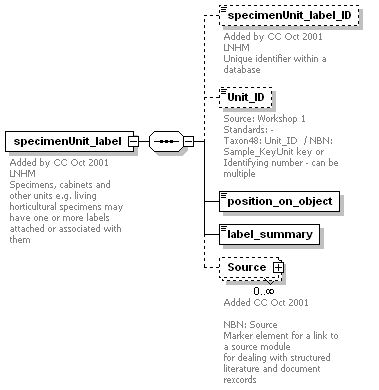 |
||||||||||||||||||
| children | specimenUnit_label_ID Unit_ID position_on_object label_summary Source | ||||||||||||||||||
| attributes |
|
||||||||||||||||||
| annotation |
|
||||||||||||||||||
| source | <xs:element name="specimenUnit_label" minOccurs="0" maxOccurs="unbounded"> <xs:annotation> <xs:documentation>Added by CC Oct 2001 LNHM Specimens, cabinets and other units e.g. living horticultural specimens may have one or more labels attached or associated with them</xs:documentation> </xs:annotation> <xs:complexType> <xs:sequence> <xs:element name="specimenUnit_label_ID" type="xs:string" minOccurs="0"> <xs:annotation> <xs:documentation>Added by CC Oct 2001 LNHM Unique identifier within a database</xs:documentation> </xs:annotation> </xs:element> <xs:element name="Unit_ID" type="Unit_ID" minOccurs="0"> <xs:annotation> <xs:documentation>Source: Workshop 1 Standards: - Taxon48: Unit_ID / NBN: Sample_KeyUnit key or Identifying number - can be multiple</xs:documentation> </xs:annotation> </xs:element> <xs:element name="position_on_object" type="xs:string"/> <xs:element name="label_summary" type="xs:string"/> <xs:element name="Source" type="SourceType" minOccurs="0" maxOccurs="unbounded"> <xs:annotation> <xs:documentation>Added CC Oct 2001 NBN: Source Marker element for a link to a source module for dealing with structured literature and document rexcords</xs:documentation> </xs:annotation> </xs:element> </xs:sequence> <xs:attribute name="entered_by" type="xs:string" use="required"/> <xs:attribute name="entry_date" type="xs:string" use="required"/> </xs:complexType> </xs:element> |
| diagram | 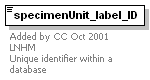 |
||
| type | xs:string | ||
| annotation |
|
||
| source | <xs:element name="specimenUnit_label_ID" type="xs:string" minOccurs="0"> <xs:annotation> <xs:documentation>Added by CC Oct 2001 LNHM Unique identifier within a database</xs:documentation> </xs:annotation> </xs:element> |
| diagram | 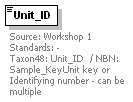 |
||
| type | Unit_ID | ||
| annotation |
|
||
| source | <xs:element name="Unit_ID" type="Unit_ID" minOccurs="0"> <xs:annotation> <xs:documentation>Source: Workshop 1 Standards: - Taxon48: Unit_ID / NBN: Sample_KeyUnit key or Identifying number - can be multiple</xs:documentation> </xs:annotation> </xs:element> |
| diagram |  |
| type | xs:string |
| source | <xs:element name="position_on_object" type="xs:string"/> |
| diagram |  |
| type | xs:string |
| source | <xs:element name="label_summary" type="xs:string"/> |
| diagram | 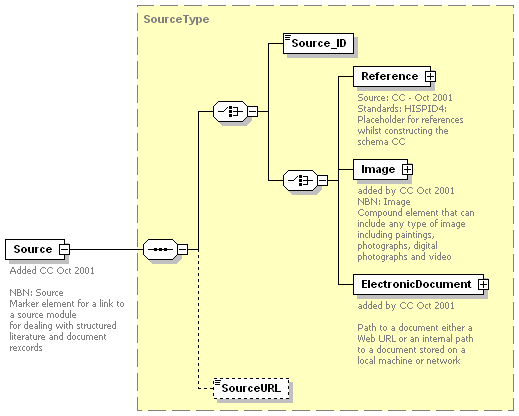 |
||||||||||||
| type | SourceType | ||||||||||||
| children | Source_ID Reference Image ElectronicDocument SourceURL | ||||||||||||
| attributes |
|
||||||||||||
| annotation |
|
||||||||||||
| source | <xs:element name="Source" type="SourceType" minOccurs="0" maxOccurs="unbounded"> <xs:annotation> <xs:documentation>Added CC Oct 2001 NBN: Source Marker element for a link to a source module for dealing with structured literature and document rexcords</xs:documentation> </xs:annotation> </xs:element> |
| diagram | 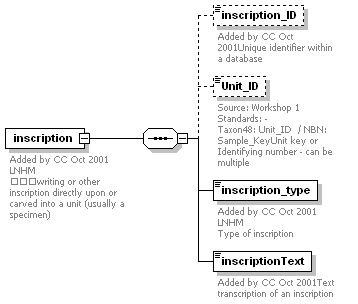 |
||||||||||||||||||
| children | inscription_ID Unit_ID inscription_type inscriptionText | ||||||||||||||||||
| attributes |
|
||||||||||||||||||
| annotation |
|
||||||||||||||||||
| source | <xs:element name="inscription" minOccurs="0" maxOccurs="unbounded"> <xs:annotation> <xs:documentation>Added by CC Oct 2001 LNHM writing or other inscription directly upon or carved into a unit (usually a specimen)</xs:documentation> </xs:annotation> <xs:complexType> <xs:sequence> <xs:element name="inscription_ID" minOccurs="0"> <xs:annotation> <xs:documentation>Added by CC Oct 2001Unique identifier within a database</xs:documentation> </xs:annotation> <xs:complexType> <xs:simpleContent> <xs:extension base="xs:string"> <xs:attribute name="type" use="required"> <xs:simpleType> <xs:restriction base="xs:NMTOKEN"> <xs:enumeration value="nbn"/> <xs:enumeration value="local"/> </xs:restriction> </xs:simpleType> </xs:attribute> </xs:extension> </xs:simpleContent> </xs:complexType> </xs:element> <xs:element name="Unit_ID" type="Unit_ID" minOccurs="0"> <xs:annotation> <xs:documentation>Source: Workshop 1 Standards: - Taxon48: Unit_ID / NBN: Sample_KeyUnit key or Identifying number - can be multiple</xs:documentation> </xs:annotation> </xs:element> <xs:element name="inscription_type" type="xs:string"> <xs:annotation> <xs:documentation>Added by CC Oct 2001 LNHM Type of inscription</xs:documentation> </xs:annotation> </xs:element> <xs:element name="inscriptionText" type="xs:string"> <xs:annotation> <xs:documentation>Added by CC Oct 2001Text transcription of an inscription</xs:documentation> </xs:annotation> </xs:element> </xs:sequence> <xs:attribute name="entered_by" type="xs:string" use="required"/> <xs:attribute name="entry_date" type="xs:string" use="required"/> </xs:complexType> </xs:element> |
| diagram |  |
||||||||||||
| type | extension of xs:string | ||||||||||||
| attributes |
|
||||||||||||
| annotation |
|
||||||||||||
| source | <xs:element name="inscription_ID" minOccurs="0"> <xs:annotation> <xs:documentation>Added by CC Oct 2001Unique identifier within a database</xs:documentation> </xs:annotation> <xs:complexType> <xs:simpleContent> <xs:extension base="xs:string"> <xs:attribute name="type" use="required"> <xs:simpleType> <xs:restriction base="xs:NMTOKEN"> <xs:enumeration value="nbn"/> <xs:enumeration value="local"/> </xs:restriction> </xs:simpleType> </xs:attribute> </xs:extension> </xs:simpleContent> </xs:complexType> </xs:element> |
| diagram |  |
||
| type | Unit_ID | ||
| annotation |
|
||
| source | <xs:element name="Unit_ID" type="Unit_ID" minOccurs="0"> <xs:annotation> <xs:documentation>Source: Workshop 1 Standards: - Taxon48: Unit_ID / NBN: Sample_KeyUnit key or Identifying number - can be multiple</xs:documentation> </xs:annotation> </xs:element> |
| diagram |  |
||
| type | xs:string | ||
| annotation |
|
||
| source | <xs:element name="inscription_type" type="xs:string"> <xs:annotation> <xs:documentation>Added by CC Oct 2001 LNHM Type of inscription</xs:documentation> </xs:annotation> </xs:element> |
| diagram |  |
||
| type | xs:string | ||
| annotation |
|
||
| source | <xs:element name="inscriptionText" type="xs:string"> <xs:annotation> <xs:documentation>Added by CC Oct 2001Text transcription of an inscription</xs:documentation> </xs:annotation> </xs:element> |
| diagram | 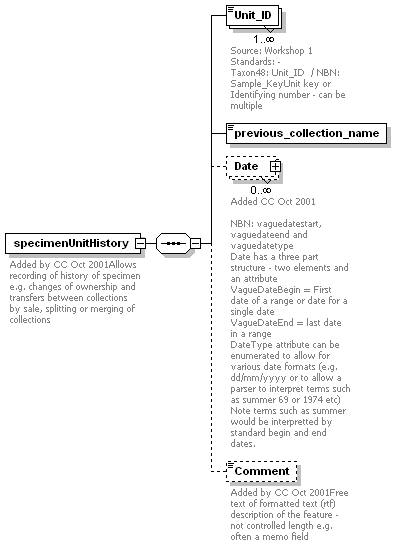 |
||||||||||||||||||
| children | Unit_ID previous_collection_name Date Comment | ||||||||||||||||||
| attributes |
|
||||||||||||||||||
| annotation |
|
||||||||||||||||||
| source | <xs:element name="specimenUnitHistory" minOccurs="0" maxOccurs="unbounded"> <xs:annotation> <xs:documentation>Added by CC Oct 2001Allows recording of history of specimen e.g. changes of ownership and transfers between collections by sale, splitting or merging of collections</xs:documentation> </xs:annotation> <xs:complexType> <xs:sequence> <xs:element name="Unit_ID" type="Unit_ID" maxOccurs="unbounded"> <xs:annotation> <xs:documentation>Source: Workshop 1 Standards: - Taxon48: Unit_ID / NBN: Sample_KeyUnit key or Identifying number - can be multiple</xs:documentation> </xs:annotation> </xs:element> <xs:element name="previous_collection_name" type="xs:string"/> <xs:element name="Date" type="DateType" minOccurs="0" maxOccurs="unbounded"> <xs:annotation> <xs:documentation>Added CC Oct 2001 NBN: vaguedatestart, vaguedateend and vaguedatetype Date has a three part structure - two elements and an attribute VagueDateBegin = First date of a range or date for a single date VagueDateEnd = last date in a range DateType attribute can be enumerated to allow for various date formats (e.g. dd/mm/yyyy or to allow a parser to interpret terms such as summer 69 or 1974 etc) Note terms such as summer would be interpretted by standard begin and end dates.</xs:documentation> </xs:annotation> </xs:element> <xs:element name="Comment" type="Comment" minOccurs="0"> <xs:annotation> <xs:documentation>Added by CC Oct 2001Free text of formatted text (rtf) description of the feature - not controlled length e.g. often a memo field</xs:documentation> </xs:annotation> </xs:element> </xs:sequence> <xs:attribute name="entered_by" type="xs:string" use="required"/> <xs:attribute name="entry_date" type="xs:string" use="required"/> </xs:complexType> </xs:element> |
| diagram |  |
||
| type | Unit_ID | ||
| annotation |
|
||
| source | <xs:element name="Unit_ID" type="Unit_ID" maxOccurs="unbounded"> <xs:annotation> <xs:documentation>Source: Workshop 1 Standards: - Taxon48: Unit_ID / NBN: Sample_KeyUnit key or Identifying number - can be multiple</xs:documentation> </xs:annotation> </xs:element> |
| diagram |  |
| type | xs:string |
| source | <xs:element name="previous_collection_name" type="xs:string"/> |
| diagram | 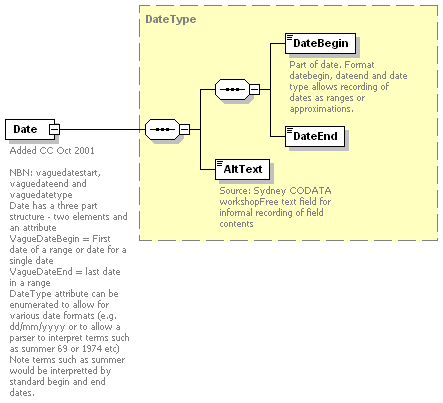 |
||||||||||||
| type | DateType | ||||||||||||
| children | DateBegin DateEnd AltText | ||||||||||||
| attributes |
|
||||||||||||
| annotation |
|
||||||||||||
| source | <xs:element name="Date" type="DateType" minOccurs="0" maxOccurs="unbounded"> <xs:annotation> <xs:documentation>Added CC Oct 2001 NBN: vaguedatestart, vaguedateend and vaguedatetype Date has a three part structure - two elements and an attribute VagueDateBegin = First date of a range or date for a single date VagueDateEnd = last date in a range DateType attribute can be enumerated to allow for various date formats (e.g. dd/mm/yyyy or to allow a parser to interpret terms such as summer 69 or 1974 etc) Note terms such as summer would be interpretted by standard begin and end dates.</xs:documentation> </xs:annotation> </xs:element> |
| diagram |  |
||
| type | Comment | ||
| annotation |
|
||
| source | <xs:element name="Comment" type="Comment" minOccurs="0"> <xs:annotation> <xs:documentation>Added by CC Oct 2001Free text of formatted text (rtf) description of the feature - not controlled length e.g. often a memo field</xs:documentation> </xs:annotation> </xs:element> |
| diagram | 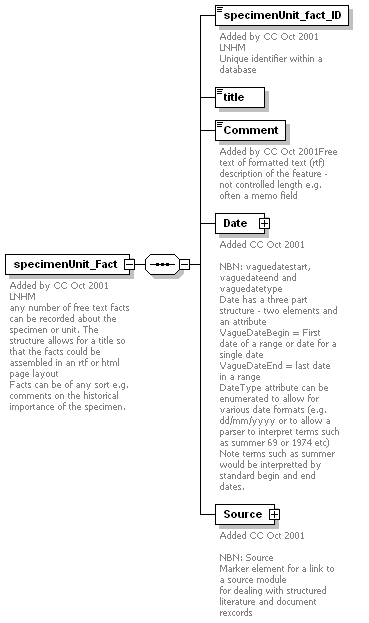 |
||||||||||||||||||||||||||||||||||||||||||
| children | specimenUnit_fact_ID title Comment Date Source | ||||||||||||||||||||||||||||||||||||||||||
| attributes |
|
||||||||||||||||||||||||||||||||||||||||||
| annotation |
|
||||||||||||||||||||||||||||||||||||||||||
| source | <xs:element name="specimenUnit_Fact" minOccurs="0" maxOccurs="unbounded"> <xs:annotation> <xs:documentation>Added by CC Oct 2001 LNHM any number of free text facts can be recorded about the specimen or unit. The structure allows for a title so that the facts could be assembled in an rtf or html page layout Facts can be of any sort e.g. comments on the historical importance of the specimen.</xs:documentation> </xs:annotation> <xs:complexType> <xs:sequence> <xs:element name="specimenUnit_fact_ID" type="xs:string"> <xs:annotation> <xs:documentation>Added by CC Oct 2001 LNHM Unique identifier within a database</xs:documentation> </xs:annotation> </xs:element> <xs:element name="title" type="title"/> <xs:element name="Comment" type="Comment"> <xs:annotation> <xs:documentation>Added by CC Oct 2001Free text of formatted text (rtf) description of the feature - not controlled length e.g. often a memo field</xs:documentation> </xs:annotation> </xs:element> <xs:element name="Date" type="DateType"> <xs:annotation> <xs:documentation>Added CC Oct 2001 NBN: vaguedatestart, vaguedateend and vaguedatetype Date has a three part structure - two elements and an attribute VagueDateBegin = First date of a range or date for a single date VagueDateEnd = last date in a range DateType attribute can be enumerated to allow for various date formats (e.g. dd/mm/yyyy or to allow a parser to interpret terms such as summer 69 or 1974 etc) Note terms such as summer would be interpretted by standard begin and end dates.</xs:documentation> </xs:annotation> </xs:element> <xs:element name="Source" type="SourceType"> <xs:annotation> <xs:documentation>Added CC Oct 2001 NBN: Source Marker element for a link to a source module for dealing with structured literature and document rexcords</xs:documentation> </xs:annotation> </xs:element> </xs:sequence> <xs:attribute name="entered_by" type="xs:string" use="required"/> <xs:attribute name="entry_date" type="xs:string" use="required"/> <xs:attribute name="changed_by" type="xs:string"/> <xs:attribute name="changed_date" type="xs:string"/> <xs:attribute name="system_supplied_data" default="No"> <xs:simpleType> <xs:restriction base="xs:NMTOKEN"> <xs:enumeration value="Yes"/> <xs:enumeration value="No"/> </xs:restriction> </xs:simpleType> </xs:attribute> <xs:attribute name="fact_type" type="xs:string"/> </xs:complexType> </xs:element> |
| diagram | 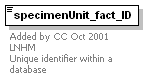 |
||
| type | xs:string | ||
| annotation |
|
||
| source | <xs:element name="specimenUnit_fact_ID" type="xs:string"> <xs:annotation> <xs:documentation>Added by CC Oct 2001 LNHM Unique identifier within a database</xs:documentation> </xs:annotation> </xs:element> |
| diagram |  |
| type | title |
| source | <xs:element name="title" type="title"/> |
| diagram | 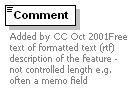 |
||
| type | Comment | ||
| annotation |
|
||
| source | <xs:element name="Comment" type="Comment"> <xs:annotation> <xs:documentation>Added by CC Oct 2001Free text of formatted text (rtf) description of the feature - not controlled length e.g. often a memo field</xs:documentation> </xs:annotation> </xs:element> |
| diagram | 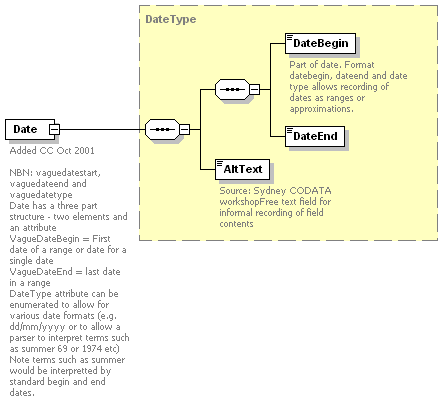 |
||||||||||||
| type | DateType | ||||||||||||
| children | DateBegin DateEnd AltText | ||||||||||||
| attributes |
|
||||||||||||
| annotation |
|
||||||||||||
| source | <xs:element name="Date" type="DateType"> <xs:annotation> <xs:documentation>Added CC Oct 2001 NBN: vaguedatestart, vaguedateend and vaguedatetype Date has a three part structure - two elements and an attribute VagueDateBegin = First date of a range or date for a single date VagueDateEnd = last date in a range DateType attribute can be enumerated to allow for various date formats (e.g. dd/mm/yyyy or to allow a parser to interpret terms such as summer 69 or 1974 etc) Note terms such as summer would be interpretted by standard begin and end dates.</xs:documentation> </xs:annotation> </xs:element> |
| diagram | 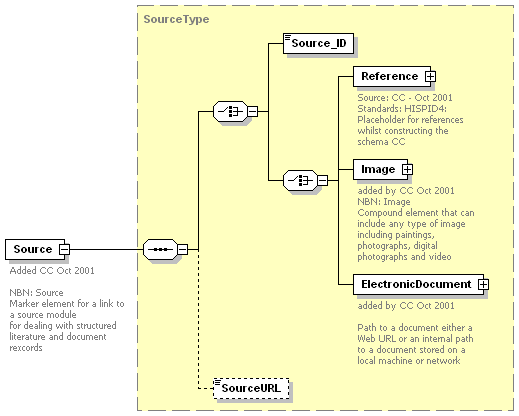 |
||||||||||||
| type | SourceType | ||||||||||||
| children | Source_ID Reference Image ElectronicDocument SourceURL | ||||||||||||
| attributes |
|
||||||||||||
| annotation |
|
||||||||||||
| source | <xs:element name="Source" type="SourceType"> <xs:annotation> <xs:documentation>Added CC Oct 2001 NBN: Source Marker element for a link to a source module for dealing with structured literature and document rexcords</xs:documentation> </xs:annotation> </xs:element> |
| diagram | 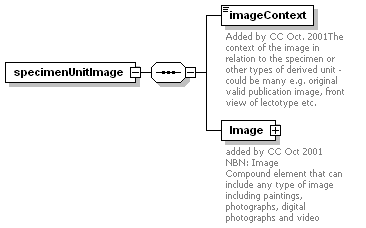 |
| children | imageContext Image |
| source | <xs:element name="specimenUnitImage" minOccurs="0" maxOccurs="unbounded"> <xs:complexType> <xs:sequence> <xs:element name="imageContext" type="xs:string"> <xs:annotation> <xs:documentation>Added by CC Oct. 2001The context of the image in relation to the specimen or other types of derived unit - could be many e.g. original valid publication image, front view of lectotype etc.</xs:documentation> </xs:annotation> </xs:element> <xs:element name="Image" type="ImageType"> <xs:annotation> <xs:documentation>added by CC Oct 2001 NBN: Image Compound element that can include any type of image including paintings, photographs, digital photographs and video</xs:documentation> </xs:annotation> </xs:element> </xs:sequence> </xs:complexType> </xs:element> |
| diagram | 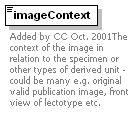 |
||
| type | xs:string | ||
| annotation |
|
||
| source | <xs:element name="imageContext" type="xs:string"> <xs:annotation> <xs:documentation>Added by CC Oct. 2001The context of the image in relation to the specimen or other types of derived unit - could be many e.g. original valid publication image, front view of lectotype etc.</xs:documentation> </xs:annotation> </xs:element> |
| diagram | 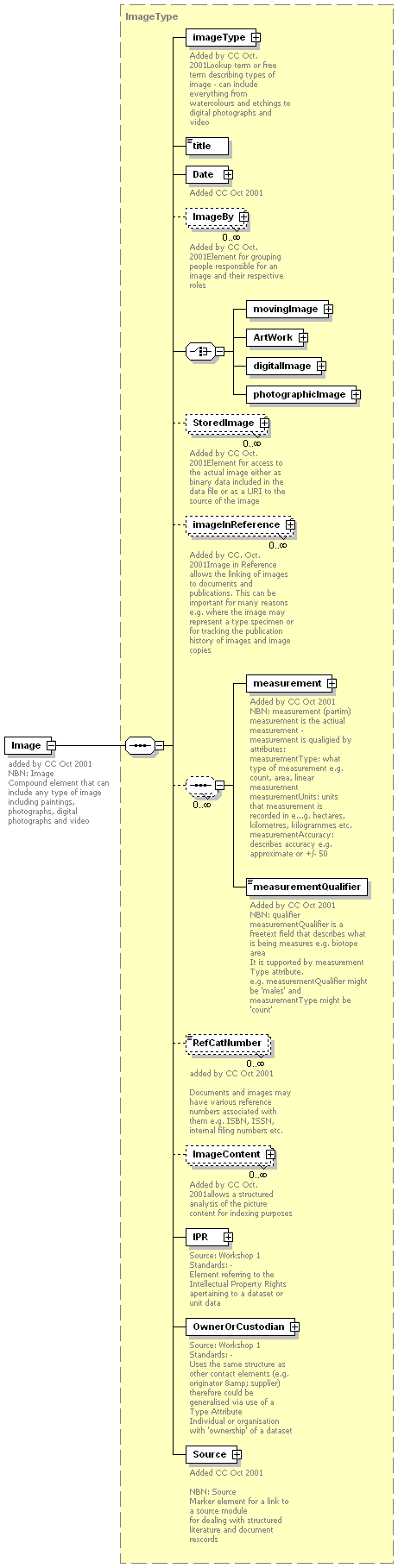 |
||||||||||||
| type | ImageType | ||||||||||||
| children | imageType title Date ImageBy movingImage ArtWork digitalImage photographicImage StoredImage imageInReference measurement measurementQualifier RefCatNumber ImageContent IPR OwnerOrCustodian Source | ||||||||||||
| attributes |
|
||||||||||||
| annotation |
|
||||||||||||
| source | <xs:element name="Image" type="ImageType"> <xs:annotation> <xs:documentation>added by CC Oct 2001 NBN: Image Compound element that can include any type of image including paintings, photographs, digital photographs and video</xs:documentation> </xs:annotation> </xs:element> |
| diagram | 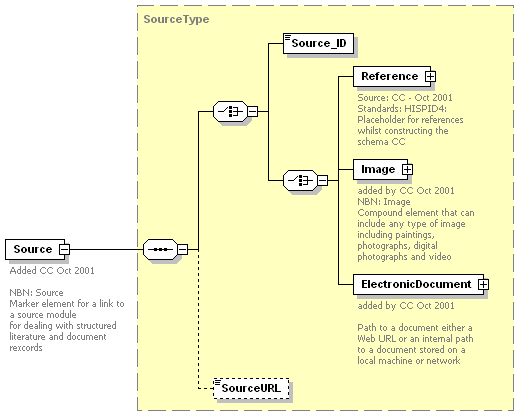 |
||||||||||||
| type | SourceType | ||||||||||||
| children | Source_ID Reference Image ElectronicDocument SourceURL | ||||||||||||
| attributes |
|
||||||||||||
| annotation |
|
||||||||||||
| source | <xs:element name="Source" type="SourceType" minOccurs="0" maxOccurs="unbounded"> <xs:annotation> <xs:documentation>Added CC Oct 2001 NBN: Source Marker element for a link to a source module for dealing with structured literature and document rexcords </xs:documentation> </xs:annotation> </xs:element> |
| diagram | 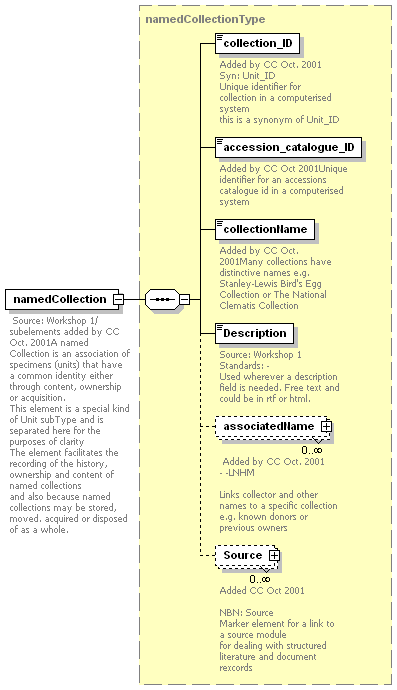 |
||||||||||||||||||
| type | namedCollectionType | ||||||||||||||||||
| children | collection_ID accession_catalogue_ID collectionName Description associatedName Source | ||||||||||||||||||
| attributes |
|
||||||||||||||||||
| annotation |
|
||||||||||||||||||
| source | <xs:element name="namedCollection" type="namedCollectionType" minOccurs="0"> <xs:annotation> <xs:documentation> Source: Workshop 1/ subelements added by CC Oct. 2001A named Collection is an association of specimens (units) that have a common identity either through content, ownership or acquisition. This element is a special kind of Unit subType and is separated here for the purposes of clarity The element facilitates the recording of the history, ownership and content of named collections and also because named collections may be stored, moved. acquired or disposed of as a whole.</xs:documentation> </xs:annotation> </xs:element> |
| diagram |  |
||
| type | Description | ||
| annotation |
|
||
| source | <xs:element name="Description" type="Description" minOccurs="0"> <xs:annotation> <xs:documentation>Source: Workshop 1 Standards: - Used wherever a description field is needed. Free text and could be in rtf or html.</xs:documentation> </xs:annotation> </xs:element> |
| diagram | 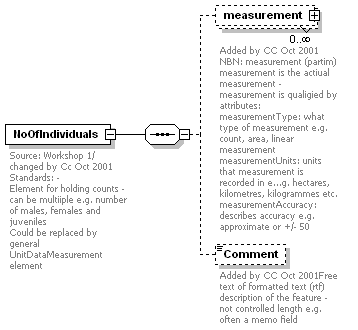 |
||
| children | measurement Comment | ||
| annotation |
|
||
| source | <xs:element name="NoOfIndividuals"> <xs:annotation> <xs:documentation>Source: Workshop 1/ changed by Cc Oct 2001 Standards: - Element for holding counts - can be multiiple e.g. number of males, females and juveniles Could be replaced by general UnitDataMeasurement element</xs:documentation> </xs:annotation> <xs:complexType> <xs:sequence> <xs:element name="measurement" type="measurementType" minOccurs="0" maxOccurs="unbounded"> <xs:annotation> <xs:documentation>Added by CC Oct 2001 NBN: measurement (partim) measurement is the actiual measurement - measurement is qualigied by attributes: measurementType: what type of measurement e.g. count, area, linear measurement measurementUnits: units that measurement is recorded in e...g. hectares, kilometres, kilogrammes etc. measurementAccuracy: describes accuracy e.g. approximate or +/- 50</xs:documentation> </xs:annotation> </xs:element> <xs:element name="Comment" type="Comment" minOccurs="0"> <xs:annotation> <xs:documentation>Added by CC Oct 2001Free text of formatted text (rtf) description of the feature - not controlled length e.g. often a memo field</xs:documentation> </xs:annotation> </xs:element> </xs:sequence> </xs:complexType> </xs:element> |
| diagram | 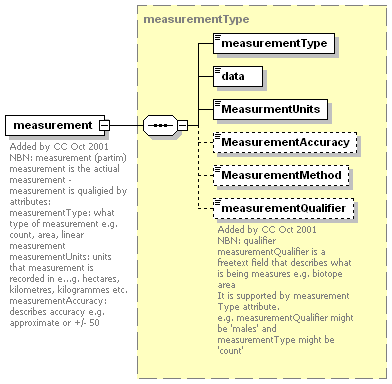 |
||
| type | measurementType | ||
| children | measurementType data MeasurmentUnits MeasurementAccuracy MeasurementMethod measurementQualifier | ||
| annotation |
|
||
| source | <xs:element name="measurement" type="measurementType" minOccurs="0" maxOccurs="unbounded"> <xs:annotation> <xs:documentation>Added by CC Oct 2001 NBN: measurement (partim) measurement is the actiual measurement - measurement is qualigied by attributes: measurementType: what type of measurement e.g. count, area, linear measurement measurementUnits: units that measurement is recorded in e...g. hectares, kilometres, kilogrammes etc. measurementAccuracy: describes accuracy e.g. approximate or +/- 50</xs:documentation> </xs:annotation> </xs:element> |
| diagram |  |
||
| type | Comment | ||
| annotation |
|
||
| source | <xs:element name="Comment" type="Comment" minOccurs="0"> <xs:annotation> <xs:documentation>Added by CC Oct 2001Free text of formatted text (rtf) description of the feature - not controlled length e.g. often a memo field</xs:documentation> </xs:annotation> </xs:element> |
| diagram | 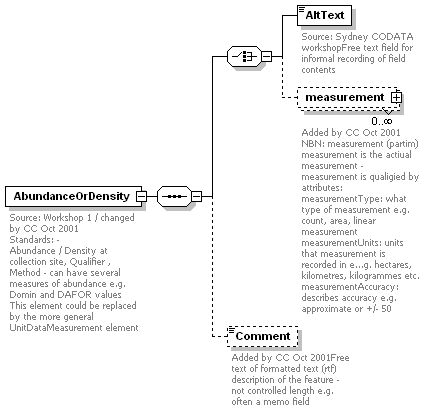 |
||
| children | AltText measurement Comment | ||
| annotation |
|
||
| source | <xs:element name="AbundanceOrDensity" minOccurs="0"> <xs:annotation> <xs:documentation>Source: Workshop 1 / changed by CC Oct 2001 Standards: - Abundance / Density at collection site, Qualifier , Method - can have several measures of abundance e.g. Domin and DAFOR values This element could be replaced by the more general UnitDataMeasurement element</xs:documentation> </xs:annotation> <xs:complexType> <xs:sequence> <xs:choice> <xs:element name="AltText" type="AltText"> <xs:annotation> <xs:documentation>Source: Sydney CODATA workshopFree text field for informal recording of field contents</xs:documentation> </xs:annotation> </xs:element> <xs:element name="measurement" type="measurementType" minOccurs="0" maxOccurs="unbounded"> <xs:annotation> <xs:documentation>Added by CC Oct 2001 NBN: measurement (partim) measurement is the actiual measurement - measurement is qualigied by attributes: measurementType: what type of measurement e.g. count, area, linear measurement measurementUnits: units that measurement is recorded in e...g. hectares, kilometres, kilogrammes etc. measurementAccuracy: describes accuracy e.g. approximate or +/- 50</xs:documentation> </xs:annotation> </xs:element> </xs:choice> <xs:element name="Comment" type="Comment" minOccurs="0"> <xs:annotation> <xs:documentation>Added by CC Oct 2001Free text of formatted text (rtf) description of the feature - not controlled length e.g. often a memo field</xs:documentation> </xs:annotation> </xs:element> </xs:sequence> </xs:complexType> </xs:element> |
| diagram |  |
||
| type | AltText | ||
| annotation |
|
||
| source | <xs:element name="AltText" type="AltText"> <xs:annotation> <xs:documentation>Source: Sydney CODATA workshopFree text field for informal recording of field contents</xs:documentation> </xs:annotation> </xs:element> |
| diagram | 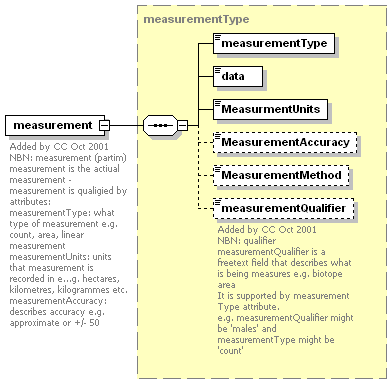 |
||
| type | measurementType | ||
| children | measurementType data MeasurmentUnits MeasurementAccuracy MeasurementMethod measurementQualifier | ||
| annotation |
|
||
| source | <xs:element name="measurement" type="measurementType" minOccurs="0" maxOccurs="unbounded"> <xs:annotation> <xs:documentation>Added by CC Oct 2001 NBN: measurement (partim) measurement is the actiual measurement - measurement is qualigied by attributes: measurementType: what type of measurement e.g. count, area, linear measurement measurementUnits: units that measurement is recorded in e...g. hectares, kilometres, kilogrammes etc. measurementAccuracy: describes accuracy e.g. approximate or +/- 50</xs:documentation> </xs:annotation> </xs:element> |
| diagram | 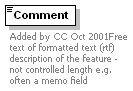 |
||
| type | Comment | ||
| annotation |
|
||
| source | <xs:element name="Comment" type="Comment" minOccurs="0"> <xs:annotation> <xs:documentation>Added by CC Oct 2001Free text of formatted text (rtf) description of the feature - not controlled length e.g. often a memo field</xs:documentation> </xs:annotation> </xs:element> |
| diagram | 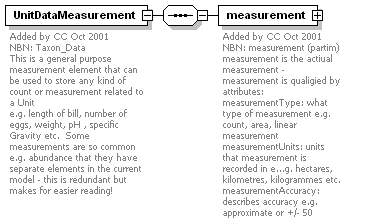 |
||||||||||||
| children | measurement | ||||||||||||
| attributes |
|
||||||||||||
| annotation |
|
||||||||||||
| source | <xs:element name="UnitDataMeasurement" minOccurs="0" maxOccurs="unbounded"> <xs:annotation> <xs:documentation>Added by CC Oct 2001 NBN: Taxon_Data This is a general purpose measurement element that can be used to store any kind of count or measurement related to a Unit e.g. length of bill, number of eggs, weight, pH , specific Gravity etc. Some measurements are so common e.g. abundance that they have separate elements in the current model - this is redundant but makes for easier reading!</xs:documentation> </xs:annotation> <xs:complexType> <xs:sequence> <xs:element name="measurement" type="measurementType"> <xs:annotation> <xs:documentation>Added by CC Oct 2001 NBN: measurement (partim) measurement is the actiual measurement - measurement is qualigied by attributes: measurementType: what type of measurement e.g. count, area, linear measurement measurementUnits: units that measurement is recorded in e...g. hectares, kilometres, kilogrammes etc. measurementAccuracy: describes accuracy e.g. approximate or +/- 50</xs:documentation> </xs:annotation> </xs:element> </xs:sequence> <xs:attribute name="UnitDataMeasurement_ID" type="xs:string"/> </xs:complexType> </xs:element> |
| diagram | 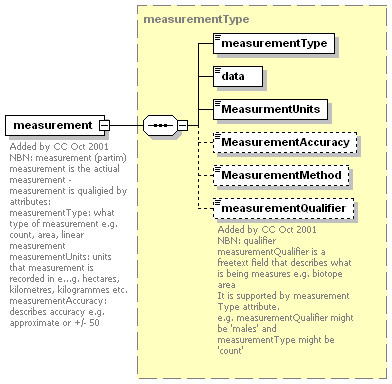 |
||
| type | measurementType | ||
| children | measurementType data MeasurmentUnits MeasurementAccuracy MeasurementMethod measurementQualifier | ||
| annotation |
|
||
| source | <xs:element name="measurement" type="measurementType"> <xs:annotation> <xs:documentation>Added by CC Oct 2001 NBN: measurement (partim) measurement is the actiual measurement - measurement is qualigied by attributes: measurementType: what type of measurement e.g. count, area, linear measurement measurementUnits: units that measurement is recorded in e...g. hectares, kilometres, kilogrammes etc. measurementAccuracy: describes accuracy e.g. approximate or +/- 50</xs:documentation> </xs:annotation> </xs:element> |
| diagram | 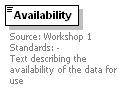 |
||
| type | xs:string | ||
| annotation |
|
||
| source | <xs:element name="Availability" type="xs:string" minOccurs="0"> <xs:annotation> <xs:documentation>Source: Workshop 1 Standards: - Text describing the availability of the data for use</xs:documentation> </xs:annotation> </xs:element> |
| diagram | 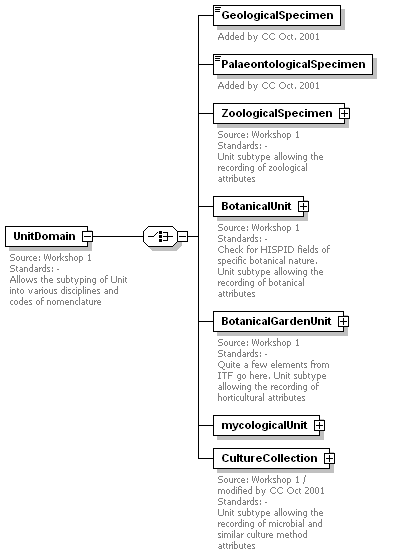 |
||
| children | GeologicalSpecimen PalaeontologicalSpecimen ZoologicalSpecimen BotanicalUnit BotanicalGardenUnit mycologicalUnit CultureCollection | ||
| annotation |
|
||
| source | <xs:element name="UnitDomain"> <xs:annotation> <xs:documentation>Source: Workshop 1 Standards: - Allows the subtyping of Unit into various disciplines and codes of nomenclature</xs:documentation> </xs:annotation> <xs:complexType> <xs:choice> <xs:element name="GeologicalSpecimen" type="xs:string"> <xs:annotation> <xs:documentation>Added by CC Oct. 2001</xs:documentation> </xs:annotation> </xs:element> <xs:element name="PalaeontologicalSpecimen" type="xs:string"> <xs:annotation> <xs:documentation>Added by CC Oct. 2001</xs:documentation> </xs:annotation> </xs:element> <xs:element name="ZoologicalSpecimen"> <xs:annotation> <xs:documentation>Source: Workshop 1 Standards: - Unit subtype allowing the recording of zoological attributes</xs:documentation> </xs:annotation> <xs:complexType> <xs:sequence> <xs:element name="ZoologyAge" type="xs:string"> <xs:annotation> <xs:documentation>Source: Workshop 1 Standards: -</xs:documentation> </xs:annotation> </xs:element> <xs:element name="ZoologySex" type="xs:string"> <xs:annotation> <xs:documentation>Source: Workshop 1 Standards: -</xs:documentation> </xs:annotation> </xs:element> <xs:element name="ZoologyPhase" type="xs:string"> <xs:annotation> <xs:documentation>Source: Workshop 1 Standards: -</xs:documentation> </xs:annotation> </xs:element> </xs:sequence> </xs:complexType> </xs:element> <xs:element name="BotanicalUnit"> <xs:annotation> <xs:documentation>Source: Workshop 1 Standards: - Check for HISPID fields of specific botanical nature. Unit subtype allowing the recording of botanical attributes</xs:documentation> </xs:annotation> <xs:complexType> <xs:sequence> <xs:element name="Unit_ID" type="Unit_ID" minOccurs="0"> <xs:annotation> <xs:documentation>Source: Workshop 1 Standards: - Taxon48: Unit_ID / NBN: Sample_KeyUnit key or Identifying number - can be multiple</xs:documentation> </xs:annotation> </xs:element> </xs:sequence> </xs:complexType> </xs:element> <xs:element name="BotanicalGardenUnit"> <xs:annotation> <xs:documentation>Source: Workshop 1 Standards: - Quite a few elements from ITF go here. Unit subtype allowing the recording of horticultural attributes</xs:documentation> </xs:annotation> <xs:complexType> <xs:sequence> <xs:element name="Unit_ID" type="Unit_ID" minOccurs="0"> <xs:annotation> <xs:documentation>Source: Workshop 1 Standards: - Taxon48: Unit_ID / NBN: Sample_KeyUnit key or Identifying number - can be multiple</xs:documentation> </xs:annotation> </xs:element> <xs:element name="Hardiness" type="xs:string"> <xs:annotation> <xs:documentation>Source: Workshop 1 Standards: - </xs:documentation> </xs:annotation> </xs:element> </xs:sequence> </xs:complexType> </xs:element> <xs:element name="mycologicalUnit"> <xs:complexType> <xs:sequence> <xs:element name="LichenMorphotype" type="xs:string" minOccurs="0"> <xs:annotation> <xs:documentation>Source:Paul Kirk (in email) Standards: - Name of algal or cyanobacterial component of lichen</xs:documentation> </xs:annotation> </xs:element> <xs:element name="MycologicalLiveStage" type="xs:string" minOccurs="0"> <xs:annotation> <xs:documentation>Source:Paul Kirk (in email) Standards: -</xs:documentation> </xs:annotation> </xs:element> <xs:element name="MycologicalSexualStage" type="xs:string" minOccurs="0"> <xs:annotation> <xs:documentation>Source:Paul Kirk (in email) Standards: -</xs:documentation> </xs:annotation> </xs:element> </xs:sequence> </xs:complexType> </xs:element> <xs:element name="CultureCollection"> <xs:annotation> <xs:documentation>Source: Workshop 1 / modified by CC Oct 2001 Standards: - Unit subtype allowing the recording of microbial and similar culture method attributes</xs:documentation> </xs:annotation> <xs:complexType> <xs:sequence> <xs:sequence maxOccurs="unbounded"> <xs:element name="Unit_ID" type="Unit_ID" minOccurs="0"> <xs:annotation> <xs:documentation>Source: Workshop 1 Standards: - Taxon48: Unit_ID / NBN: Sample_KeyUnit key or Identifying number - can be multiple</xs:documentation> </xs:annotation> </xs:element> <xs:element name="CultureName" type="xs:string" minOccurs="0"> <xs:annotation> <xs:documentation>Added by CC Oct. 2001Reference or trade name for a microbial culture</xs:documentation> </xs:annotation> </xs:element> </xs:sequence> <xs:element name="GrowthConditions" type="xs:string" minOccurs="0"> <xs:annotation> <xs:documentation>Source: Workshop 1 Standards: - </xs:documentation> </xs:annotation> </xs:element> <xs:element name="CultureMedium" type="xs:string" minOccurs="0"> <xs:annotation> <xs:documentation>Source: Workshop 1 Standards: - The growth medium for a microbial or similar culture e.g. agar</xs:documentation> </xs:annotation> </xs:element> <xs:element name="Aerobicity" type="xs:string" minOccurs="0"> <xs:annotation> <xs:documentation>Source: Workshop 1 Standards: -</xs:documentation> </xs:annotation> </xs:element> <xs:element name="Temperature" minOccurs="0"> <xs:annotation> <xs:documentation>Source: Workshop 1 Standards: - Preferably a number - attribute gives temperature scale used</xs:documentation> </xs:annotation> <xs:complexType> <xs:simpleContent> <xs:extension base="xs:string"> <xs:attribute name="TempType"> <xs:simpleType> <xs:restriction base="xs:NMTOKEN"> <xs:enumeration value="Celsius"/> <xs:enumeration value="Fahrenheit"/> <xs:enumeration value="Absolute"/> </xs:restriction> </xs:simpleType> </xs:attribute> </xs:extension> </xs:simpleContent> </xs:complexType> </xs:element> <xs:element name="Applications" type="xs:string" minOccurs="0"> <xs:annotation> <xs:documentation>Source: Workshop 1 Standards: - </xs:documentation> </xs:annotation> </xs:element> <xs:element name="Source" type="SourceType" minOccurs="0" maxOccurs="unbounded"> <xs:annotation> <xs:documentation>Added CC Oct 2001 NBN: Source Marker element for a link to a source module for dealing with structured literature and document rexcords</xs:documentation> </xs:annotation> </xs:element> <xs:element name="Hazard" type="xs:string" minOccurs="0"> <xs:annotation> <xs:documentation>Source: Workshop 1 Standards: -</xs:documentation> </xs:annotation> </xs:element> </xs:sequence> </xs:complexType> </xs:element> </xs:choice> </xs:complexType> </xs:element> |
| diagram |  |
||
| type | xs:string | ||
| annotation |
|
||
| source | <xs:element name="GeologicalSpecimen" type="xs:string"> <xs:annotation> <xs:documentation>Added by CC Oct. 2001</xs:documentation> </xs:annotation> </xs:element> |
| diagram |  |
||
| type | xs:string | ||
| annotation |
|
||
| source | <xs:element name="PalaeontologicalSpecimen" type="xs:string"> <xs:annotation> <xs:documentation>Added by CC Oct. 2001</xs:documentation> </xs:annotation> </xs:element> |
| diagram | 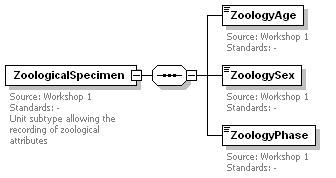 |
||
| children | ZoologyAge ZoologySex ZoologyPhase | ||
| annotation |
|
||
| source | <xs:element name="ZoologicalSpecimen"> <xs:annotation> <xs:documentation>Source: Workshop 1 Standards: - Unit subtype allowing the recording of zoological attributes</xs:documentation> </xs:annotation> <xs:complexType> <xs:sequence> <xs:element name="ZoologyAge" type="xs:string"> <xs:annotation> <xs:documentation>Source: Workshop 1 Standards: -</xs:documentation> </xs:annotation> </xs:element> <xs:element name="ZoologySex" type="xs:string"> <xs:annotation> <xs:documentation>Source: Workshop 1 Standards: -</xs:documentation> </xs:annotation> </xs:element> <xs:element name="ZoologyPhase" type="xs:string"> <xs:annotation> <xs:documentation>Source: Workshop 1 Standards: -</xs:documentation> </xs:annotation> </xs:element> </xs:sequence> </xs:complexType> </xs:element> |
| diagram |  |
||
| type | xs:string | ||
| annotation |
|
||
| source | <xs:element name="ZoologyAge" type="xs:string"> <xs:annotation> <xs:documentation>Source: Workshop 1 Standards: -</xs:documentation> </xs:annotation> </xs:element> |
| diagram |  |
||
| type | xs:string | ||
| annotation |
|
||
| source | <xs:element name="ZoologySex" type="xs:string"> <xs:annotation> <xs:documentation>Source: Workshop 1 Standards: -</xs:documentation> </xs:annotation> </xs:element> |
| diagram |  |
||
| type | xs:string | ||
| annotation |
|
||
| source | <xs:element name="ZoologyPhase" type="xs:string"> <xs:annotation> <xs:documentation>Source: Workshop 1 Standards: -</xs:documentation> </xs:annotation> </xs:element> |
| diagram | 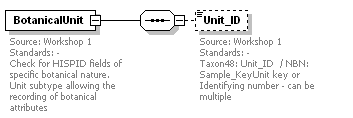 |
||
| children | Unit_ID | ||
| annotation |
|
||
| source | <xs:element name="BotanicalUnit"> <xs:annotation> <xs:documentation>Source: Workshop 1 Standards: - Check for HISPID fields of specific botanical nature. Unit subtype allowing the recording of botanical attributes</xs:documentation> </xs:annotation> <xs:complexType> <xs:sequence> <xs:element name="Unit_ID" type="Unit_ID" minOccurs="0"> <xs:annotation> <xs:documentation>Source: Workshop 1 Standards: - Taxon48: Unit_ID / NBN: Sample_KeyUnit key or Identifying number - can be multiple</xs:documentation> </xs:annotation> </xs:element> </xs:sequence> </xs:complexType> </xs:element> |
| diagram |  |
||
| type | Unit_ID | ||
| annotation |
|
||
| source | <xs:element name="Unit_ID" type="Unit_ID" minOccurs="0"> <xs:annotation> <xs:documentation>Source: Workshop 1 Standards: - Taxon48: Unit_ID / NBN: Sample_KeyUnit key or Identifying number - can be multiple</xs:documentation> </xs:annotation> </xs:element> |
| diagram | 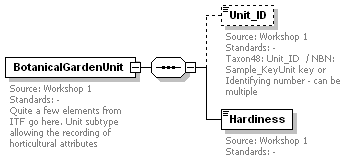 |
||
| children | Unit_ID Hardiness | ||
| annotation |
|
||
| source | <xs:element name="BotanicalGardenUnit"> <xs:annotation> <xs:documentation>Source: Workshop 1 Standards: - Quite a few elements from ITF go here. Unit subtype allowing the recording of horticultural attributes</xs:documentation> </xs:annotation> <xs:complexType> <xs:sequence> <xs:element name="Unit_ID" type="Unit_ID" minOccurs="0"> <xs:annotation> <xs:documentation>Source: Workshop 1 Standards: - Taxon48: Unit_ID / NBN: Sample_KeyUnit key or Identifying number - can be multiple</xs:documentation> </xs:annotation> </xs:element> <xs:element name="Hardiness" type="xs:string"> <xs:annotation> <xs:documentation>Source: Workshop 1 Standards: - </xs:documentation> </xs:annotation> </xs:element> </xs:sequence> </xs:complexType> </xs:element> |
| diagram |  |
||
| type | Unit_ID | ||
| annotation |
|
||
| source | <xs:element name="Unit_ID" type="Unit_ID" minOccurs="0"> <xs:annotation> <xs:documentation>Source: Workshop 1 Standards: - Taxon48: Unit_ID / NBN: Sample_KeyUnit key or Identifying number - can be multiple</xs:documentation> </xs:annotation> </xs:element> |
| diagram |  |
||
| type | xs:string | ||
| annotation |
|
||
| source | <xs:element name="Hardiness" type="xs:string"> <xs:annotation> <xs:documentation>Source: Workshop 1 Standards: - </xs:documentation> </xs:annotation> </xs:element> |
| diagram | 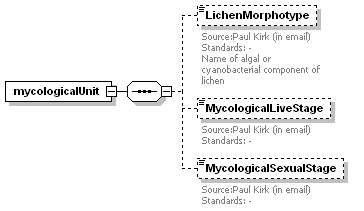 |
| children | LichenMorphotype MycologicalLiveStage MycologicalSexualStage |
| source | <xs:element name="mycologicalUnit"> <xs:complexType> <xs:sequence> <xs:element name="LichenMorphotype" type="xs:string" minOccurs="0"> <xs:annotation> <xs:documentation>Source:Paul Kirk (in email) Standards: - Name of algal or cyanobacterial component of lichen</xs:documentation> </xs:annotation> </xs:element> <xs:element name="MycologicalLiveStage" type="xs:string" minOccurs="0"> <xs:annotation> <xs:documentation>Source:Paul Kirk (in email) Standards: -</xs:documentation> </xs:annotation> </xs:element> <xs:element name="MycologicalSexualStage" type="xs:string" minOccurs="0"> <xs:annotation> <xs:documentation>Source:Paul Kirk (in email) Standards: -</xs:documentation> </xs:annotation> </xs:element> </xs:sequence> </xs:complexType> </xs:element> |
| diagram |  |
||
| type | xs:string | ||
| annotation |
|
||
| source | <xs:element name="LichenMorphotype" type="xs:string" minOccurs="0"> <xs:annotation> <xs:documentation>Source:Paul Kirk (in email) Standards: - Name of algal or cyanobacterial component of lichen</xs:documentation> </xs:annotation> </xs:element> |
| diagram |  |
||
| type | xs:string | ||
| annotation |
|
||
| source | <xs:element name="MycologicalLiveStage" type="xs:string" minOccurs="0"> <xs:annotation> <xs:documentation>Source:Paul Kirk (in email) Standards: -</xs:documentation> </xs:annotation> </xs:element> |
| diagram |  |
||
| type | xs:string | ||
| annotation |
|
||
| source | <xs:element name="MycologicalSexualStage" type="xs:string" minOccurs="0"> <xs:annotation> <xs:documentation>Source:Paul Kirk (in email) Standards: -</xs:documentation> </xs:annotation> </xs:element> |
| diagram | 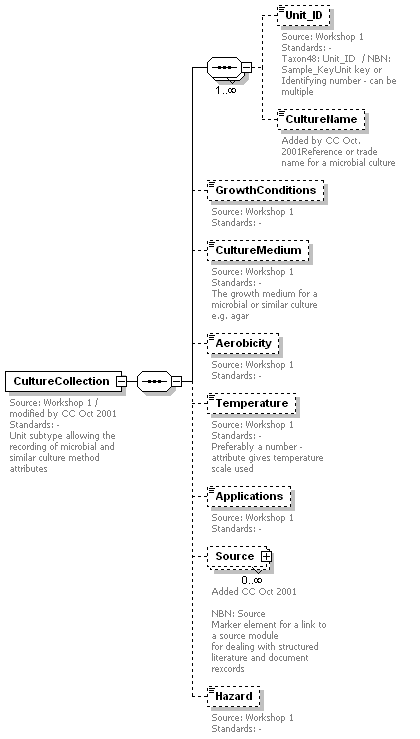 |
||
| children | Unit_ID CultureName GrowthConditions CultureMedium Aerobicity Temperature Applications Source Hazard | ||
| annotation |
|
||
| source | <xs:element name="CultureCollection"> <xs:annotation> <xs:documentation>Source: Workshop 1 / modified by CC Oct 2001 Standards: - Unit subtype allowing the recording of microbial and similar culture method attributes</xs:documentation> </xs:annotation> <xs:complexType> <xs:sequence> <xs:sequence maxOccurs="unbounded"> <xs:element name="Unit_ID" type="Unit_ID" minOccurs="0"> <xs:annotation> <xs:documentation>Source: Workshop 1 Standards: - Taxon48: Unit_ID / NBN: Sample_KeyUnit key or Identifying number - can be multiple</xs:documentation> </xs:annotation> </xs:element> <xs:element name="CultureName" type="xs:string" minOccurs="0"> <xs:annotation> <xs:documentation>Added by CC Oct. 2001Reference or trade name for a microbial culture</xs:documentation> </xs:annotation> </xs:element> </xs:sequence> <xs:element name="GrowthConditions" type="xs:string" minOccurs="0"> <xs:annotation> <xs:documentation>Source: Workshop 1 Standards: - </xs:documentation> </xs:annotation> </xs:element> <xs:element name="CultureMedium" type="xs:string" minOccurs="0"> <xs:annotation> <xs:documentation>Source: Workshop 1 Standards: - The growth medium for a microbial or similar culture e.g. agar</xs:documentation> </xs:annotation> </xs:element> <xs:element name="Aerobicity" type="xs:string" minOccurs="0"> <xs:annotation> <xs:documentation>Source: Workshop 1 Standards: -</xs:documentation> </xs:annotation> </xs:element> <xs:element name="Temperature" minOccurs="0"> <xs:annotation> <xs:documentation>Source: Workshop 1 Standards: - Preferably a number - attribute gives temperature scale used</xs:documentation> </xs:annotation> <xs:complexType> <xs:simpleContent> <xs:extension base="xs:string"> <xs:attribute name="TempType"> <xs:simpleType> <xs:restriction base="xs:NMTOKEN"> <xs:enumeration value="Celsius"/> <xs:enumeration value="Fahrenheit"/> <xs:enumeration value="Absolute"/> </xs:restriction> </xs:simpleType> </xs:attribute> </xs:extension> </xs:simpleContent> </xs:complexType> </xs:element> <xs:element name="Applications" type="xs:string" minOccurs="0"> <xs:annotation> <xs:documentation>Source: Workshop 1 Standards: - </xs:documentation> </xs:annotation> </xs:element> <xs:element name="Source" type="SourceType" minOccurs="0" maxOccurs="unbounded"> <xs:annotation> <xs:documentation>Added CC Oct 2001 NBN: Source Marker element for a link to a source module for dealing with structured literature and document rexcords</xs:documentation> </xs:annotation> </xs:element> <xs:element name="Hazard" type="xs:string" minOccurs="0"> <xs:annotation> <xs:documentation>Source: Workshop 1 Standards: -</xs:documentation> </xs:annotation> </xs:element> </xs:sequence> </xs:complexType> </xs:element> |
| diagram |  |
||
| type | Unit_ID | ||
| annotation |
|
||
| source | <xs:element name="Unit_ID" type="Unit_ID" minOccurs="0"> <xs:annotation> <xs:documentation>Source: Workshop 1 Standards: - Taxon48: Unit_ID / NBN: Sample_KeyUnit key or Identifying number - can be multiple</xs:documentation> </xs:annotation> </xs:element> |
| diagram |  |
||
| type | xs:string | ||
| annotation |
|
||
| source | <xs:element name="CultureName" type="xs:string" minOccurs="0"> <xs:annotation> <xs:documentation>Added by CC Oct. 2001Reference or trade name for a microbial culture</xs:documentation> </xs:annotation> </xs:element> |
| diagram |  |
||
| type | xs:string | ||
| annotation |
|
||
| source | <xs:element name="GrowthConditions" type="xs:string" minOccurs="0"> <xs:annotation> <xs:documentation>Source: Workshop 1 Standards: - </xs:documentation> </xs:annotation> </xs:element> |
| diagram |  |
||
| type | xs:string | ||
| annotation |
|
||
| source | <xs:element name="CultureMedium" type="xs:string" minOccurs="0"> <xs:annotation> <xs:documentation>Source: Workshop 1 Standards: - The growth medium for a microbial or similar culture e.g. agar</xs:documentation> </xs:annotation> </xs:element> |
| diagram |  |
||
| type | xs:string | ||
| annotation |
|
||
| source | <xs:element name="Aerobicity" type="xs:string" minOccurs="0"> <xs:annotation> <xs:documentation>Source: Workshop 1 Standards: -</xs:documentation> </xs:annotation> </xs:element> |
| diagram |  |
||||||||||||
| type | extension of xs:string | ||||||||||||
| attributes |
|
||||||||||||
| annotation |
|
||||||||||||
| source | <xs:element name="Temperature" minOccurs="0"> <xs:annotation> <xs:documentation>Source: Workshop 1 Standards: - Preferably a number - attribute gives temperature scale used</xs:documentation> </xs:annotation> <xs:complexType> <xs:simpleContent> <xs:extension base="xs:string"> <xs:attribute name="TempType"> <xs:simpleType> <xs:restriction base="xs:NMTOKEN"> <xs:enumeration value="Celsius"/> <xs:enumeration value="Fahrenheit"/> <xs:enumeration value="Absolute"/> </xs:restriction> </xs:simpleType> </xs:attribute> </xs:extension> </xs:simpleContent> </xs:complexType> </xs:element> |
| diagram |  |
||
| type | xs:string | ||
| annotation |
|
||
| source | <xs:element name="Applications" type="xs:string" minOccurs="0"> <xs:annotation> <xs:documentation>Source: Workshop 1 Standards: - </xs:documentation> </xs:annotation> </xs:element> |
| diagram | 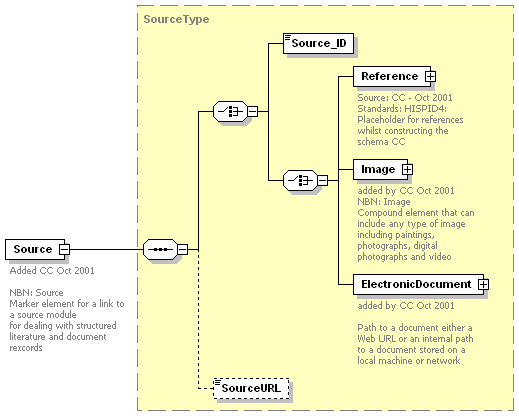 |
||||||||||||
| type | SourceType | ||||||||||||
| children | Source_ID Reference Image ElectronicDocument SourceURL | ||||||||||||
| attributes |
|
||||||||||||
| annotation |
|
||||||||||||
| source | <xs:element name="Source" type="SourceType" minOccurs="0" maxOccurs="unbounded"> <xs:annotation> <xs:documentation>Added CC Oct 2001 NBN: Source Marker element for a link to a source module for dealing with structured literature and document rexcords</xs:documentation> </xs:annotation> </xs:element> |
| diagram |  |
||
| type | xs:string | ||
| annotation |
|
||
| source | <xs:element name="Hazard" type="xs:string" minOccurs="0"> <xs:annotation> <xs:documentation>Source: Workshop 1 Standards: -</xs:documentation> </xs:annotation> </xs:element> |
| diagram |  |
||
| children | Project GatheringAgent GatheringCode GatheringDateTime GatheringSite GatheringEventData Substrate Aspect Exposure Slope Altitude | ||
| annotation |
|
||
| source | <xs:element name="GatheringEvent"> <xs:annotation> <xs:documentation>Source: Workshop 1 Standards: - </xs:documentation> </xs:annotation> <xs:complexType> <xs:sequence> <xs:element name="Project" minOccurs="0"> <xs:annotation> <xs:documentation>Source: Workshop 1 / modified by CC Oct 2001 Standards: - Taxon48: Project Proj_Pk </xs:documentation> </xs:annotation> <xs:complexType> <xs:sequence> <xs:element name="Proj_Pk" type="xs:string" minOccurs="0"> <xs:annotation> <xs:documentation>Source: Workshop 1 Standards: - - -Taxon48 Proj_Pk Unique identifier in database</xs:documentation> </xs:annotation> </xs:element> <xs:element name="ParProj_Fk" type="xs:string" minOccurs="0"> <xs:annotation> <xs:documentation>Source: Workshop 1 Standards: - Taxon48: ParProj_Pk Name or reference to a parent project where expedition is part of a bigger project</xs:documentation> </xs:annotation> </xs:element> <xs:element name="ProjTitle" type="xs:string"> <xs:annotation> <xs:documentation>Source: Workshop 1 Standards: - Taxon48: ProjTitle Main project title</xs:documentation> </xs:annotation> </xs:element> <xs:element name="ProjTitle2" type="xs:string" minOccurs="0"> <xs:annotation> <xs:documentation>Source: Workshop 1 Standards: - Taxon48: ProjTitle2 Project subtitle</xs:documentation> </xs:annotation> </xs:element> <xs:element name="PlatformNm" type="xs:string" minOccurs="0"> <xs:annotation> <xs:documentation>Source: Workshop 1 Standards: - - - Taxon48: PlatformNm ASC: PLATFORM-NAM CC. Free text element platform name - refers to the 'platform' from which observations where made e.g. the name of a research vessel or a remote operated vehicle.</xs:documentation> </xs:annotation> </xs:element> <xs:choice> <xs:element name="Duration" type="DurationType"> <xs:annotation> <xs:documentation>Source: Workshop 1/ modified by CC Oct 2001 Standards: - Taxon48: Duration measurement of time elapsed - decimal number</xs:documentation> </xs:annotation> </xs:element> <xs:sequence> <xs:element name="dateFrom"> <xs:annotation> <xs:documentation>Added by CC Oct. 2001Element for recording the starting date in a range</xs:documentation> </xs:annotation> <xs:complexType> <xs:sequence> <xs:element name="Date" type="DateType"/> </xs:sequence> </xs:complexType> </xs:element> <xs:element name="dateTo"> <xs:annotation> <xs:documentation>End date for use in date ranges</xs:documentation> </xs:annotation> <xs:complexType> <xs:sequence> <xs:element name="Date" type="DateType"/> </xs:sequence> </xs:complexType> </xs:element> </xs:sequence> </xs:choice> <xs:choice> <xs:element name="ProjAckn" type="xs:string" minOccurs="0"> <xs:annotation> <xs:documentation>Source: Workshop 1 Standards: - Taxon48: ProjAckn Project funding acknowledgements - free text</xs:documentation> </xs:annotation> </xs:element> </xs:choice> <xs:element name="ProjTxt" type="xs:string" minOccurs="0"> <xs:annotation> <xs:documentation>Source: Workshop 1 Standards: - Taxon48: ProjTxt Free text description of the project</xs:documentation> </xs:annotation> </xs:element> <xs:element name="Contact" type="ContactType" minOccurs="0"> <xs:annotation> <xs:documentation>Source: Workshop 1 modified by CC Oct 2001 Standards: - CC - should address also be part of contact detail? It could be different from the parent element</xs:documentation> </xs:annotation> </xs:element> </xs:sequence> </xs:complexType> </xs:element> <xs:element name="GatheringAgent"> <xs:annotation> <xs:documentation>Source: Workshop 1 / modified CC Oct 2001 Standards: - Taxon48: GatheringAgent incl. LegTm1_Fk,LegTmAl_Fk, LegTmPr_Fk/ NBN: Event_Recorder & Sample_Recorder Not grouped in HISPID The person team responsible for collecting or recording. The element contains a FirstCollector,e.g. the principle team member or organisation name, additional collectors who were part of the team and per Collectors who are other individuals who may have passed specimens or data onto the team. Probably better structured as a repeatable 'Recorder' element with a Type attribute to allow differentiation e.g. botanists and entomologists working on the same team and also a preferred flag for the team leader.</xs:documentation> </xs:annotation> <xs:complexType> <xs:sequence> <xs:element name="FirstCollector"> <xs:annotation> <xs:documentation>Source: Workshop 1 Standards: - ABIS, ITF, TLR NBN: Survey_Recorder & Sample_Recorder HISPID4: Primary Collector's Name (cnam) TDWG: Collector Normally a single person in charge of field book to which records are added or the team leader. May be the person whose collection number is cited. could be an organisation name where collector not known Could be handled by uniting all observers in one repeatable element name with an element attribute for first or preferred</xs:documentation> </xs:annotation> <xs:complexType> <xs:sequence> <xs:element name="name_ID" type="name_ID" minOccurs="0"/> <xs:choice> <xs:element name="Organisation" type="OrganisationType"> <xs:annotation> <xs:documentation>Added by CC Oct 2001Name (elements) for organisations</xs:documentation> </xs:annotation> </xs:element> <xs:element name="PersonName" type="PersonNameType"> <xs:annotation> <xs:documentation>Source: Workshop 1/ changed by CC from old Name Element Standards: - Group element for parts of a personal name - see also name_ID (ref to a database entry) and fullName (free text format)</xs:documentation> </xs:annotation> </xs:element> <xs:element name="AltText" type="AltText"> <xs:annotation> <xs:documentation>Source: Sydney CODATA workshopFree text field for informal recording of field contents</xs:documentation> </xs:annotation> </xs:element> </xs:choice> </xs:sequence> </xs:complexType> </xs:element> <xs:element name="AdditionalCollector" minOccurs="0" maxOccurs="unbounded"> <xs:annotation> <xs:documentation>Source: Workshop 1 Standards: - ITF Taxon48: Additional Collectors / NBN: Event_Recorder & Sample_Recorder / HISPID4: Secondary Collectors Name (cnam2) TDWG: Collteam Persons other than the primary collector responsible for collections or observations</xs:documentation> </xs:annotation> <xs:complexType> <xs:choice> <xs:element name="name_ID" type="name_ID"/> <xs:element name="PersonName" type="PersonNameType"> <xs:annotation> <xs:documentation>Source: Workshop 1/ changed by CC from old Name Element Standards: - Group element for parts of a personal name - see also name_ID (ref to a database entry) and fullName (free text format)</xs:documentation> </xs:annotation> </xs:element> <xs:element name="AltText" type="AltText"> <xs:annotation> <xs:documentation>Source: Sydney CODATA workshopFree text field for informal recording of field contents</xs:documentation> </xs:annotation> </xs:element> </xs:choice> </xs:complexType> </xs:element> <xs:element name="PerCollector" minOccurs="0" maxOccurs="unbounded"> <xs:annotation> <xs:documentation>Source: Workshop 1 Standards: - HISPID4: Per Collector (cper) / NBN: Event_Recorder & Sample_Recorder (Recorders are distinguished by an attribute: Role)'Per' collector - ie person who collected specimen on behalf of a primary collector Free text name but could have syntax rules</xs:documentation> </xs:annotation> <xs:complexType> <xs:sequence> <xs:element name="name_ID" type="name_ID" minOccurs="0"/> <xs:choice> <xs:element name="Organisation" type="OrganisationType"> <xs:annotation> <xs:documentation>Added by CC Oct 2001Name (elements) for organisations</xs:documentation> </xs:annotation> </xs:element> <xs:element name="PersonName" type="PersonNameType"> <xs:annotation> <xs:documentation>Source: Workshop 1/ changed by CC from old Name Element Standards: - Group element for parts of a personal name - see also name_ID (ref to a database entry) and fullName (free text format)</xs:documentation> </xs:annotation> </xs:element> <xs:element name="AltText" type="AltText"> <xs:annotation> <xs:documentation>Source: Sydney CODATA workshopFree text field for informal recording of field contents</xs:documentation> </xs:annotation> </xs:element> </xs:choice> </xs:sequence> </xs:complexType> </xs:element> </xs:sequence> </xs:complexType> </xs:element> <xs:element name="GatheringCode" type="xs:string"> <xs:annotation> <xs:documentation>Source: Workshop 1 Standards: - - - NBN: Sample_Reference Refers to FirstCollector's number or code for the gathering event</xs:documentation> </xs:annotation> </xs:element> <xs:element name="GatheringDateTime"> <xs:annotation> <xs:documentation>Source: Workshop 1 Standards: - HISPID4: cdat NBN: Survey_Event_Date (3 part vague date) Taxon48: GDate Gives date of the gathering or observation event which can be a range or qualified as a vague date (=HISPID4: cdat) can also be attached to GatheringEventSample as a means of adding greater precision to specific groups of observations within a range event (=cdat2 in part)</xs:documentation> </xs:annotation> <xs:complexType> <xs:sequence> <xs:element name="Calendar" type="xs:string" minOccurs="0"> <xs:annotation> <xs:documentation>Source: Workshop 1 Standards: - Which calendar a date pertains to e.g. Julian</xs:documentation> </xs:annotation> </xs:element> <xs:choice> <xs:element name="DateText" type="xs:string"> <xs:annotation> <xs:documentation>Source: Workshop 1 Standards: - includes HISPID4: texcdat NBN: Vague date structure covers this and standard dates in one tripartite element free text field for imprecise dates that do not conform to standard or parsable types</xs:documentation> </xs:annotation> </xs:element> <xs:sequence> <xs:element name="DateModifier" type="xs:string"> <xs:annotation> <xs:documentation>Source: Workshop 1 Standards: -</xs:documentation> </xs:annotation> </xs:element> <xs:element name="BeginYear" type="xs:string"> <xs:annotation> <xs:documentation>Source: Workshop 1 Standards: -</xs:documentation> </xs:annotation> </xs:element> <xs:element name="BeginMonth" type="xs:string"> <xs:annotation> <xs:documentation>Source: Workshop 1 Standards: -</xs:documentation> </xs:annotation> </xs:element> <xs:element name="BeginDay" type="xs:string"> <xs:annotation> <xs:documentation>Source: Workshop 1 Standards: -</xs:documentation> </xs:annotation> </xs:element> <xs:element name="EndYear" type="xs:string"> <xs:annotation> <xs:documentation>Source: Workshop 1 Standards: - Year date fragment for last day of a gathering event - probably unnecessary as could easily be parsed from a standard date type</xs:documentation> </xs:annotation> </xs:element> <xs:element name="EndMonth" type="xs:string"> <xs:annotation> <xs:documentation>Source: Workshop 1 Standards: - month date fragment for last day of a gathering event - probably unnecessary as could easily be parsed from a standard date type</xs:documentation> </xs:annotation> </xs:element> <xs:element name="EndDay" type="xs:string"> <xs:annotation> <xs:documentation>Source: Workshop 1 Standards: - Day date fragment for last day of a gathering event - probably unnecessary as could easily be parsed from a standard date type</xs:documentation> </xs:annotation> </xs:element> </xs:sequence> </xs:choice> </xs:sequence> </xs:complexType> </xs:element> <xs:element name="GatheringSite"> <xs:annotation> <xs:documentation>Source: Workshop 1 Standards: - ABIS, ITF Taxon48: StatedLoc HISPID4: Locality (loc) / TDWG: Locality, Stanloc(?) / ASC Locality-Nam Location at which a Gathering Event takes place Element contains both geospatial and descriptive elements</xs:documentation> </xs:annotation> <xs:complexType> <xs:sequence> <xs:element name="SiteText" type="xs:string"> <xs:annotation> <xs:documentation>Source: Workshop 1 Standards: -</xs:documentation> </xs:annotation> </xs:element> <xs:element name="Country" type="CountryType"> <xs:annotation> <xs:documentation>Source: Workshop 1 Standards: - At least one of Countryname|ISO2|ISO3 should be present but more are allowed This should be the political country having jurisdiction over the collection site. Historical country names and water bodies outside the coastal zone can be entered under named area. CC - There is conflict here between use as an address line (essentially text handy for sorting) and more structured use in collections (GatheringSite) where standardised terms linked to ISO country codes may be desirable </xs:documentation> </xs:annotation> </xs:element> <xs:element name="CountrySubdivision" minOccurs="0" maxOccurs="unbounded"> <xs:annotation> <xs:documentation>Added by CC Oct 2001 standards: Hollis & Brummitt 1992 & local administrative area standards (e.g. NBN Admin Dictionary) Includes HISPID4: pru & sru , could also be used for sgu / NBN: Admin_Area Allows specification of more detailed geographic and administrative area contextual info to a collecting locality Attributes: subdivSrc - enumerated list of standards ( at present just H&B and local) couldbe ref to a lookup list SubdivLevel: level number where that forms part of a classification (e.g. for HISPID pru and sru) AreaType: Allows recording of local or national subdiv. level e.g. county, district, state etc.</xs:documentation> </xs:annotation> <xs:complexType> <xs:sequence> <xs:element name="AreaName" type="xs:string"> <xs:annotation> <xs:documentation>Added by CC Oct 2001 standards: Hollis & Brummitt 1992 & local administrative area standards (e.g. NBN Admin Dictionary) Includes HISPID4: pru & sru / NBN: Admin_Area Free text name - hopefully from a standard list</xs:documentation> </xs:annotation> </xs:element> <xs:element name="AreaCode" type="xs:string"> <xs:annotation> <xs:documentation>Added by CC Oct 2001Allows use of abbreviations and codes for area names</xs:documentation> </xs:annotation> </xs:element> <xs:element name="Source" type="SourceType" minOccurs="0"> <xs:annotation> <xs:documentation>Added CC Oct 2001 NBN: Source Marker element for a link to a source module for dealing with structured literature and document rexcords </xs:documentation> </xs:annotation> </xs:element> </xs:sequence> <xs:attribute name="SubdivSrc"> <xs:simpleType> <xs:restriction base="xs:NMTOKEN"> <xs:enumeration value="local"/> <xs:enumeration value="HB92"/> </xs:restriction> </xs:simpleType> </xs:attribute> <xs:attribute name="SubdivLevel"> <xs:simpleType> <xs:restriction base="xs:NMTOKEN"> <xs:enumeration value="1"/> <xs:enumeration value="2"/> <xs:enumeration value="3"/> <xs:enumeration value="4"/> </xs:restriction> </xs:simpleType> </xs:attribute> <xs:attribute name="AreaType" type="xs:string"/> </xs:complexType> </xs:element> <xs:element name="WorldGeographicScheme" type="xs:string" minOccurs="0"> <xs:annotation> <xs:documentation>Added by CC Oct 2001 Standard: Hollis & Brummitt 1992 HISPID4: wgs Free text - Allows specimens to be allocated to a standard geographic area derived from H&B</xs:documentation> </xs:annotation> </xs:element> <xs:element name="NamedAreas" minOccurs="0" maxOccurs="unbounded"> <xs:annotation> <xs:documentation>Source: Workshop 1 Standards: -</xs:documentation> </xs:annotation> <xs:complexType> <xs:choice> <xs:sequence> <xs:element name="AltText" type="AltText" minOccurs="0"> <xs:annotation> <xs:documentation>Source: Sydney CODATA workshopFree text field for informal recording of field contents</xs:documentation> </xs:annotation> </xs:element> <xs:element name="Language" type="Language"> <xs:annotation> <xs:documentation>Source: Workshop 1 Standards: -</xs:documentation> </xs:annotation> </xs:element> </xs:sequence> <xs:choice> <xs:element name="NamedArea" minOccurs="0" maxOccurs="unbounded"> <xs:annotation> <xs:documentation>Source: Workshop 1 Standards: -</xs:documentation> </xs:annotation> <xs:complexType> <xs:sequence> <xs:element name="NamedAreaSequenceNo" type="xs:string" minOccurs="0"/> <xs:element name="NamedAreaClass" type="xs:string" minOccurs="0"/> <xs:element name="NamedAreaName" type="xs:string"/> <xs:element name="Language" type="Language" minOccurs="0"/> <xs:element name="DerivedFlag" type="DerivedFlag" minOccurs="0"/> </xs:sequence> </xs:complexType> </xs:element> </xs:choice> </xs:choice> </xs:complexType> </xs:element> <xs:element name="AreaDetail" type="xs:string" minOccurs="0"> <xs:annotation> <xs:documentation>Source: Workshop 1 Standards: - Free text description of detail pertaining to the observation, sampling or collection locality</xs:documentation> </xs:annotation> </xs:element> <xs:element name="NearestNamedPlace" type="xs:string" minOccurs="0"> <xs:annotation> <xs:documentation>Source: Workshop 1 Standards: - ABIS, AUSLIG HISPID4: nnp / TDWG: Stanloc The nearest named place to the collection or observation location e.g. on 1:100,000 map or better</xs:documentation> </xs:annotation> </xs:element> <xs:element name="RelationToNearestNamedPlace" type="xs:string" minOccurs="0"> <xs:annotation> <xs:documentation>Source: WGB 10/01 Standards: - </xs:documentation> </xs:annotation> </xs:element> <xs:element name="Shape" minOccurs="0"> <xs:annotation> <xs:documentation>Source: Workshop 1 Standards: -</xs:documentation> </xs:annotation> <xs:complexType> <xs:sequence> <xs:element name="ShapeCoordinateSystem" type="xs:string"> <xs:annotation> <xs:documentation>Source: Workshop 1 Standards: -</xs:documentation> </xs:annotation> </xs:element> <xs:element name="ShapeCoordinates" type="xs:string" minOccurs="0" maxOccurs="unbounded"> <xs:annotation> <xs:documentation>Source: Workshop 1 Standards: -</xs:documentation> </xs:annotation> </xs:element> </xs:sequence> </xs:complexType> </xs:element> <xs:element name="FootprintURL" type="xs:string" minOccurs="0"> <xs:annotation> <xs:documentation>Source: Workshop 1 Standards: - URL (e.g. web address) for thelocation of a boundary polygon or centroid spatial reference relating to a gathering site</xs:documentation> </xs:annotation> </xs:element> <xs:element name="SiteCoordinates" minOccurs="0" maxOccurs="unbounded"> <xs:annotation> <xs:documentation>Added by CC Oct 2001 Composite element to allow observations to record multiple coordinates or same coordinate in different systems</xs:documentation> </xs:annotation> <xs:complexType> <xs:choice> <xs:element name="CoordinatesGrid"> <xs:annotation> <xs:documentation>Source: Workshop 1 Standards: - Taxon48: Geospatial Coordinates GridSysNam, GridCode, GridPreQual,CrdMsmtMth Geospatial coordinates recorded using a grid system</xs:documentation> </xs:annotation> <xs:complexType> <xs:sequence> <xs:element name="GridCellSystem" type="xs:string"> <xs:annotation> <xs:documentation>Source: Workshop 1 Standards: - Taxon48: GrdSystTxt Grid system name e.g. "GB OS"</xs:documentation> </xs:annotation> </xs:element> <xs:element name="GridCellCode" type="xs:string"> <xs:annotation> <xs:documentation>Source: Workshop 1 Standards: - </xs:documentation> </xs:annotation> </xs:element> <xs:element name="GridQualifier" type="xs:string"> <xs:annotation> <xs:documentation>Source: Workshop 1 Standards: - Taxon48:GridPrecQual Grid reference precision qualifier</xs:documentation> </xs:annotation> </xs:element> <xs:element name="GridMethod" type="xs:string"> <xs:annotation> <xs:documentation>Source: Workshop 1 Standards: - HISPID4: geosou (part) / Taxon48: CrdMsmthMtd Coordinates measuring system e.g. GPS, field map reference, inferred map reference</xs:documentation> </xs:annotation> </xs:element> </xs:sequence> </xs:complexType> </xs:element> <xs:element name="CoordinatesLatLong"> <xs:annotation> <xs:documentation>Source: Workshop 1 Standards: - ABIS, ITF, AUSLIG Element that allows the recording of the latitude and longitude of a recording or collecting position Could be simplified by converting many of the sub-elements into attributes.</xs:documentation> </xs:annotation> <xs:complexType> <xs:sequence> <xs:choice> <xs:element name="LatLongDecimal"> <xs:annotation> <xs:documentation>Source: Workshop 1 Standards: -</xs:documentation> </xs:annotation> <xs:complexType> <xs:sequence> <xs:element name="LatitudeDecimal" type="xs:string"> <xs:annotation> <xs:documentation>Source: Workshop 1 Standards: - </xs:documentation> </xs:annotation> </xs:element> <xs:element name="LongitudeDecimal" type="xs:string"> <xs:annotation> <xs:documentation>Source: Workshop 1 Standards: - </xs:documentation> </xs:annotation> </xs:element> </xs:sequence> </xs:complexType> </xs:element> <xs:element name="LatLongDMS"> <xs:annotation> <xs:documentation>Source: Workshop 1 Standards: -</xs:documentation> </xs:annotation> <xs:complexType> <xs:sequence> <xs:element name="LatDegrees" type="xs:string"> <xs:annotation> <xs:documentation>Source: Workshop 1 Standards: - HISPID4: latdeg / TDWG: LatDegH, LatDegL Degrees of latitude for collecting site in range 0-90</xs:documentation> </xs:annotation> </xs:element> <xs:element name="LatMinutes" type="xs:string"> <xs:annotation> <xs:documentation>Source: Workshop 1 Standards: - HISPID4: latmin / TDWG LatMinH, LatMinL Minutes within the latitude reading - range 0 - 59</xs:documentation> </xs:annotation> </xs:element> <xs:element name="LatSeconds" type="xs:string"> <xs:annotation> <xs:documentation>Source: Workshop 1 Standards: - - - HISPID4: latsec / TDWG: LatSecH, LatSecL Seconds within the latitude reading range 0 - 59</xs:documentation> </xs:annotation> </xs:element> <xs:element name="LatNS" type="xs:string"> <xs:annotation> <xs:documentation>Source: Workshop 1 Standards: - HISPID4: latdir / TDWG: LatDirHigh, LatDirLow </xs:documentation> </xs:annotation> </xs:element> <xs:element name="LongDegrees" type="xs:string"> <xs:annotation> <xs:documentation>Source: Workshop 1 Standards: - HISPID4: londeg / TDWG : LongDegH, LonDegL Degrees of longitude of the collecting/recording site - range 0 - 90</xs:documentation> </xs:annotation> </xs:element> <xs:element name="LongMinutes" type="xs:string"> <xs:annotation> <xs:documentation>Source: Workshop 1 Standards: - - - HISPID4: lonmin / TDWG: LongMinH , LongMinL Minutes in the longitude reading range 0-59</xs:documentation> </xs:annotation> </xs:element> <xs:element name="LongSeconds" type="xs:string"> <xs:annotation> <xs:documentation>Source: Workshop 1 Standards: - - - HISPID4: lonsec / TDWG: LongSecH , LongSecL Seconds in the longitude reading - range 0 - 59</xs:documentation> </xs:annotation> </xs:element> <xs:element name="LongEW" type="xs:string"> <xs:annotation> <xs:documentation>Source: Workshop 1 Standards: - </xs:documentation> </xs:annotation> </xs:element> </xs:sequence> </xs:complexType> </xs:element> </xs:choice> <xs:sequence> <xs:element name="LatLongMethod" type="xs:string"> <xs:annotation> <xs:documentation>HISPID4: geosou (part)Method of establishing Lat/Long position</xs:documentation> </xs:annotation> </xs:element> <xs:element name="spatialdatum" type="xs:string"> <xs:annotation> <xs:documentation>Source: Workshop 1 Standards: - AS/NZS4270 spatial transfer standard, SDTS spatial transfer standard mathematical surface on which the mapping and coordinate system used for the geocodes of the record are based</xs:documentation> </xs:annotation> </xs:element> <xs:element name="ISOAccuracy" type="xs:string" minOccurs="0"> <xs:annotation> <xs:documentation>Source: Workshop 1 Standards: - </xs:documentation> </xs:annotation> </xs:element> <xs:element name="AccuracyStatement" type="xs:string" minOccurs="0"> <xs:annotation> <xs:documentation>Source: Workshop 1 Standards: - HISPID4: includes geoacy TDWG: LatAccurr, LongAccur Free text statement of degree of accuracy</xs:documentation> </xs:annotation> </xs:element> </xs:sequence> </xs:sequence> </xs:complexType> </xs:element> <xs:element name="CoordinatesUTM"> <xs:annotation> <xs:documentation>Source: Workshop 1 Standards: - </xs:documentation> </xs:annotation> <xs:complexType> <xs:sequence> <xs:element name="UTMZone" type="xs:string"> <xs:annotation> <xs:documentation>Source: Workshop 1 Standards: - HISPID4: sqz </xs:documentation> </xs:annotation> </xs:element> <xs:element name="UTMEW" type="xs:string"> <xs:annotation> <xs:documentation>Source: Workshop 1 Standards: - HISPID4: sge (part) </xs:documentation> </xs:annotation> </xs:element> <xs:element name="UTMNS" type="xs:string"> <xs:annotation> <xs:documentation>Source: Workshop 1 Standards: - HISPID4: sgn (part)</xs:documentation> </xs:annotation> </xs:element> <xs:element name="UTMMethod" type="xs:string"> <xs:annotation> <xs:documentation>Source: Workshop 1 Standards: -</xs:documentation> </xs:annotation> </xs:element> </xs:sequence> </xs:complexType> </xs:element> </xs:choice> <xs:attribute name="AppliesTo" use="required"> <xs:simpleType> <xs:restriction base="xs:NMTOKEN"> <xs:enumeration value="centroid"/> <xs:enumeration value="endPoint"/> <xs:enumeration value="boxSW"/> <xs:enumeration value="boxNE"/> </xs:restriction> </xs:simpleType> </xs:attribute> </xs:complexType> </xs:element> <xs:element name="DepthHeight" minOccurs="0"> <xs:annotation> <xs:documentation>Source: Workshop 1/ changed by CC Oct 2001 Standards: - SDTS, ITRF, AHD, ABIS, ITF HISPID4: dep,depacy, depx, depacyx NBN: Locality_data or Sample_Data (depending on use) with qualifier for measurement type Element that can be used to record both heights above ground and depths below ground or water (Attribute DHType) method, units of measurement and accuracy are also attributes. DepthHeightLowerValues and DepthHeightUpperValue give ability to record ranges.</xs:documentation> </xs:annotation> <xs:complexType> <xs:sequence> <xs:element name="DepthHeightLowerValue" type="xs:string"> <xs:annotation> <xs:documentation>Source: Workshop 1 Standards: - Lower value of range (ie that nearest to ground datum)</xs:documentation> </xs:annotation> </xs:element> <xs:element name="DepthHeightUpperValue" type="xs:string"> <xs:annotation> <xs:documentation>Source: Workshop 1 Standards: - Higher value in range (ie. measurement furthest from ground datum)</xs:documentation> </xs:annotation> </xs:element> </xs:sequence> <xs:attribute name="DHType"> <xs:simpleType> <xs:restriction base="xs:NMTOKEN"> <xs:enumeration value="water_depth"/> <xs:enumeration value="beneath_ground"/> <xs:enumeration value="height"/> </xs:restriction> </xs:simpleType> </xs:attribute> <xs:attribute name="DHMethod" type="xs:string"/> <xs:attribute name="DHUnits" use="required"> <xs:simpleType> <xs:restriction base="xs:NMTOKEN"> <xs:enumeration value="kilometres"/> <xs:enumeration value="metres"/> <xs:enumeration value="centimetres"/> <xs:enumeration value="millimetres"/> <xs:enumeration value="Miles"/> <xs:enumeration value="yards"/> <xs:enumeration value="feet"/> <xs:enumeration value="inches"/> <xs:enumeration value="fathoms"/> <xs:enumeration value="cables"/> </xs:restriction> </xs:simpleType> </xs:attribute> <xs:attribute name="DHAccuracy"> <xs:simpleType> <xs:restriction base="xs:NMTOKEN"> <xs:enumeration value="collector"/> <xs:enumeration value="compiled"/> <xs:enumeration value="autogenerated"/> </xs:restriction> </xs:simpleType> </xs:attribute> </xs:complexType> </xs:element> <xs:element name="Altitude" type="AltitudeType" minOccurs="0"> <xs:annotation> <xs:documentation>Source: Workshop 1/ changed by CC 2001 Standards: - ABIS, ITF, SDTS, IRTF, AHD71 HISPID4: alt ,altacy, altx, altxcy,altdet,altsou / TDWG: ElevationL, Elevelaccur, ElevationH,ElevHAccur / NBN variables recorded in Location_Data using qualifier and accuracy attributes Element for recording altitude of observation or recording area - ranges expressed by lower and Upper values Note that method, units, accuracy and source of accuracy are attributes which may be enumerated</xs:documentation> </xs:annotation> </xs:element> <xs:element name="Aspect" type="AspectType" minOccurs="0"> <xs:annotation> <xs:documentation>Added by CC Oct 2001 HISPID4: Aspect (asp) Measurement of Aspect (ie facing direction) of either whole site or sample point measured in either letters (e.g. NE, SW) or Degrees (e.g. 270)</xs:documentation> </xs:annotation> </xs:element> <xs:element name="Notes" type="xs:string" minOccurs="0"> <xs:annotation> <xs:documentation>Source: Workshop 1 Standards: - </xs:documentation> </xs:annotation> </xs:element> </xs:sequence> </xs:complexType> </xs:element> <xs:element name="GatheringEventData" minOccurs="0"> <xs:complexType> <xs:sequence> <xs:element name="PhysicalData" minOccurs="0" maxOccurs="unbounded"> <xs:annotation> <xs:documentation>Added by CC Oct 2001PhysicalFeatures brings together all items related to earthscience features of a site or sample location</xs:documentation> </xs:annotation> <xs:complexType> <xs:sequence> <xs:element name="Geomorphology" minOccurs="0" maxOccurs="unbounded"> <xs:annotation> <xs:documentation>Source: Workshop 1 Standards: - </xs:documentation> </xs:annotation> <xs:complexType> <xs:sequence> <xs:choice> <xs:element name="LookupTerm" type="LookupTermType"> <xs:annotation> <xs:documentation> Added by CC Oct 2001 NBN: Term Typical structure for a simple lookup list of term contents - structure consists of an attribute for the type e.g. name of the look up list together with long and short versions of the term</xs:documentation> </xs:annotation> </xs:element> <xs:sequence> <xs:element name="AltText" type="AltText"> <xs:annotation> <xs:documentation>Source: Sydney CODATA workshopFree text field for informal recording of field contents</xs:documentation> </xs:annotation> </xs:element> <xs:element name="Source" type="SourceType" minOccurs="0"> <xs:annotation> <xs:documentation>Added CC Oct 2001 NBN: Source Marker element for a link to a source module for dealing with structured literature and document rexcords </xs:documentation> </xs:annotation> </xs:element> </xs:sequence> </xs:choice> <xs:element name="Comment" type="Comment" minOccurs="0"> <xs:annotation> <xs:documentation>Added by CC Oct 2001Free text of formatted text (rtf) description of the feature - not controlled length e.g. often a memo field</xs:documentation> </xs:annotation> </xs:element> </xs:sequence> </xs:complexType> </xs:element> <xs:element name="Stratigraphy" type="StratigraphyType" minOccurs="0" maxOccurs="unbounded"> <xs:annotation> <xs:documentation>Source: Workshop 1/ changed by CC Oct. 2001 Standards: - LNHM model Allows the linking of geological dating and rock unit names to sites or sample locations Structure allows for full analysis of stratigraphy e.g. to allow fossils in collections to be sorted by period and zone Also allows for free text terms when their staus is unknown or for more full descriptions of stratigraphy of site.</xs:documentation> </xs:annotation> </xs:element> <xs:element name="Topography" minOccurs="0"> <xs:annotation> <xs:documentation>Added by CC Oct 2001 HISPID4: top Free text description of the topography either related to a site as a feature or recorded as part of a sample (i.e attaches info to recorders and date)</xs:documentation> </xs:annotation> <xs:complexType> <xs:sequence> <xs:choice> <xs:element name="LookupTerm" type="LookupTermType"> <xs:annotation> <xs:documentation>Added by CC Oct 2001 NBN: Term Typical structure for a simple lookup list of term contents - structure consists of an attribute for the type e.g. name of the look up list together with long and short versions of the term</xs:documentation> </xs:annotation> </xs:element> <xs:sequence> <xs:element name="AltText" type="AltText"> <xs:annotation> <xs:documentation>Source: Sydney CODATA workshopFree text field for informal recording of field contents</xs:documentation> </xs:annotation> </xs:element> <xs:element name="Source" type="SourceType" minOccurs="0"> <xs:annotation> <xs:documentation>Added CC Oct 2001 NBN: Source Marker element for a link to a source module for dealing with structured literature and document rexcords </xs:documentation> </xs:annotation> </xs:element> </xs:sequence> </xs:choice> <xs:element name="Comment" type="Comment" minOccurs="0"> <xs:annotation> <xs:documentation>Added by CC Oct 2001Free text of formatted text (rtf) description of the feature - not controlled length e.g. often a memo field</xs:documentation> </xs:annotation> </xs:element> </xs:sequence> </xs:complexType> </xs:element> <xs:element name="Hydrology" minOccurs="0"> <xs:annotation> <xs:documentation>Added by CC Oct 2001Hydrological features of the site or collection point</xs:documentation> </xs:annotation> <xs:complexType> <xs:sequence> <xs:choice> <xs:element name="LookupTerm" type="LookupTermType"> <xs:annotation> <xs:documentation>Added by CC Oct 2001 NBN: Term Typical structure for a simple lookup list of term contents - structure consists of an attribute for the type e.g. name of the look up list together with long and short versions of the term</xs:documentation> </xs:annotation> </xs:element> <xs:sequence> <xs:element name="AltText" type="AltText"> <xs:annotation> <xs:documentation>Source: Sydney CODATA workshopFree text field for informal recording of field contents</xs:documentation> </xs:annotation> </xs:element> <xs:element name="Source" type="SourceType" minOccurs="0"> <xs:annotation> <xs:documentation>Added CC Oct 2001 NBN: Source Marker element for a link to a source module for dealing with structured literature and document rexcords </xs:documentation> </xs:annotation> </xs:element> </xs:sequence> </xs:choice> <xs:element name="Comment" type="Comment" minOccurs="0"> <xs:annotation> <xs:documentation>Added by CC Oct 2001Free text of formatted text (rtf) description of the feature - not controlled length e.g. often a memo field</xs:documentation> </xs:annotation> </xs:element> </xs:sequence> </xs:complexType> </xs:element> </xs:sequence> </xs:complexType> </xs:element> <xs:element name="EcologicalData" minOccurs="0" maxOccurs="unbounded"> <xs:annotation> <xs:documentation>Source: Workshop 1/ modified by CC Oct 2001 Standards: - Group element used to delineate bio-ecological features of a gathering site</xs:documentation> </xs:annotation> <xs:complexType> <xs:sequence> <xs:element name="BiotopeRecord" minOccurs="0" maxOccurs="unbounded"> <xs:annotation> <xs:documentation>Added by CC Oct 2001 NBN: Biotope-occurrence HISPID4: hab (part) / TDWG: Habitat (part) Biotoperecord is an element for recording habitat and land type terms that can be associated either with taxon/specimen data or directly for recording habitat areas and other variables (e.g. vegetation height) in a gathering site or related to a specific gathering event Include </xs:documentation> </xs:annotation> <xs:complexType> <xs:sequence> <xs:element name="Biotope"> <xs:annotation> <xs:documentation>Source: Workshop 1/ modified by CC Oct 2001 Standards: - HISPID4: asspp Interpreted here as relationships with other taxa Note this can be recorded as a feature of a location (e.g. at this site the following species are known to grow together) or can be used to record relationships in an observation (e.g. caterpillar and observed food plant, parasite and host etc.) </xs:documentation> </xs:annotation> <xs:complexType> <xs:choice> <xs:sequence> <xs:element name="BiotopeKey" minOccurs="0"> <xs:annotation> <xs:documentation>Added by CC Oct 2001 - - NBN: Biotope_Key The Primary key for an entry in a standard dictionary or other database Could use attribute to record database source e.g. a URL for lookup or reference to Internal entity in DTD (supplied dictionary) </xs:documentation> </xs:annotation> <xs:complexType> <xs:simpleContent> <xs:extension base="xs:string"> <xs:attribute name="KeyType" type="xs:string"/> </xs:extension> </xs:simpleContent> </xs:complexType> </xs:element> <xs:element name="BiotopeCode" minOccurs="0"> <xs:annotation> <xs:documentation>Added by CC Oct 2001 NBN: Short_Name Short name or code for a Biotope e.g. in UK NVC mg5a (for a type of mesotrophic grassland) Attribute records the source or possibly URL for origianl dictionary source </xs:documentation> </xs:annotation> <xs:complexType> <xs:simpleContent> <xs:extension base="xs:string"> <xs:attribute name="ClassificationUsed" type="xs:string"/> </xs:extension> </xs:simpleContent> </xs:complexType> </xs:element> <xs:element name="BiotopeLongName" minOccurs="0"> <xs:annotation> <xs:documentation>Added by CC Oct 2001 NBN: Long_Name The full dictionary name of the habitat within a classification</xs:documentation> </xs:annotation> <xs:complexType> <xs:simpleContent> <xs:extension base="xs:string"> <xs:attribute name="ClassificationUsed" type="xs:string"/> </xs:extension> </xs:simpleContent> </xs:complexType> </xs:element> </xs:sequence> <xs:element name="AltText" type="AltText"> <xs:annotation> <xs:documentation>Source: Sydney CODATA workshopFree text field for informal recording of field contents</xs:documentation> </xs:annotation> </xs:element> </xs:choice> </xs:complexType> </xs:element> <xs:element name="BiotopeData" minOccurs="0" maxOccurs="unbounded"> <xs:annotation> <xs:documentation>Added by CC Oct 2001 NBN: biotope_occurrence_data BiotopeData allows the linkuing of any measurement (e.g. biotope area) to a biotope record</xs:documentation> </xs:annotation> <xs:complexType> <xs:sequence> <xs:choice> <xs:element name="AltText" type="AltText"> <xs:annotation> <xs:documentation>Source: Sydney CODATA workshopFree text field for informal recording of field contents</xs:documentation> </xs:annotation> </xs:element> <xs:sequence> <xs:element name="measurement" type="measurementType"> <xs:annotation> <xs:documentation>Added by CC Oct 2001 NBN: measurement (partim) measurement is the actiual measurement - measurement is qualigied by attributes: measurementType: what type of measurement e.g. count, area, linear measurement measurementUnits: units that measurement is recorded in e...g. hectares, kilometres, kilogrammes etc. measurementAccuracy: describes accuracy e.g. approximate or +/- 50 </xs:documentation> </xs:annotation> </xs:element> <xs:element name="measurementQualifier" type="measurementQualifier"> <xs:annotation> <xs:documentation>Added by CC Oct 2001 NBN: qualifier measurementQualifier is a freetext field that describes what is being measures e.g. biotope area It is supported by measurement Type attribute. e.g. measurementQualifier might be 'males' and measurementType might be 'count' </xs:documentation> </xs:annotation> </xs:element> </xs:sequence> </xs:choice> <xs:element name="Comment" type="Comment" minOccurs="0"> <xs:annotation> <xs:documentation>Added by CC Oct 2001Free text of formatted text (rtf) description of the feature - not controlled length e.g. often a memo field</xs:documentation> </xs:annotation> </xs:element> </xs:sequence> <xs:attribute name="BiotopeData_ID" type="xs:string"/> </xs:complexType> </xs:element> </xs:sequence> </xs:complexType> </xs:element> <xs:element name="Synecology" minOccurs="0" maxOccurs="unbounded"> <xs:annotation> <xs:documentation>Source: Workshop 1/ modified by CC Oct 2001 Standards: - HISPID4: asspp Interpreted here as relationships with other taxa Note this can be recorded as a feature of a location (e.g. at this site the following species are known to grow together) or can be used to record relationships in an observation (e.g. caterpillar and observed food plant, parasite and host etc.) </xs:documentation> </xs:annotation> <xs:complexType> <xs:sequence> <xs:element name="TaxonIdentified" type="TaxonIdentifiedType" maxOccurs="unbounded"> <xs:annotation> <xs:documentation>Source: Workshop 1 Standards: - </xs:documentation> </xs:annotation> </xs:element> <xs:element name="Comment" type="Comment" minOccurs="0"> <xs:annotation> <xs:documentation>Added by CC Oct 2001Free text of formatted text (rtf) description of the feature - not controlled length e.g. often a memo field</xs:documentation> </xs:annotation> </xs:element> </xs:sequence> </xs:complexType> </xs:element> </xs:sequence> </xs:complexType> </xs:element> </xs:sequence> </xs:complexType> </xs:element> <xs:element name="Substrate" type="SubstrateType" minOccurs="0"> <xs:annotation> <xs:documentation>Source: Workshop 1/ modified by CC Oct 2001 Standards: - HISPID4: sub Substrate is the surface or medium from which one or more specimens are recorded or collected e.g. in soft mud, on leaf surface, under rock, on granite etc.</xs:documentation> </xs:annotation> </xs:element> <xs:element name="Aspect" type="AspectType" minOccurs="0"> <xs:annotation> <xs:documentation>Added by CC Oct 2001 HISPID4: Aspect (asp) Measurement of Aspect (ie facing direction) of either whole site or sample point measured in either letters (e.g. NE, SW) or Degrees (e.g. 270)</xs:documentation> </xs:annotation> </xs:element> <xs:element name="Exposure" minOccurs="0"> <xs:annotation> <xs:documentation>Added by CC Oct 2001Measurement of the degree of exposure of a collecting or recording site - (often used with marine shore recording) e.g. sheltered </xs:documentation> </xs:annotation> <xs:complexType> <xs:choice> <xs:element name="AltText" type="AltText"> <xs:annotation> <xs:documentation>Source: Sydney CODATA workshopFree text field for informal recording of field contents</xs:documentation> </xs:annotation> </xs:element> <xs:sequence> <xs:element name="measurement" type="measurementType"> <xs:annotation> <xs:documentation>Added by CC Oct 2001 NBN: measurement (partim) measurement is the actiual measurement - measurement is qualigied by attributes: measurementType: what type of measurement e.g. count, area, linear measurement measurementUnits: units that measurement is recorded in e...g. hectares, kilometres, kilogrammes etc. measurementAccuracy: describes accuracy e.g. approximate or +/- 50 </xs:documentation> </xs:annotation> </xs:element> <xs:element name="measurementQualifier" type="measurementQualifier"> <xs:annotation> <xs:documentation>Added by CC Oct 2001 NBN: qualifier measurementQualifier is a freetext field that describes what is being measures e.g. biotope area It is supported by measurement Type attribute. e.g. measurementQualifier might be 'males' and measurementType might be 'count' </xs:documentation> </xs:annotation> </xs:element> </xs:sequence> </xs:choice> </xs:complexType> </xs:element> <xs:element name="Slope" minOccurs="0"> <xs:annotation> <xs:documentation>Added by CC Oct 2001Measurement of the angle of slope either as free text or in number of degress</xs:documentation> </xs:annotation> <xs:complexType> <xs:choice> <xs:element name="AltText" type="AltText"> <xs:annotation> <xs:documentation>Source: Sydney CODATA workshopFree text field for informal recording of field contents</xs:documentation> </xs:annotation> </xs:element> <xs:element name="measurement" type="measurementType"> <xs:annotation> <xs:documentation>Added by CC Oct 2001 NBN: measurement (partim) measurement is the actiual measurement - measurement is qualigied by attributes: measurementType: what type of measurement e.g. count, area, linear measurement measurementUnits: units that measurement is recorded in e...g. hectares, kilometres, kilogrammes etc. measurementAccuracy: describes accuracy e.g. approximate or +/- 50 </xs:documentation> </xs:annotation> </xs:element> </xs:choice> </xs:complexType> </xs:element> <xs:element name="Altitude" type="AltitudeType" minOccurs="0"> <xs:annotation> <xs:documentation>Source: Workshop 1/ changed by CC 2001 Standards: - ABIS, ITF, SDTS, IRTF, AHD71 HISPID4: alt ,altacy, altx, altxcy,altdet,altsou / TDWG: ElevationL, Elevelaccur, ElevationH,ElevHAccur / NBN variables recorded in Location_Data using qualifier and accuracy attributes Element for recording altitude of observation or recording area - ranges expressed by lower and Upper values Note that method, units, accuracy and source of accuracy are attributes which may be enumerated</xs:documentation> </xs:annotation> </xs:element> </xs:sequence> </xs:complexType> </xs:element> |
| diagram | 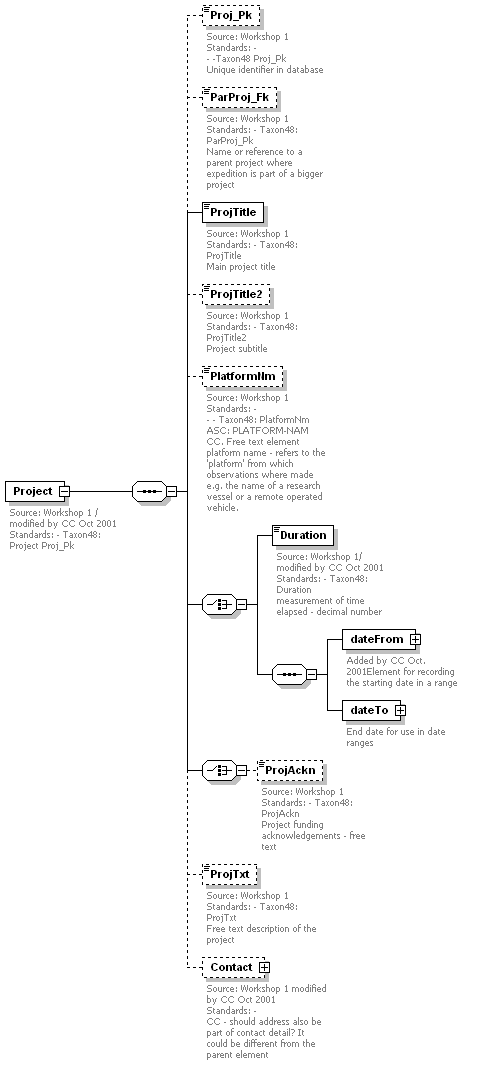 |
||
| children | Proj_Pk ParProj_Fk ProjTitle ProjTitle2 PlatformNm Duration dateFrom dateTo ProjAckn ProjTxt Contact | ||
| annotation |
|
||
| source | <xs:element name="Project" minOccurs="0"> <xs:annotation> <xs:documentation>Source: Workshop 1 / modified by CC Oct 2001 Standards: - Taxon48: Project Proj_Pk </xs:documentation> </xs:annotation> <xs:complexType> <xs:sequence> <xs:element name="Proj_Pk" type="xs:string" minOccurs="0"> <xs:annotation> <xs:documentation>Source: Workshop 1 Standards: - - -Taxon48 Proj_Pk Unique identifier in database</xs:documentation> </xs:annotation> </xs:element> <xs:element name="ParProj_Fk" type="xs:string" minOccurs="0"> <xs:annotation> <xs:documentation>Source: Workshop 1 Standards: - Taxon48: ParProj_Pk Name or reference to a parent project where expedition is part of a bigger project</xs:documentation> </xs:annotation> </xs:element> <xs:element name="ProjTitle" type="xs:string"> <xs:annotation> <xs:documentation>Source: Workshop 1 Standards: - Taxon48: ProjTitle Main project title</xs:documentation> </xs:annotation> </xs:element> <xs:element name="ProjTitle2" type="xs:string" minOccurs="0"> <xs:annotation> <xs:documentation>Source: Workshop 1 Standards: - Taxon48: ProjTitle2 Project subtitle</xs:documentation> </xs:annotation> </xs:element> <xs:element name="PlatformNm" type="xs:string" minOccurs="0"> <xs:annotation> <xs:documentation>Source: Workshop 1 Standards: - - - Taxon48: PlatformNm ASC: PLATFORM-NAM CC. Free text element platform name - refers to the 'platform' from which observations where made e.g. the name of a research vessel or a remote operated vehicle.</xs:documentation> </xs:annotation> </xs:element> <xs:choice> <xs:element name="Duration" type="DurationType"> <xs:annotation> <xs:documentation>Source: Workshop 1/ modified by CC Oct 2001 Standards: - Taxon48: Duration measurement of time elapsed - decimal number</xs:documentation> </xs:annotation> </xs:element> <xs:sequence> <xs:element name="dateFrom"> <xs:annotation> <xs:documentation>Added by CC Oct. 2001Element for recording the starting date in a range</xs:documentation> </xs:annotation> <xs:complexType> <xs:sequence> <xs:element name="Date" type="DateType"/> </xs:sequence> </xs:complexType> </xs:element> <xs:element name="dateTo"> <xs:annotation> <xs:documentation>End date for use in date ranges</xs:documentation> </xs:annotation> <xs:complexType> <xs:sequence> <xs:element name="Date" type="DateType"/> </xs:sequence> </xs:complexType> </xs:element> </xs:sequence> </xs:choice> <xs:choice> <xs:element name="ProjAckn" type="xs:string" minOccurs="0"> <xs:annotation> <xs:documentation>Source: Workshop 1 Standards: - Taxon48: ProjAckn Project funding acknowledgements - free text</xs:documentation> </xs:annotation> </xs:element> </xs:choice> <xs:element name="ProjTxt" type="xs:string" minOccurs="0"> <xs:annotation> <xs:documentation>Source: Workshop 1 Standards: - Taxon48: ProjTxt Free text description of the project</xs:documentation> </xs:annotation> </xs:element> <xs:element name="Contact" type="ContactType" minOccurs="0"> <xs:annotation> <xs:documentation>Source: Workshop 1 modified by CC Oct 2001 Standards: - CC - should address also be part of contact detail? It could be different from the parent element</xs:documentation> </xs:annotation> </xs:element> </xs:sequence> </xs:complexType> </xs:element> |
| diagram |  |
||
| type | xs:string | ||
| annotation |
|
||
| source | <xs:element name="Proj_Pk" type="xs:string" minOccurs="0"> <xs:annotation> <xs:documentation>Source: Workshop 1 Standards: - - -Taxon48 Proj_Pk Unique identifier in database</xs:documentation> </xs:annotation> </xs:element> |
| diagram |  |
||
| type | xs:string | ||
| annotation |
|
||
| source | <xs:element name="ParProj_Fk" type="xs:string" minOccurs="0"> <xs:annotation> <xs:documentation>Source: Workshop 1 Standards: - Taxon48: ParProj_Pk Name or reference to a parent project where expedition is part of a bigger project</xs:documentation> </xs:annotation> </xs:element> |
| diagram |  |
||
| type | xs:string | ||
| annotation |
|
||
| source | <xs:element name="ProjTitle" type="xs:string"> <xs:annotation> <xs:documentation>Source: Workshop 1 Standards: - Taxon48: ProjTitle Main project title</xs:documentation> </xs:annotation> </xs:element> |
| diagram |  |
||
| type | xs:string | ||
| annotation |
|
||
| source | <xs:element name="ProjTitle2" type="xs:string" minOccurs="0"> <xs:annotation> <xs:documentation>Source: Workshop 1 Standards: - Taxon48: ProjTitle2 Project subtitle</xs:documentation> </xs:annotation> </xs:element> |
| diagram | 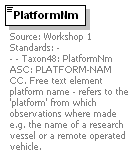 |
||
| type | xs:string | ||
| annotation |
|
||
| source | <xs:element name="PlatformNm" type="xs:string" minOccurs="0"> <xs:annotation> <xs:documentation>Source: Workshop 1 Standards: - - - Taxon48: PlatformNm ASC: PLATFORM-NAM CC. Free text element platform name - refers to the 'platform' from which observations where made e.g. the name of a research vessel or a remote operated vehicle.</xs:documentation> </xs:annotation> </xs:element> |
| diagram | 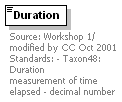 |
||||||||||||
| type | DurationType | ||||||||||||
| attributes |
|
||||||||||||
| annotation |
|
||||||||||||
| source | <xs:element name="Duration" type="DurationType"> <xs:annotation> <xs:documentation>Source: Workshop 1/ modified by CC Oct 2001 Standards: - Taxon48: Duration measurement of time elapsed - decimal number</xs:documentation> </xs:annotation> </xs:element> |
| diagram | 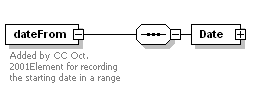 |
||
| children | Date | ||
| annotation |
|
||
| source | <xs:element name="dateFrom"> <xs:annotation> <xs:documentation>Added by CC Oct. 2001Element for recording the starting date in a range</xs:documentation> </xs:annotation> <xs:complexType> <xs:sequence> <xs:element name="Date" type="DateType"/> </xs:sequence> </xs:complexType> </xs:element> |
| diagram | 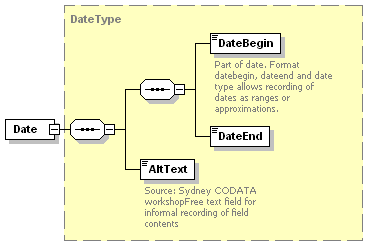 |
||||||||||||
| type | DateType | ||||||||||||
| children | DateBegin DateEnd AltText | ||||||||||||
| attributes |
|
||||||||||||
| source | <xs:element name="Date" type="DateType"/> |
| diagram | 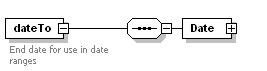 |
||
| children | Date | ||
| annotation |
|
||
| source | <xs:element name="dateTo"> <xs:annotation> <xs:documentation>End date for use in date ranges</xs:documentation> </xs:annotation> <xs:complexType> <xs:sequence> <xs:element name="Date" type="DateType"/> </xs:sequence> </xs:complexType> </xs:element> |
| diagram | 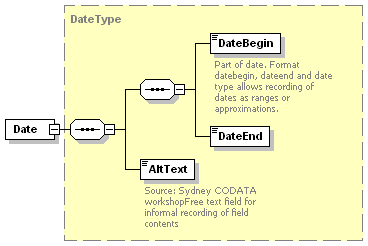 |
||||||||||||
| type | DateType | ||||||||||||
| children | DateBegin DateEnd AltText | ||||||||||||
| attributes |
|
||||||||||||
| source | <xs:element name="Date" type="DateType"/> |
| diagram |  |
||
| type | xs:string | ||
| annotation |
|
||
| source | <xs:element name="ProjAckn" type="xs:string" minOccurs="0"> <xs:annotation> <xs:documentation>Source: Workshop 1 Standards: - Taxon48: ProjAckn Project funding acknowledgements - free text</xs:documentation> </xs:annotation> </xs:element> |
| diagram |  |
||
| type | xs:string | ||
| annotation |
|
||
| source | <xs:element name="ProjTxt" type="xs:string" minOccurs="0"> <xs:annotation> <xs:documentation>Source: Workshop 1 Standards: - Taxon48: ProjTxt Free text description of the project</xs:documentation> </xs:annotation> </xs:element> |
| diagram | 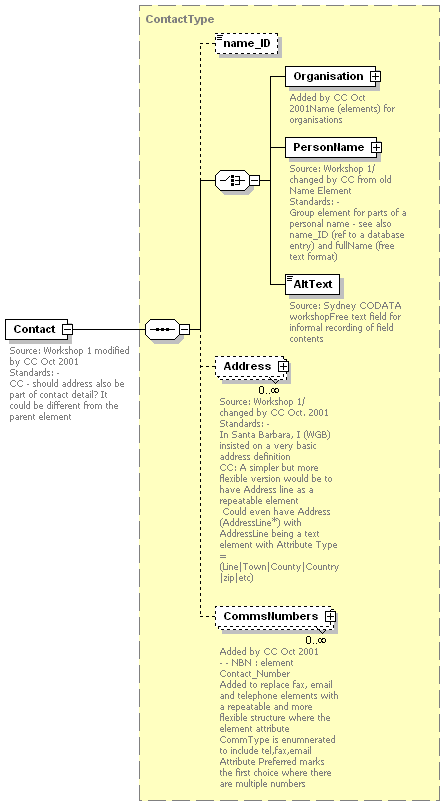 |
||
| type | ContactType | ||
| children | name_ID Organisation PersonName AltText Address CommsNumbers | ||
| annotation |
|
||
| source | <xs:element name="Contact" type="ContactType" minOccurs="0"> <xs:annotation> <xs:documentation>Source: Workshop 1 modified by CC Oct 2001 Standards: - CC - should address also be part of contact detail? It could be different from the parent element</xs:documentation> </xs:annotation> </xs:element> |
| diagram | 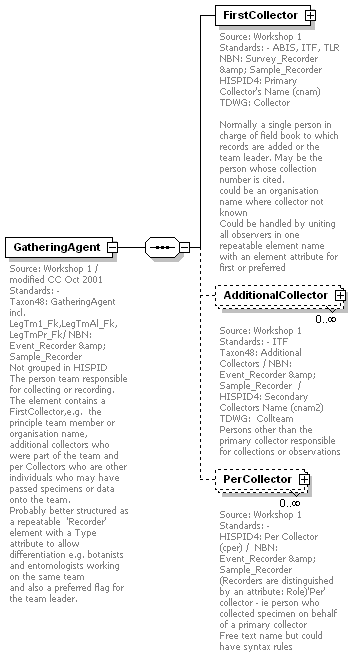 |
||
| children | FirstCollector AdditionalCollector PerCollector | ||
| annotation |
|
||
| source | <xs:element name="GatheringAgent"> <xs:annotation> <xs:documentation>Source: Workshop 1 / modified CC Oct 2001 Standards: - Taxon48: GatheringAgent incl. LegTm1_Fk,LegTmAl_Fk, LegTmPr_Fk/ NBN: Event_Recorder & Sample_Recorder Not grouped in HISPID The person team responsible for collecting or recording. The element contains a FirstCollector,e.g. the principle team member or organisation name, additional collectors who were part of the team and per Collectors who are other individuals who may have passed specimens or data onto the team. Probably better structured as a repeatable 'Recorder' element with a Type attribute to allow differentiation e.g. botanists and entomologists working on the same team and also a preferred flag for the team leader.</xs:documentation> </xs:annotation> <xs:complexType> <xs:sequence> <xs:element name="FirstCollector"> <xs:annotation> <xs:documentation>Source: Workshop 1 Standards: - ABIS, ITF, TLR NBN: Survey_Recorder & Sample_Recorder HISPID4: Primary Collector's Name (cnam) TDWG: Collector Normally a single person in charge of field book to which records are added or the team leader. May be the person whose collection number is cited. could be an organisation name where collector not known Could be handled by uniting all observers in one repeatable element name with an element attribute for first or preferred</xs:documentation> </xs:annotation> <xs:complexType> <xs:sequence> <xs:element name="name_ID" type="name_ID" minOccurs="0"/> <xs:choice> <xs:element name="Organisation" type="OrganisationType"> <xs:annotation> <xs:documentation>Added by CC Oct 2001Name (elements) for organisations</xs:documentation> </xs:annotation> </xs:element> <xs:element name="PersonName" type="PersonNameType"> <xs:annotation> <xs:documentation>Source: Workshop 1/ changed by CC from old Name Element Standards: - Group element for parts of a personal name - see also name_ID (ref to a database entry) and fullName (free text format)</xs:documentation> </xs:annotation> </xs:element> <xs:element name="AltText" type="AltText"> <xs:annotation> <xs:documentation>Source: Sydney CODATA workshopFree text field for informal recording of field contents</xs:documentation> </xs:annotation> </xs:element> </xs:choice> </xs:sequence> </xs:complexType> </xs:element> <xs:element name="AdditionalCollector" minOccurs="0" maxOccurs="unbounded"> <xs:annotation> <xs:documentation>Source: Workshop 1 Standards: - ITF Taxon48: Additional Collectors / NBN: Event_Recorder & Sample_Recorder / HISPID4: Secondary Collectors Name (cnam2) TDWG: Collteam Persons other than the primary collector responsible for collections or observations</xs:documentation> </xs:annotation> <xs:complexType> <xs:choice> <xs:element name="name_ID" type="name_ID"/> <xs:element name="PersonName" type="PersonNameType"> <xs:annotation> <xs:documentation>Source: Workshop 1/ changed by CC from old Name Element Standards: - Group element for parts of a personal name - see also name_ID (ref to a database entry) and fullName (free text format)</xs:documentation> </xs:annotation> </xs:element> <xs:element name="AltText" type="AltText"> <xs:annotation> <xs:documentation>Source: Sydney CODATA workshopFree text field for informal recording of field contents</xs:documentation> </xs:annotation> </xs:element> </xs:choice> </xs:complexType> </xs:element> <xs:element name="PerCollector" minOccurs="0" maxOccurs="unbounded"> <xs:annotation> <xs:documentation>Source: Workshop 1 Standards: - HISPID4: Per Collector (cper) / NBN: Event_Recorder & Sample_Recorder (Recorders are distinguished by an attribute: Role)'Per' collector - ie person who collected specimen on behalf of a primary collector Free text name but could have syntax rules</xs:documentation> </xs:annotation> <xs:complexType> <xs:sequence> <xs:element name="name_ID" type="name_ID" minOccurs="0"/> <xs:choice> <xs:element name="Organisation" type="OrganisationType"> <xs:annotation> <xs:documentation>Added by CC Oct 2001Name (elements) for organisations</xs:documentation> </xs:annotation> </xs:element> <xs:element name="PersonName" type="PersonNameType"> <xs:annotation> <xs:documentation>Source: Workshop 1/ changed by CC from old Name Element Standards: - Group element for parts of a personal name - see also name_ID (ref to a database entry) and fullName (free text format)</xs:documentation> </xs:annotation> </xs:element> <xs:element name="AltText" type="AltText"> <xs:annotation> <xs:documentation>Source: Sydney CODATA workshopFree text field for informal recording of field contents</xs:documentation> </xs:annotation> </xs:element> </xs:choice> </xs:sequence> </xs:complexType> </xs:element> </xs:sequence> </xs:complexType> </xs:element> |
| diagram | 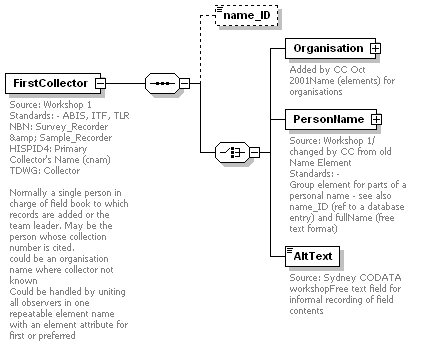 |
||
| children | name_ID Organisation PersonName AltText | ||
| annotation |
|
||
| source | <xs:element name="FirstCollector"> <xs:annotation> <xs:documentation>Source: Workshop 1 Standards: - ABIS, ITF, TLR NBN: Survey_Recorder & Sample_Recorder HISPID4: Primary Collector's Name (cnam) TDWG: Collector Normally a single person in charge of field book to which records are added or the team leader. May be the person whose collection number is cited. could be an organisation name where collector not known Could be handled by uniting all observers in one repeatable element name with an element attribute for first or preferred</xs:documentation> </xs:annotation> <xs:complexType> <xs:sequence> <xs:element name="name_ID" type="name_ID" minOccurs="0"/> <xs:choice> <xs:element name="Organisation" type="OrganisationType"> <xs:annotation> <xs:documentation>Added by CC Oct 2001Name (elements) for organisations</xs:documentation> </xs:annotation> </xs:element> <xs:element name="PersonName" type="PersonNameType"> <xs:annotation> <xs:documentation>Source: Workshop 1/ changed by CC from old Name Element Standards: - Group element for parts of a personal name - see also name_ID (ref to a database entry) and fullName (free text format)</xs:documentation> </xs:annotation> </xs:element> <xs:element name="AltText" type="AltText"> <xs:annotation> <xs:documentation>Source: Sydney CODATA workshopFree text field for informal recording of field contents</xs:documentation> </xs:annotation> </xs:element> </xs:choice> </xs:sequence> </xs:complexType> </xs:element> |
| diagram |  |
| type | name_ID |
| source | <xs:element name="name_ID" type="name_ID" minOccurs="0"/> |
| diagram | 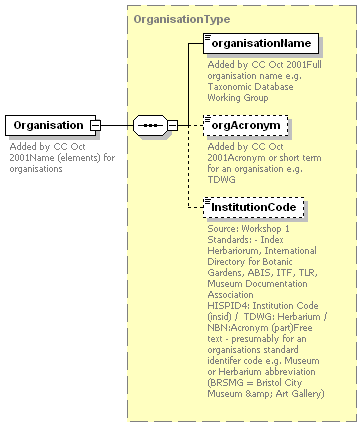 |
||
| type | OrganisationType | ||
| children | organisationName orgAcronym InstitutionCode | ||
| annotation |
|
||
| source | <xs:element name="Organisation" type="OrganisationType"> <xs:annotation> <xs:documentation>Added by CC Oct 2001Name (elements) for organisations</xs:documentation> </xs:annotation> </xs:element> |
| diagram | 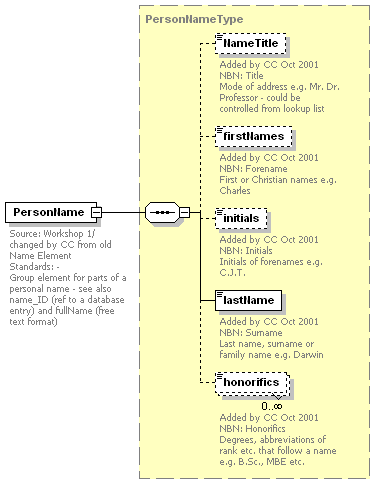 |
||
| type | PersonNameType | ||
| children | NameTitle firstNames initials lastName honorifics | ||
| annotation |
|
||
| source | <xs:element name="PersonName" type="PersonNameType"> <xs:annotation> <xs:documentation>Source: Workshop 1/ changed by CC from old Name Element Standards: - Group element for parts of a personal name - see also name_ID (ref to a database entry) and fullName (free text format)</xs:documentation> </xs:annotation> </xs:element> |
| diagram |  |
||
| type | AltText | ||
| annotation |
|
||
| source | <xs:element name="AltText" type="AltText"> <xs:annotation> <xs:documentation>Source: Sydney CODATA workshopFree text field for informal recording of field contents</xs:documentation> </xs:annotation> </xs:element> |
| diagram | 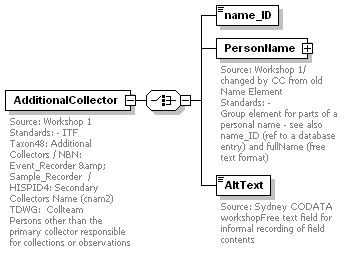 |
||
| children | name_ID PersonName AltText | ||
| annotation |
|
||
| source | <xs:element name="AdditionalCollector" minOccurs="0" maxOccurs="unbounded"> <xs:annotation> <xs:documentation>Source: Workshop 1 Standards: - ITF Taxon48: Additional Collectors / NBN: Event_Recorder & Sample_Recorder / HISPID4: Secondary Collectors Name (cnam2) TDWG: Collteam Persons other than the primary collector responsible for collections or observations</xs:documentation> </xs:annotation> <xs:complexType> <xs:choice> <xs:element name="name_ID" type="name_ID"/> <xs:element name="PersonName" type="PersonNameType"> <xs:annotation> <xs:documentation>Source: Workshop 1/ changed by CC from old Name Element Standards: - Group element for parts of a personal name - see also name_ID (ref to a database entry) and fullName (free text format)</xs:documentation> </xs:annotation> </xs:element> <xs:element name="AltText" type="AltText"> <xs:annotation> <xs:documentation>Source: Sydney CODATA workshopFree text field for informal recording of field contents</xs:documentation> </xs:annotation> </xs:element> </xs:choice> </xs:complexType> </xs:element> |
| diagram |  |
| type | name_ID |
| source | <xs:element name="name_ID" type="name_ID"/> |
| diagram | 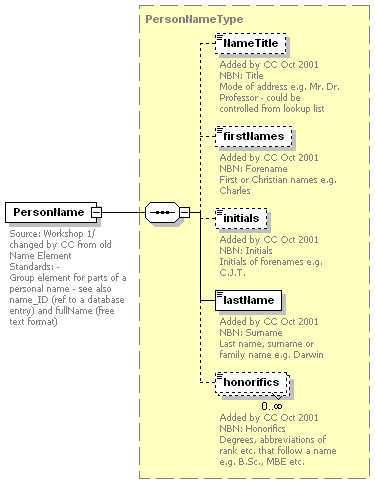 |
||
| type | PersonNameType | ||
| children | NameTitle firstNames initials lastName honorifics | ||
| annotation |
|
||
| source | <xs:element name="PersonName" type="PersonNameType"> <xs:annotation> <xs:documentation>Source: Workshop 1/ changed by CC from old Name Element Standards: - Group element for parts of a personal name - see also name_ID (ref to a database entry) and fullName (free text format)</xs:documentation> </xs:annotation> </xs:element> |
| diagram |  |
||
| type | AltText | ||
| annotation |
|
||
| source | <xs:element name="AltText" type="AltText"> <xs:annotation> <xs:documentation>Source: Sydney CODATA workshopFree text field for informal recording of field contents</xs:documentation> </xs:annotation> </xs:element> |
| diagram | 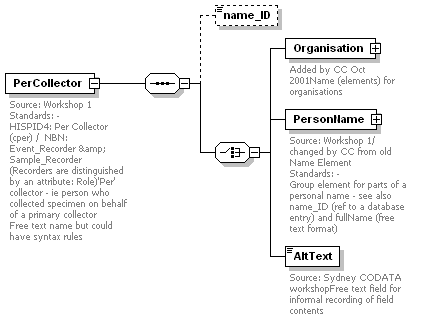 |
||
| children | name_ID Organisation PersonName AltText | ||
| annotation |
|
||
| source | <xs:element name="PerCollector" minOccurs="0" maxOccurs="unbounded"> <xs:annotation> <xs:documentation>Source: Workshop 1 Standards: - HISPID4: Per Collector (cper) / NBN: Event_Recorder & Sample_Recorder (Recorders are distinguished by an attribute: Role)'Per' collector - ie person who collected specimen on behalf of a primary collector Free text name but could have syntax rules</xs:documentation> </xs:annotation> <xs:complexType> <xs:sequence> <xs:element name="name_ID" type="name_ID" minOccurs="0"/> <xs:choice> <xs:element name="Organisation" type="OrganisationType"> <xs:annotation> <xs:documentation>Added by CC Oct 2001Name (elements) for organisations</xs:documentation> </xs:annotation> </xs:element> <xs:element name="PersonName" type="PersonNameType"> <xs:annotation> <xs:documentation>Source: Workshop 1/ changed by CC from old Name Element Standards: - Group element for parts of a personal name - see also name_ID (ref to a database entry) and fullName (free text format)</xs:documentation> </xs:annotation> </xs:element> <xs:element name="AltText" type="AltText"> <xs:annotation> <xs:documentation>Source: Sydney CODATA workshopFree text field for informal recording of field contents</xs:documentation> </xs:annotation> </xs:element> </xs:choice> </xs:sequence> </xs:complexType> </xs:element> |
| diagram |  |
| type | name_ID |
| source | <xs:element name="name_ID" type="name_ID" minOccurs="0"/> |
| diagram | 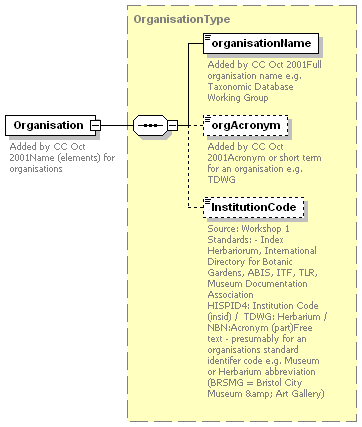 |
||
| type | OrganisationType | ||
| children | organisationName orgAcronym InstitutionCode | ||
| annotation |
|
||
| source | <xs:element name="Organisation" type="OrganisationType"> <xs:annotation> <xs:documentation>Added by CC Oct 2001Name (elements) for organisations</xs:documentation> </xs:annotation> </xs:element> |
| diagram | 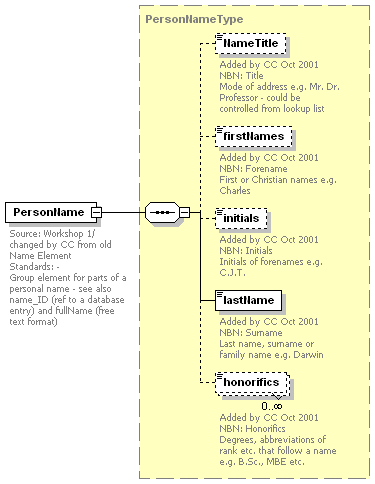 |
||
| type | PersonNameType | ||
| children | NameTitle firstNames initials lastName honorifics | ||
| annotation |
|
||
| source | <xs:element name="PersonName" type="PersonNameType"> <xs:annotation> <xs:documentation>Source: Workshop 1/ changed by CC from old Name Element Standards: - Group element for parts of a personal name - see also name_ID (ref to a database entry) and fullName (free text format)</xs:documentation> </xs:annotation> </xs:element> |
| diagram | 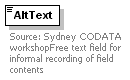 |
||
| type | AltText | ||
| annotation |
|
||
| source | <xs:element name="AltText" type="AltText"> <xs:annotation> <xs:documentation>Source: Sydney CODATA workshopFree text field for informal recording of field contents</xs:documentation> </xs:annotation> </xs:element> |
| diagram |  |
||
| type | xs:string | ||
| annotation |
|
||
| source | <xs:element name="GatheringCode" type="xs:string"> <xs:annotation> <xs:documentation>Source: Workshop 1 Standards: - - - NBN: Sample_Reference Refers to FirstCollector's number or code for the gathering event</xs:documentation> </xs:annotation> </xs:element> |
| diagram | 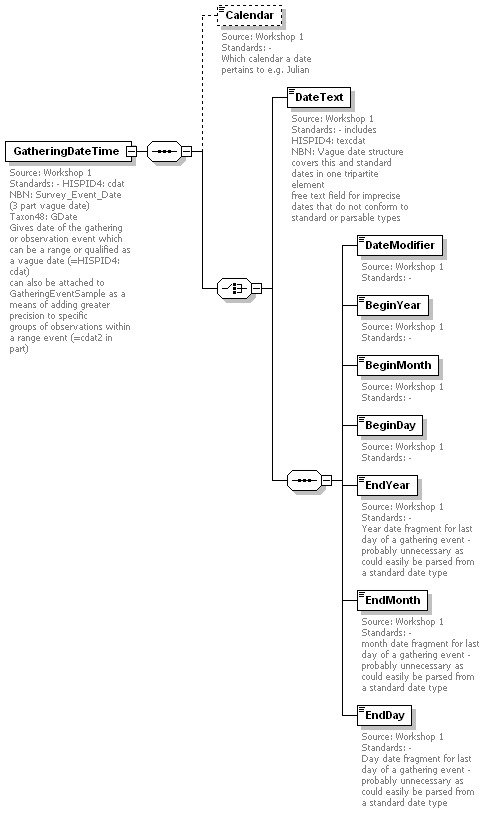 |
||
| children | Calendar DateText DateModifier BeginYear BeginMonth BeginDay EndYear EndMonth EndDay | ||
| annotation |
|
||
| source | <xs:element name="GatheringDateTime"> <xs:annotation> <xs:documentation>Source: Workshop 1 Standards: - HISPID4: cdat NBN: Survey_Event_Date (3 part vague date) Taxon48: GDate Gives date of the gathering or observation event which can be a range or qualified as a vague date (=HISPID4: cdat) can also be attached to GatheringEventSample as a means of adding greater precision to specific groups of observations within a range event (=cdat2 in part)</xs:documentation> </xs:annotation> <xs:complexType> <xs:sequence> <xs:element name="Calendar" type="xs:string" minOccurs="0"> <xs:annotation> <xs:documentation>Source: Workshop 1 Standards: - Which calendar a date pertains to e.g. Julian</xs:documentation> </xs:annotation> </xs:element> <xs:choice> <xs:element name="DateText" type="xs:string"> <xs:annotation> <xs:documentation>Source: Workshop 1 Standards: - includes HISPID4: texcdat NBN: Vague date structure covers this and standard dates in one tripartite element free text field for imprecise dates that do not conform to standard or parsable types</xs:documentation> </xs:annotation> </xs:element> <xs:sequence> <xs:element name="DateModifier" type="xs:string"> <xs:annotation> <xs:documentation>Source: Workshop 1 Standards: -</xs:documentation> </xs:annotation> </xs:element> <xs:element name="BeginYear" type="xs:string"> <xs:annotation> <xs:documentation>Source: Workshop 1 Standards: -</xs:documentation> </xs:annotation> </xs:element> <xs:element name="BeginMonth" type="xs:string"> <xs:annotation> <xs:documentation>Source: Workshop 1 Standards: -</xs:documentation> </xs:annotation> </xs:element> <xs:element name="BeginDay" type="xs:string"> <xs:annotation> <xs:documentation>Source: Workshop 1 Standards: -</xs:documentation> </xs:annotation> </xs:element> <xs:element name="EndYear" type="xs:string"> <xs:annotation> <xs:documentation>Source: Workshop 1 Standards: - Year date fragment for last day of a gathering event - probably unnecessary as could easily be parsed from a standard date type</xs:documentation> </xs:annotation> </xs:element> <xs:element name="EndMonth" type="xs:string"> <xs:annotation> <xs:documentation>Source: Workshop 1 Standards: - month date fragment for last day of a gathering event - probably unnecessary as could easily be parsed from a standard date type</xs:documentation> </xs:annotation> </xs:element> <xs:element name="EndDay" type="xs:string"> <xs:annotation> <xs:documentation>Source: Workshop 1 Standards: - Day date fragment for last day of a gathering event - probably unnecessary as could easily be parsed from a standard date type</xs:documentation> </xs:annotation> </xs:element> </xs:sequence> </xs:choice> </xs:sequence> </xs:complexType> </xs:element> |
| diagram |  |
||
| type | xs:string | ||
| annotation |
|
||
| source | <xs:element name="Calendar" type="xs:string" minOccurs="0"> <xs:annotation> <xs:documentation>Source: Workshop 1 Standards: - Which calendar a date pertains to e.g. Julian</xs:documentation> </xs:annotation> </xs:element> |
| diagram |  |
||
| type | xs:string | ||
| annotation |
|
||
| source | <xs:element name="DateText" type="xs:string"> <xs:annotation> <xs:documentation>Source: Workshop 1 Standards: - includes HISPID4: texcdat NBN: Vague date structure covers this and standard dates in one tripartite element free text field for imprecise dates that do not conform to standard or parsable types</xs:documentation> </xs:annotation> </xs:element> |
| diagram |  |
||
| type | xs:string | ||
| annotation |
|
||
| source | <xs:element name="DateModifier" type="xs:string"> <xs:annotation> <xs:documentation>Source: Workshop 1 Standards: -</xs:documentation> </xs:annotation> </xs:element> |
| diagram |  |
||
| type | xs:string | ||
| annotation |
|
||
| source | <xs:element name="BeginYear" type="xs:string"> <xs:annotation> <xs:documentation>Source: Workshop 1 Standards: -</xs:documentation> </xs:annotation> </xs:element> |
| diagram |  |
||
| type | xs:string | ||
| annotation |
|
||
| source | <xs:element name="BeginMonth" type="xs:string"> <xs:annotation> <xs:documentation>Source: Workshop 1 Standards: -</xs:documentation> </xs:annotation> </xs:element> |
| diagram |  |
||
| type | xs:string | ||
| annotation |
|
||
| source | <xs:element name="BeginDay" type="xs:string"> <xs:annotation> <xs:documentation>Source: Workshop 1 Standards: -</xs:documentation> </xs:annotation> </xs:element> |
| diagram |  |
||
| type | xs:string | ||
| annotation |
|
||
| source | <xs:element name="EndYear" type="xs:string"> <xs:annotation> <xs:documentation>Source: Workshop 1 Standards: - Year date fragment for last day of a gathering event - probably unnecessary as could easily be parsed from a standard date type</xs:documentation> </xs:annotation> </xs:element> |
| diagram |  |
||
| type | xs:string | ||
| annotation |
|
||
| source | <xs:element name="EndMonth" type="xs:string"> <xs:annotation> <xs:documentation>Source: Workshop 1 Standards: - month date fragment for last day of a gathering event - probably unnecessary as could easily be parsed from a standard date type</xs:documentation> </xs:annotation> </xs:element> |
| diagram |  |
||
| type | xs:string | ||
| annotation |
|
||
| source | <xs:element name="EndDay" type="xs:string"> <xs:annotation> <xs:documentation>Source: Workshop 1 Standards: - Day date fragment for last day of a gathering event - probably unnecessary as could easily be parsed from a standard date type</xs:documentation> </xs:annotation> </xs:element> |
| diagram |  |
||
| children | SiteText Country CountrySubdivision WorldGeographicScheme NamedAreas AreaDetail NearestNamedPlace RelationToNearestNamedPlace Shape FootprintURL SiteCoordinates DepthHeight Altitude Aspect Notes | ||
| annotation |
|
||
| source | <xs:element name="GatheringSite"> <xs:annotation> <xs:documentation>Source: Workshop 1 Standards: - ABIS, ITF Taxon48: StatedLoc HISPID4: Locality (loc) / TDWG: Locality, Stanloc(?) / ASC Locality-Nam Location at which a Gathering Event takes place Element contains both geospatial and descriptive elements</xs:documentation> </xs:annotation> <xs:complexType> <xs:sequence> <xs:element name="SiteText" type="xs:string"> <xs:annotation> <xs:documentation>Source: Workshop 1 Standards: -</xs:documentation> </xs:annotation> </xs:element> <xs:element name="Country" type="CountryType"> <xs:annotation> <xs:documentation>Source: Workshop 1 Standards: - At least one of Countryname|ISO2|ISO3 should be present but more are allowed This should be the political country having jurisdiction over the collection site. Historical country names and water bodies outside the coastal zone can be entered under named area. CC - There is conflict here between use as an address line (essentially text handy for sorting) and more structured use in collections (GatheringSite) where standardised terms linked to ISO country codes may be desirable </xs:documentation> </xs:annotation> </xs:element> <xs:element name="CountrySubdivision" minOccurs="0" maxOccurs="unbounded"> <xs:annotation> <xs:documentation>Added by CC Oct 2001 standards: Hollis & Brummitt 1992 & local administrative area standards (e.g. NBN Admin Dictionary) Includes HISPID4: pru & sru , could also be used for sgu / NBN: Admin_Area Allows specification of more detailed geographic and administrative area contextual info to a collecting locality Attributes: subdivSrc - enumerated list of standards ( at present just H&B and local) couldbe ref to a lookup list SubdivLevel: level number where that forms part of a classification (e.g. for HISPID pru and sru) AreaType: Allows recording of local or national subdiv. level e.g. county, district, state etc.</xs:documentation> </xs:annotation> <xs:complexType> <xs:sequence> <xs:element name="AreaName" type="xs:string"> <xs:annotation> <xs:documentation>Added by CC Oct 2001 standards: Hollis & Brummitt 1992 & local administrative area standards (e.g. NBN Admin Dictionary) Includes HISPID4: pru & sru / NBN: Admin_Area Free text name - hopefully from a standard list</xs:documentation> </xs:annotation> </xs:element> <xs:element name="AreaCode" type="xs:string"> <xs:annotation> <xs:documentation>Added by CC Oct 2001Allows use of abbreviations and codes for area names</xs:documentation> </xs:annotation> </xs:element> <xs:element name="Source" type="SourceType" minOccurs="0"> <xs:annotation> <xs:documentation>Added CC Oct 2001 NBN: Source Marker element for a link to a source module for dealing with structured literature and document rexcords </xs:documentation> </xs:annotation> </xs:element> </xs:sequence> <xs:attribute name="SubdivSrc"> <xs:simpleType> <xs:restriction base="xs:NMTOKEN"> <xs:enumeration value="local"/> <xs:enumeration value="HB92"/> </xs:restriction> </xs:simpleType> </xs:attribute> <xs:attribute name="SubdivLevel"> <xs:simpleType> <xs:restriction base="xs:NMTOKEN"> <xs:enumeration value="1"/> <xs:enumeration value="2"/> <xs:enumeration value="3"/> <xs:enumeration value="4"/> </xs:restriction> </xs:simpleType> </xs:attribute> <xs:attribute name="AreaType" type="xs:string"/> </xs:complexType> </xs:element> <xs:element name="WorldGeographicScheme" type="xs:string" minOccurs="0"> <xs:annotation> <xs:documentation>Added by CC Oct 2001 Standard: Hollis & Brummitt 1992 HISPID4: wgs Free text - Allows specimens to be allocated to a standard geographic area derived from H&B</xs:documentation> </xs:annotation> </xs:element> <xs:element name="NamedAreas" minOccurs="0" maxOccurs="unbounded"> <xs:annotation> <xs:documentation>Source: Workshop 1 Standards: -</xs:documentation> </xs:annotation> <xs:complexType> <xs:choice> <xs:sequence> <xs:element name="AltText" type="AltText" minOccurs="0"> <xs:annotation> <xs:documentation>Source: Sydney CODATA workshopFree text field for informal recording of field contents</xs:documentation> </xs:annotation> </xs:element> <xs:element name="Language" type="Language"> <xs:annotation> <xs:documentation>Source: Workshop 1 Standards: -</xs:documentation> </xs:annotation> </xs:element> </xs:sequence> <xs:choice> <xs:element name="NamedArea" minOccurs="0" maxOccurs="unbounded"> <xs:annotation> <xs:documentation>Source: Workshop 1 Standards: -</xs:documentation> </xs:annotation> <xs:complexType> <xs:sequence> <xs:element name="NamedAreaSequenceNo" type="xs:string" minOccurs="0"/> <xs:element name="NamedAreaClass" type="xs:string" minOccurs="0"/> <xs:element name="NamedAreaName" type="xs:string"/> <xs:element name="Language" type="Language" minOccurs="0"/> <xs:element name="DerivedFlag" type="DerivedFlag" minOccurs="0"/> </xs:sequence> </xs:complexType> </xs:element> </xs:choice> </xs:choice> </xs:complexType> </xs:element> <xs:element name="AreaDetail" type="xs:string" minOccurs="0"> <xs:annotation> <xs:documentation>Source: Workshop 1 Standards: - Free text description of detail pertaining to the observation, sampling or collection locality</xs:documentation> </xs:annotation> </xs:element> <xs:element name="NearestNamedPlace" type="xs:string" minOccurs="0"> <xs:annotation> <xs:documentation>Source: Workshop 1 Standards: - ABIS, AUSLIG HISPID4: nnp / TDWG: Stanloc The nearest named place to the collection or observation location e.g. on 1:100,000 map or better</xs:documentation> </xs:annotation> </xs:element> <xs:element name="RelationToNearestNamedPlace" type="xs:string" minOccurs="0"> <xs:annotation> <xs:documentation>Source: WGB 10/01 Standards: - </xs:documentation> </xs:annotation> </xs:element> <xs:element name="Shape" minOccurs="0"> <xs:annotation> <xs:documentation>Source: Workshop 1 Standards: -</xs:documentation> </xs:annotation> <xs:complexType> <xs:sequence> <xs:element name="ShapeCoordinateSystem" type="xs:string"> <xs:annotation> <xs:documentation>Source: Workshop 1 Standards: -</xs:documentation> </xs:annotation> </xs:element> <xs:element name="ShapeCoordinates" type="xs:string" minOccurs="0" maxOccurs="unbounded"> <xs:annotation> <xs:documentation>Source: Workshop 1 Standards: -</xs:documentation> </xs:annotation> </xs:element> </xs:sequence> </xs:complexType> </xs:element> <xs:element name="FootprintURL" type="xs:string" minOccurs="0"> <xs:annotation> <xs:documentation>Source: Workshop 1 Standards: - URL (e.g. web address) for thelocation of a boundary polygon or centroid spatial reference relating to a gathering site</xs:documentation> </xs:annotation> </xs:element> <xs:element name="SiteCoordinates" minOccurs="0" maxOccurs="unbounded"> <xs:annotation> <xs:documentation>Added by CC Oct 2001 Composite element to allow observations to record multiple coordinates or same coordinate in different systems</xs:documentation> </xs:annotation> <xs:complexType> <xs:choice> <xs:element name="CoordinatesGrid"> <xs:annotation> <xs:documentation>Source: Workshop 1 Standards: - Taxon48: Geospatial Coordinates GridSysNam, GridCode, GridPreQual,CrdMsmtMth Geospatial coordinates recorded using a grid system</xs:documentation> </xs:annotation> <xs:complexType> <xs:sequence> <xs:element name="GridCellSystem" type="xs:string"> <xs:annotation> <xs:documentation>Source: Workshop 1 Standards: - Taxon48: GrdSystTxt Grid system name e.g. "GB OS"</xs:documentation> </xs:annotation> </xs:element> <xs:element name="GridCellCode" type="xs:string"> <xs:annotation> <xs:documentation>Source: Workshop 1 Standards: - </xs:documentation> </xs:annotation> </xs:element> <xs:element name="GridQualifier" type="xs:string"> <xs:annotation> <xs:documentation>Source: Workshop 1 Standards: - Taxon48:GridPrecQual Grid reference precision qualifier</xs:documentation> </xs:annotation> </xs:element> <xs:element name="GridMethod" type="xs:string"> <xs:annotation> <xs:documentation>Source: Workshop 1 Standards: - HISPID4: geosou (part) / Taxon48: CrdMsmthMtd Coordinates measuring system e.g. GPS, field map reference, inferred map reference</xs:documentation> </xs:annotation> </xs:element> </xs:sequence> </xs:complexType> </xs:element> <xs:element name="CoordinatesLatLong"> <xs:annotation> <xs:documentation>Source: Workshop 1 Standards: - ABIS, ITF, AUSLIG Element that allows the recording of the latitude and longitude of a recording or collecting position Could be simplified by converting many of the sub-elements into attributes.</xs:documentation> </xs:annotation> <xs:complexType> <xs:sequence> <xs:choice> <xs:element name="LatLongDecimal"> <xs:annotation> <xs:documentation>Source: Workshop 1 Standards: -</xs:documentation> </xs:annotation> <xs:complexType> <xs:sequence> <xs:element name="LatitudeDecimal" type="xs:string"> <xs:annotation> <xs:documentation>Source: Workshop 1 Standards: - </xs:documentation> </xs:annotation> </xs:element> <xs:element name="LongitudeDecimal" type="xs:string"> <xs:annotation> <xs:documentation>Source: Workshop 1 Standards: - </xs:documentation> </xs:annotation> </xs:element> </xs:sequence> </xs:complexType> </xs:element> <xs:element name="LatLongDMS"> <xs:annotation> <xs:documentation>Source: Workshop 1 Standards: -</xs:documentation> </xs:annotation> <xs:complexType> <xs:sequence> <xs:element name="LatDegrees" type="xs:string"> <xs:annotation> <xs:documentation>Source: Workshop 1 Standards: - HISPID4: latdeg / TDWG: LatDegH, LatDegL Degrees of latitude for collecting site in range 0-90</xs:documentation> </xs:annotation> </xs:element> <xs:element name="LatMinutes" type="xs:string"> <xs:annotation> <xs:documentation>Source: Workshop 1 Standards: - HISPID4: latmin / TDWG LatMinH, LatMinL Minutes within the latitude reading - range 0 - 59</xs:documentation> </xs:annotation> </xs:element> <xs:element name="LatSeconds" type="xs:string"> <xs:annotation> <xs:documentation>Source: Workshop 1 Standards: - - - HISPID4: latsec / TDWG: LatSecH, LatSecL Seconds within the latitude reading range 0 - 59</xs:documentation> </xs:annotation> </xs:element> <xs:element name="LatNS" type="xs:string"> <xs:annotation> <xs:documentation>Source: Workshop 1 Standards: - HISPID4: latdir / TDWG: LatDirHigh, LatDirLow </xs:documentation> </xs:annotation> </xs:element> <xs:element name="LongDegrees" type="xs:string"> <xs:annotation> <xs:documentation>Source: Workshop 1 Standards: - HISPID4: londeg / TDWG : LongDegH, LonDegL Degrees of longitude of the collecting/recording site - range 0 - 90</xs:documentation> </xs:annotation> </xs:element> <xs:element name="LongMinutes" type="xs:string"> <xs:annotation> <xs:documentation>Source: Workshop 1 Standards: - - - HISPID4: lonmin / TDWG: LongMinH , LongMinL Minutes in the longitude reading range 0-59</xs:documentation> </xs:annotation> </xs:element> <xs:element name="LongSeconds" type="xs:string"> <xs:annotation> <xs:documentation>Source: Workshop 1 Standards: - - - HISPID4: lonsec / TDWG: LongSecH , LongSecL Seconds in the longitude reading - range 0 - 59</xs:documentation> </xs:annotation> </xs:element> <xs:element name="LongEW" type="xs:string"> <xs:annotation> <xs:documentation>Source: Workshop 1 Standards: - </xs:documentation> </xs:annotation> </xs:element> </xs:sequence> </xs:complexType> </xs:element> </xs:choice> <xs:sequence> <xs:element name="LatLongMethod" type="xs:string"> <xs:annotation> <xs:documentation>HISPID4: geosou (part)Method of establishing Lat/Long position</xs:documentation> </xs:annotation> </xs:element> <xs:element name="spatialdatum" type="xs:string"> <xs:annotation> <xs:documentation>Source: Workshop 1 Standards: - AS/NZS4270 spatial transfer standard, SDTS spatial transfer standard mathematical surface on which the mapping and coordinate system used for the geocodes of the record are based</xs:documentation> </xs:annotation> </xs:element> <xs:element name="ISOAccuracy" type="xs:string" minOccurs="0"> <xs:annotation> <xs:documentation>Source: Workshop 1 Standards: - </xs:documentation> </xs:annotation> </xs:element> <xs:element name="AccuracyStatement" type="xs:string" minOccurs="0"> <xs:annotation> <xs:documentation>Source: Workshop 1 Standards: - HISPID4: includes geoacy TDWG: LatAccurr, LongAccur Free text statement of degree of accuracy</xs:documentation> </xs:annotation> </xs:element> </xs:sequence> </xs:sequence> </xs:complexType> </xs:element> <xs:element name="CoordinatesUTM"> <xs:annotation> <xs:documentation>Source: Workshop 1 Standards: - </xs:documentation> </xs:annotation> <xs:complexType> <xs:sequence> <xs:element name="UTMZone" type="xs:string"> <xs:annotation> <xs:documentation>Source: Workshop 1 Standards: - HISPID4: sqz </xs:documentation> </xs:annotation> </xs:element> <xs:element name="UTMEW" type="xs:string"> <xs:annotation> <xs:documentation>Source: Workshop 1 Standards: - HISPID4: sge (part) </xs:documentation> </xs:annotation> </xs:element> <xs:element name="UTMNS" type="xs:string"> <xs:annotation> <xs:documentation>Source: Workshop 1 Standards: - HISPID4: sgn (part)</xs:documentation> </xs:annotation> </xs:element> <xs:element name="UTMMethod" type="xs:string"> <xs:annotation> <xs:documentation>Source: Workshop 1 Standards: -</xs:documentation> </xs:annotation> </xs:element> </xs:sequence> </xs:complexType> </xs:element> </xs:choice> <xs:attribute name="AppliesTo" use="required"> <xs:simpleType> <xs:restriction base="xs:NMTOKEN"> <xs:enumeration value="centroid"/> <xs:enumeration value="endPoint"/> <xs:enumeration value="boxSW"/> <xs:enumeration value="boxNE"/> </xs:restriction> </xs:simpleType> </xs:attribute> </xs:complexType> </xs:element> <xs:element name="DepthHeight" minOccurs="0"> <xs:annotation> <xs:documentation>Source: Workshop 1/ changed by CC Oct 2001 Standards: - SDTS, ITRF, AHD, ABIS, ITF HISPID4: dep,depacy, depx, depacyx NBN: Locality_data or Sample_Data (depending on use) with qualifier for measurement type Element that can be used to record both heights above ground and depths below ground or water (Attribute DHType) method, units of measurement and accuracy are also attributes. DepthHeightLowerValues and DepthHeightUpperValue give ability to record ranges.</xs:documentation> </xs:annotation> <xs:complexType> <xs:sequence> <xs:element name="DepthHeightLowerValue" type="xs:string"> <xs:annotation> <xs:documentation>Source: Workshop 1 Standards: - Lower value of range (ie that nearest to ground datum)</xs:documentation> </xs:annotation> </xs:element> <xs:element name="DepthHeightUpperValue" type="xs:string"> <xs:annotation> <xs:documentation>Source: Workshop 1 Standards: - Higher value in range (ie. measurement furthest from ground datum)</xs:documentation> </xs:annotation> </xs:element> </xs:sequence> <xs:attribute name="DHType"> <xs:simpleType> <xs:restriction base="xs:NMTOKEN"> <xs:enumeration value="water_depth"/> <xs:enumeration value="beneath_ground"/> <xs:enumeration value="height"/> </xs:restriction> </xs:simpleType> </xs:attribute> <xs:attribute name="DHMethod" type="xs:string"/> <xs:attribute name="DHUnits" use="required"> <xs:simpleType> <xs:restriction base="xs:NMTOKEN"> <xs:enumeration value="kilometres"/> <xs:enumeration value="metres"/> <xs:enumeration value="centimetres"/> <xs:enumeration value="millimetres"/> <xs:enumeration value="Miles"/> <xs:enumeration value="yards"/> <xs:enumeration value="feet"/> <xs:enumeration value="inches"/> <xs:enumeration value="fathoms"/> <xs:enumeration value="cables"/> </xs:restriction> </xs:simpleType> </xs:attribute> <xs:attribute name="DHAccuracy"> <xs:simpleType> <xs:restriction base="xs:NMTOKEN"> <xs:enumeration value="collector"/> <xs:enumeration value="compiled"/> <xs:enumeration value="autogenerated"/> </xs:restriction> </xs:simpleType> </xs:attribute> </xs:complexType> </xs:element> <xs:element name="Altitude" type="AltitudeType" minOccurs="0"> <xs:annotation> <xs:documentation>Source: Workshop 1/ changed by CC 2001 Standards: - ABIS, ITF, SDTS, IRTF, AHD71 HISPID4: alt ,altacy, altx, altxcy,altdet,altsou / TDWG: ElevationL, Elevelaccur, ElevationH,ElevHAccur / NBN variables recorded in Location_Data using qualifier and accuracy attributes Element for recording altitude of observation or recording area - ranges expressed by lower and Upper values Note that method, units, accuracy and source of accuracy are attributes which may be enumerated</xs:documentation> </xs:annotation> </xs:element> <xs:element name="Aspect" type="AspectType" minOccurs="0"> <xs:annotation> <xs:documentation>Added by CC Oct 2001 HISPID4: Aspect (asp) Measurement of Aspect (ie facing direction) of either whole site or sample point measured in either letters (e.g. NE, SW) or Degrees (e.g. 270)</xs:documentation> </xs:annotation> </xs:element> <xs:element name="Notes" type="xs:string" minOccurs="0"> <xs:annotation> <xs:documentation>Source: Workshop 1 Standards: - </xs:documentation> </xs:annotation> </xs:element> </xs:sequence> </xs:complexType> </xs:element> |
| diagram |  |
||
| type | xs:string | ||
| annotation |
|
||
| source | <xs:element name="SiteText" type="xs:string"> <xs:annotation> <xs:documentation>Source: Workshop 1 Standards: -</xs:documentation> </xs:annotation> </xs:element> |
| diagram | 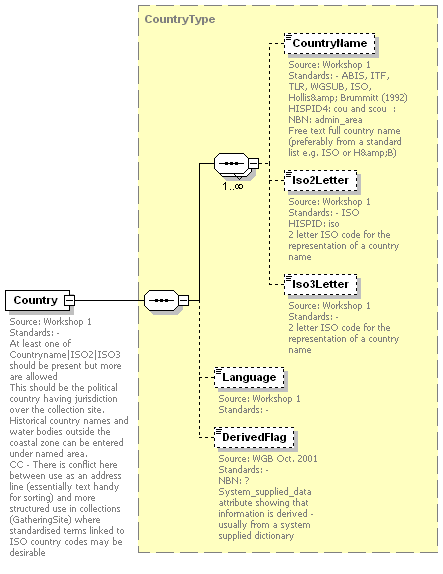 |
||
| type | CountryType | ||
| children | CountryName Iso2Letter Iso3Letter Language DerivedFlag | ||
| annotation |
|
||
| source | <xs:element name="Country" type="CountryType"> <xs:annotation> <xs:documentation>Source: Workshop 1 Standards: - At least one of Countryname|ISO2|ISO3 should be present but more are allowed This should be the political country having jurisdiction over the collection site. Historical country names and water bodies outside the coastal zone can be entered under named area. CC - There is conflict here between use as an address line (essentially text handy for sorting) and more structured use in collections (GatheringSite) where standardised terms linked to ISO country codes may be desirable </xs:documentation> </xs:annotation> </xs:element> |
| diagram | 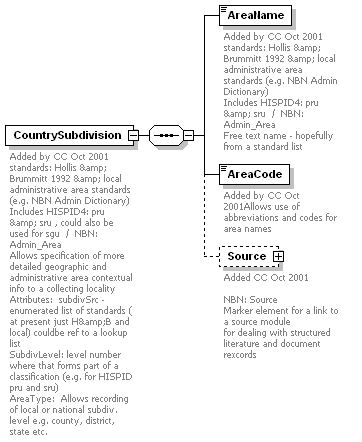 |
||||||||||||||||||||||||
| children | AreaName AreaCode Source | ||||||||||||||||||||||||
| attributes |
|
||||||||||||||||||||||||
| annotation |
|
||||||||||||||||||||||||
| source | <xs:element name="CountrySubdivision" minOccurs="0" maxOccurs="unbounded"> <xs:annotation> <xs:documentation>Added by CC Oct 2001 standards: Hollis & Brummitt 1992 & local administrative area standards (e.g. NBN Admin Dictionary) Includes HISPID4: pru & sru , could also be used for sgu / NBN: Admin_Area Allows specification of more detailed geographic and administrative area contextual info to a collecting locality Attributes: subdivSrc - enumerated list of standards ( at present just H&B and local) couldbe ref to a lookup list SubdivLevel: level number where that forms part of a classification (e.g. for HISPID pru and sru) AreaType: Allows recording of local or national subdiv. level e.g. county, district, state etc.</xs:documentation> </xs:annotation> <xs:complexType> <xs:sequence> <xs:element name="AreaName" type="xs:string"> <xs:annotation> <xs:documentation>Added by CC Oct 2001 standards: Hollis & Brummitt 1992 & local administrative area standards (e.g. NBN Admin Dictionary) Includes HISPID4: pru & sru / NBN: Admin_Area Free text name - hopefully from a standard list</xs:documentation> </xs:annotation> </xs:element> <xs:element name="AreaCode" type="xs:string"> <xs:annotation> <xs:documentation>Added by CC Oct 2001Allows use of abbreviations and codes for area names</xs:documentation> </xs:annotation> </xs:element> <xs:element name="Source" type="SourceType" minOccurs="0"> <xs:annotation> <xs:documentation>Added CC Oct 2001 NBN: Source Marker element for a link to a source module for dealing with structured literature and document rexcords </xs:documentation> </xs:annotation> </xs:element> </xs:sequence> <xs:attribute name="SubdivSrc"> <xs:simpleType> <xs:restriction base="xs:NMTOKEN"> <xs:enumeration value="local"/> <xs:enumeration value="HB92"/> </xs:restriction> </xs:simpleType> </xs:attribute> <xs:attribute name="SubdivLevel"> <xs:simpleType> <xs:restriction base="xs:NMTOKEN"> <xs:enumeration value="1"/> <xs:enumeration value="2"/> <xs:enumeration value="3"/> <xs:enumeration value="4"/> </xs:restriction> </xs:simpleType> </xs:attribute> <xs:attribute name="AreaType" type="xs:string"/> </xs:complexType> </xs:element> |
| diagram |  |
||
| type | xs:string | ||
| annotation |
|
||
| source | <xs:element name="AreaName" type="xs:string"> <xs:annotation> <xs:documentation>Added by CC Oct 2001 standards: Hollis & Brummitt 1992 & local administrative area standards (e.g. NBN Admin Dictionary) Includes HISPID4: pru & sru / NBN: Admin_Area Free text name - hopefully from a standard list</xs:documentation> </xs:annotation> </xs:element> |
| diagram |  |
||
| type | xs:string | ||
| annotation |
|
||
| source | <xs:element name="AreaCode" type="xs:string"> <xs:annotation> <xs:documentation>Added by CC Oct 2001Allows use of abbreviations and codes for area names</xs:documentation> </xs:annotation> </xs:element> |
| diagram | 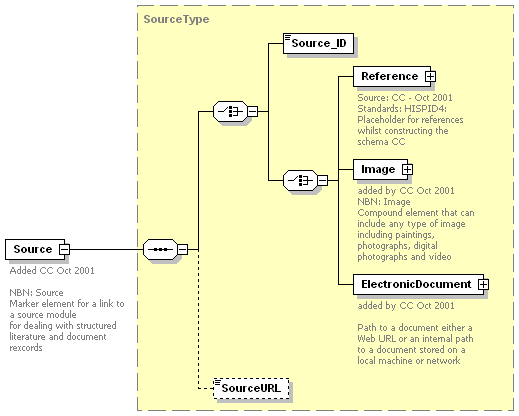 |
||||||||||||
| type | SourceType | ||||||||||||
| children | Source_ID Reference Image ElectronicDocument SourceURL | ||||||||||||
| attributes |
|
||||||||||||
| annotation |
|
||||||||||||
| source | <xs:element name="Source" type="SourceType" minOccurs="0"> <xs:annotation> <xs:documentation>Added CC Oct 2001 NBN: Source Marker element for a link to a source module for dealing with structured literature and document rexcords </xs:documentation> </xs:annotation> </xs:element> |
| diagram | 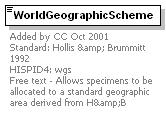 |
||
| type | xs:string | ||
| annotation |
|
||
| source | <xs:element name="WorldGeographicScheme" type="xs:string" minOccurs="0"> <xs:annotation> <xs:documentation>Added by CC Oct 2001 Standard: Hollis & Brummitt 1992 HISPID4: wgs Free text - Allows specimens to be allocated to a standard geographic area derived from H&B</xs:documentation> </xs:annotation> </xs:element> |
| diagram | 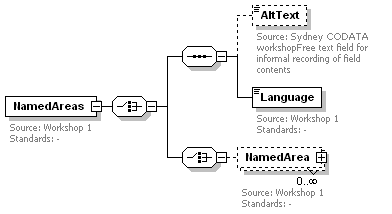 |
||
| children | AltText Language NamedArea | ||
| annotation |
|
||
| source | <xs:element name="NamedAreas" minOccurs="0" maxOccurs="unbounded"> <xs:annotation> <xs:documentation>Source: Workshop 1 Standards: -</xs:documentation> </xs:annotation> <xs:complexType> <xs:choice> <xs:sequence> <xs:element name="AltText" type="AltText" minOccurs="0"> <xs:annotation> <xs:documentation>Source: Sydney CODATA workshopFree text field for informal recording of field contents</xs:documentation> </xs:annotation> </xs:element> <xs:element name="Language" type="Language"> <xs:annotation> <xs:documentation>Source: Workshop 1 Standards: -</xs:documentation> </xs:annotation> </xs:element> </xs:sequence> <xs:choice> <xs:element name="NamedArea" minOccurs="0" maxOccurs="unbounded"> <xs:annotation> <xs:documentation>Source: Workshop 1 Standards: -</xs:documentation> </xs:annotation> <xs:complexType> <xs:sequence> <xs:element name="NamedAreaSequenceNo" type="xs:string" minOccurs="0"/> <xs:element name="NamedAreaClass" type="xs:string" minOccurs="0"/> <xs:element name="NamedAreaName" type="xs:string"/> <xs:element name="Language" type="Language" minOccurs="0"/> <xs:element name="DerivedFlag" type="DerivedFlag" minOccurs="0"/> </xs:sequence> </xs:complexType> </xs:element> </xs:choice> </xs:choice> </xs:complexType> </xs:element> |
| diagram |  |
||
| type | AltText | ||
| annotation |
|
||
| source | <xs:element name="AltText" type="AltText" minOccurs="0"> <xs:annotation> <xs:documentation>Source: Sydney CODATA workshopFree text field for informal recording of field contents</xs:documentation> </xs:annotation> </xs:element> |
| diagram |  |
||
| type | Language | ||
| annotation |
|
||
| source | <xs:element name="Language" type="Language"> <xs:annotation> <xs:documentation>Source: Workshop 1 Standards: -</xs:documentation> </xs:annotation> </xs:element> |
| diagram | 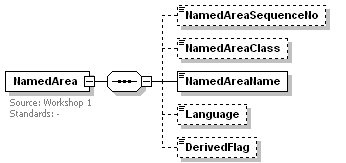 |
||
| children | NamedAreaSequenceNo NamedAreaClass NamedAreaName Language DerivedFlag | ||
| annotation |
|
||
| source | <xs:element name="NamedArea" minOccurs="0" maxOccurs="unbounded"> <xs:annotation> <xs:documentation>Source: Workshop 1 Standards: -</xs:documentation> </xs:annotation> <xs:complexType> <xs:sequence> <xs:element name="NamedAreaSequenceNo" type="xs:string" minOccurs="0"/> <xs:element name="NamedAreaClass" type="xs:string" minOccurs="0"/> <xs:element name="NamedAreaName" type="xs:string"/> <xs:element name="Language" type="Language" minOccurs="0"/> <xs:element name="DerivedFlag" type="DerivedFlag" minOccurs="0"/> </xs:sequence> </xs:complexType> </xs:element> |
| diagram |  |
| type | xs:string |
| source | <xs:element name="NamedAreaSequenceNo" type="xs:string" minOccurs="0"/> |
| diagram |  |
| type | xs:string |
| source | <xs:element name="NamedAreaClass" type="xs:string" minOccurs="0"/> |
| diagram |  |
| type | xs:string |
| source | <xs:element name="NamedAreaName" type="xs:string"/> |
| diagram |  |
| type | Language |
| source | <xs:element name="Language" type="Language" minOccurs="0"/> |
| diagram |  |
| type | DerivedFlag |
| source | <xs:element name="DerivedFlag" type="DerivedFlag" minOccurs="0"/> |
| diagram | 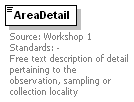 |
||
| type | xs:string | ||
| annotation |
|
||
| source | <xs:element name="AreaDetail" type="xs:string" minOccurs="0"> <xs:annotation> <xs:documentation>Source: Workshop 1 Standards: - Free text description of detail pertaining to the observation, sampling or collection locality</xs:documentation> </xs:annotation> </xs:element> |
| diagram | 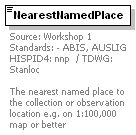 |
||
| type | xs:string | ||
| annotation |
|
||
| source | <xs:element name="NearestNamedPlace" type="xs:string" minOccurs="0"> <xs:annotation> <xs:documentation>Source: Workshop 1 Standards: - ABIS, AUSLIG HISPID4: nnp / TDWG: Stanloc The nearest named place to the collection or observation location e.g. on 1:100,000 map or better</xs:documentation> </xs:annotation> </xs:element> |
| diagram |  |
||
| type | xs:string | ||
| annotation |
|
||
| source | <xs:element name="RelationToNearestNamedPlace" type="xs:string" minOccurs="0"> <xs:annotation> <xs:documentation>Source: WGB 10/01 Standards: - </xs:documentation> </xs:annotation> </xs:element> |
| diagram | 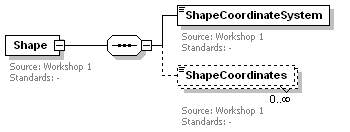 |
||
| children | ShapeCoordinateSystem ShapeCoordinates | ||
| annotation |
|
||
| source | <xs:element name="Shape" minOccurs="0"> <xs:annotation> <xs:documentation>Source: Workshop 1 Standards: -</xs:documentation> </xs:annotation> <xs:complexType> <xs:sequence> <xs:element name="ShapeCoordinateSystem" type="xs:string"> <xs:annotation> <xs:documentation>Source: Workshop 1 Standards: -</xs:documentation> </xs:annotation> </xs:element> <xs:element name="ShapeCoordinates" type="xs:string" minOccurs="0" maxOccurs="unbounded"> <xs:annotation> <xs:documentation>Source: Workshop 1 Standards: -</xs:documentation> </xs:annotation> </xs:element> </xs:sequence> </xs:complexType> </xs:element> |
| diagram |  |
||
| type | xs:string | ||
| annotation |
|
||
| source | <xs:element name="ShapeCoordinateSystem" type="xs:string"> <xs:annotation> <xs:documentation>Source: Workshop 1 Standards: -</xs:documentation> </xs:annotation> </xs:element> |
| diagram |  |
||
| type | xs:string | ||
| annotation |
|
||
| source | <xs:element name="ShapeCoordinates" type="xs:string" minOccurs="0" maxOccurs="unbounded"> <xs:annotation> <xs:documentation>Source: Workshop 1 Standards: -</xs:documentation> </xs:annotation> </xs:element> |
| diagram |  |
||
| type | xs:string | ||
| annotation |
|
||
| source | <xs:element name="FootprintURL" type="xs:string" minOccurs="0"> <xs:annotation> <xs:documentation>Source: Workshop 1 Standards: - URL (e.g. web address) for thelocation of a boundary polygon or centroid spatial reference relating to a gathering site</xs:documentation> </xs:annotation> </xs:element> |
| diagram | 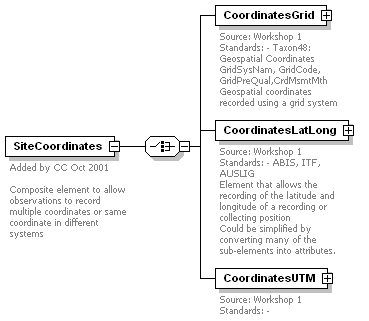 |
||||||||||||
| children | CoordinatesGrid CoordinatesLatLong CoordinatesUTM | ||||||||||||
| attributes |
|
||||||||||||
| annotation |
|
||||||||||||
| source | <xs:element name="SiteCoordinates" minOccurs="0" maxOccurs="unbounded"> <xs:annotation> <xs:documentation>Added by CC Oct 2001 Composite element to allow observations to record multiple coordinates or same coordinate in different systems</xs:documentation> </xs:annotation> <xs:complexType> <xs:choice> <xs:element name="CoordinatesGrid"> <xs:annotation> <xs:documentation>Source: Workshop 1 Standards: - Taxon48: Geospatial Coordinates GridSysNam, GridCode, GridPreQual,CrdMsmtMth Geospatial coordinates recorded using a grid system</xs:documentation> </xs:annotation> <xs:complexType> <xs:sequence> <xs:element name="GridCellSystem" type="xs:string"> <xs:annotation> <xs:documentation>Source: Workshop 1 Standards: - Taxon48: GrdSystTxt Grid system name e.g. "GB OS"</xs:documentation> </xs:annotation> </xs:element> <xs:element name="GridCellCode" type="xs:string"> <xs:annotation> <xs:documentation>Source: Workshop 1 Standards: - </xs:documentation> </xs:annotation> </xs:element> <xs:element name="GridQualifier" type="xs:string"> <xs:annotation> <xs:documentation>Source: Workshop 1 Standards: - Taxon48:GridPrecQual Grid reference precision qualifier</xs:documentation> </xs:annotation> </xs:element> <xs:element name="GridMethod" type="xs:string"> <xs:annotation> <xs:documentation>Source: Workshop 1 Standards: - HISPID4: geosou (part) / Taxon48: CrdMsmthMtd Coordinates measuring system e.g. GPS, field map reference, inferred map reference</xs:documentation> </xs:annotation> </xs:element> </xs:sequence> </xs:complexType> </xs:element> <xs:element name="CoordinatesLatLong"> <xs:annotation> <xs:documentation>Source: Workshop 1 Standards: - ABIS, ITF, AUSLIG Element that allows the recording of the latitude and longitude of a recording or collecting position Could be simplified by converting many of the sub-elements into attributes.</xs:documentation> </xs:annotation> <xs:complexType> <xs:sequence> <xs:choice> <xs:element name="LatLongDecimal"> <xs:annotation> <xs:documentation>Source: Workshop 1 Standards: -</xs:documentation> </xs:annotation> <xs:complexType> <xs:sequence> <xs:element name="LatitudeDecimal" type="xs:string"> <xs:annotation> <xs:documentation>Source: Workshop 1 Standards: - </xs:documentation> </xs:annotation> </xs:element> <xs:element name="LongitudeDecimal" type="xs:string"> <xs:annotation> <xs:documentation>Source: Workshop 1 Standards: - </xs:documentation> </xs:annotation> </xs:element> </xs:sequence> </xs:complexType> </xs:element> <xs:element name="LatLongDMS"> <xs:annotation> <xs:documentation>Source: Workshop 1 Standards: -</xs:documentation> </xs:annotation> <xs:complexType> <xs:sequence> <xs:element name="LatDegrees" type="xs:string"> <xs:annotation> <xs:documentation>Source: Workshop 1 Standards: - HISPID4: latdeg / TDWG: LatDegH, LatDegL Degrees of latitude for collecting site in range 0-90</xs:documentation> </xs:annotation> </xs:element> <xs:element name="LatMinutes" type="xs:string"> <xs:annotation> <xs:documentation>Source: Workshop 1 Standards: - HISPID4: latmin / TDWG LatMinH, LatMinL Minutes within the latitude reading - range 0 - 59</xs:documentation> </xs:annotation> </xs:element> <xs:element name="LatSeconds" type="xs:string"> <xs:annotation> <xs:documentation>Source: Workshop 1 Standards: - - - HISPID4: latsec / TDWG: LatSecH, LatSecL Seconds within the latitude reading range 0 - 59</xs:documentation> </xs:annotation> </xs:element> <xs:element name="LatNS" type="xs:string"> <xs:annotation> <xs:documentation>Source: Workshop 1 Standards: - HISPID4: latdir / TDWG: LatDirHigh, LatDirLow </xs:documentation> </xs:annotation> </xs:element> <xs:element name="LongDegrees" type="xs:string"> <xs:annotation> <xs:documentation>Source: Workshop 1 Standards: - HISPID4: londeg / TDWG : LongDegH, LonDegL Degrees of longitude of the collecting/recording site - range 0 - 90</xs:documentation> </xs:annotation> </xs:element> <xs:element name="LongMinutes" type="xs:string"> <xs:annotation> <xs:documentation>Source: Workshop 1 Standards: - - - HISPID4: lonmin / TDWG: LongMinH , LongMinL Minutes in the longitude reading range 0-59</xs:documentation> </xs:annotation> </xs:element> <xs:element name="LongSeconds" type="xs:string"> <xs:annotation> <xs:documentation>Source: Workshop 1 Standards: - - - HISPID4: lonsec / TDWG: LongSecH , LongSecL Seconds in the longitude reading - range 0 - 59</xs:documentation> </xs:annotation> </xs:element> <xs:element name="LongEW" type="xs:string"> <xs:annotation> <xs:documentation>Source: Workshop 1 Standards: - </xs:documentation> </xs:annotation> </xs:element> </xs:sequence> </xs:complexType> </xs:element> </xs:choice> <xs:sequence> <xs:element name="LatLongMethod" type="xs:string"> <xs:annotation> <xs:documentation>HISPID4: geosou (part)Method of establishing Lat/Long position</xs:documentation> </xs:annotation> </xs:element> <xs:element name="spatialdatum" type="xs:string"> <xs:annotation> <xs:documentation>Source: Workshop 1 Standards: - AS/NZS4270 spatial transfer standard, SDTS spatial transfer standard mathematical surface on which the mapping and coordinate system used for the geocodes of the record are based</xs:documentation> </xs:annotation> </xs:element> <xs:element name="ISOAccuracy" type="xs:string" minOccurs="0"> <xs:annotation> <xs:documentation>Source: Workshop 1 Standards: - </xs:documentation> </xs:annotation> </xs:element> <xs:element name="AccuracyStatement" type="xs:string" minOccurs="0"> <xs:annotation> <xs:documentation>Source: Workshop 1 Standards: - HISPID4: includes geoacy TDWG: LatAccurr, LongAccur Free text statement of degree of accuracy</xs:documentation> </xs:annotation> </xs:element> </xs:sequence> </xs:sequence> </xs:complexType> </xs:element> <xs:element name="CoordinatesUTM"> <xs:annotation> <xs:documentation>Source: Workshop 1 Standards: - </xs:documentation> </xs:annotation> <xs:complexType> <xs:sequence> <xs:element name="UTMZone" type="xs:string"> <xs:annotation> <xs:documentation>Source: Workshop 1 Standards: - HISPID4: sqz </xs:documentation> </xs:annotation> </xs:element> <xs:element name="UTMEW" type="xs:string"> <xs:annotation> <xs:documentation>Source: Workshop 1 Standards: - HISPID4: sge (part) </xs:documentation> </xs:annotation> </xs:element> <xs:element name="UTMNS" type="xs:string"> <xs:annotation> <xs:documentation>Source: Workshop 1 Standards: - HISPID4: sgn (part)</xs:documentation> </xs:annotation> </xs:element> <xs:element name="UTMMethod" type="xs:string"> <xs:annotation> <xs:documentation>Source: Workshop 1 Standards: -</xs:documentation> </xs:annotation> </xs:element> </xs:sequence> </xs:complexType> </xs:element> </xs:choice> <xs:attribute name="AppliesTo" use="required"> <xs:simpleType> <xs:restriction base="xs:NMTOKEN"> <xs:enumeration value="centroid"/> <xs:enumeration value="endPoint"/> <xs:enumeration value="boxSW"/> <xs:enumeration value="boxNE"/> </xs:restriction> </xs:simpleType> </xs:attribute> </xs:complexType> </xs:element> |
| diagram | 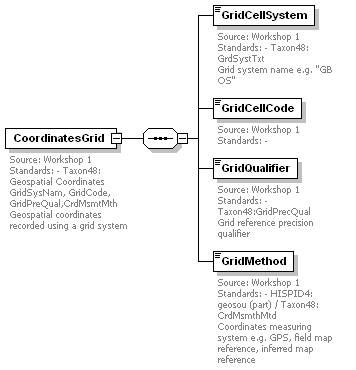 |
||
| children | GridCellSystem GridCellCode GridQualifier GridMethod | ||
| annotation |
|
||
| source | <xs:element name="CoordinatesGrid"> <xs:annotation> <xs:documentation>Source: Workshop 1 Standards: - Taxon48: Geospatial Coordinates GridSysNam, GridCode, GridPreQual,CrdMsmtMth Geospatial coordinates recorded using a grid system</xs:documentation> </xs:annotation> <xs:complexType> <xs:sequence> <xs:element name="GridCellSystem" type="xs:string"> <xs:annotation> <xs:documentation>Source: Workshop 1 Standards: - Taxon48: GrdSystTxt Grid system name e.g. "GB OS"</xs:documentation> </xs:annotation> </xs:element> <xs:element name="GridCellCode" type="xs:string"> <xs:annotation> <xs:documentation>Source: Workshop 1 Standards: - </xs:documentation> </xs:annotation> </xs:element> <xs:element name="GridQualifier" type="xs:string"> <xs:annotation> <xs:documentation>Source: Workshop 1 Standards: - Taxon48:GridPrecQual Grid reference precision qualifier</xs:documentation> </xs:annotation> </xs:element> <xs:element name="GridMethod" type="xs:string"> <xs:annotation> <xs:documentation>Source: Workshop 1 Standards: - HISPID4: geosou (part) / Taxon48: CrdMsmthMtd Coordinates measuring system e.g. GPS, field map reference, inferred map reference</xs:documentation> </xs:annotation> </xs:element> </xs:sequence> </xs:complexType> </xs:element> |
| diagram |  |
||
| type | xs:string | ||
| annotation |
|
||
| source | <xs:element name="GridCellSystem" type="xs:string"> <xs:annotation> <xs:documentation>Source: Workshop 1 Standards: - Taxon48: GrdSystTxt Grid system name e.g. "GB OS"</xs:documentation> </xs:annotation> </xs:element> |
| diagram |  |
||
| type | xs:string | ||
| annotation |
|
||
| source | <xs:element name="GridCellCode" type="xs:string"> <xs:annotation> <xs:documentation>Source: Workshop 1 Standards: - </xs:documentation> </xs:annotation> </xs:element> |
| diagram |  |
||
| type | xs:string | ||
| annotation |
|
||
| source | <xs:element name="GridQualifier" type="xs:string"> <xs:annotation> <xs:documentation>Source: Workshop 1 Standards: - Taxon48:GridPrecQual Grid reference precision qualifier</xs:documentation> </xs:annotation> </xs:element> |
| diagram |  |
||
| type | xs:string | ||
| annotation |
|
||
| source | <xs:element name="GridMethod" type="xs:string"> <xs:annotation> <xs:documentation>Source: Workshop 1 Standards: - HISPID4: geosou (part) / Taxon48: CrdMsmthMtd Coordinates measuring system e.g. GPS, field map reference, inferred map reference</xs:documentation> </xs:annotation> </xs:element> |
| diagram | 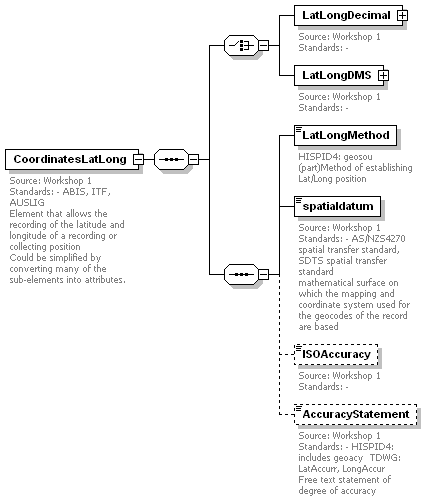 |
||
| children | LatLongDecimal LatLongDMS LatLongMethod spatialdatum ISOAccuracy AccuracyStatement | ||
| annotation |
|
||
| source | <xs:element name="CoordinatesLatLong"> <xs:annotation> <xs:documentation>Source: Workshop 1 Standards: - ABIS, ITF, AUSLIG Element that allows the recording of the latitude and longitude of a recording or collecting position Could be simplified by converting many of the sub-elements into attributes.</xs:documentation> </xs:annotation> <xs:complexType> <xs:sequence> <xs:choice> <xs:element name="LatLongDecimal"> <xs:annotation> <xs:documentation>Source: Workshop 1 Standards: -</xs:documentation> </xs:annotation> <xs:complexType> <xs:sequence> <xs:element name="LatitudeDecimal" type="xs:string"> <xs:annotation> <xs:documentation>Source: Workshop 1 Standards: - </xs:documentation> </xs:annotation> </xs:element> <xs:element name="LongitudeDecimal" type="xs:string"> <xs:annotation> <xs:documentation>Source: Workshop 1 Standards: - </xs:documentation> </xs:annotation> </xs:element> </xs:sequence> </xs:complexType> </xs:element> <xs:element name="LatLongDMS"> <xs:annotation> <xs:documentation>Source: Workshop 1 Standards: -</xs:documentation> </xs:annotation> <xs:complexType> <xs:sequence> <xs:element name="LatDegrees" type="xs:string"> <xs:annotation> <xs:documentation>Source: Workshop 1 Standards: - HISPID4: latdeg / TDWG: LatDegH, LatDegL Degrees of latitude for collecting site in range 0-90</xs:documentation> </xs:annotation> </xs:element> <xs:element name="LatMinutes" type="xs:string"> <xs:annotation> <xs:documentation>Source: Workshop 1 Standards: - HISPID4: latmin / TDWG LatMinH, LatMinL Minutes within the latitude reading - range 0 - 59</xs:documentation> </xs:annotation> </xs:element> <xs:element name="LatSeconds" type="xs:string"> <xs:annotation> <xs:documentation>Source: Workshop 1 Standards: - - - HISPID4: latsec / TDWG: LatSecH, LatSecL Seconds within the latitude reading range 0 - 59</xs:documentation> </xs:annotation> </xs:element> <xs:element name="LatNS" type="xs:string"> <xs:annotation> <xs:documentation>Source: Workshop 1 Standards: - HISPID4: latdir / TDWG: LatDirHigh, LatDirLow </xs:documentation> </xs:annotation> </xs:element> <xs:element name="LongDegrees" type="xs:string"> <xs:annotation> <xs:documentation>Source: Workshop 1 Standards: - HISPID4: londeg / TDWG : LongDegH, LonDegL Degrees of longitude of the collecting/recording site - range 0 - 90</xs:documentation> </xs:annotation> </xs:element> <xs:element name="LongMinutes" type="xs:string"> <xs:annotation> <xs:documentation>Source: Workshop 1 Standards: - - - HISPID4: lonmin / TDWG: LongMinH , LongMinL Minutes in the longitude reading range 0-59</xs:documentation> </xs:annotation> </xs:element> <xs:element name="LongSeconds" type="xs:string"> <xs:annotation> <xs:documentation>Source: Workshop 1 Standards: - - - HISPID4: lonsec / TDWG: LongSecH , LongSecL Seconds in the longitude reading - range 0 - 59</xs:documentation> </xs:annotation> </xs:element> <xs:element name="LongEW" type="xs:string"> <xs:annotation> <xs:documentation>Source: Workshop 1 Standards: - </xs:documentation> </xs:annotation> </xs:element> </xs:sequence> </xs:complexType> </xs:element> </xs:choice> <xs:sequence> <xs:element name="LatLongMethod" type="xs:string"> <xs:annotation> <xs:documentation>HISPID4: geosou (part)Method of establishing Lat/Long position</xs:documentation> </xs:annotation> </xs:element> <xs:element name="spatialdatum" type="xs:string"> <xs:annotation> <xs:documentation>Source: Workshop 1 Standards: - AS/NZS4270 spatial transfer standard, SDTS spatial transfer standard mathematical surface on which the mapping and coordinate system used for the geocodes of the record are based</xs:documentation> </xs:annotation> </xs:element> <xs:element name="ISOAccuracy" type="xs:string" minOccurs="0"> <xs:annotation> <xs:documentation>Source: Workshop 1 Standards: - </xs:documentation> </xs:annotation> </xs:element> <xs:element name="AccuracyStatement" type="xs:string" minOccurs="0"> <xs:annotation> <xs:documentation>Source: Workshop 1 Standards: - HISPID4: includes geoacy TDWG: LatAccurr, LongAccur Free text statement of degree of accuracy</xs:documentation> </xs:annotation> </xs:element> </xs:sequence> </xs:sequence> </xs:complexType> </xs:element> |
| diagram | 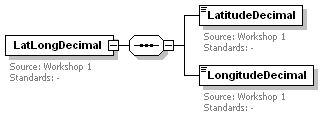 |
||
| children | LatitudeDecimal LongitudeDecimal | ||
| annotation |
|
||
| source | <xs:element name="LatLongDecimal"> <xs:annotation> <xs:documentation>Source: Workshop 1 Standards: -</xs:documentation> </xs:annotation> <xs:complexType> <xs:sequence> <xs:element name="LatitudeDecimal" type="xs:string"> <xs:annotation> <xs:documentation>Source: Workshop 1 Standards: - </xs:documentation> </xs:annotation> </xs:element> <xs:element name="LongitudeDecimal" type="xs:string"> <xs:annotation> <xs:documentation>Source: Workshop 1 Standards: - </xs:documentation> </xs:annotation> </xs:element> </xs:sequence> </xs:complexType> </xs:element> |
| diagram |  |
||
| type | xs:string | ||
| annotation |
|
||
| source | <xs:element name="LatitudeDecimal" type="xs:string"> <xs:annotation> <xs:documentation>Source: Workshop 1 Standards: - </xs:documentation> </xs:annotation> </xs:element> |
| diagram |  |
||
| type | xs:string | ||
| annotation |
|
||
| source | <xs:element name="LongitudeDecimal" type="xs:string"> <xs:annotation> <xs:documentation>Source: Workshop 1 Standards: - </xs:documentation> </xs:annotation> </xs:element> |
| diagram | 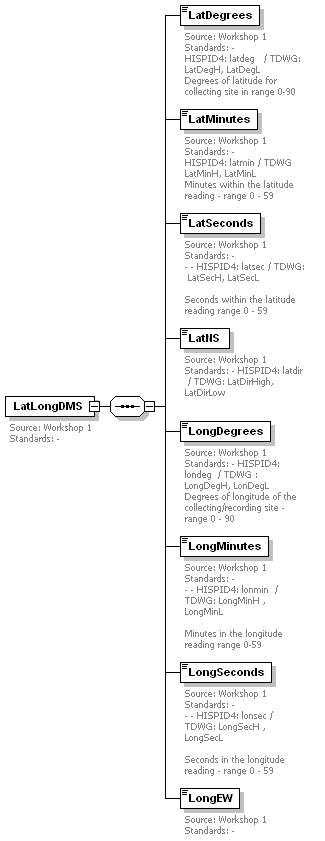 |
||
| children | LatDegrees LatMinutes LatSeconds LatNS LongDegrees LongMinutes LongSeconds LongEW | ||
| annotation |
|
||
| source | <xs:element name="LatLongDMS"> <xs:annotation> <xs:documentation>Source: Workshop 1 Standards: -</xs:documentation> </xs:annotation> <xs:complexType> <xs:sequence> <xs:element name="LatDegrees" type="xs:string"> <xs:annotation> <xs:documentation>Source: Workshop 1 Standards: - HISPID4: latdeg / TDWG: LatDegH, LatDegL Degrees of latitude for collecting site in range 0-90</xs:documentation> </xs:annotation> </xs:element> <xs:element name="LatMinutes" type="xs:string"> <xs:annotation> <xs:documentation>Source: Workshop 1 Standards: - HISPID4: latmin / TDWG LatMinH, LatMinL Minutes within the latitude reading - range 0 - 59</xs:documentation> </xs:annotation> </xs:element> <xs:element name="LatSeconds" type="xs:string"> <xs:annotation> <xs:documentation>Source: Workshop 1 Standards: - - - HISPID4: latsec / TDWG: LatSecH, LatSecL Seconds within the latitude reading range 0 - 59</xs:documentation> </xs:annotation> </xs:element> <xs:element name="LatNS" type="xs:string"> <xs:annotation> <xs:documentation>Source: Workshop 1 Standards: - HISPID4: latdir / TDWG: LatDirHigh, LatDirLow </xs:documentation> </xs:annotation> </xs:element> <xs:element name="LongDegrees" type="xs:string"> <xs:annotation> <xs:documentation>Source: Workshop 1 Standards: - HISPID4: londeg / TDWG : LongDegH, LonDegL Degrees of longitude of the collecting/recording site - range 0 - 90</xs:documentation> </xs:annotation> </xs:element> <xs:element name="LongMinutes" type="xs:string"> <xs:annotation> <xs:documentation>Source: Workshop 1 Standards: - - - HISPID4: lonmin / TDWG: LongMinH , LongMinL Minutes in the longitude reading range 0-59</xs:documentation> </xs:annotation> </xs:element> <xs:element name="LongSeconds" type="xs:string"> <xs:annotation> <xs:documentation>Source: Workshop 1 Standards: - - - HISPID4: lonsec / TDWG: LongSecH , LongSecL Seconds in the longitude reading - range 0 - 59</xs:documentation> </xs:annotation> </xs:element> <xs:element name="LongEW" type="xs:string"> <xs:annotation> <xs:documentation>Source: Workshop 1 Standards: - </xs:documentation> </xs:annotation> </xs:element> </xs:sequence> </xs:complexType> </xs:element> |
| diagram |  |
||
| type | xs:string | ||
| annotation |
|
||
| source | <xs:element name="LatDegrees" type="xs:string"> <xs:annotation> <xs:documentation>Source: Workshop 1 Standards: - HISPID4: latdeg / TDWG: LatDegH, LatDegL Degrees of latitude for collecting site in range 0-90</xs:documentation> </xs:annotation> </xs:element> |
| diagram |  |
||
| type | xs:string | ||
| annotation |
|
||
| source | <xs:element name="LatMinutes" type="xs:string"> <xs:annotation> <xs:documentation>Source: Workshop 1 Standards: - HISPID4: latmin / TDWG LatMinH, LatMinL Minutes within the latitude reading - range 0 - 59</xs:documentation> </xs:annotation> </xs:element> |
| diagram |  |
||
| type | xs:string | ||
| annotation |
|
||
| source | <xs:element name="LatSeconds" type="xs:string"> <xs:annotation> <xs:documentation>Source: Workshop 1 Standards: - - - HISPID4: latsec / TDWG: LatSecH, LatSecL Seconds within the latitude reading range 0 - 59</xs:documentation> </xs:annotation> </xs:element> |
| diagram |  |
||
| type | xs:string | ||
| annotation |
|
||
| source | <xs:element name="LatNS" type="xs:string"> <xs:annotation> <xs:documentation>Source: Workshop 1 Standards: - HISPID4: latdir / TDWG: LatDirHigh, LatDirLow </xs:documentation> </xs:annotation> </xs:element> |
| diagram |  |
||
| type | xs:string | ||
| annotation |
|
||
| source | <xs:element name="LongDegrees" type="xs:string"> <xs:annotation> <xs:documentation>Source: Workshop 1 Standards: - HISPID4: londeg / TDWG : LongDegH, LonDegL Degrees of longitude of the collecting/recording site - range 0 - 90</xs:documentation> </xs:annotation> </xs:element> |
| diagram |  |
||
| type | xs:string | ||
| annotation |
|
||
| source | <xs:element name="LongMinutes" type="xs:string"> <xs:annotation> <xs:documentation>Source: Workshop 1 Standards: - - - HISPID4: lonmin / TDWG: LongMinH , LongMinL Minutes in the longitude reading range 0-59</xs:documentation> </xs:annotation> </xs:element> |
| diagram | 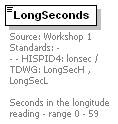 |
||
| type | xs:string | ||
| annotation |
|
||
| source | <xs:element name="LongSeconds" type="xs:string"> <xs:annotation> <xs:documentation>Source: Workshop 1 Standards: - - - HISPID4: lonsec / TDWG: LongSecH , LongSecL Seconds in the longitude reading - range 0 - 59</xs:documentation> </xs:annotation> </xs:element> |
| diagram |  |
||
| type | xs:string | ||
| annotation |
|
||
| source | <xs:element name="LongEW" type="xs:string"> <xs:annotation> <xs:documentation>Source: Workshop 1 Standards: - </xs:documentation> </xs:annotation> </xs:element> |
| diagram | 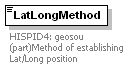 |
||
| type | xs:string | ||
| annotation |
|
||
| source | <xs:element name="LatLongMethod" type="xs:string"> <xs:annotation> <xs:documentation>HISPID4: geosou (part)Method of establishing Lat/Long position</xs:documentation> </xs:annotation> </xs:element> |
| diagram | 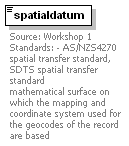 |
||
| type | xs:string | ||
| annotation |
|
||
| source | <xs:element name="spatialdatum" type="xs:string"> <xs:annotation> <xs:documentation>Source: Workshop 1 Standards: - AS/NZS4270 spatial transfer standard, SDTS spatial transfer standard mathematical surface on which the mapping and coordinate system used for the geocodes of the record are based</xs:documentation> </xs:annotation> </xs:element> |
| diagram |  |
||
| type | xs:string | ||
| annotation |
|
||
| source | <xs:element name="ISOAccuracy" type="xs:string" minOccurs="0"> <xs:annotation> <xs:documentation>Source: Workshop 1 Standards: - </xs:documentation> </xs:annotation> </xs:element> |
| diagram | 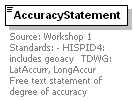 |
||
| type | xs:string | ||
| annotation |
|
||
| source | <xs:element name="AccuracyStatement" type="xs:string" minOccurs="0"> <xs:annotation> <xs:documentation>Source: Workshop 1 Standards: - HISPID4: includes geoacy TDWG: LatAccurr, LongAccur Free text statement of degree of accuracy</xs:documentation> </xs:annotation> </xs:element> |
| diagram | 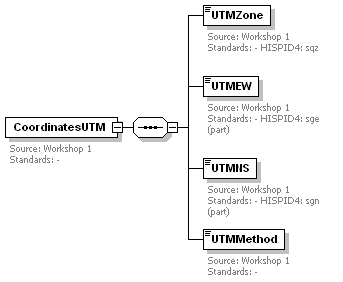 |
||
| children | UTMZone UTMEW UTMNS UTMMethod | ||
| annotation |
|
||
| source | <xs:element name="CoordinatesUTM"> <xs:annotation> <xs:documentation>Source: Workshop 1 Standards: - </xs:documentation> </xs:annotation> <xs:complexType> <xs:sequence> <xs:element name="UTMZone" type="xs:string"> <xs:annotation> <xs:documentation>Source: Workshop 1 Standards: - HISPID4: sqz </xs:documentation> </xs:annotation> </xs:element> <xs:element name="UTMEW" type="xs:string"> <xs:annotation> <xs:documentation>Source: Workshop 1 Standards: - HISPID4: sge (part) </xs:documentation> </xs:annotation> </xs:element> <xs:element name="UTMNS" type="xs:string"> <xs:annotation> <xs:documentation>Source: Workshop 1 Standards: - HISPID4: sgn (part)</xs:documentation> </xs:annotation> </xs:element> <xs:element name="UTMMethod" type="xs:string"> <xs:annotation> <xs:documentation>Source: Workshop 1 Standards: -</xs:documentation> </xs:annotation> </xs:element> </xs:sequence> </xs:complexType> </xs:element> |
| diagram |  |
||
| type | xs:string | ||
| annotation |
|
||
| source | <xs:element name="UTMZone" type="xs:string"> <xs:annotation> <xs:documentation>Source: Workshop 1 Standards: - HISPID4: sqz </xs:documentation> </xs:annotation> </xs:element> |
| diagram |  |
||
| type | xs:string | ||
| annotation |
|
||
| source | <xs:element name="UTMEW" type="xs:string"> <xs:annotation> <xs:documentation>Source: Workshop 1 Standards: - HISPID4: sge (part) </xs:documentation> </xs:annotation> </xs:element> |
| diagram |  |
||
| type | xs:string | ||
| annotation |
|
||
| source | <xs:element name="UTMNS" type="xs:string"> <xs:annotation> <xs:documentation>Source: Workshop 1 Standards: - HISPID4: sgn (part)</xs:documentation> </xs:annotation> </xs:element> |
| diagram |  |
||
| type | xs:string | ||
| annotation |
|
||
| source | <xs:element name="UTMMethod" type="xs:string"> <xs:annotation> <xs:documentation>Source: Workshop 1 Standards: -</xs:documentation> </xs:annotation> </xs:element> |
| diagram | 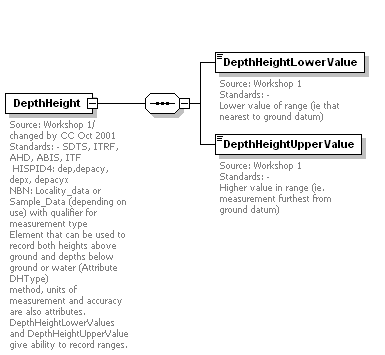 |
||||||||||||||||||||||||||||||
| children | DepthHeightLowerValue DepthHeightUpperValue | ||||||||||||||||||||||||||||||
| attributes |
|
||||||||||||||||||||||||||||||
| annotation |
|
||||||||||||||||||||||||||||||
| source | <xs:element name="DepthHeight" minOccurs="0"> <xs:annotation> <xs:documentation>Source: Workshop 1/ changed by CC Oct 2001 Standards: - SDTS, ITRF, AHD, ABIS, ITF HISPID4: dep,depacy, depx, depacyx NBN: Locality_data or Sample_Data (depending on use) with qualifier for measurement type Element that can be used to record both heights above ground and depths below ground or water (Attribute DHType) method, units of measurement and accuracy are also attributes. DepthHeightLowerValues and DepthHeightUpperValue give ability to record ranges.</xs:documentation> </xs:annotation> <xs:complexType> <xs:sequence> <xs:element name="DepthHeightLowerValue" type="xs:string"> <xs:annotation> <xs:documentation>Source: Workshop 1 Standards: - Lower value of range (ie that nearest to ground datum)</xs:documentation> </xs:annotation> </xs:element> <xs:element name="DepthHeightUpperValue" type="xs:string"> <xs:annotation> <xs:documentation>Source: Workshop 1 Standards: - Higher value in range (ie. measurement furthest from ground datum)</xs:documentation> </xs:annotation> </xs:element> </xs:sequence> <xs:attribute name="DHType"> <xs:simpleType> <xs:restriction base="xs:NMTOKEN"> <xs:enumeration value="water_depth"/> <xs:enumeration value="beneath_ground"/> <xs:enumeration value="height"/> </xs:restriction> </xs:simpleType> </xs:attribute> <xs:attribute name="DHMethod" type="xs:string"/> <xs:attribute name="DHUnits" use="required"> <xs:simpleType> <xs:restriction base="xs:NMTOKEN"> <xs:enumeration value="kilometres"/> <xs:enumeration value="metres"/> <xs:enumeration value="centimetres"/> <xs:enumeration value="millimetres"/> <xs:enumeration value="Miles"/> <xs:enumeration value="yards"/> <xs:enumeration value="feet"/> <xs:enumeration value="inches"/> <xs:enumeration value="fathoms"/> <xs:enumeration value="cables"/> </xs:restriction> </xs:simpleType> </xs:attribute> <xs:attribute name="DHAccuracy"> <xs:simpleType> <xs:restriction base="xs:NMTOKEN"> <xs:enumeration value="collector"/> <xs:enumeration value="compiled"/> <xs:enumeration value="autogenerated"/> </xs:restriction> </xs:simpleType> </xs:attribute> </xs:complexType> </xs:element> |
| diagram | 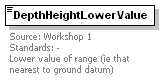 |
||
| type | xs:string | ||
| annotation |
|
||
| source | <xs:element name="DepthHeightLowerValue" type="xs:string"> <xs:annotation> <xs:documentation>Source: Workshop 1 Standards: - Lower value of range (ie that nearest to ground datum)</xs:documentation> </xs:annotation> </xs:element> |
| diagram | 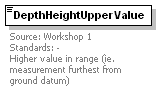 |
||
| type | xs:string | ||
| annotation |
|
||
| source | <xs:element name="DepthHeightUpperValue" type="xs:string"> <xs:annotation> <xs:documentation>Source: Workshop 1 Standards: - Higher value in range (ie. measurement furthest from ground datum)</xs:documentation> </xs:annotation> </xs:element> |
| diagram | 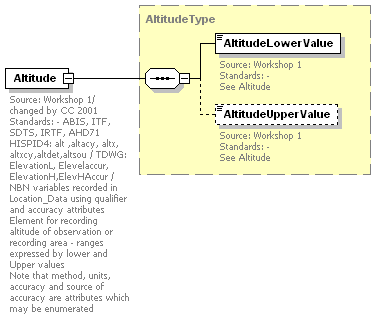 |
||||||||||||||||||||||||||||||
| type | AltitudeType | ||||||||||||||||||||||||||||||
| children | AltitudeLowerValue AltitudeUpperValue | ||||||||||||||||||||||||||||||
| attributes |
|
||||||||||||||||||||||||||||||
| annotation |
|
||||||||||||||||||||||||||||||
| source | <xs:element name="Altitude" type="AltitudeType" minOccurs="0"> <xs:annotation> <xs:documentation>Source: Workshop 1/ changed by CC 2001 Standards: - ABIS, ITF, SDTS, IRTF, AHD71 HISPID4: alt ,altacy, altx, altxcy,altdet,altsou / TDWG: ElevationL, Elevelaccur, ElevationH,ElevHAccur / NBN variables recorded in Location_Data using qualifier and accuracy attributes Element for recording altitude of observation or recording area - ranges expressed by lower and Upper values Note that method, units, accuracy and source of accuracy are attributes which may be enumerated</xs:documentation> </xs:annotation> </xs:element> |
| diagram | 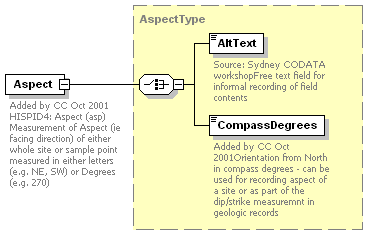 |
||||||||||||
| type | AspectType | ||||||||||||
| children | AltText CompassDegrees | ||||||||||||
| attributes |
|
||||||||||||
| annotation |
|
||||||||||||
| source | <xs:element name="Aspect" type="AspectType" minOccurs="0"> <xs:annotation> <xs:documentation>Added by CC Oct 2001 HISPID4: Aspect (asp) Measurement of Aspect (ie facing direction) of either whole site or sample point measured in either letters (e.g. NE, SW) or Degrees (e.g. 270)</xs:documentation> </xs:annotation> </xs:element> |
| diagram |  |
||
| type | xs:string | ||
| annotation |
|
||
| source | <xs:element name="Notes" type="xs:string" minOccurs="0"> <xs:annotation> <xs:documentation>Source: Workshop 1 Standards: - </xs:documentation> </xs:annotation> </xs:element> |
| diagram | 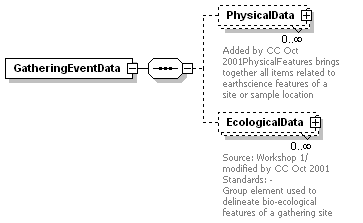 |
| children | PhysicalData EcologicalData |
| source | <xs:element name="GatheringEventData" minOccurs="0"> <xs:complexType> <xs:sequence> <xs:element name="PhysicalData" minOccurs="0" maxOccurs="unbounded"> <xs:annotation> <xs:documentation>Added by CC Oct 2001PhysicalFeatures brings together all items related to earthscience features of a site or sample location</xs:documentation> </xs:annotation> <xs:complexType> <xs:sequence> <xs:element name="Geomorphology" minOccurs="0" maxOccurs="unbounded"> <xs:annotation> <xs:documentation>Source: Workshop 1 Standards: - </xs:documentation> </xs:annotation> <xs:complexType> <xs:sequence> <xs:choice> <xs:element name="LookupTerm" type="LookupTermType"> <xs:annotation> <xs:documentation> Added by CC Oct 2001 NBN: Term Typical structure for a simple lookup list of term contents - structure consists of an attribute for the type e.g. name of the look up list together with long and short versions of the term</xs:documentation> </xs:annotation> </xs:element> <xs:sequence> <xs:element name="AltText" type="AltText"> <xs:annotation> <xs:documentation>Source: Sydney CODATA workshopFree text field for informal recording of field contents</xs:documentation> </xs:annotation> </xs:element> <xs:element name="Source" type="SourceType" minOccurs="0"> <xs:annotation> <xs:documentation>Added CC Oct 2001 NBN: Source Marker element for a link to a source module for dealing with structured literature and document rexcords </xs:documentation> </xs:annotation> </xs:element> </xs:sequence> </xs:choice> <xs:element name="Comment" type="Comment" minOccurs="0"> <xs:annotation> <xs:documentation>Added by CC Oct 2001Free text of formatted text (rtf) description of the feature - not controlled length e.g. often a memo field</xs:documentation> </xs:annotation> </xs:element> </xs:sequence> </xs:complexType> </xs:element> <xs:element name="Stratigraphy" type="StratigraphyType" minOccurs="0" maxOccurs="unbounded"> <xs:annotation> <xs:documentation>Source: Workshop 1/ changed by CC Oct. 2001 Standards: - LNHM model Allows the linking of geological dating and rock unit names to sites or sample locations Structure allows for full analysis of stratigraphy e.g. to allow fossils in collections to be sorted by period and zone Also allows for free text terms when their staus is unknown or for more full descriptions of stratigraphy of site.</xs:documentation> </xs:annotation> </xs:element> <xs:element name="Topography" minOccurs="0"> <xs:annotation> <xs:documentation>Added by CC Oct 2001 HISPID4: top Free text description of the topography either related to a site as a feature or recorded as part of a sample (i.e attaches info to recorders and date)</xs:documentation> </xs:annotation> <xs:complexType> <xs:sequence> <xs:choice> <xs:element name="LookupTerm" type="LookupTermType"> <xs:annotation> <xs:documentation>Added by CC Oct 2001 NBN: Term Typical structure for a simple lookup list of term contents - structure consists of an attribute for the type e.g. name of the look up list together with long and short versions of the term</xs:documentation> </xs:annotation> </xs:element> <xs:sequence> <xs:element name="AltText" type="AltText"> <xs:annotation> <xs:documentation>Source: Sydney CODATA workshopFree text field for informal recording of field contents</xs:documentation> </xs:annotation> </xs:element> <xs:element name="Source" type="SourceType" minOccurs="0"> <xs:annotation> <xs:documentation>Added CC Oct 2001 NBN: Source Marker element for a link to a source module for dealing with structured literature and document rexcords </xs:documentation> </xs:annotation> </xs:element> </xs:sequence> </xs:choice> <xs:element name="Comment" type="Comment" minOccurs="0"> <xs:annotation> <xs:documentation>Added by CC Oct 2001Free text of formatted text (rtf) description of the feature - not controlled length e.g. often a memo field</xs:documentation> </xs:annotation> </xs:element> </xs:sequence> </xs:complexType> </xs:element> <xs:element name="Hydrology" minOccurs="0"> <xs:annotation> <xs:documentation>Added by CC Oct 2001Hydrological features of the site or collection point</xs:documentation> </xs:annotation> <xs:complexType> <xs:sequence> <xs:choice> <xs:element name="LookupTerm" type="LookupTermType"> <xs:annotation> <xs:documentation>Added by CC Oct 2001 NBN: Term Typical structure for a simple lookup list of term contents - structure consists of an attribute for the type e.g. name of the look up list together with long and short versions of the term</xs:documentation> </xs:annotation> </xs:element> <xs:sequence> <xs:element name="AltText" type="AltText"> <xs:annotation> <xs:documentation>Source: Sydney CODATA workshopFree text field for informal recording of field contents</xs:documentation> </xs:annotation> </xs:element> <xs:element name="Source" type="SourceType" minOccurs="0"> <xs:annotation> <xs:documentation>Added CC Oct 2001 NBN: Source Marker element for a link to a source module for dealing with structured literature and document rexcords </xs:documentation> </xs:annotation> </xs:element> </xs:sequence> </xs:choice> <xs:element name="Comment" type="Comment" minOccurs="0"> <xs:annotation> <xs:documentation>Added by CC Oct 2001Free text of formatted text (rtf) description of the feature - not controlled length e.g. often a memo field</xs:documentation> </xs:annotation> </xs:element> </xs:sequence> </xs:complexType> </xs:element> </xs:sequence> </xs:complexType> </xs:element> <xs:element name="EcologicalData" minOccurs="0" maxOccurs="unbounded"> <xs:annotation> <xs:documentation>Source: Workshop 1/ modified by CC Oct 2001 Standards: - Group element used to delineate bio-ecological features of a gathering site</xs:documentation> </xs:annotation> <xs:complexType> <xs:sequence> <xs:element name="BiotopeRecord" minOccurs="0" maxOccurs="unbounded"> <xs:annotation> <xs:documentation>Added by CC Oct 2001 NBN: Biotope-occurrence HISPID4: hab (part) / TDWG: Habitat (part) Biotoperecord is an element for recording habitat and land type terms that can be associated either with taxon/specimen data or directly for recording habitat areas and other variables (e.g. vegetation height) in a gathering site or related to a specific gathering event Include </xs:documentation> </xs:annotation> <xs:complexType> <xs:sequence> <xs:element name="Biotope"> <xs:annotation> <xs:documentation>Source: Workshop 1/ modified by CC Oct 2001 Standards: - HISPID4: asspp Interpreted here as relationships with other taxa Note this can be recorded as a feature of a location (e.g. at this site the following species are known to grow together) or can be used to record relationships in an observation (e.g. caterpillar and observed food plant, parasite and host etc.) </xs:documentation> </xs:annotation> <xs:complexType> <xs:choice> <xs:sequence> <xs:element name="BiotopeKey" minOccurs="0"> <xs:annotation> <xs:documentation>Added by CC Oct 2001 - - NBN: Biotope_Key The Primary key for an entry in a standard dictionary or other database Could use attribute to record database source e.g. a URL for lookup or reference to Internal entity in DTD (supplied dictionary) </xs:documentation> </xs:annotation> <xs:complexType> <xs:simpleContent> <xs:extension base="xs:string"> <xs:attribute name="KeyType" type="xs:string"/> </xs:extension> </xs:simpleContent> </xs:complexType> </xs:element> <xs:element name="BiotopeCode" minOccurs="0"> <xs:annotation> <xs:documentation>Added by CC Oct 2001 NBN: Short_Name Short name or code for a Biotope e.g. in UK NVC mg5a (for a type of mesotrophic grassland) Attribute records the source or possibly URL for origianl dictionary source </xs:documentation> </xs:annotation> <xs:complexType> <xs:simpleContent> <xs:extension base="xs:string"> <xs:attribute name="ClassificationUsed" type="xs:string"/> </xs:extension> </xs:simpleContent> </xs:complexType> </xs:element> <xs:element name="BiotopeLongName" minOccurs="0"> <xs:annotation> <xs:documentation>Added by CC Oct 2001 NBN: Long_Name The full dictionary name of the habitat within a classification</xs:documentation> </xs:annotation> <xs:complexType> <xs:simpleContent> <xs:extension base="xs:string"> <xs:attribute name="ClassificationUsed" type="xs:string"/> </xs:extension> </xs:simpleContent> </xs:complexType> </xs:element> </xs:sequence> <xs:element name="AltText" type="AltText"> <xs:annotation> <xs:documentation>Source: Sydney CODATA workshopFree text field for informal recording of field contents</xs:documentation> </xs:annotation> </xs:element> </xs:choice> </xs:complexType> </xs:element> <xs:element name="BiotopeData" minOccurs="0" maxOccurs="unbounded"> <xs:annotation> <xs:documentation>Added by CC Oct 2001 NBN: biotope_occurrence_data BiotopeData allows the linkuing of any measurement (e.g. biotope area) to a biotope record</xs:documentation> </xs:annotation> <xs:complexType> <xs:sequence> <xs:choice> <xs:element name="AltText" type="AltText"> <xs:annotation> <xs:documentation>Source: Sydney CODATA workshopFree text field for informal recording of field contents</xs:documentation> </xs:annotation> </xs:element> <xs:sequence> <xs:element name="measurement" type="measurementType"> <xs:annotation> <xs:documentation>Added by CC Oct 2001 NBN: measurement (partim) measurement is the actiual measurement - measurement is qualigied by attributes: measurementType: what type of measurement e.g. count, area, linear measurement measurementUnits: units that measurement is recorded in e...g. hectares, kilometres, kilogrammes etc. measurementAccuracy: describes accuracy e.g. approximate or +/- 50 </xs:documentation> </xs:annotation> </xs:element> <xs:element name="measurementQualifier" type="measurementQualifier"> <xs:annotation> <xs:documentation>Added by CC Oct 2001 NBN: qualifier measurementQualifier is a freetext field that describes what is being measures e.g. biotope area It is supported by measurement Type attribute. e.g. measurementQualifier might be 'males' and measurementType might be 'count' </xs:documentation> </xs:annotation> </xs:element> </xs:sequence> </xs:choice> <xs:element name="Comment" type="Comment" minOccurs="0"> <xs:annotation> <xs:documentation>Added by CC Oct 2001Free text of formatted text (rtf) description of the feature - not controlled length e.g. often a memo field</xs:documentation> </xs:annotation> </xs:element> </xs:sequence> <xs:attribute name="BiotopeData_ID" type="xs:string"/> </xs:complexType> </xs:element> </xs:sequence> </xs:complexType> </xs:element> <xs:element name="Synecology" minOccurs="0" maxOccurs="unbounded"> <xs:annotation> <xs:documentation>Source: Workshop 1/ modified by CC Oct 2001 Standards: - HISPID4: asspp Interpreted here as relationships with other taxa Note this can be recorded as a feature of a location (e.g. at this site the following species are known to grow together) or can be used to record relationships in an observation (e.g. caterpillar and observed food plant, parasite and host etc.) </xs:documentation> </xs:annotation> <xs:complexType> <xs:sequence> <xs:element name="TaxonIdentified" type="TaxonIdentifiedType" maxOccurs="unbounded"> <xs:annotation> <xs:documentation>Source: Workshop 1 Standards: - </xs:documentation> </xs:annotation> </xs:element> <xs:element name="Comment" type="Comment" minOccurs="0"> <xs:annotation> <xs:documentation>Added by CC Oct 2001Free text of formatted text (rtf) description of the feature - not controlled length e.g. often a memo field</xs:documentation> </xs:annotation> </xs:element> </xs:sequence> </xs:complexType> </xs:element> </xs:sequence> </xs:complexType> </xs:element> </xs:sequence> </xs:complexType> </xs:element> |
| diagram | 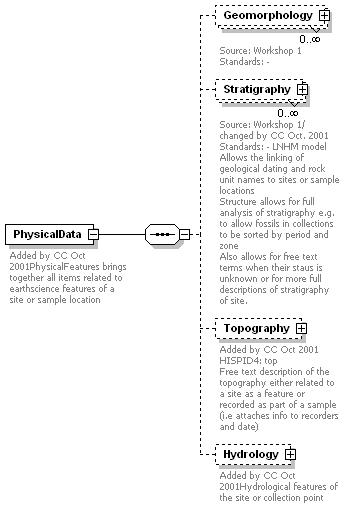 |
||
| children | Geomorphology Stratigraphy Topography Hydrology | ||
| annotation |
|
||
| source | <xs:element name="PhysicalData" minOccurs="0" maxOccurs="unbounded"> <xs:annotation> <xs:documentation>Added by CC Oct 2001PhysicalFeatures brings together all items related to earthscience features of a site or sample location</xs:documentation> </xs:annotation> <xs:complexType> <xs:sequence> <xs:element name="Geomorphology" minOccurs="0" maxOccurs="unbounded"> <xs:annotation> <xs:documentation>Source: Workshop 1 Standards: - </xs:documentation> </xs:annotation> <xs:complexType> <xs:sequence> <xs:choice> <xs:element name="LookupTerm" type="LookupTermType"> <xs:annotation> <xs:documentation> Added by CC Oct 2001 NBN: Term Typical structure for a simple lookup list of term contents - structure consists of an attribute for the type e.g. name of the look up list together with long and short versions of the term</xs:documentation> </xs:annotation> </xs:element> <xs:sequence> <xs:element name="AltText" type="AltText"> <xs:annotation> <xs:documentation>Source: Sydney CODATA workshopFree text field for informal recording of field contents</xs:documentation> </xs:annotation> </xs:element> <xs:element name="Source" type="SourceType" minOccurs="0"> <xs:annotation> <xs:documentation>Added CC Oct 2001 NBN: Source Marker element for a link to a source module for dealing with structured literature and document rexcords </xs:documentation> </xs:annotation> </xs:element> </xs:sequence> </xs:choice> <xs:element name="Comment" type="Comment" minOccurs="0"> <xs:annotation> <xs:documentation>Added by CC Oct 2001Free text of formatted text (rtf) description of the feature - not controlled length e.g. often a memo field</xs:documentation> </xs:annotation> </xs:element> </xs:sequence> </xs:complexType> </xs:element> <xs:element name="Stratigraphy" type="StratigraphyType" minOccurs="0" maxOccurs="unbounded"> <xs:annotation> <xs:documentation>Source: Workshop 1/ changed by CC Oct. 2001 Standards: - LNHM model Allows the linking of geological dating and rock unit names to sites or sample locations Structure allows for full analysis of stratigraphy e.g. to allow fossils in collections to be sorted by period and zone Also allows for free text terms when their staus is unknown or for more full descriptions of stratigraphy of site.</xs:documentation> </xs:annotation> </xs:element> <xs:element name="Topography" minOccurs="0"> <xs:annotation> <xs:documentation>Added by CC Oct 2001 HISPID4: top Free text description of the topography either related to a site as a feature or recorded as part of a sample (i.e attaches info to recorders and date)</xs:documentation> </xs:annotation> <xs:complexType> <xs:sequence> <xs:choice> <xs:element name="LookupTerm" type="LookupTermType"> <xs:annotation> <xs:documentation>Added by CC Oct 2001 NBN: Term Typical structure for a simple lookup list of term contents - structure consists of an attribute for the type e.g. name of the look up list together with long and short versions of the term</xs:documentation> </xs:annotation> </xs:element> <xs:sequence> <xs:element name="AltText" type="AltText"> <xs:annotation> <xs:documentation>Source: Sydney CODATA workshopFree text field for informal recording of field contents</xs:documentation> </xs:annotation> </xs:element> <xs:element name="Source" type="SourceType" minOccurs="0"> <xs:annotation> <xs:documentation>Added CC Oct 2001 NBN: Source Marker element for a link to a source module for dealing with structured literature and document rexcords </xs:documentation> </xs:annotation> </xs:element> </xs:sequence> </xs:choice> <xs:element name="Comment" type="Comment" minOccurs="0"> <xs:annotation> <xs:documentation>Added by CC Oct 2001Free text of formatted text (rtf) description of the feature - not controlled length e.g. often a memo field</xs:documentation> </xs:annotation> </xs:element> </xs:sequence> </xs:complexType> </xs:element> <xs:element name="Hydrology" minOccurs="0"> <xs:annotation> <xs:documentation>Added by CC Oct 2001Hydrological features of the site or collection point</xs:documentation> </xs:annotation> <xs:complexType> <xs:sequence> <xs:choice> <xs:element name="LookupTerm" type="LookupTermType"> <xs:annotation> <xs:documentation>Added by CC Oct 2001 NBN: Term Typical structure for a simple lookup list of term contents - structure consists of an attribute for the type e.g. name of the look up list together with long and short versions of the term</xs:documentation> </xs:annotation> </xs:element> <xs:sequence> <xs:element name="AltText" type="AltText"> <xs:annotation> <xs:documentation>Source: Sydney CODATA workshopFree text field for informal recording of field contents</xs:documentation> </xs:annotation> </xs:element> <xs:element name="Source" type="SourceType" minOccurs="0"> <xs:annotation> <xs:documentation>Added CC Oct 2001 NBN: Source Marker element for a link to a source module for dealing with structured literature and document rexcords </xs:documentation> </xs:annotation> </xs:element> </xs:sequence> </xs:choice> <xs:element name="Comment" type="Comment" minOccurs="0"> <xs:annotation> <xs:documentation>Added by CC Oct 2001Free text of formatted text (rtf) description of the feature - not controlled length e.g. often a memo field</xs:documentation> </xs:annotation> </xs:element> </xs:sequence> </xs:complexType> </xs:element> </xs:sequence> </xs:complexType> </xs:element> |
| diagram | 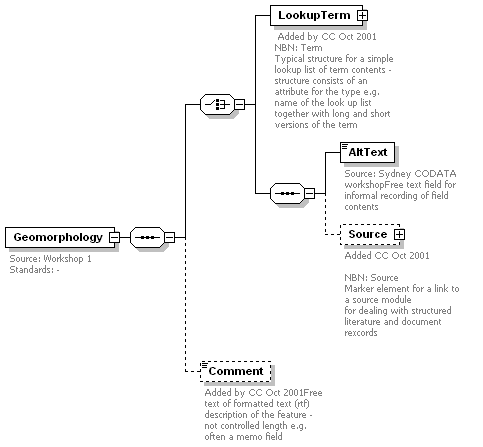 |
||
| children | LookupTerm AltText Source Comment | ||
| annotation |
|
||
| source | <xs:element name="Geomorphology" minOccurs="0" maxOccurs="unbounded"> <xs:annotation> <xs:documentation>Source: Workshop 1 Standards: - </xs:documentation> </xs:annotation> <xs:complexType> <xs:sequence> <xs:choice> <xs:element name="LookupTerm" type="LookupTermType"> <xs:annotation> <xs:documentation> Added by CC Oct 2001 NBN: Term Typical structure for a simple lookup list of term contents - structure consists of an attribute for the type e.g. name of the look up list together with long and short versions of the term</xs:documentation> </xs:annotation> </xs:element> <xs:sequence> <xs:element name="AltText" type="AltText"> <xs:annotation> <xs:documentation>Source: Sydney CODATA workshopFree text field for informal recording of field contents</xs:documentation> </xs:annotation> </xs:element> <xs:element name="Source" type="SourceType" minOccurs="0"> <xs:annotation> <xs:documentation>Added CC Oct 2001 NBN: Source Marker element for a link to a source module for dealing with structured literature and document rexcords </xs:documentation> </xs:annotation> </xs:element> </xs:sequence> </xs:choice> <xs:element name="Comment" type="Comment" minOccurs="0"> <xs:annotation> <xs:documentation>Added by CC Oct 2001Free text of formatted text (rtf) description of the feature - not controlled length e.g. often a memo field</xs:documentation> </xs:annotation> </xs:element> </xs:sequence> </xs:complexType> </xs:element> |
| diagram | 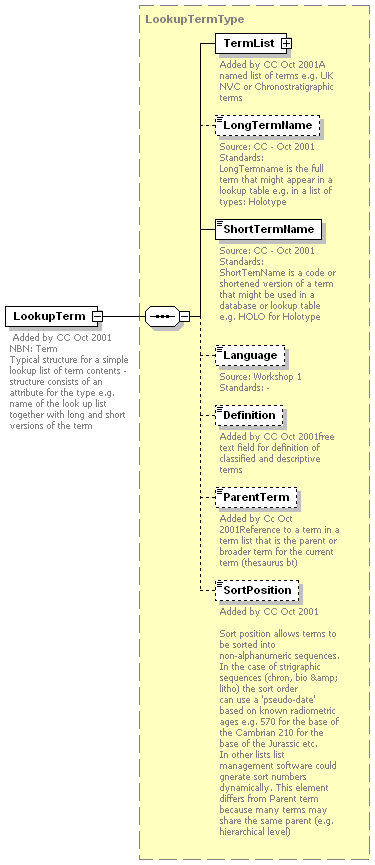 |
||||||||||||||||||
| type | LookupTermType | ||||||||||||||||||
| children | TermList LongTermName ShortTermName Language Definition ParentTerm SortPosition | ||||||||||||||||||
| attributes |
|
||||||||||||||||||
| annotation |
|
||||||||||||||||||
| source | <xs:element name="LookupTerm" type="LookupTermType"> <xs:annotation> <xs:documentation> Added by CC Oct 2001 NBN: Term Typical structure for a simple lookup list of term contents - structure consists of an attribute for the type e.g. name of the look up list together with long and short versions of the term</xs:documentation> </xs:annotation> </xs:element> |
| diagram | 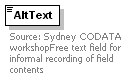 |
||
| type | AltText | ||
| annotation |
|
||
| source | <xs:element name="AltText" type="AltText"> <xs:annotation> <xs:documentation>Source: Sydney CODATA workshopFree text field for informal recording of field contents</xs:documentation> </xs:annotation> </xs:element> |
| diagram | 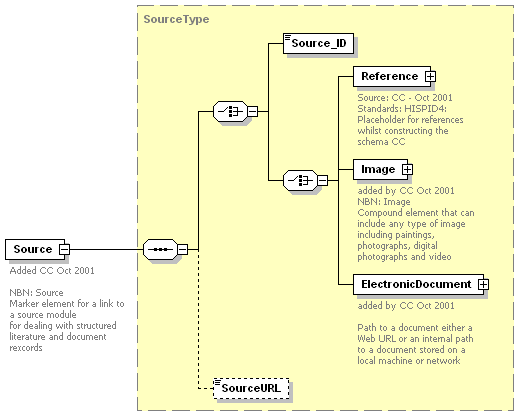 |
||||||||||||
| type | SourceType | ||||||||||||
| children | Source_ID Reference Image ElectronicDocument SourceURL | ||||||||||||
| attributes |
|
||||||||||||
| annotation |
|
||||||||||||
| source | <xs:element name="Source" type="SourceType" minOccurs="0"> <xs:annotation> <xs:documentation>Added CC Oct 2001 NBN: Source Marker element for a link to a source module for dealing with structured literature and document rexcords </xs:documentation> </xs:annotation> </xs:element> |
| diagram | 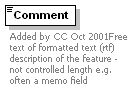 |
||
| type | Comment | ||
| annotation |
|
||
| source | <xs:element name="Comment" type="Comment" minOccurs="0"> <xs:annotation> <xs:documentation>Added by CC Oct 2001Free text of formatted text (rtf) description of the feature - not controlled length e.g. often a memo field</xs:documentation> </xs:annotation> </xs:element> |
| diagram | 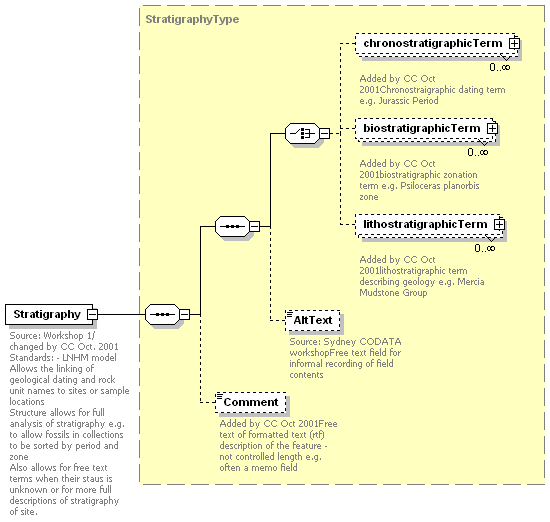 |
||
| type | StratigraphyType | ||
| children | chronostratigraphicTerm biostratigraphicTerm lithostratigraphicTerm AltText Comment | ||
| annotation |
|
||
| source | <xs:element name="Stratigraphy" type="StratigraphyType" minOccurs="0" maxOccurs="unbounded"> <xs:annotation> <xs:documentation>Source: Workshop 1/ changed by CC Oct. 2001 Standards: - LNHM model Allows the linking of geological dating and rock unit names to sites or sample locations Structure allows for full analysis of stratigraphy e.g. to allow fossils in collections to be sorted by period and zone Also allows for free text terms when their staus is unknown or for more full descriptions of stratigraphy of site.</xs:documentation> </xs:annotation> </xs:element> |
| diagram | 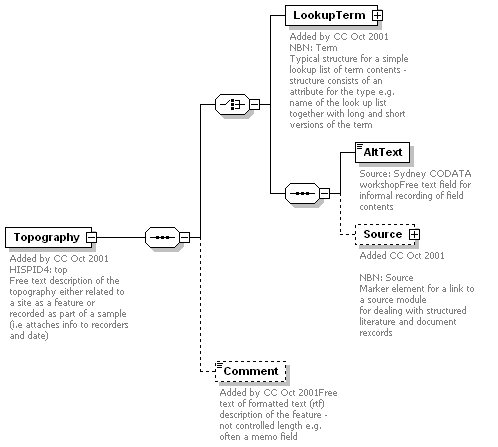 |
||
| children | LookupTerm AltText Source Comment | ||
| annotation |
|
||
| source | <xs:element name="Topography" minOccurs="0"> <xs:annotation> <xs:documentation>Added by CC Oct 2001 HISPID4: top Free text description of the topography either related to a site as a feature or recorded as part of a sample (i.e attaches info to recorders and date)</xs:documentation> </xs:annotation> <xs:complexType> <xs:sequence> <xs:choice> <xs:element name="LookupTerm" type="LookupTermType"> <xs:annotation> <xs:documentation>Added by CC Oct 2001 NBN: Term Typical structure for a simple lookup list of term contents - structure consists of an attribute for the type e.g. name of the look up list together with long and short versions of the term</xs:documentation> </xs:annotation> </xs:element> <xs:sequence> <xs:element name="AltText" type="AltText"> <xs:annotation> <xs:documentation>Source: Sydney CODATA workshopFree text field for informal recording of field contents</xs:documentation> </xs:annotation> </xs:element> <xs:element name="Source" type="SourceType" minOccurs="0"> <xs:annotation> <xs:documentation>Added CC Oct 2001 NBN: Source Marker element for a link to a source module for dealing with structured literature and document rexcords </xs:documentation> </xs:annotation> </xs:element> </xs:sequence> </xs:choice> <xs:element name="Comment" type="Comment" minOccurs="0"> <xs:annotation> <xs:documentation>Added by CC Oct 2001Free text of formatted text (rtf) description of the feature - not controlled length e.g. often a memo field</xs:documentation> </xs:annotation> </xs:element> </xs:sequence> </xs:complexType> </xs:element> |
| diagram | 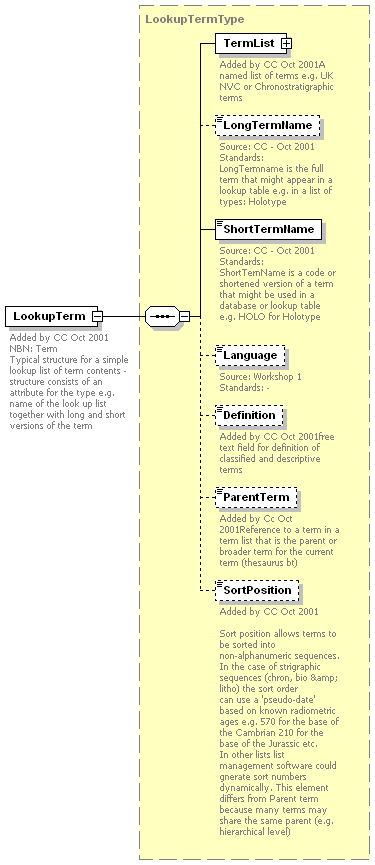 |
||||||||||||||||||
| type | LookupTermType | ||||||||||||||||||
| children | TermList LongTermName ShortTermName Language Definition ParentTerm SortPosition | ||||||||||||||||||
| attributes |
|
||||||||||||||||||
| annotation |
|
||||||||||||||||||
| source | <xs:element name="LookupTerm" type="LookupTermType"> <xs:annotation> <xs:documentation>Added by CC Oct 2001 NBN: Term Typical structure for a simple lookup list of term contents - structure consists of an attribute for the type e.g. name of the look up list together with long and short versions of the term</xs:documentation> </xs:annotation> </xs:element> |
| diagram | 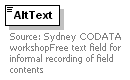 |
||
| type | AltText | ||
| annotation |
|
||
| source | <xs:element name="AltText" type="AltText"> <xs:annotation> <xs:documentation>Source: Sydney CODATA workshopFree text field for informal recording of field contents</xs:documentation> </xs:annotation> </xs:element> |
| diagram | 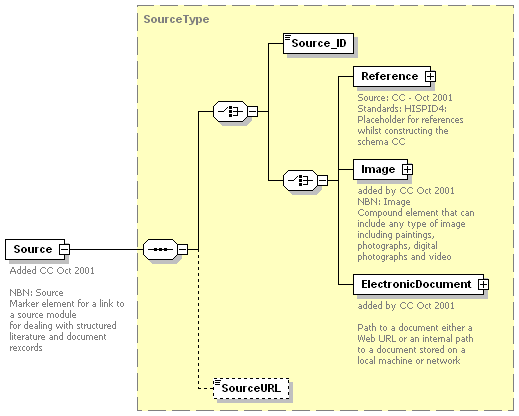 |
||||||||||||
| type | SourceType | ||||||||||||
| children | Source_ID Reference Image ElectronicDocument SourceURL | ||||||||||||
| attributes |
|
||||||||||||
| annotation |
|
||||||||||||
| source | <xs:element name="Source" type="SourceType" minOccurs="0"> <xs:annotation> <xs:documentation>Added CC Oct 2001 NBN: Source Marker element for a link to a source module for dealing with structured literature and document rexcords </xs:documentation> </xs:annotation> </xs:element> |
| diagram |  |
||
| type | Comment | ||
| annotation |
|
||
| source | <xs:element name="Comment" type="Comment" minOccurs="0"> <xs:annotation> <xs:documentation>Added by CC Oct 2001Free text of formatted text (rtf) description of the feature - not controlled length e.g. often a memo field</xs:documentation> </xs:annotation> </xs:element> |
| diagram | 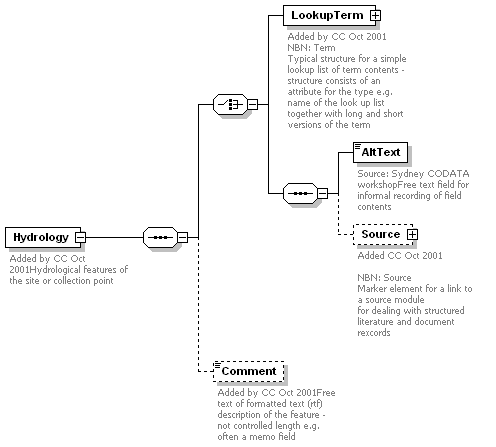 |
||
| children | LookupTerm AltText Source Comment | ||
| annotation |
|
||
| source | <xs:element name="Hydrology" minOccurs="0"> <xs:annotation> <xs:documentation>Added by CC Oct 2001Hydrological features of the site or collection point</xs:documentation> </xs:annotation> <xs:complexType> <xs:sequence> <xs:choice> <xs:element name="LookupTerm" type="LookupTermType"> <xs:annotation> <xs:documentation>Added by CC Oct 2001 NBN: Term Typical structure for a simple lookup list of term contents - structure consists of an attribute for the type e.g. name of the look up list together with long and short versions of the term</xs:documentation> </xs:annotation> </xs:element> <xs:sequence> <xs:element name="AltText" type="AltText"> <xs:annotation> <xs:documentation>Source: Sydney CODATA workshopFree text field for informal recording of field contents</xs:documentation> </xs:annotation> </xs:element> <xs:element name="Source" type="SourceType" minOccurs="0"> <xs:annotation> <xs:documentation>Added CC Oct 2001 NBN: Source Marker element for a link to a source module for dealing with structured literature and document rexcords </xs:documentation> </xs:annotation> </xs:element> </xs:sequence> </xs:choice> <xs:element name="Comment" type="Comment" minOccurs="0"> <xs:annotation> <xs:documentation>Added by CC Oct 2001Free text of formatted text (rtf) description of the feature - not controlled length e.g. often a memo field</xs:documentation> </xs:annotation> </xs:element> </xs:sequence> </xs:complexType> </xs:element> |
| diagram | 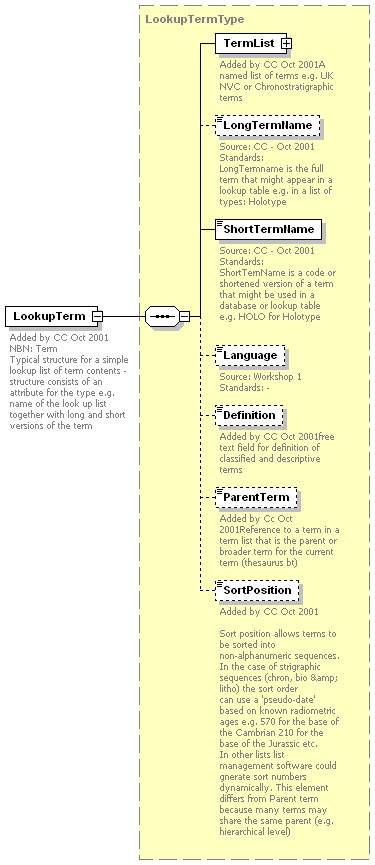 |
||||||||||||||||||
| type | LookupTermType | ||||||||||||||||||
| children | TermList LongTermName ShortTermName Language Definition ParentTerm SortPosition | ||||||||||||||||||
| attributes |
|
||||||||||||||||||
| annotation |
|
||||||||||||||||||
| source | <xs:element name="LookupTerm" type="LookupTermType"> <xs:annotation> <xs:documentation>Added by CC Oct 2001 NBN: Term Typical structure for a simple lookup list of term contents - structure consists of an attribute for the type e.g. name of the look up list together with long and short versions of the term</xs:documentation> </xs:annotation> </xs:element> |
| diagram |  |
||
| type | AltText | ||
| annotation |
|
||
| source | <xs:element name="AltText" type="AltText"> <xs:annotation> <xs:documentation>Source: Sydney CODATA workshopFree text field for informal recording of field contents</xs:documentation> </xs:annotation> </xs:element> |
| diagram | 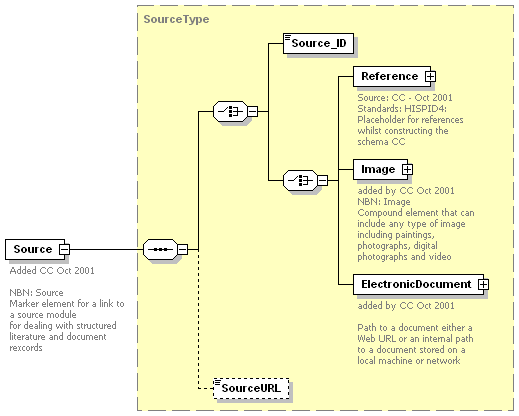 |
||||||||||||
| type | SourceType | ||||||||||||
| children | Source_ID Reference Image ElectronicDocument SourceURL | ||||||||||||
| attributes |
|
||||||||||||
| annotation |
|
||||||||||||
| source | <xs:element name="Source" type="SourceType" minOccurs="0"> <xs:annotation> <xs:documentation>Added CC Oct 2001 NBN: Source Marker element for a link to a source module for dealing with structured literature and document rexcords </xs:documentation> </xs:annotation> </xs:element> |
| diagram |  |
||
| type | Comment | ||
| annotation |
|
||
| source | <xs:element name="Comment" type="Comment" minOccurs="0"> <xs:annotation> <xs:documentation>Added by CC Oct 2001Free text of formatted text (rtf) description of the feature - not controlled length e.g. often a memo field</xs:documentation> </xs:annotation> </xs:element> |
| diagram | 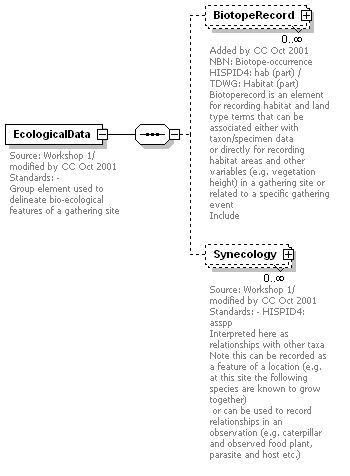 |
||
| children | BiotopeRecord Synecology | ||
| annotation |
|
||
| source | <xs:element name="EcologicalData" minOccurs="0" maxOccurs="unbounded"> <xs:annotation> <xs:documentation>Source: Workshop 1/ modified by CC Oct 2001 Standards: - Group element used to delineate bio-ecological features of a gathering site</xs:documentation> </xs:annotation> <xs:complexType> <xs:sequence> <xs:element name="BiotopeRecord" minOccurs="0" maxOccurs="unbounded"> <xs:annotation> <xs:documentation>Added by CC Oct 2001 NBN: Biotope-occurrence HISPID4: hab (part) / TDWG: Habitat (part) Biotoperecord is an element for recording habitat and land type terms that can be associated either with taxon/specimen data or directly for recording habitat areas and other variables (e.g. vegetation height) in a gathering site or related to a specific gathering event Include </xs:documentation> </xs:annotation> <xs:complexType> <xs:sequence> <xs:element name="Biotope"> <xs:annotation> <xs:documentation>Source: Workshop 1/ modified by CC Oct 2001 Standards: - HISPID4: asspp Interpreted here as relationships with other taxa Note this can be recorded as a feature of a location (e.g. at this site the following species are known to grow together) or can be used to record relationships in an observation (e.g. caterpillar and observed food plant, parasite and host etc.) </xs:documentation> </xs:annotation> <xs:complexType> <xs:choice> <xs:sequence> <xs:element name="BiotopeKey" minOccurs="0"> <xs:annotation> <xs:documentation>Added by CC Oct 2001 - - NBN: Biotope_Key The Primary key for an entry in a standard dictionary or other database Could use attribute to record database source e.g. a URL for lookup or reference to Internal entity in DTD (supplied dictionary) </xs:documentation> </xs:annotation> <xs:complexType> <xs:simpleContent> <xs:extension base="xs:string"> <xs:attribute name="KeyType" type="xs:string"/> </xs:extension> </xs:simpleContent> </xs:complexType> </xs:element> <xs:element name="BiotopeCode" minOccurs="0"> <xs:annotation> <xs:documentation>Added by CC Oct 2001 NBN: Short_Name Short name or code for a Biotope e.g. in UK NVC mg5a (for a type of mesotrophic grassland) Attribute records the source or possibly URL for origianl dictionary source </xs:documentation> </xs:annotation> <xs:complexType> <xs:simpleContent> <xs:extension base="xs:string"> <xs:attribute name="ClassificationUsed" type="xs:string"/> </xs:extension> </xs:simpleContent> </xs:complexType> </xs:element> <xs:element name="BiotopeLongName" minOccurs="0"> <xs:annotation> <xs:documentation>Added by CC Oct 2001 NBN: Long_Name The full dictionary name of the habitat within a classification</xs:documentation> </xs:annotation> <xs:complexType> <xs:simpleContent> <xs:extension base="xs:string"> <xs:attribute name="ClassificationUsed" type="xs:string"/> </xs:extension> </xs:simpleContent> </xs:complexType> </xs:element> </xs:sequence> <xs:element name="AltText" type="AltText"> <xs:annotation> <xs:documentation>Source: Sydney CODATA workshopFree text field for informal recording of field contents</xs:documentation> </xs:annotation> </xs:element> </xs:choice> </xs:complexType> </xs:element> <xs:element name="BiotopeData" minOccurs="0" maxOccurs="unbounded"> <xs:annotation> <xs:documentation>Added by CC Oct 2001 NBN: biotope_occurrence_data BiotopeData allows the linkuing of any measurement (e.g. biotope area) to a biotope record</xs:documentation> </xs:annotation> <xs:complexType> <xs:sequence> <xs:choice> <xs:element name="AltText" type="AltText"> <xs:annotation> <xs:documentation>Source: Sydney CODATA workshopFree text field for informal recording of field contents</xs:documentation> </xs:annotation> </xs:element> <xs:sequence> <xs:element name="measurement" type="measurementType"> <xs:annotation> <xs:documentation>Added by CC Oct 2001 NBN: measurement (partim) measurement is the actiual measurement - measurement is qualigied by attributes: measurementType: what type of measurement e.g. count, area, linear measurement measurementUnits: units that measurement is recorded in e...g. hectares, kilometres, kilogrammes etc. measurementAccuracy: describes accuracy e.g. approximate or +/- 50 </xs:documentation> </xs:annotation> </xs:element> <xs:element name="measurementQualifier" type="measurementQualifier"> <xs:annotation> <xs:documentation>Added by CC Oct 2001 NBN: qualifier measurementQualifier is a freetext field that describes what is being measures e.g. biotope area It is supported by measurement Type attribute. e.g. measurementQualifier might be 'males' and measurementType might be 'count' </xs:documentation> </xs:annotation> </xs:element> </xs:sequence> </xs:choice> <xs:element name="Comment" type="Comment" minOccurs="0"> <xs:annotation> <xs:documentation>Added by CC Oct 2001Free text of formatted text (rtf) description of the feature - not controlled length e.g. often a memo field</xs:documentation> </xs:annotation> </xs:element> </xs:sequence> <xs:attribute name="BiotopeData_ID" type="xs:string"/> </xs:complexType> </xs:element> </xs:sequence> </xs:complexType> </xs:element> <xs:element name="Synecology" minOccurs="0" maxOccurs="unbounded"> <xs:annotation> <xs:documentation>Source: Workshop 1/ modified by CC Oct 2001 Standards: - HISPID4: asspp Interpreted here as relationships with other taxa Note this can be recorded as a feature of a location (e.g. at this site the following species are known to grow together) or can be used to record relationships in an observation (e.g. caterpillar and observed food plant, parasite and host etc.) </xs:documentation> </xs:annotation> <xs:complexType> <xs:sequence> <xs:element name="TaxonIdentified" type="TaxonIdentifiedType" maxOccurs="unbounded"> <xs:annotation> <xs:documentation>Source: Workshop 1 Standards: - </xs:documentation> </xs:annotation> </xs:element> <xs:element name="Comment" type="Comment" minOccurs="0"> <xs:annotation> <xs:documentation>Added by CC Oct 2001Free text of formatted text (rtf) description of the feature - not controlled length e.g. often a memo field</xs:documentation> </xs:annotation> </xs:element> </xs:sequence> </xs:complexType> </xs:element> </xs:sequence> </xs:complexType> </xs:element> |
| diagram | 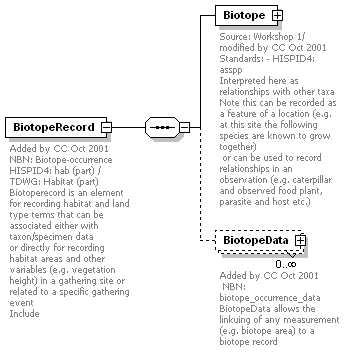 |
||
| children | Biotope BiotopeData | ||
| annotation |
|
||
| source | <xs:element name="BiotopeRecord" minOccurs="0" maxOccurs="unbounded"> <xs:annotation> <xs:documentation>Added by CC Oct 2001 NBN: Biotope-occurrence HISPID4: hab (part) / TDWG: Habitat (part) Biotoperecord is an element for recording habitat and land type terms that can be associated either with taxon/specimen data or directly for recording habitat areas and other variables (e.g. vegetation height) in a gathering site or related to a specific gathering event Include </xs:documentation> </xs:annotation> <xs:complexType> <xs:sequence> <xs:element name="Biotope"> <xs:annotation> <xs:documentation>Source: Workshop 1/ modified by CC Oct 2001 Standards: - HISPID4: asspp Interpreted here as relationships with other taxa Note this can be recorded as a feature of a location (e.g. at this site the following species are known to grow together) or can be used to record relationships in an observation (e.g. caterpillar and observed food plant, parasite and host etc.) </xs:documentation> </xs:annotation> <xs:complexType> <xs:choice> <xs:sequence> <xs:element name="BiotopeKey" minOccurs="0"> <xs:annotation> <xs:documentation>Added by CC Oct 2001 - - NBN: Biotope_Key The Primary key for an entry in a standard dictionary or other database Could use attribute to record database source e.g. a URL for lookup or reference to Internal entity in DTD (supplied dictionary) </xs:documentation> </xs:annotation> <xs:complexType> <xs:simpleContent> <xs:extension base="xs:string"> <xs:attribute name="KeyType" type="xs:string"/> </xs:extension> </xs:simpleContent> </xs:complexType> </xs:element> <xs:element name="BiotopeCode" minOccurs="0"> <xs:annotation> <xs:documentation>Added by CC Oct 2001 NBN: Short_Name Short name or code for a Biotope e.g. in UK NVC mg5a (for a type of mesotrophic grassland) Attribute records the source or possibly URL for origianl dictionary source </xs:documentation> </xs:annotation> <xs:complexType> <xs:simpleContent> <xs:extension base="xs:string"> <xs:attribute name="ClassificationUsed" type="xs:string"/> </xs:extension> </xs:simpleContent> </xs:complexType> </xs:element> <xs:element name="BiotopeLongName" minOccurs="0"> <xs:annotation> <xs:documentation>Added by CC Oct 2001 NBN: Long_Name The full dictionary name of the habitat within a classification</xs:documentation> </xs:annotation> <xs:complexType> <xs:simpleContent> <xs:extension base="xs:string"> <xs:attribute name="ClassificationUsed" type="xs:string"/> </xs:extension> </xs:simpleContent> </xs:complexType> </xs:element> </xs:sequence> <xs:element name="AltText" type="AltText"> <xs:annotation> <xs:documentation>Source: Sydney CODATA workshopFree text field for informal recording of field contents</xs:documentation> </xs:annotation> </xs:element> </xs:choice> </xs:complexType> </xs:element> <xs:element name="BiotopeData" minOccurs="0" maxOccurs="unbounded"> <xs:annotation> <xs:documentation>Added by CC Oct 2001 NBN: biotope_occurrence_data BiotopeData allows the linkuing of any measurement (e.g. biotope area) to a biotope record</xs:documentation> </xs:annotation> <xs:complexType> <xs:sequence> <xs:choice> <xs:element name="AltText" type="AltText"> <xs:annotation> <xs:documentation>Source: Sydney CODATA workshopFree text field for informal recording of field contents</xs:documentation> </xs:annotation> </xs:element> <xs:sequence> <xs:element name="measurement" type="measurementType"> <xs:annotation> <xs:documentation>Added by CC Oct 2001 NBN: measurement (partim) measurement is the actiual measurement - measurement is qualigied by attributes: measurementType: what type of measurement e.g. count, area, linear measurement measurementUnits: units that measurement is recorded in e...g. hectares, kilometres, kilogrammes etc. measurementAccuracy: describes accuracy e.g. approximate or +/- 50 </xs:documentation> </xs:annotation> </xs:element> <xs:element name="measurementQualifier" type="measurementQualifier"> <xs:annotation> <xs:documentation>Added by CC Oct 2001 NBN: qualifier measurementQualifier is a freetext field that describes what is being measures e.g. biotope area It is supported by measurement Type attribute. e.g. measurementQualifier might be 'males' and measurementType might be 'count' </xs:documentation> </xs:annotation> </xs:element> </xs:sequence> </xs:choice> <xs:element name="Comment" type="Comment" minOccurs="0"> <xs:annotation> <xs:documentation>Added by CC Oct 2001Free text of formatted text (rtf) description of the feature - not controlled length e.g. often a memo field</xs:documentation> </xs:annotation> </xs:element> </xs:sequence> <xs:attribute name="BiotopeData_ID" type="xs:string"/> </xs:complexType> </xs:element> </xs:sequence> </xs:complexType> </xs:element> |
| diagram | 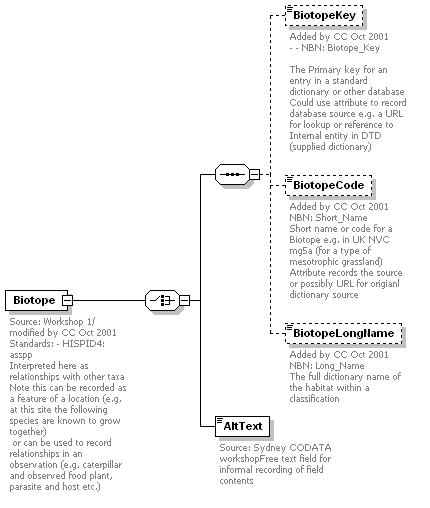 |
||
| children | BiotopeKey BiotopeCode BiotopeLongName AltText | ||
| annotation |
|
||
| source | <xs:element name="Biotope"> <xs:annotation> <xs:documentation>Source: Workshop 1/ modified by CC Oct 2001 Standards: - HISPID4: asspp Interpreted here as relationships with other taxa Note this can be recorded as a feature of a location (e.g. at this site the following species are known to grow together) or can be used to record relationships in an observation (e.g. caterpillar and observed food plant, parasite and host etc.) </xs:documentation> </xs:annotation> <xs:complexType> <xs:choice> <xs:sequence> <xs:element name="BiotopeKey" minOccurs="0"> <xs:annotation> <xs:documentation>Added by CC Oct 2001 - - NBN: Biotope_Key The Primary key for an entry in a standard dictionary or other database Could use attribute to record database source e.g. a URL for lookup or reference to Internal entity in DTD (supplied dictionary) </xs:documentation> </xs:annotation> <xs:complexType> <xs:simpleContent> <xs:extension base="xs:string"> <xs:attribute name="KeyType" type="xs:string"/> </xs:extension> </xs:simpleContent> </xs:complexType> </xs:element> <xs:element name="BiotopeCode" minOccurs="0"> <xs:annotation> <xs:documentation>Added by CC Oct 2001 NBN: Short_Name Short name or code for a Biotope e.g. in UK NVC mg5a (for a type of mesotrophic grassland) Attribute records the source or possibly URL for origianl dictionary source </xs:documentation> </xs:annotation> <xs:complexType> <xs:simpleContent> <xs:extension base="xs:string"> <xs:attribute name="ClassificationUsed" type="xs:string"/> </xs:extension> </xs:simpleContent> </xs:complexType> </xs:element> <xs:element name="BiotopeLongName" minOccurs="0"> <xs:annotation> <xs:documentation>Added by CC Oct 2001 NBN: Long_Name The full dictionary name of the habitat within a classification</xs:documentation> </xs:annotation> <xs:complexType> <xs:simpleContent> <xs:extension base="xs:string"> <xs:attribute name="ClassificationUsed" type="xs:string"/> </xs:extension> </xs:simpleContent> </xs:complexType> </xs:element> </xs:sequence> <xs:element name="AltText" type="AltText"> <xs:annotation> <xs:documentation>Source: Sydney CODATA workshopFree text field for informal recording of field contents</xs:documentation> </xs:annotation> </xs:element> </xs:choice> </xs:complexType> </xs:element> |
| diagram | 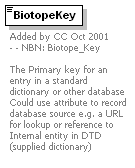 |
||||||||||||
| type | extension of xs:string | ||||||||||||
| attributes |
|
||||||||||||
| annotation |
|
||||||||||||
| source | <xs:element name="BiotopeKey" minOccurs="0"> <xs:annotation> <xs:documentation>Added by CC Oct 2001 - - NBN: Biotope_Key The Primary key for an entry in a standard dictionary or other database Could use attribute to record database source e.g. a URL for lookup or reference to Internal entity in DTD (supplied dictionary) </xs:documentation> </xs:annotation> <xs:complexType> <xs:simpleContent> <xs:extension base="xs:string"> <xs:attribute name="KeyType" type="xs:string"/> </xs:extension> </xs:simpleContent> </xs:complexType> </xs:element> |
| diagram | 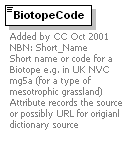 |
||||||||||||
| type | extension of xs:string | ||||||||||||
| attributes |
|
||||||||||||
| annotation |
|
||||||||||||
| source | <xs:element name="BiotopeCode" minOccurs="0"> <xs:annotation> <xs:documentation>Added by CC Oct 2001 NBN: Short_Name Short name or code for a Biotope e.g. in UK NVC mg5a (for a type of mesotrophic grassland) Attribute records the source or possibly URL for origianl dictionary source </xs:documentation> </xs:annotation> <xs:complexType> <xs:simpleContent> <xs:extension base="xs:string"> <xs:attribute name="ClassificationUsed" type="xs:string"/> </xs:extension> </xs:simpleContent> </xs:complexType> </xs:element> |
| diagram |  |
||||||||||||
| type | extension of xs:string | ||||||||||||
| attributes |
|
||||||||||||
| annotation |
|
||||||||||||
| source | <xs:element name="BiotopeLongName" minOccurs="0"> <xs:annotation> <xs:documentation>Added by CC Oct 2001 NBN: Long_Name The full dictionary name of the habitat within a classification</xs:documentation> </xs:annotation> <xs:complexType> <xs:simpleContent> <xs:extension base="xs:string"> <xs:attribute name="ClassificationUsed" type="xs:string"/> </xs:extension> </xs:simpleContent> </xs:complexType> </xs:element> |
| diagram |  |
||
| type | AltText | ||
| annotation |
|
||
| source | <xs:element name="AltText" type="AltText"> <xs:annotation> <xs:documentation>Source: Sydney CODATA workshopFree text field for informal recording of field contents</xs:documentation> </xs:annotation> </xs:element> |
| diagram | 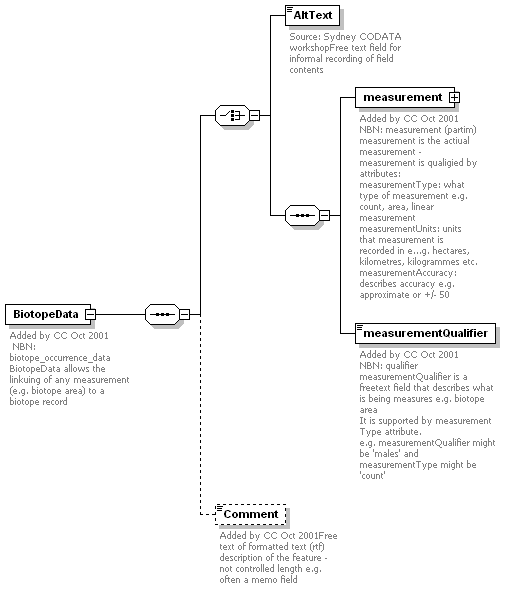 |
||||||||||||
| children | AltText measurement measurementQualifier Comment | ||||||||||||
| attributes |
|
||||||||||||
| annotation |
|
||||||||||||
| source | <xs:element name="BiotopeData" minOccurs="0" maxOccurs="unbounded"> <xs:annotation> <xs:documentation>Added by CC Oct 2001 NBN: biotope_occurrence_data BiotopeData allows the linkuing of any measurement (e.g. biotope area) to a biotope record</xs:documentation> </xs:annotation> <xs:complexType> <xs:sequence> <xs:choice> <xs:element name="AltText" type="AltText"> <xs:annotation> <xs:documentation>Source: Sydney CODATA workshopFree text field for informal recording of field contents</xs:documentation> </xs:annotation> </xs:element> <xs:sequence> <xs:element name="measurement" type="measurementType"> <xs:annotation> <xs:documentation>Added by CC Oct 2001 NBN: measurement (partim) measurement is the actiual measurement - measurement is qualigied by attributes: measurementType: what type of measurement e.g. count, area, linear measurement measurementUnits: units that measurement is recorded in e...g. hectares, kilometres, kilogrammes etc. measurementAccuracy: describes accuracy e.g. approximate or +/- 50 </xs:documentation> </xs:annotation> </xs:element> <xs:element name="measurementQualifier" type="measurementQualifier"> <xs:annotation> <xs:documentation>Added by CC Oct 2001 NBN: qualifier measurementQualifier is a freetext field that describes what is being measures e.g. biotope area It is supported by measurement Type attribute. e.g. measurementQualifier might be 'males' and measurementType might be 'count' </xs:documentation> </xs:annotation> </xs:element> </xs:sequence> </xs:choice> <xs:element name="Comment" type="Comment" minOccurs="0"> <xs:annotation> <xs:documentation>Added by CC Oct 2001Free text of formatted text (rtf) description of the feature - not controlled length e.g. often a memo field</xs:documentation> </xs:annotation> </xs:element> </xs:sequence> <xs:attribute name="BiotopeData_ID" type="xs:string"/> </xs:complexType> </xs:element> |
| diagram |  |
||
| type | AltText | ||
| annotation |
|
||
| source | <xs:element name="AltText" type="AltText"> <xs:annotation> <xs:documentation>Source: Sydney CODATA workshopFree text field for informal recording of field contents</xs:documentation> </xs:annotation> </xs:element> |
| diagram | 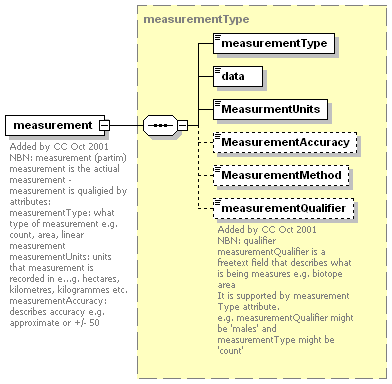 |
||
| type | measurementType | ||
| children | measurementType data MeasurmentUnits MeasurementAccuracy MeasurementMethod measurementQualifier | ||
| annotation |
|
||
| source | <xs:element name="measurement" type="measurementType"> <xs:annotation> <xs:documentation>Added by CC Oct 2001 NBN: measurement (partim) measurement is the actiual measurement - measurement is qualigied by attributes: measurementType: what type of measurement e.g. count, area, linear measurement measurementUnits: units that measurement is recorded in e...g. hectares, kilometres, kilogrammes etc. measurementAccuracy: describes accuracy e.g. approximate or +/- 50 </xs:documentation> </xs:annotation> </xs:element> |
| diagram |  |
||
| type | measurementQualifier | ||
| annotation |
|
||
| source | <xs:element name="measurementQualifier" type="measurementQualifier"> <xs:annotation> <xs:documentation>Added by CC Oct 2001 NBN: qualifier measurementQualifier is a freetext field that describes what is being measures e.g. biotope area It is supported by measurement Type attribute. e.g. measurementQualifier might be 'males' and measurementType might be 'count' </xs:documentation> </xs:annotation> </xs:element> |
| diagram |  |
||
| type | Comment | ||
| annotation |
|
||
| source | <xs:element name="Comment" type="Comment" minOccurs="0"> <xs:annotation> <xs:documentation>Added by CC Oct 2001Free text of formatted text (rtf) description of the feature - not controlled length e.g. often a memo field</xs:documentation> </xs:annotation> </xs:element> |
| diagram | 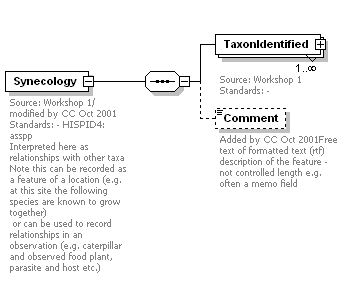 |
||
| children | TaxonIdentified Comment | ||
| annotation |
|
||
| source | <xs:element name="Synecology" minOccurs="0" maxOccurs="unbounded"> <xs:annotation> <xs:documentation>Source: Workshop 1/ modified by CC Oct 2001 Standards: - HISPID4: asspp Interpreted here as relationships with other taxa Note this can be recorded as a feature of a location (e.g. at this site the following species are known to grow together) or can be used to record relationships in an observation (e.g. caterpillar and observed food plant, parasite and host etc.) </xs:documentation> </xs:annotation> <xs:complexType> <xs:sequence> <xs:element name="TaxonIdentified" type="TaxonIdentifiedType" maxOccurs="unbounded"> <xs:annotation> <xs:documentation>Source: Workshop 1 Standards: - </xs:documentation> </xs:annotation> </xs:element> <xs:element name="Comment" type="Comment" minOccurs="0"> <xs:annotation> <xs:documentation>Added by CC Oct 2001Free text of formatted text (rtf) description of the feature - not controlled length e.g. often a memo field</xs:documentation> </xs:annotation> </xs:element> </xs:sequence> </xs:complexType> </xs:element> |
| diagram | 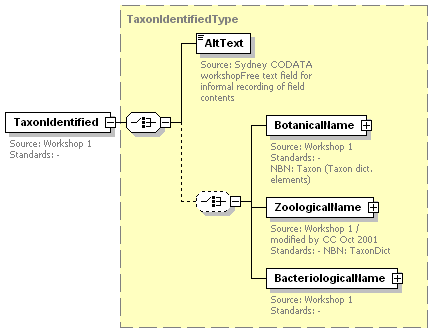 |
||||||||||||
| type | TaxonIdentifiedType | ||||||||||||
| children | AltText BotanicalName ZoologicalName BacteriologicalName | ||||||||||||
| attributes |
|
||||||||||||
| annotation |
|
||||||||||||
| source | <xs:element name="TaxonIdentified" type="TaxonIdentifiedType" maxOccurs="unbounded"> <xs:annotation> <xs:documentation>Source: Workshop 1 Standards: - </xs:documentation> </xs:annotation> </xs:element> |
| diagram |  |
||
| type | Comment | ||
| annotation |
|
||
| source | <xs:element name="Comment" type="Comment" minOccurs="0"> <xs:annotation> <xs:documentation>Added by CC Oct 2001Free text of formatted text (rtf) description of the feature - not controlled length e.g. often a memo field</xs:documentation> </xs:annotation> </xs:element> |
| diagram | 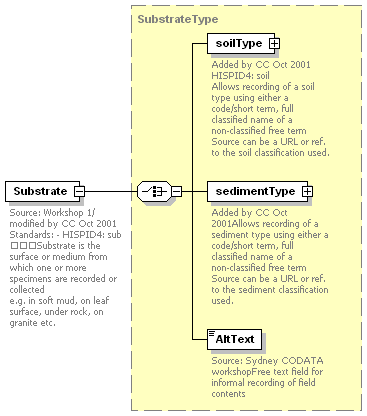 |
||
| type | SubstrateType | ||
| children | soilType sedimentType AltText | ||
| annotation |
|
||
| source | <xs:element name="Substrate" type="SubstrateType" minOccurs="0"> <xs:annotation> <xs:documentation>Source: Workshop 1/ modified by CC Oct 2001 Standards: - HISPID4: sub Substrate is the surface or medium from which one or more specimens are recorded or collected e.g. in soft mud, on leaf surface, under rock, on granite etc.</xs:documentation> </xs:annotation> </xs:element> |
| diagram | 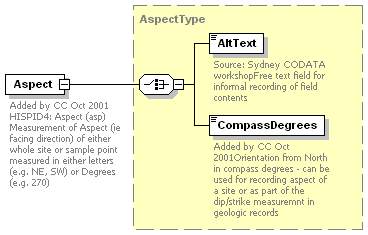 |
||||||||||||
| type | AspectType | ||||||||||||
| children | AltText CompassDegrees | ||||||||||||
| attributes |
|
||||||||||||
| annotation |
|
||||||||||||
| source | <xs:element name="Aspect" type="AspectType" minOccurs="0"> <xs:annotation> <xs:documentation>Added by CC Oct 2001 HISPID4: Aspect (asp) Measurement of Aspect (ie facing direction) of either whole site or sample point measured in either letters (e.g. NE, SW) or Degrees (e.g. 270)</xs:documentation> </xs:annotation> </xs:element> |
| diagram | 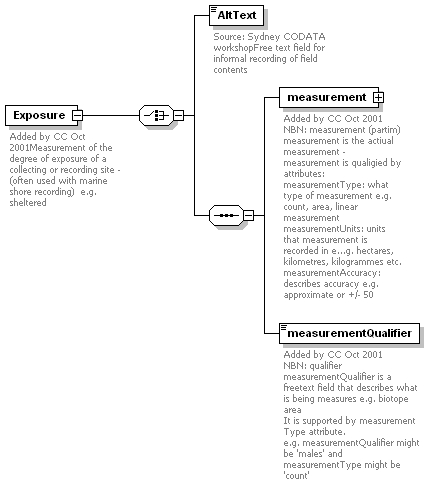 |
||
| children | AltText measurement measurementQualifier | ||
| annotation |
|
||
| source | <xs:element name="Exposure" minOccurs="0"> <xs:annotation> <xs:documentation>Added by CC Oct 2001Measurement of the degree of exposure of a collecting or recording site - (often used with marine shore recording) e.g. sheltered </xs:documentation> </xs:annotation> <xs:complexType> <xs:choice> <xs:element name="AltText" type="AltText"> <xs:annotation> <xs:documentation>Source: Sydney CODATA workshopFree text field for informal recording of field contents</xs:documentation> </xs:annotation> </xs:element> <xs:sequence> <xs:element name="measurement" type="measurementType"> <xs:annotation> <xs:documentation>Added by CC Oct 2001 NBN: measurement (partim) measurement is the actiual measurement - measurement is qualigied by attributes: measurementType: what type of measurement e.g. count, area, linear measurement measurementUnits: units that measurement is recorded in e...g. hectares, kilometres, kilogrammes etc. measurementAccuracy: describes accuracy e.g. approximate or +/- 50 </xs:documentation> </xs:annotation> </xs:element> <xs:element name="measurementQualifier" type="measurementQualifier"> <xs:annotation> <xs:documentation>Added by CC Oct 2001 NBN: qualifier measurementQualifier is a freetext field that describes what is being measures e.g. biotope area It is supported by measurement Type attribute. e.g. measurementQualifier might be 'males' and measurementType might be 'count' </xs:documentation> </xs:annotation> </xs:element> </xs:sequence> </xs:choice> </xs:complexType> </xs:element> |
| diagram |  |
||
| type | AltText | ||
| annotation |
|
||
| source | <xs:element name="AltText" type="AltText"> <xs:annotation> <xs:documentation>Source: Sydney CODATA workshopFree text field for informal recording of field contents</xs:documentation> </xs:annotation> </xs:element> |
| diagram | 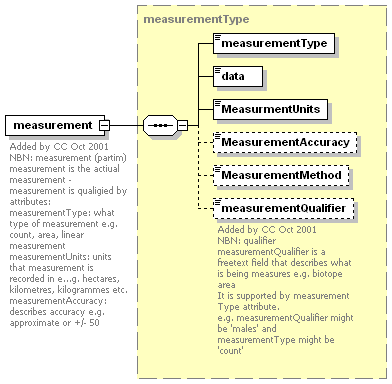 |
||
| type | measurementType | ||
| children | measurementType data MeasurmentUnits MeasurementAccuracy MeasurementMethod measurementQualifier | ||
| annotation |
|
||
| source | <xs:element name="measurement" type="measurementType"> <xs:annotation> <xs:documentation>Added by CC Oct 2001 NBN: measurement (partim) measurement is the actiual measurement - measurement is qualigied by attributes: measurementType: what type of measurement e.g. count, area, linear measurement measurementUnits: units that measurement is recorded in e...g. hectares, kilometres, kilogrammes etc. measurementAccuracy: describes accuracy e.g. approximate or +/- 50 </xs:documentation> </xs:annotation> </xs:element> |
| diagram |  |
||
| type | measurementQualifier | ||
| annotation |
|
||
| source | <xs:element name="measurementQualifier" type="measurementQualifier"> <xs:annotation> <xs:documentation>Added by CC Oct 2001 NBN: qualifier measurementQualifier is a freetext field that describes what is being measures e.g. biotope area It is supported by measurement Type attribute. e.g. measurementQualifier might be 'males' and measurementType might be 'count' </xs:documentation> </xs:annotation> </xs:element> |
| diagram | 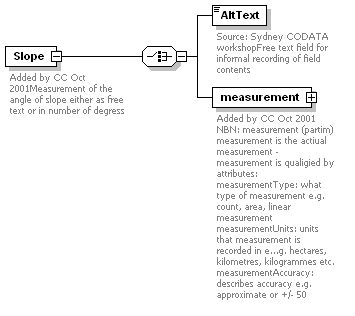 |
||
| children | AltText measurement | ||
| annotation |
|
||
| source | <xs:element name="Slope" minOccurs="0"> <xs:annotation> <xs:documentation>Added by CC Oct 2001Measurement of the angle of slope either as free text or in number of degress</xs:documentation> </xs:annotation> <xs:complexType> <xs:choice> <xs:element name="AltText" type="AltText"> <xs:annotation> <xs:documentation>Source: Sydney CODATA workshopFree text field for informal recording of field contents</xs:documentation> </xs:annotation> </xs:element> <xs:element name="measurement" type="measurementType"> <xs:annotation> <xs:documentation>Added by CC Oct 2001 NBN: measurement (partim) measurement is the actiual measurement - measurement is qualigied by attributes: measurementType: what type of measurement e.g. count, area, linear measurement measurementUnits: units that measurement is recorded in e...g. hectares, kilometres, kilogrammes etc. measurementAccuracy: describes accuracy e.g. approximate or +/- 50 </xs:documentation> </xs:annotation> </xs:element> </xs:choice> </xs:complexType> </xs:element> |
| diagram |  |
||
| type | AltText | ||
| annotation |
|
||
| source | <xs:element name="AltText" type="AltText"> <xs:annotation> <xs:documentation>Source: Sydney CODATA workshopFree text field for informal recording of field contents</xs:documentation> </xs:annotation> </xs:element> |
| diagram | 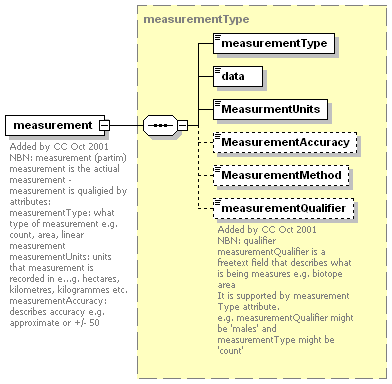 |
||
| type | measurementType | ||
| children | measurementType data MeasurmentUnits MeasurementAccuracy MeasurementMethod measurementQualifier | ||
| annotation |
|
||
| source | <xs:element name="measurement" type="measurementType"> <xs:annotation> <xs:documentation>Added by CC Oct 2001 NBN: measurement (partim) measurement is the actiual measurement - measurement is qualigied by attributes: measurementType: what type of measurement e.g. count, area, linear measurement measurementUnits: units that measurement is recorded in e...g. hectares, kilometres, kilogrammes etc. measurementAccuracy: describes accuracy e.g. approximate or +/- 50 </xs:documentation> </xs:annotation> </xs:element> |
| diagram | 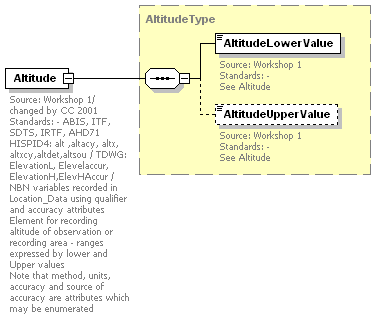 |
||||||||||||||||||||||||||||||
| type | AltitudeType | ||||||||||||||||||||||||||||||
| children | AltitudeLowerValue AltitudeUpperValue | ||||||||||||||||||||||||||||||
| attributes |
|
||||||||||||||||||||||||||||||
| annotation |
|
||||||||||||||||||||||||||||||
| source | <xs:element name="Altitude" type="AltitudeType" minOccurs="0"> <xs:annotation> <xs:documentation>Source: Workshop 1/ changed by CC 2001 Standards: - ABIS, ITF, SDTS, IRTF, AHD71 HISPID4: alt ,altacy, altx, altxcy,altdet,altsou / TDWG: ElevationL, Elevelaccur, ElevationH,ElevHAccur / NBN variables recorded in Location_Data using qualifier and accuracy attributes Element for recording altitude of observation or recording area - ranges expressed by lower and Upper values Note that method, units, accuracy and source of accuracy are attributes which may be enumerated</xs:documentation> </xs:annotation> </xs:element> |
| diagram | 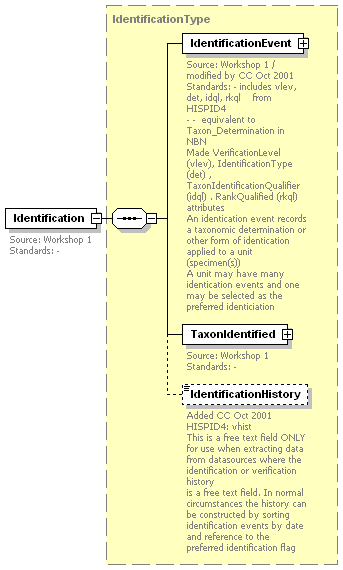 |
||||||||||||
| type | IdentificationType | ||||||||||||
| children | IdentificationEvent TaxonIdentified IdentificationHistory | ||||||||||||
| attributes |
|
||||||||||||
| annotation |
|
||||||||||||
| source | <xs:element name="Identification" type="IdentificationType" minOccurs="0" maxOccurs="unbounded"> <xs:annotation> <xs:documentation>Source: Workshop 1 Standards: - </xs:documentation> </xs:annotation> </xs:element> |
| diagram | 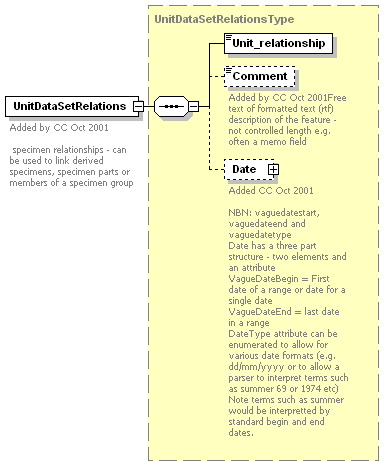 |
||||||||||||||||||||||||||||||
| type | UnitDataSetRelationsType | ||||||||||||||||||||||||||||||
| children | Unit_relationship Comment Date | ||||||||||||||||||||||||||||||
| attributes |
|
||||||||||||||||||||||||||||||
| annotation |
|
||||||||||||||||||||||||||||||
| source | <xs:element name="UnitDataSetRelations" type="UnitDataSetRelationsType" minOccurs="0" maxOccurs="unbounded"> <xs:annotation> <xs:documentation>Added by CC Oct 2001 specimen relationships - can be used to link derived specimens, specimen parts or members of a specimen group</xs:documentation> </xs:annotation> </xs:element> |
| diagram | 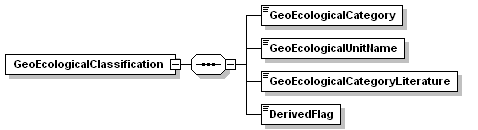 |
| children | GeoEcologicalCategory GeoEcologicalUnitName GeoEcologicalCategoryLiterature DerivedFlag |
| source | <xs:element name="GeoEcologicalClassification"> <xs:complexType> <xs:sequence> <xs:element name="GeoEcologicalCategory" type="xs:string"/> <xs:element name="GeoEcologicalUnitName" type="xs:string"/> <xs:element name="GeoEcologicalCategoryLiterature" type="xs:string"/> <xs:element name="DerivedFlag" type="DerivedFlag"/> </xs:sequence> </xs:complexType> </xs:element> |
| diagram |  |
| type | xs:string |
| source | <xs:element name="GeoEcologicalCategory" type="xs:string"/> |
| diagram |  |
| type | xs:string |
| source | <xs:element name="GeoEcologicalUnitName" type="xs:string"/> |
| diagram |  |
| type | xs:string |
| source | <xs:element name="GeoEcologicalCategoryLiterature" type="xs:string"/> |
| diagram |  |
| type | DerivedFlag |
| source | <xs:element name="DerivedFlag" type="DerivedFlag"/> |
| diagram |  |
| children | Stratigraphy GeologicalData |
| source | <xs:element name="GeologicalRecord"> <xs:complexType> <xs:sequence> <xs:element name="Stratigraphy" type="StratigraphyType"/> <xs:element name="GeologicalData"> <xs:complexType> <xs:sequence> <xs:choice> <xs:element name="AltText" type="AltText"> <xs:annotation> <xs:documentation>Source: Sydney CODATA workshopFree text field for informal recording of field contents</xs:documentation> </xs:annotation> </xs:element> <xs:element name="measurement" type="measurementType"/> </xs:choice> <xs:element name="Comment" type="Comment" minOccurs="0"/> </xs:sequence> <xs:attribute name="GeolData-ID" type="xs:string"/> </xs:complexType> </xs:element> </xs:sequence> </xs:complexType> </xs:element> |
| diagram | 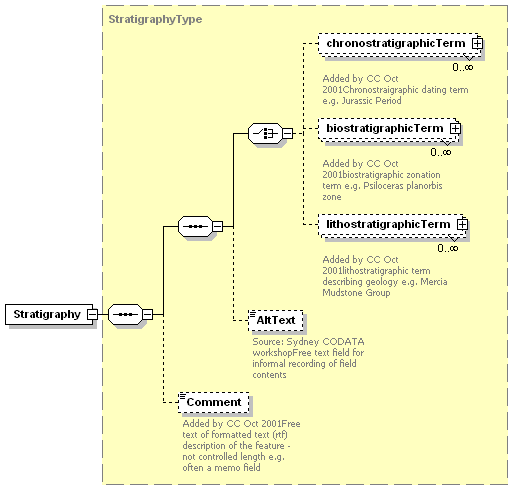 |
| type | StratigraphyType |
| children | chronostratigraphicTerm biostratigraphicTerm lithostratigraphicTerm AltText Comment |
| source | <xs:element name="Stratigraphy" type="StratigraphyType"/> |
| diagram | 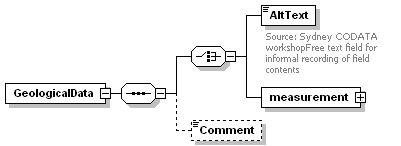 |
||||||||||||
| children | AltText measurement Comment | ||||||||||||
| attributes |
|
||||||||||||
| source | <xs:element name="GeologicalData"> <xs:complexType> <xs:sequence> <xs:choice> <xs:element name="AltText" type="AltText"> <xs:annotation> <xs:documentation>Source: Sydney CODATA workshopFree text field for informal recording of field contents</xs:documentation> </xs:annotation> </xs:element> <xs:element name="measurement" type="measurementType"/> </xs:choice> <xs:element name="Comment" type="Comment" minOccurs="0"/> </xs:sequence> <xs:attribute name="GeolData-ID" type="xs:string"/> </xs:complexType> </xs:element> |
| diagram |  |
||
| type | AltText | ||
| annotation |
|
||
| source | <xs:element name="AltText" type="AltText"> <xs:annotation> <xs:documentation>Source: Sydney CODATA workshopFree text field for informal recording of field contents</xs:documentation> </xs:annotation> </xs:element> |
| diagram | 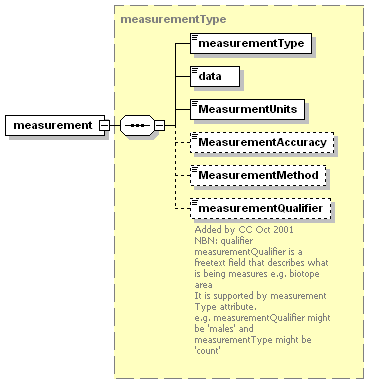 |
| type | measurementType |
| children | measurementType data MeasurmentUnits MeasurementAccuracy MeasurementMethod measurementQualifier |
| source | <xs:element name="measurement" type="measurementType"/> |
| diagram |  |
| type | Comment |
| source | <xs:element name="Comment" type="Comment" minOccurs="0"/> |
| diagram |  |
| type | xs:string |
| source | <xs:element name="PreferredIdentificationFlag" type="xs:string"/> |
| diagram | 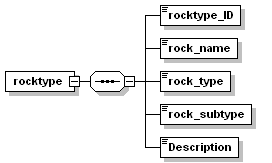 |
||||||||||||||||||||||||
| children | rocktype_ID rock_name rock_type rock_subtype Description | ||||||||||||||||||||||||
| attributes |
|
||||||||||||||||||||||||
| source | <xs:element name="rocktype"> <xs:complexType> <xs:sequence> <xs:element name="rocktype_ID"> <xs:complexType> <xs:simpleContent> <xs:extension base="xs:string"> <xs:attribute name="type" use="required"> <xs:simpleType> <xs:restriction base="xs:NMTOKEN"> <xs:enumeration value="nbn"/> <xs:enumeration value="local"/> </xs:restriction> </xs:simpleType> </xs:attribute> </xs:extension> </xs:simpleContent> </xs:complexType> </xs:element> <xs:element name="rock_name" type="xs:string"/> <xs:element name="rock_type" type="xs:string"/> <xs:element name="rock_subtype" type="xs:string"/> <xs:element name="Description" type="Description"/> </xs:sequence> <xs:attribute name="entered_by" type="xs:string" use="required"/> <xs:attribute name="entry_date" type="xs:string" use="required"/> <xs:attribute name="system_supplied_data" default="No"> <xs:simpleType> <xs:restriction base="xs:NMTOKEN"> <xs:enumeration value="Yes"/> <xs:enumeration value="No"/> </xs:restriction> </xs:simpleType> </xs:attribute> </xs:complexType> </xs:element> |
| diagram |  |
||||||||||||
| type | extension of xs:string | ||||||||||||
| attributes |
|
||||||||||||
| source | <xs:element name="rocktype_ID"> <xs:complexType> <xs:simpleContent> <xs:extension base="xs:string"> <xs:attribute name="type" use="required"> <xs:simpleType> <xs:restriction base="xs:NMTOKEN"> <xs:enumeration value="nbn"/> <xs:enumeration value="local"/> </xs:restriction> </xs:simpleType> </xs:attribute> </xs:extension> </xs:simpleContent> </xs:complexType> </xs:element> |
| diagram |  |
| type | xs:string |
| source | <xs:element name="rock_name" type="xs:string"/> |
| diagram |  |
| type | xs:string |
| source | <xs:element name="rock_type" type="xs:string"/> |
| diagram |  |
| type | xs:string |
| source | <xs:element name="rock_subtype" type="xs:string"/> |
| diagram |  |
| type | Description |
| source | <xs:element name="Description" type="Description"/> |
| diagram | 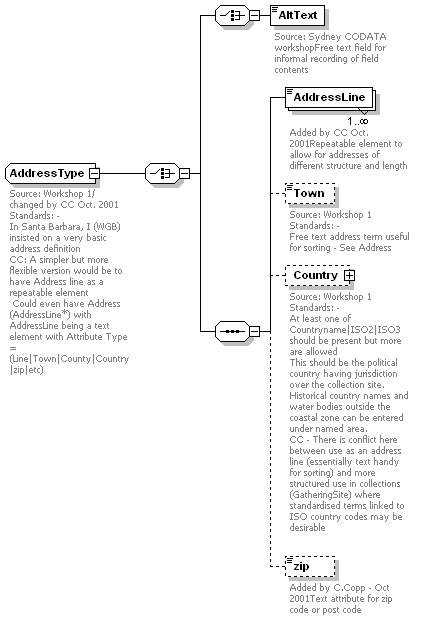 |
||
| children | AltText AddressLine Town Country zip | ||
| used by |
|
||
| annotation |
|
||
| source | <xs:complexType name="AddressType"> <xs:annotation> <xs:documentation>Source: Workshop 1/ changed by CC Oct. 2001 Standards: - In Santa Barbara, I (WGB) insisted on a very basic address definition CC: A simpler but more flexible version would be to have Address line as a repeatable element Could even have Address (AddressLine*) with AddressLine being a text element with Attribute Type = (Line|Town|County|Country|zip|etc) </xs:documentation> </xs:annotation> <xs:choice> <xs:choice> <xs:element name="AltText" type="AltText"> <xs:annotation> <xs:documentation>Source: Sydney CODATA workshopFree text field for informal recording of field contents</xs:documentation> </xs:annotation> </xs:element> </xs:choice> <xs:sequence> <xs:element name="AddressLine" maxOccurs="unbounded"> <xs:annotation> <xs:documentation>Added by CC Oct. 2001Repeatable element to allow for addresses of different structure and length</xs:documentation> </xs:annotation> <xs:complexType> <xs:simpleContent> <xs:extension base="xs:string"> <xs:attribute name="AddressLineType" type="xs:string"/> </xs:extension> </xs:simpleContent> </xs:complexType> </xs:element> <xs:element name="Town" type="xs:string" minOccurs="0"> <xs:annotation> <xs:documentation>Source: Workshop 1 Standards: - Free text address term useful for sorting - See Address</xs:documentation> </xs:annotation> </xs:element> <xs:element name="Country" type="CountryType" minOccurs="0"> <xs:annotation> <xs:documentation>Source: Workshop 1 Standards: - At least one of Countryname|ISO2|ISO3 should be present but more are allowed This should be the political country having jurisdiction over the collection site. Historical country names and water bodies outside the coastal zone can be entered under named area. CC - There is conflict here between use as an address line (essentially text handy for sorting) and more structured use in collections (GatheringSite) where standardised terms linked to ISO country codes may be desirable </xs:documentation> </xs:annotation> </xs:element> <xs:element name="zip" type="xs:string" minOccurs="0"> <xs:annotation> <xs:documentation>Added by C.Copp - Oct 2001Text attribute for zip code or post code</xs:documentation> </xs:annotation> </xs:element> </xs:sequence> </xs:choice> </xs:complexType> |
| diagram |  |
||
| type | AltText | ||
| annotation |
|
||
| source | <xs:element name="AltText" type="AltText"> <xs:annotation> <xs:documentation>Source: Sydney CODATA workshopFree text field for informal recording of field contents</xs:documentation> </xs:annotation> </xs:element> |
| diagram |  |
||||||||||||
| type | extension of xs:string | ||||||||||||
| attributes |
|
||||||||||||
| annotation |
|
||||||||||||
| source | <xs:element name="AddressLine" maxOccurs="unbounded"> <xs:annotation> <xs:documentation>Added by CC Oct. 2001Repeatable element to allow for addresses of different structure and length</xs:documentation> </xs:annotation> <xs:complexType> <xs:simpleContent> <xs:extension base="xs:string"> <xs:attribute name="AddressLineType" type="xs:string"/> </xs:extension> </xs:simpleContent> </xs:complexType> </xs:element> |
| diagram |  |
||
| type | xs:string | ||
| annotation |
|
||
| source | <xs:element name="Town" type="xs:string" minOccurs="0"> <xs:annotation> <xs:documentation>Source: Workshop 1 Standards: - Free text address term useful for sorting - See Address</xs:documentation> </xs:annotation> </xs:element> |
| diagram | 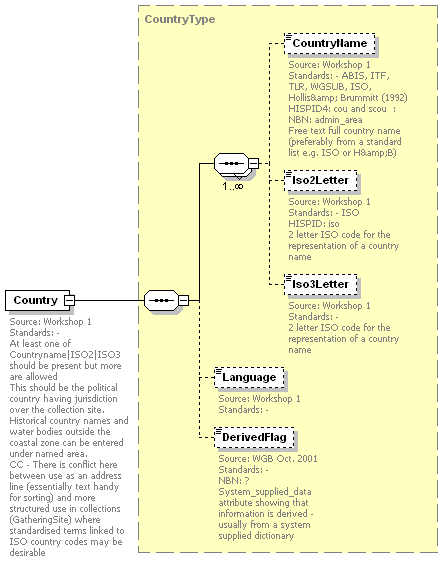 |
||
| type | CountryType | ||
| children | CountryName Iso2Letter Iso3Letter Language DerivedFlag | ||
| annotation |
|
||
| source | <xs:element name="Country" type="CountryType" minOccurs="0"> <xs:annotation> <xs:documentation>Source: Workshop 1 Standards: - At least one of Countryname|ISO2|ISO3 should be present but more are allowed This should be the political country having jurisdiction over the collection site. Historical country names and water bodies outside the coastal zone can be entered under named area. CC - There is conflict here between use as an address line (essentially text handy for sorting) and more structured use in collections (GatheringSite) where standardised terms linked to ISO country codes may be desirable </xs:documentation> </xs:annotation> </xs:element> |
| diagram |  |
||
| type | xs:string | ||
| annotation |
|
||
| source | <xs:element name="zip" type="xs:string" minOccurs="0"> <xs:annotation> <xs:documentation>Added by C.Copp - Oct 2001Text attribute for zip code or post code</xs:documentation> </xs:annotation> </xs:element> |
| diagram | 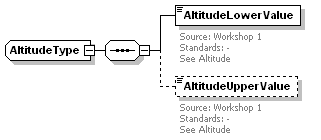 |
||||||||||||||||||||||||||||||
| children | AltitudeLowerValue AltitudeUpperValue | ||||||||||||||||||||||||||||||
| used by |
|
||||||||||||||||||||||||||||||
| attributes |
|
||||||||||||||||||||||||||||||
| source | <xs:complexType name="AltitudeType"> <xs:sequence> <xs:element name="AltitudeLowerValue" type="xs:string"> <xs:annotation> <xs:documentation>Source: Workshop 1 Standards: - See Altitude</xs:documentation> </xs:annotation> </xs:element> <xs:element name="AltitudeUpperValue" type="xs:string" minOccurs="0"> <xs:annotation> <xs:documentation>Source: Workshop 1 Standards: - See Altitude</xs:documentation> </xs:annotation> </xs:element> </xs:sequence> <xs:attribute name="AltitudeMethod"> <xs:simpleType> <xs:restriction base="xs:NMTOKEN"> <xs:enumeration value="Altimeter"/> <xs:enumeration value="DEM"/> <xs:enumeration value="GPS"/> <xs:enumeration value="Estimate"/> <xs:enumeration value="Map"/> <xs:enumeration value="Unknown"/> </xs:restriction> </xs:simpleType> </xs:attribute> <xs:attribute name="AltitudeAccuracy" type="xs:string"/> <xs:attribute name="AltitudeUnits" use="required"> <xs:simpleType> <xs:restriction base="xs:NMTOKEN"> <xs:enumeration value="metres"/> <xs:enumeration value="feet"/> </xs:restriction> </xs:simpleType> </xs:attribute> <xs:attribute name="AltAccSrc"> <xs:simpleType> <xs:restriction base="xs:NMTOKEN"> <xs:enumeration value="collector"/> <xs:enumeration value="compiled"/> <xs:enumeration value="autogenerated"/> </xs:restriction> </xs:simpleType> </xs:attribute> </xs:complexType> |
| diagram |  |
||
| type | xs:string | ||
| annotation |
|
||
| source | <xs:element name="AltitudeLowerValue" type="xs:string"> <xs:annotation> <xs:documentation>Source: Workshop 1 Standards: - See Altitude</xs:documentation> </xs:annotation> </xs:element> |
| diagram |  |
||
| type | xs:string | ||
| annotation |
|
||
| source | <xs:element name="AltitudeUpperValue" type="xs:string" minOccurs="0"> <xs:annotation> <xs:documentation>Source: Workshop 1 Standards: - See Altitude</xs:documentation> </xs:annotation> </xs:element> |
| diagram | 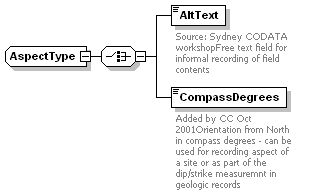 |
||||||||||||
| children | AltText CompassDegrees | ||||||||||||
| used by |
|
||||||||||||
| attributes |
|
||||||||||||
| source | <xs:complexType name="AspectType"> <xs:choice> <xs:element name="AltText" type="AltText"> <xs:annotation> <xs:documentation>Source: Sydney CODATA workshopFree text field for informal recording of field contents</xs:documentation> </xs:annotation> </xs:element> <xs:element name="CompassDegrees" type="xs:string"> <xs:annotation> <xs:documentation>Added by CC Oct 2001Orientation from North in compass degrees - can be used for recording aspect of a site or as part of the dip/strike measuremnt in geologic records</xs:documentation> </xs:annotation> </xs:element> </xs:choice> <xs:attribute name="Accuracy" type="xs:string"/> </xs:complexType> |
| diagram |  |
||
| type | AltText | ||
| annotation |
|
||
| source | <xs:element name="AltText" type="AltText"> <xs:annotation> <xs:documentation>Source: Sydney CODATA workshopFree text field for informal recording of field contents</xs:documentation> </xs:annotation> </xs:element> |
| diagram |  |
||
| type | xs:string | ||
| annotation |
|
||
| source | <xs:element name="CompassDegrees" type="xs:string"> <xs:annotation> <xs:documentation>Added by CC Oct 2001Orientation from North in compass degrees - can be used for recording aspect of a site or as part of the dip/strike measuremnt in geologic records</xs:documentation> </xs:annotation> </xs:element> |
| diagram | 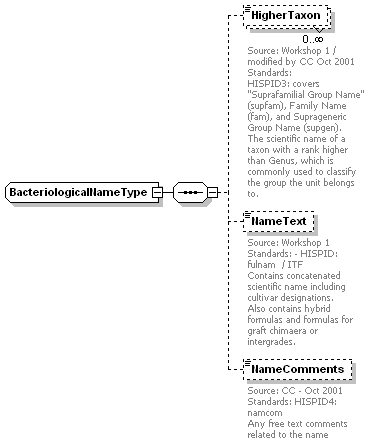 |
||
| children | HigherTaxon NameText NameComments | ||
| used by |
|
||
| source | <xs:complexType name="BacteriologicalNameType"> <xs:sequence> <xs:element name="HigherTaxon" type="HigherTaxonType" minOccurs="0" maxOccurs="unbounded"> <xs:annotation> <xs:documentation>Source: Workshop 1 / modified by CC Oct 2001 Standards: HISPID3: covers "Suprafamilial Group Name" (supfam), Family Name (fam), and Suprageneric Group Name (supgen). The scientific name of a taxon with a rank higher than Genus, which is commonly used to classify the group the unit belongs to. </xs:documentation> </xs:annotation> </xs:element> <xs:element name="NameText" type="NameText" minOccurs="0"> <xs:annotation> <xs:documentation>Source: Workshop 1 Standards: - HISPID: fulnam / ITF Contains concatenated scientific name including cultivar designations. Also contains hybrid formulas and formulas for graft chimaera or intergrades.</xs:documentation> </xs:annotation> </xs:element> <xs:element name="NameComments" type="NameComments" minOccurs="0"> <xs:annotation> <xs:documentation>Source: CC - Oct 2001 Standards: HISPID4: namcom Any free text comments related to the name</xs:documentation> </xs:annotation> </xs:element> </xs:sequence> </xs:complexType> |
| diagram |  |
||||||||||||
| type | HigherTaxonType | ||||||||||||
| attributes |
|
||||||||||||
| annotation |
|
||||||||||||
| source | <xs:element name="HigherTaxon" type="HigherTaxonType" minOccurs="0" maxOccurs="unbounded"> <xs:annotation> <xs:documentation>Source: Workshop 1 / modified by CC Oct 2001 Standards: HISPID3: covers "Suprafamilial Group Name" (supfam), Family Name (fam), and Suprageneric Group Name (supgen). The scientific name of a taxon with a rank higher than Genus, which is commonly used to classify the group the unit belongs to. </xs:documentation> </xs:annotation> </xs:element> |
| diagram |  |
||
| type | NameText | ||
| annotation |
|
||
| source | <xs:element name="NameText" type="NameText" minOccurs="0"> <xs:annotation> <xs:documentation>Source: Workshop 1 Standards: - HISPID: fulnam / ITF Contains concatenated scientific name including cultivar designations. Also contains hybrid formulas and formulas for graft chimaera or intergrades.</xs:documentation> </xs:annotation> </xs:element> |
| diagram |  |
||
| type | NameComments | ||
| annotation |
|
||
| source | <xs:element name="NameComments" type="NameComments" minOccurs="0"> <xs:annotation> <xs:documentation>Source: CC - Oct 2001 Standards: HISPID4: namcom Any free text comments related to the name</xs:documentation> </xs:annotation> </xs:element> |
| diagram | 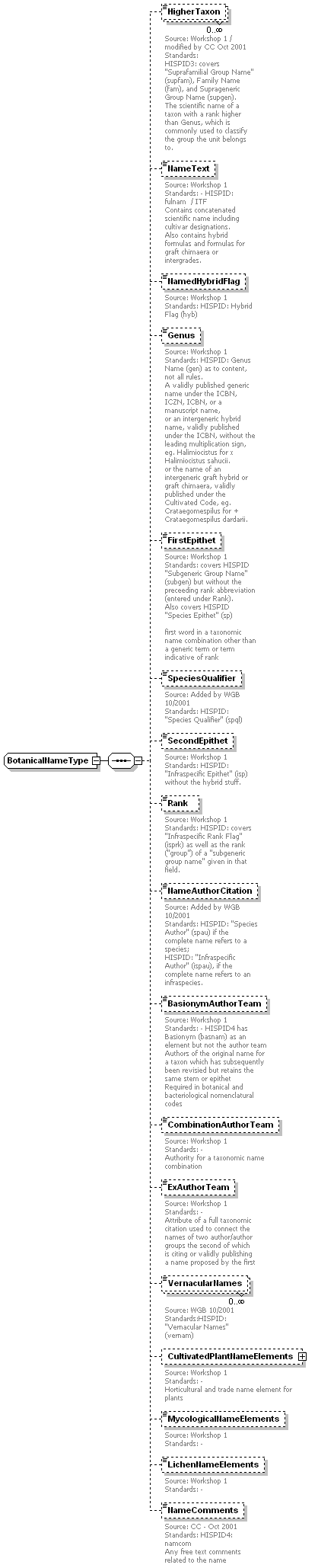 |
||
| children | HigherTaxon NameText NamedHybridFlag Genus FirstEpithet SpeciesQualifier SecondEpithet Rank NameAuthorCitation BasionymAuthorTeam CombinationAuthorTeam ExAuthorTeam VernacularNames CultivatedPlantNameElements MycologicalNameElements LichenNameElements NameComments | ||
| used by |
|
||
| source | <xs:complexType name="BotanicalNameType"> <xs:sequence> <xs:element name="HigherTaxon" type="HigherTaxonType" minOccurs="0" maxOccurs="unbounded"> <xs:annotation> <xs:documentation>Source: Workshop 1 / modified by CC Oct 2001 Standards: HISPID3: covers "Suprafamilial Group Name" (supfam), Family Name (fam), and Suprageneric Group Name (supgen). The scientific name of a taxon with a rank higher than Genus, which is commonly used to classify the group the unit belongs to. </xs:documentation> </xs:annotation> </xs:element> <xs:element name="NameText" type="NameText" minOccurs="0"> <xs:annotation> <xs:documentation>Source: Workshop 1 Standards: - HISPID: fulnam / ITF Contains concatenated scientific name including cultivar designations. Also contains hybrid formulas and formulas for graft chimaera or intergrades.</xs:documentation> </xs:annotation> </xs:element> <xs:element name="NamedHybridFlag" type="xs:string" minOccurs="0"> <xs:annotation> <xs:documentation>Source: Workshop 1 Standards: HISPID: Hybrid Flag (hyb) </xs:documentation> </xs:annotation> </xs:element> <xs:element name="Genus" type="Genus" minOccurs="0"> <xs:annotation> <xs:documentation>Source: Workshop 1 Standards: HISPID: Genus Name (gen) as to content, not all rules. A validly published generic name under the ICBN, ICZN, ICBN, or a manuscript name, or an intergeneric hybrid name, validly published under the ICBN, without the leading multiplication sign, eg. Halimiocistus for x Halimiocistus sahucii. or the name of an intergeneric graft hybrid or graft chimaera, validly published under the Cultivated Code, eg. Crataegomespilus for + Crataegomespilus dardarii.</xs:documentation> </xs:annotation> </xs:element> <xs:element name="FirstEpithet" type="FirstEpithet" minOccurs="0"> <xs:annotation> <xs:documentation>Source: Workshop 1 Standards: covers HISPID "Subgeneric Group Name" (subgen) but without the preceeding rank abbreviation (entered under Rank). Also covers HISPID "Species Epithet" (sp) first word in a taxonomic name combination other than a generic term or term indicative of rank</xs:documentation> </xs:annotation> </xs:element> <xs:element name="SpeciesQualifier" type="xs:string" minOccurs="0"> <xs:annotation> <xs:documentation>Source: Added by WGB 10/2001 Standards: HISPID: "Species Qualifier" (spql)</xs:documentation> </xs:annotation> </xs:element> <xs:element name="SecondEpithet" type="SecondEpithet" minOccurs="0"> <xs:annotation> <xs:documentation>Source: Workshop 1 Standards: HISPID: "Infraspecific Epithet" (isp) without the hybrid stuff.</xs:documentation> </xs:annotation> </xs:element> <xs:element name="Rank" type="Rank" minOccurs="0"> <xs:annotation> <xs:documentation>Source: Workshop 1 Standards: HISPID: covers "Infraspecific Rank Flag" (isprk) as well as the rank ("group") of a "subgeneric group name" given in that field.</xs:documentation> </xs:annotation> </xs:element> <xs:element name="NameAuthorCitation" type="xs:string" minOccurs="0"> <xs:annotation> <xs:documentation>Source: Added by WGB 10/2001 Standards: HISPID: "Species Author" (spau) if the complete name refers to a species; HISPID: "Infraspecific Author" (ispau), if the complete name refers to an infraspecies.</xs:documentation> </xs:annotation> </xs:element> <xs:element name="BasionymAuthorTeam" type="xs:string" minOccurs="0"> <xs:annotation> <xs:documentation>Source: Workshop 1 Standards: - HISPID4 has Basionym (basnam) as an element but not the author team Authors of the original name for a taxon which has subsequently been revisied but retains the same stem or epithet Required in botanical and bacteriological nomenclatural codes</xs:documentation> </xs:annotation> </xs:element> <xs:element name="CombinationAuthorTeam" type="xs:string" minOccurs="0"> <xs:annotation> <xs:documentation>Source: Workshop 1 Standards: - Authority for a taxonomic name combination</xs:documentation> </xs:annotation> </xs:element> <xs:element name="ExAuthorTeam" type="xs:string" minOccurs="0"> <xs:annotation> <xs:documentation>Source: Workshop 1 Standards: - Attribute of a full taxonomic citation used to connect the names of two author/author groups the second of which is citing or validly publishing a name proposed by the first</xs:documentation> </xs:annotation> </xs:element> <xs:element name="VernacularNames" type="VernacularNames" minOccurs="0" maxOccurs="unbounded"> <xs:annotation> <xs:documentation>Source: WGB 10/2001 Standards:HISPID: "Vernacular Names" (vernam)</xs:documentation> </xs:annotation> </xs:element> <xs:element name="CultivatedPlantNameElements" minOccurs="0"> <xs:annotation> <xs:documentation>Source: Workshop 1 Standards: - Horticultural and trade name element for plants</xs:documentation> </xs:annotation> <xs:complexType> <xs:sequence> <xs:element name="CultivarGroupName" type="xs:string" minOccurs="0"> <xs:annotation> <xs:documentation>Source: CC - Oct 2001 Standards: HISPID4: culgnam /ITF / Treharne(1995) Cultivar group name e.g. "Cauliflower"</xs:documentation> </xs:annotation> </xs:element> <xs:element name="CultivarName" type="xs:string" minOccurs="0"> <xs:annotation> <xs:documentation>Source: CC - Oct 2001 Standards: HISPID4: culnam / ITF /ICNCP / Treharne(1995) Cultivar name e.g. the type of cauliflower.</xs:documentation> </xs:annotation> </xs:element> <xs:element name="TradeDesignationName" type="xs:string" minOccurs="0" maxOccurs="unbounded"> <xs:annotation> <xs:documentation>Source: CC - Oct 2001 Standards: HISPID4: tranam / ITF / ICNCP (Treharne(1995) Trade name used for a specific cultivar</xs:documentation> </xs:annotation> </xs:element> </xs:sequence> </xs:complexType> </xs:element> <xs:element name="MycologicalNameElements" type="xs:string" minOccurs="0"> <xs:annotation> <xs:documentation>Source: Workshop 1 Standards: -</xs:documentation> </xs:annotation> </xs:element> <xs:element name="LichenNameElements" type="xs:string" minOccurs="0"> <xs:annotation> <xs:documentation>Source: Workshop 1 Standards: - </xs:documentation> </xs:annotation> </xs:element> <xs:element name="NameComments" type="NameComments" minOccurs="0"> <xs:annotation> <xs:documentation>Source: CC - Oct 2001 Standards: HISPID4: namcom Any free text comments related to the name</xs:documentation> </xs:annotation> </xs:element> </xs:sequence> </xs:complexType> |
| diagram |  |
||||||||||||
| type | HigherTaxonType | ||||||||||||
| attributes |
|
||||||||||||
| annotation |
|
||||||||||||
| source | <xs:element name="HigherTaxon" type="HigherTaxonType" minOccurs="0" maxOccurs="unbounded"> <xs:annotation> <xs:documentation>Source: Workshop 1 / modified by CC Oct 2001 Standards: HISPID3: covers "Suprafamilial Group Name" (supfam), Family Name (fam), and Suprageneric Group Name (supgen). The scientific name of a taxon with a rank higher than Genus, which is commonly used to classify the group the unit belongs to. </xs:documentation> </xs:annotation> </xs:element> |
| diagram |  |
||
| type | NameText | ||
| annotation |
|
||
| source | <xs:element name="NameText" type="NameText" minOccurs="0"> <xs:annotation> <xs:documentation>Source: Workshop 1 Standards: - HISPID: fulnam / ITF Contains concatenated scientific name including cultivar designations. Also contains hybrid formulas and formulas for graft chimaera or intergrades.</xs:documentation> </xs:annotation> </xs:element> |
| diagram |  |
||
| type | xs:string | ||
| annotation |
|
||
| source | <xs:element name="NamedHybridFlag" type="xs:string" minOccurs="0"> <xs:annotation> <xs:documentation>Source: Workshop 1 Standards: HISPID: Hybrid Flag (hyb) </xs:documentation> </xs:annotation> </xs:element> |
| diagram | 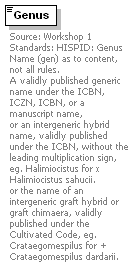 |
||
| type | Genus | ||
| annotation |
|
||
| source | <xs:element name="Genus" type="Genus" minOccurs="0"> <xs:annotation> <xs:documentation>Source: Workshop 1 Standards: HISPID: Genus Name (gen) as to content, not all rules. A validly published generic name under the ICBN, ICZN, ICBN, or a manuscript name, or an intergeneric hybrid name, validly published under the ICBN, without the leading multiplication sign, eg. Halimiocistus for x Halimiocistus sahucii. or the name of an intergeneric graft hybrid or graft chimaera, validly published under the Cultivated Code, eg. Crataegomespilus for + Crataegomespilus dardarii.</xs:documentation> </xs:annotation> </xs:element> |
| diagram | 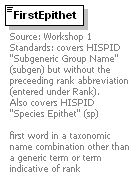 |
||
| type | FirstEpithet | ||
| annotation |
|
||
| source | <xs:element name="FirstEpithet" type="FirstEpithet" minOccurs="0"> <xs:annotation> <xs:documentation>Source: Workshop 1 Standards: covers HISPID "Subgeneric Group Name" (subgen) but without the preceeding rank abbreviation (entered under Rank). Also covers HISPID "Species Epithet" (sp) first word in a taxonomic name combination other than a generic term or term indicative of rank</xs:documentation> </xs:annotation> </xs:element> |
| diagram |  |
||
| type | xs:string | ||
| annotation |
|
||
| source | <xs:element name="SpeciesQualifier" type="xs:string" minOccurs="0"> <xs:annotation> <xs:documentation>Source: Added by WGB 10/2001 Standards: HISPID: "Species Qualifier" (spql)</xs:documentation> </xs:annotation> </xs:element> |
| diagram |  |
||
| type | SecondEpithet | ||
| annotation |
|
||
| source | <xs:element name="SecondEpithet" type="SecondEpithet" minOccurs="0"> <xs:annotation> <xs:documentation>Source: Workshop 1 Standards: HISPID: "Infraspecific Epithet" (isp) without the hybrid stuff.</xs:documentation> </xs:annotation> </xs:element> |
| diagram |  |
||
| type | Rank | ||
| annotation |
|
||
| source | <xs:element name="Rank" type="Rank" minOccurs="0"> <xs:annotation> <xs:documentation>Source: Workshop 1 Standards: HISPID: covers "Infraspecific Rank Flag" (isprk) as well as the rank ("group") of a "subgeneric group name" given in that field.</xs:documentation> </xs:annotation> </xs:element> |
| diagram |  |
||
| type | xs:string | ||
| annotation |
|
||
| source | <xs:element name="NameAuthorCitation" type="xs:string" minOccurs="0"> <xs:annotation> <xs:documentation>Source: Added by WGB 10/2001 Standards: HISPID: "Species Author" (spau) if the complete name refers to a species; HISPID: "Infraspecific Author" (ispau), if the complete name refers to an infraspecies.</xs:documentation> </xs:annotation> </xs:element> |
| diagram |  |
||
| type | xs:string | ||
| annotation |
|
||
| source | <xs:element name="BasionymAuthorTeam" type="xs:string" minOccurs="0"> <xs:annotation> <xs:documentation>Source: Workshop 1 Standards: - HISPID4 has Basionym (basnam) as an element but not the author team Authors of the original name for a taxon which has subsequently been revisied but retains the same stem or epithet Required in botanical and bacteriological nomenclatural codes</xs:documentation> </xs:annotation> </xs:element> |
| diagram | 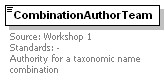 |
||
| type | xs:string | ||
| annotation |
|
||
| source | <xs:element name="CombinationAuthorTeam" type="xs:string" minOccurs="0"> <xs:annotation> <xs:documentation>Source: Workshop 1 Standards: - Authority for a taxonomic name combination</xs:documentation> </xs:annotation> </xs:element> |
| diagram | 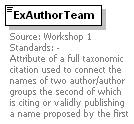 |
||
| type | xs:string | ||
| annotation |
|
||
| source | <xs:element name="ExAuthorTeam" type="xs:string" minOccurs="0"> <xs:annotation> <xs:documentation>Source: Workshop 1 Standards: - Attribute of a full taxonomic citation used to connect the names of two author/author groups the second of which is citing or validly publishing a name proposed by the first</xs:documentation> </xs:annotation> </xs:element> |
| diagram | 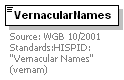 |
||
| type | VernacularNames | ||
| annotation |
|
||
| source | <xs:element name="VernacularNames" type="VernacularNames" minOccurs="0" maxOccurs="unbounded"> <xs:annotation> <xs:documentation>Source: WGB 10/2001 Standards:HISPID: "Vernacular Names" (vernam)</xs:documentation> </xs:annotation> </xs:element> |
| diagram | 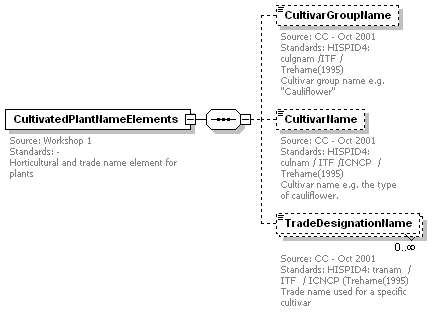 |
||
| children | CultivarGroupName CultivarName TradeDesignationName | ||
| annotation |
|
||
| source | <xs:element name="CultivatedPlantNameElements" minOccurs="0"> <xs:annotation> <xs:documentation>Source: Workshop 1 Standards: - Horticultural and trade name element for plants</xs:documentation> </xs:annotation> <xs:complexType> <xs:sequence> <xs:element name="CultivarGroupName" type="xs:string" minOccurs="0"> <xs:annotation> <xs:documentation>Source: CC - Oct 2001 Standards: HISPID4: culgnam /ITF / Treharne(1995) Cultivar group name e.g. "Cauliflower"</xs:documentation> </xs:annotation> </xs:element> <xs:element name="CultivarName" type="xs:string" minOccurs="0"> <xs:annotation> <xs:documentation>Source: CC - Oct 2001 Standards: HISPID4: culnam / ITF /ICNCP / Treharne(1995) Cultivar name e.g. the type of cauliflower.</xs:documentation> </xs:annotation> </xs:element> <xs:element name="TradeDesignationName" type="xs:string" minOccurs="0" maxOccurs="unbounded"> <xs:annotation> <xs:documentation>Source: CC - Oct 2001 Standards: HISPID4: tranam / ITF / ICNCP (Treharne(1995) Trade name used for a specific cultivar</xs:documentation> </xs:annotation> </xs:element> </xs:sequence> </xs:complexType> </xs:element> |
| diagram | 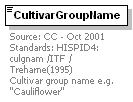 |
||
| type | xs:string | ||
| annotation |
|
||
| source | <xs:element name="CultivarGroupName" type="xs:string" minOccurs="0"> <xs:annotation> <xs:documentation>Source: CC - Oct 2001 Standards: HISPID4: culgnam /ITF / Treharne(1995) Cultivar group name e.g. "Cauliflower"</xs:documentation> </xs:annotation> </xs:element> |
| diagram | 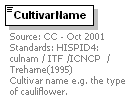 |
||
| type | xs:string | ||
| annotation |
|
||
| source | <xs:element name="CultivarName" type="xs:string" minOccurs="0"> <xs:annotation> <xs:documentation>Source: CC - Oct 2001 Standards: HISPID4: culnam / ITF /ICNCP / Treharne(1995) Cultivar name e.g. the type of cauliflower.</xs:documentation> </xs:annotation> </xs:element> |
| diagram | 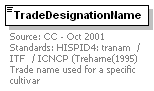 |
||
| type | xs:string | ||
| annotation |
|
||
| source | <xs:element name="TradeDesignationName" type="xs:string" minOccurs="0" maxOccurs="unbounded"> <xs:annotation> <xs:documentation>Source: CC - Oct 2001 Standards: HISPID4: tranam / ITF / ICNCP (Treharne(1995) Trade name used for a specific cultivar</xs:documentation> </xs:annotation> </xs:element> |
| diagram |  |
||
| type | xs:string | ||
| annotation |
|
||
| source | <xs:element name="MycologicalNameElements" type="xs:string" minOccurs="0"> <xs:annotation> <xs:documentation>Source: Workshop 1 Standards: -</xs:documentation> </xs:annotation> </xs:element> |
| diagram |  |
||
| type | xs:string | ||
| annotation |
|
||
| source | <xs:element name="LichenNameElements" type="xs:string" minOccurs="0"> <xs:annotation> <xs:documentation>Source: Workshop 1 Standards: - </xs:documentation> </xs:annotation> </xs:element> |
| diagram |  |
||
| type | NameComments | ||
| annotation |
|
||
| source | <xs:element name="NameComments" type="NameComments" minOccurs="0"> <xs:annotation> <xs:documentation>Source: CC - Oct 2001 Standards: HISPID4: namcom Any free text comments related to the name</xs:documentation> </xs:annotation> </xs:element> |
| diagram | 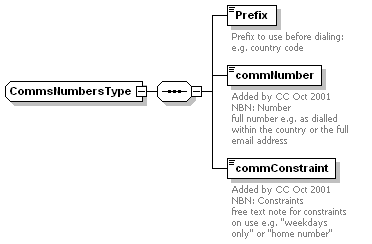 |
||||||||||||||||||
| children | Prefix commNumber commConstraint | ||||||||||||||||||
| used by |
|
||||||||||||||||||
| attributes |
|
||||||||||||||||||
| source | <xs:complexType name="CommsNumbersType"> <xs:sequence> <xs:element name="Prefix" type="xs:string"> <xs:annotation> <xs:documentation>Prefix to use before dialing: e.g. country code</xs:documentation> </xs:annotation> </xs:element> <xs:element name="commNumber" type="xs:string"> <xs:annotation> <xs:documentation>Added by CC Oct 2001 NBN: Number full number e.g. as dialled within the country or the full email address</xs:documentation> </xs:annotation> </xs:element> <xs:element name="commConstraint" type="xs:string"> <xs:annotation> <xs:documentation>Added by CC Oct 2001 NBN: Constraints free text note for constraints on use e.g. "weekdays only" or "home number"</xs:documentation> </xs:annotation> </xs:element> </xs:sequence> <xs:attribute name="CommType"> <xs:simpleType> <xs:restriction base="xs:NMTOKEN"> <xs:enumeration value="telephone"/> <xs:enumeration value="fax"/> <xs:enumeration value="email"/> </xs:restriction> </xs:simpleType> </xs:attribute> <xs:attribute name="PreferredFlag"> <xs:simpleType> <xs:restriction base="xs:NMTOKEN"> <xs:enumeration value="Yes"/> <xs:enumeration value="No"/> </xs:restriction> </xs:simpleType> </xs:attribute> </xs:complexType> |
| diagram |  |
||
| type | xs:string | ||
| annotation |
|
||
| source | <xs:element name="Prefix" type="xs:string"> <xs:annotation> <xs:documentation>Prefix to use before dialing: e.g. country code</xs:documentation> </xs:annotation> </xs:element> |
| diagram | 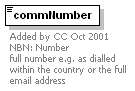 |
||
| type | xs:string | ||
| annotation |
|
||
| source | <xs:element name="commNumber" type="xs:string"> <xs:annotation> <xs:documentation>Added by CC Oct 2001 NBN: Number full number e.g. as dialled within the country or the full email address</xs:documentation> </xs:annotation> </xs:element> |
| diagram | 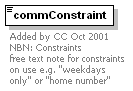 |
||
| type | xs:string | ||
| annotation |
|
||
| source | <xs:element name="commConstraint" type="xs:string"> <xs:annotation> <xs:documentation>Added by CC Oct 2001 NBN: Constraints free text note for constraints on use e.g. "weekdays only" or "home number"</xs:documentation> </xs:annotation> </xs:element> |
| diagram | 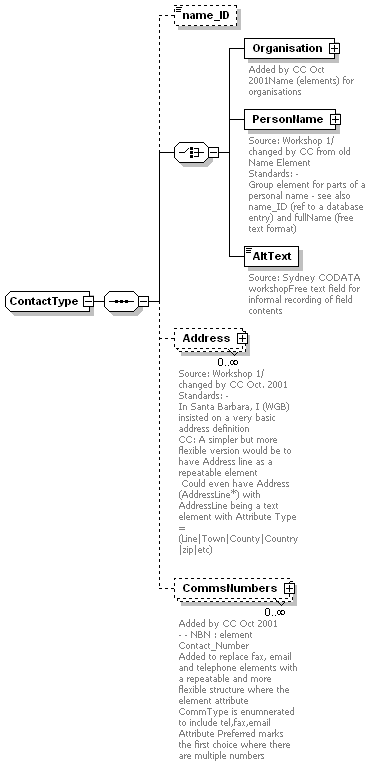 |
||
| children | name_ID Organisation PersonName AltText Address CommsNumbers | ||
| used by |
|
||
| source | <xs:complexType name="ContactType"> <xs:sequence> <xs:element name="name_ID" type="name_ID" minOccurs="0"/> <xs:choice> <xs:element name="Organisation" type="OrganisationType"> <xs:annotation> <xs:documentation>Added by CC Oct 2001Name (elements) for organisations</xs:documentation> </xs:annotation> </xs:element> <xs:element name="PersonName" type="PersonNameType"> <xs:annotation> <xs:documentation>Source: Workshop 1/ changed by CC from old Name Element Standards: - Group element for parts of a personal name - see also name_ID (ref to a database entry) and fullName (free text format)</xs:documentation> </xs:annotation> </xs:element> <xs:element name="AltText" type="AltText"> <xs:annotation> <xs:documentation>Source: Sydney CODATA workshopFree text field for informal recording of field contents</xs:documentation> </xs:annotation> </xs:element> </xs:choice> <xs:element name="Address" type="AddressType" minOccurs="0" maxOccurs="unbounded"> <xs:annotation> <xs:documentation>Source: Workshop 1/ changed by CC Oct. 2001 Standards: - In Santa Barbara, I (WGB) insisted on a very basic address definition CC: A simpler but more flexible version would be to have Address line as a repeatable element Could even have Address (AddressLine*) with AddressLine being a text element with Attribute Type = (Line|Town|County|Country|zip|etc) </xs:documentation> </xs:annotation> </xs:element> <xs:element name="CommsNumbers" type="CommsNumbersType" minOccurs="0" maxOccurs="unbounded"> <xs:annotation> <xs:documentation>Added by CC Oct 2001 - - NBN : element Contact_Number Added to replace fax, email and telephone elements with a repeatable and more flexible structure where the element attribute CommType is enumnerated to include tel,fax,email Attribute Preferred marks the first choice where there are multiple numbers</xs:documentation> </xs:annotation> </xs:element> </xs:sequence> </xs:complexType> |
| diagram |  |
| type | name_ID |
| source | <xs:element name="name_ID" type="name_ID" minOccurs="0"/> |
| diagram | 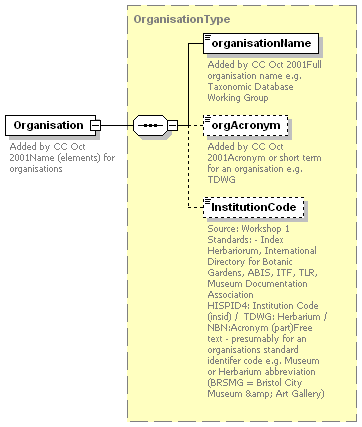 |
||
| type | OrganisationType | ||
| children | organisationName orgAcronym InstitutionCode | ||
| annotation |
|
||
| source | <xs:element name="Organisation" type="OrganisationType"> <xs:annotation> <xs:documentation>Added by CC Oct 2001Name (elements) for organisations</xs:documentation> </xs:annotation> </xs:element> |
| diagram | 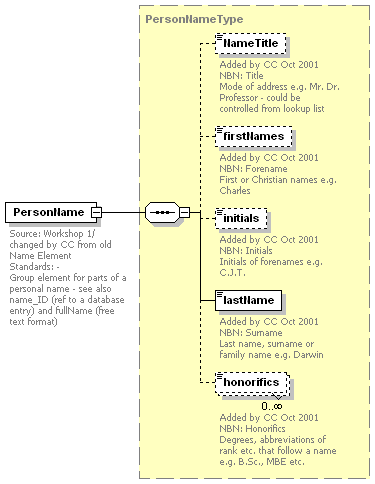 |
||
| type | PersonNameType | ||
| children | NameTitle firstNames initials lastName honorifics | ||
| annotation |
|
||
| source | <xs:element name="PersonName" type="PersonNameType"> <xs:annotation> <xs:documentation>Source: Workshop 1/ changed by CC from old Name Element Standards: - Group element for parts of a personal name - see also name_ID (ref to a database entry) and fullName (free text format)</xs:documentation> </xs:annotation> </xs:element> |
| diagram |  |
||
| type | AltText | ||
| annotation |
|
||
| source | <xs:element name="AltText" type="AltText"> <xs:annotation> <xs:documentation>Source: Sydney CODATA workshopFree text field for informal recording of field contents</xs:documentation> </xs:annotation> </xs:element> |
| diagram | 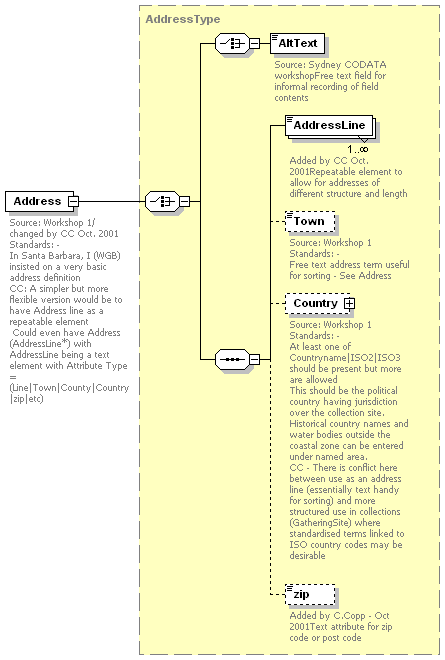 |
||
| type | AddressType | ||
| children | AltText AddressLine Town Country zip | ||
| annotation |
|
||
| source | <xs:element name="Address" type="AddressType" minOccurs="0" maxOccurs="unbounded"> <xs:annotation> <xs:documentation>Source: Workshop 1/ changed by CC Oct. 2001 Standards: - In Santa Barbara, I (WGB) insisted on a very basic address definition CC: A simpler but more flexible version would be to have Address line as a repeatable element Could even have Address (AddressLine*) with AddressLine being a text element with Attribute Type = (Line|Town|County|Country|zip|etc) </xs:documentation> </xs:annotation> </xs:element> |
| diagram | 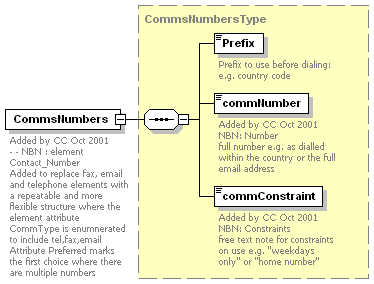 |
||||||||||||||||||
| type | CommsNumbersType | ||||||||||||||||||
| children | Prefix commNumber commConstraint | ||||||||||||||||||
| attributes |
|
||||||||||||||||||
| annotation |
|
||||||||||||||||||
| source | <xs:element name="CommsNumbers" type="CommsNumbersType" minOccurs="0" maxOccurs="unbounded"> <xs:annotation> <xs:documentation>Added by CC Oct 2001 - - NBN : element Contact_Number Added to replace fax, email and telephone elements with a repeatable and more flexible structure where the element attribute CommType is enumnerated to include tel,fax,email Attribute Preferred marks the first choice where there are multiple numbers</xs:documentation> </xs:annotation> </xs:element> |
| diagram | 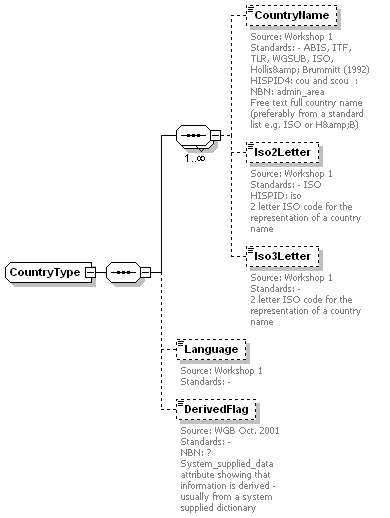 |
||
| children | CountryName Iso2Letter Iso3Letter Language DerivedFlag | ||
| used by |
|
||
| source | <xs:complexType name="CountryType"> <xs:sequence> <xs:sequence maxOccurs="unbounded"> <xs:element name="CountryName" type="xs:string" minOccurs="0"> <xs:annotation> <xs:documentation>Source: Workshop 1 Standards: - ABIS, ITF, TLR, WGSUB, ISO, Hollis& Brummitt (1992) HISPID4: cou and scou : NBN: admin_area Free text full country name (preferably from a standard list e.g. ISO or H&B)</xs:documentation> </xs:annotation> </xs:element> <xs:element name="Iso2Letter" type="xs:string" minOccurs="0"> <xs:annotation> <xs:documentation>Source: Workshop 1 Standards: - ISO HISPID: iso 2 letter ISO code for the representation of a country name</xs:documentation> </xs:annotation> </xs:element> <xs:element name="Iso3Letter" type="xs:string" minOccurs="0"> <xs:annotation> <xs:documentation>Source: Workshop 1 Standards: - 2 letter ISO code for the representation of a country name</xs:documentation> </xs:annotation> </xs:element> </xs:sequence> <xs:element name="Language" type="Language" minOccurs="0"> <xs:annotation> <xs:documentation>Source: Workshop 1 Standards: -</xs:documentation> </xs:annotation> </xs:element> <xs:element name="DerivedFlag" type="DerivedFlag" minOccurs="0"> <xs:annotation> <xs:documentation>Source: WGB Oct. 2001 Standards: - NBN: ? System_supplied_data attribute showing that information is derived - usually from a system supplied dictionary</xs:documentation> </xs:annotation> </xs:element> </xs:sequence> </xs:complexType> |
| diagram | 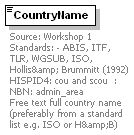 |
||
| type | xs:string | ||
| annotation |
|
||
| source | <xs:element name="CountryName" type="xs:string" minOccurs="0"> <xs:annotation> <xs:documentation>Source: Workshop 1 Standards: - ABIS, ITF, TLR, WGSUB, ISO, Hollis& Brummitt (1992) HISPID4: cou and scou : NBN: admin_area Free text full country name (preferably from a standard list e.g. ISO or H&B)</xs:documentation> </xs:annotation> </xs:element> |
| diagram |  |
||
| type | xs:string | ||
| annotation |
|
||
| source | <xs:element name="Iso2Letter" type="xs:string" minOccurs="0"> <xs:annotation> <xs:documentation>Source: Workshop 1 Standards: - ISO HISPID: iso 2 letter ISO code for the representation of a country name</xs:documentation> </xs:annotation> </xs:element> |
| diagram |  |
||
| type | xs:string | ||
| annotation |
|
||
| source | <xs:element name="Iso3Letter" type="xs:string" minOccurs="0"> <xs:annotation> <xs:documentation>Source: Workshop 1 Standards: - 2 letter ISO code for the representation of a country name</xs:documentation> </xs:annotation> </xs:element> |
| diagram |  |
||
| type | Language | ||
| annotation |
|
||
| source | <xs:element name="Language" type="Language" minOccurs="0"> <xs:annotation> <xs:documentation>Source: Workshop 1 Standards: -</xs:documentation> </xs:annotation> </xs:element> |
| diagram | 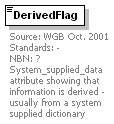 |
||
| type | DerivedFlag | ||
| annotation |
|
||
| source | <xs:element name="DerivedFlag" type="DerivedFlag" minOccurs="0"> <xs:annotation> <xs:documentation>Source: WGB Oct. 2001 Standards: - NBN: ? System_supplied_data attribute showing that information is derived - usually from a system supplied dictionary</xs:documentation> </xs:annotation> </xs:element> |
| diagram | 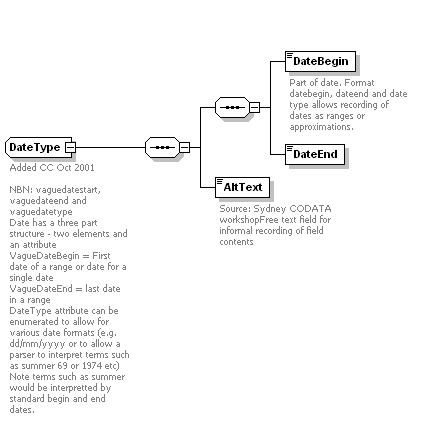 |
||||||||||||
| children | DateBegin DateEnd AltText | ||||||||||||
| used by |
|
||||||||||||
| attributes |
|
||||||||||||
| annotation |
|
||||||||||||
| source | <xs:complexType name="DateType"> <xs:annotation> <xs:documentation>Added CC Oct 2001 NBN: vaguedatestart, vaguedateend and vaguedatetype Date has a three part structure - two elements and an attribute VagueDateBegin = First date of a range or date for a single date VagueDateEnd = last date in a range DateType attribute can be enumerated to allow for various date formats (e.g. dd/mm/yyyy or to allow a parser to interpret terms such as summer 69 or 1974 etc) Note terms such as summer would be interpretted by standard begin and end dates. </xs:documentation> </xs:annotation> <xs:sequence> <xs:sequence> <xs:element name="DateBegin" type="xs:string"> <xs:annotation> <xs:documentation>Part of date. Format datebegin, dateend and date type allows recording of dates as ranges or approximations.</xs:documentation> </xs:annotation> </xs:element> <xs:element name="DateEnd" type="xs:string"/> </xs:sequence> <xs:element name="AltText" type="AltText"> <xs:annotation> <xs:documentation>Source: Sydney CODATA workshopFree text field for informal recording of field contents</xs:documentation> </xs:annotation> </xs:element> </xs:sequence> <xs:attribute name="DateType" type="xs:string"/> </xs:complexType> |
| diagram | 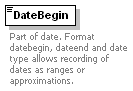 |
||
| type | xs:string | ||
| annotation |
|
||
| source | <xs:element name="DateBegin" type="xs:string"> <xs:annotation> <xs:documentation>Part of date. Format datebegin, dateend and date type allows recording of dates as ranges or approximations.</xs:documentation> </xs:annotation> </xs:element> |
| diagram |  |
| type | xs:string |
| source | <xs:element name="DateEnd" type="xs:string"/> |
| diagram | 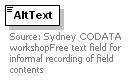 |
||
| type | AltText | ||
| annotation |
|
||
| source | <xs:element name="AltText" type="AltText"> <xs:annotation> <xs:documentation>Source: Sydney CODATA workshopFree text field for informal recording of field contents</xs:documentation> </xs:annotation> </xs:element> |
| diagram |  |
||||||||||||
| type | extension of xs:string | ||||||||||||
| used by |
|
||||||||||||
| attributes |
|
||||||||||||
| source | <xs:complexType name="DurationType"> <xs:simpleContent> <xs:extension base="xs:string"> <xs:attribute name="measurementUnits" type="xs:string"/> </xs:extension> </xs:simpleContent> </xs:complexType> |
| diagram |  |
||||||||||||
| type | extension of xs:string | ||||||||||||
| used by |
|
||||||||||||
| attributes |
|
||||||||||||
| source | <xs:complexType name="HigherTaxonType"> <xs:simpleContent> <xs:extension base="xs:string"> <xs:attribute name="TaxonRank" type="xs:string"/> </xs:extension> </xs:simpleContent> </xs:complexType> |
| diagram | 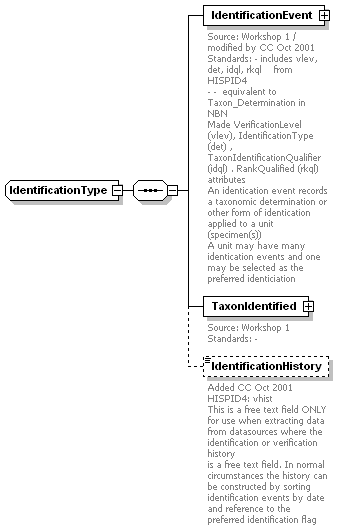 |
||||||||||||
| children | IdentificationEvent TaxonIdentified IdentificationHistory | ||||||||||||
| used by |
|
||||||||||||
| attributes |
|
||||||||||||
| source | <xs:complexType name="IdentificationType"> <xs:sequence> <xs:element name="IdentificationEvent"> <xs:annotation> <xs:documentation>Source: Workshop 1 / modified by CC Oct 2001 Standards: - includes vlev, det, idql, rkql from HISPID4 - - equivalent to Taxon_Determination in NBN Made VerificationLevel (vlev), IdentificationType (det) , TaxonIdentificationQualifier (idql) . RankQualified (rkql) attributes An identication event records a taxonomic determination or other form of identication applied to a unit (specimen(s)) A unit may have many identication events and one may be selected as the preferred identiciation</xs:documentation> </xs:annotation> <xs:complexType> <xs:sequence> <xs:element name="Indentifier" maxOccurs="unbounded"> <xs:annotation> <xs:documentation>Source: Workshop 1/ modified by CC Oct 2001 Standards: - HISPID4: vnam / NBN determiner Person or persons determining, confirming or denying the identity of a unit in an identification event. would be improved as a composite element to allow details of institutional affiliation etc.</xs:documentation> </xs:annotation> <xs:complexType> <xs:sequence> <xs:element name="name_ID" type="name_ID" minOccurs="0"/> <xs:choice> <xs:element name="AltText" type="AltText"> <xs:annotation> <xs:documentation>Source: Sydney CODATA workshopFree text field for informal recording of field contents</xs:documentation> </xs:annotation> </xs:element> <xs:element name="PersonName" type="PersonNameType"> <xs:annotation> <xs:documentation>Source: Workshop 1/ changed by CC from old Name Element Standards: - Group element for parts of a personal name - see also name_ID (ref to a database entry) and fullName (free text format)</xs:documentation> </xs:annotation> </xs:element> <xs:element name="Organisation" type="OrganisationType"> <xs:annotation> <xs:documentation>Added by CC Oct 2001Name (elements) for organisations</xs:documentation> </xs:annotation> </xs:element> </xs:choice> </xs:sequence> </xs:complexType> </xs:element> <xs:element name="IdentificationReference" minOccurs="0" maxOccurs="unbounded"> <xs:annotation> <xs:documentation>Source: Workshop 1 Standards: - HISPID4: vlit / NBN: Source</xs:documentation> </xs:annotation> <xs:complexType> <xs:choice> <xs:element name="AltText" type="AltText"> <xs:annotation> <xs:documentation>Source: Sydney CODATA workshopFree text field for informal recording of field contents</xs:documentation> </xs:annotation> </xs:element> <xs:element name="Source" type="SourceType"> <xs:annotation> <xs:documentation>Added CC Oct 2001 NBN: Source Marker element for a link to a source module for dealing with structured literature and document rexcords</xs:documentation> </xs:annotation> </xs:element> </xs:choice> </xs:complexType> </xs:element> <xs:element name="IdentificationDate"> <xs:annotation> <xs:documentation>Source: Workshop 1 Standards: - - - includes HISPID4 : vdat and texvdat / NBN determination_date (vague date ) May need to use a vague date structure (e.g. begin,end,type)</xs:documentation> </xs:annotation> <xs:complexType> <xs:choice> <xs:element name="Date" type="DateType"> <xs:annotation> <xs:documentation>Added CC Oct 2001 NBN: vaguedatestart, vaguedateend and vaguedatetype Date has a three part structure - two elements and an attribute VagueDateBegin = First date of a range or date for a single date VagueDateEnd = last date in a range DateType attribute can be enumerated to allow for various date formats (e.g. dd/mm/yyyy or to allow a parser to interpret terms such as summer 69 or 1974 etc) Note terms such as summer would be interpretted by standard begin and end dates.</xs:documentation> </xs:annotation> </xs:element> <xs:element name="AltText" type="AltText"> <xs:annotation> <xs:documentation>Source: Sydney CODATA workshopFree text field for informal recording of field contents</xs:documentation> </xs:annotation> </xs:element> </xs:choice> </xs:complexType> </xs:element> <xs:element name="IdentificationNotes" type="xs:string" minOccurs="0"> <xs:annotation> <xs:documentation>Source: Workshop 1 Standards: - HISPID4: idcom / NBN: Comme</xs:documentation> </xs:annotation> </xs:element> <xs:element name="IdentificationFoundIn" minOccurs="0"> <xs:annotation> <xs:documentation>Source: Workshop 1 Standards: - </xs:documentation> </xs:annotation> <xs:complexType> <xs:choice> <xs:element name="AltText" type="AltText"> <xs:annotation> <xs:documentation>Source: Sydney CODATA workshopFree text field for informal recording of field contents</xs:documentation> </xs:annotation> </xs:element> <xs:element name="Source" type="SourceType"> <xs:annotation> <xs:documentation>Added CC Oct 2001 NBN: Source Marker element for a link to a source module for dealing with structured literature and document rexcords</xs:documentation> </xs:annotation> </xs:element> </xs:choice> </xs:complexType> </xs:element> <xs:element name="NameAddendum" type="xs:string" minOccurs="0"> <xs:annotation> <xs:documentation>Source: Workshop 1 Standards: -</xs:documentation> </xs:annotation> </xs:element> </xs:sequence> <xs:attribute name="VerificationLevel"> <xs:simpleType> <xs:restriction base="xs:NMTOKEN"> <xs:enumeration value="0"/> <xs:enumeration value="1"/> <xs:enumeration value="2"/> <xs:enumeration value="3"/> <xs:enumeration value="4"/> </xs:restriction> </xs:simpleType> </xs:attribute> <xs:attribute name="IdentificationType" use="required"> <xs:simpleType> <xs:restriction base="xs:NMTOKEN"> <xs:enumeration value="det."/> <xs:enumeration value="conf."/> <xs:enumeration value="cit."/> <xs:enumeration value="scrips."/> <xs:enumeration value="vid."/> </xs:restriction> </xs:simpleType> </xs:attribute> <xs:attribute name="TaxonIdentificationQualifier"> <xs:simpleType> <xs:restriction base="xs:NMTOKEN"> <xs:enumeration value="aff."/> <xs:enumeration value="cf."/> <xs:enumeration value="Incorrect"/> <xs:enumeration value="forsan"/> <xs:enumeration value="near"/> <xs:enumeration value="Questionable"/> </xs:restriction> </xs:simpleType> </xs:attribute> <xs:attribute name="RankQualified"> <xs:simpleType> <xs:restriction base="xs:NMTOKEN"> <xs:enumeration value="B"/> <xs:enumeration value="F"/> <xs:enumeration value="G"/> <xs:enumeration value="S"/> <xs:enumeration value="I"/> <xs:enumeration value="J"/> <xs:enumeration value="C"/> </xs:restriction> </xs:simpleType> </xs:attribute> </xs:complexType> </xs:element> <xs:element name="TaxonIdentified" type="TaxonIdentifiedType"> <xs:annotation> <xs:documentation>Source: Workshop 1 Standards: -</xs:documentation> </xs:annotation> </xs:element> <xs:element name="IdentificationHistory" type="xs:string" minOccurs="0"> <xs:annotation> <xs:documentation>Added CC Oct 2001 HISPID4: vhist This is a free text field ONLY for use when extracting data from datasources where the identification or verification history is a free text field. In normal circumstances the history can be constructed by sorting identification events by date and reference to the preferred identification flag</xs:documentation> </xs:annotation> </xs:element> </xs:sequence> <xs:attribute name="PreferredIdentificationFlag" use="required"> <xs:simpleType> <xs:restriction base="xs:NMTOKEN"> <xs:enumeration value="Yes"/> <xs:enumeration value="No"/> </xs:restriction> </xs:simpleType> </xs:attribute> </xs:complexType> |
| diagram | 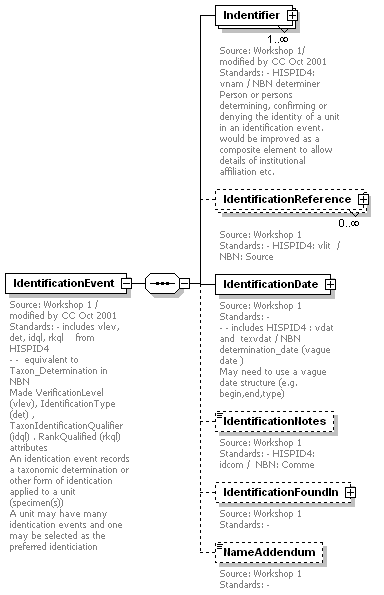 |
||||||||||||||||||||||||||||||
| children | Indentifier IdentificationReference IdentificationDate IdentificationNotes IdentificationFoundIn NameAddendum | ||||||||||||||||||||||||||||||
| attributes |
|
||||||||||||||||||||||||||||||
| annotation |
|
||||||||||||||||||||||||||||||
| source | <xs:element name="IdentificationEvent"> <xs:annotation> <xs:documentation>Source: Workshop 1 / modified by CC Oct 2001 Standards: - includes vlev, det, idql, rkql from HISPID4 - - equivalent to Taxon_Determination in NBN Made VerificationLevel (vlev), IdentificationType (det) , TaxonIdentificationQualifier (idql) . RankQualified (rkql) attributes An identication event records a taxonomic determination or other form of identication applied to a unit (specimen(s)) A unit may have many identication events and one may be selected as the preferred identiciation</xs:documentation> </xs:annotation> <xs:complexType> <xs:sequence> <xs:element name="Indentifier" maxOccurs="unbounded"> <xs:annotation> <xs:documentation>Source: Workshop 1/ modified by CC Oct 2001 Standards: - HISPID4: vnam / NBN determiner Person or persons determining, confirming or denying the identity of a unit in an identification event. would be improved as a composite element to allow details of institutional affiliation etc.</xs:documentation> </xs:annotation> <xs:complexType> <xs:sequence> <xs:element name="name_ID" type="name_ID" minOccurs="0"/> <xs:choice> <xs:element name="AltText" type="AltText"> <xs:annotation> <xs:documentation>Source: Sydney CODATA workshopFree text field for informal recording of field contents</xs:documentation> </xs:annotation> </xs:element> <xs:element name="PersonName" type="PersonNameType"> <xs:annotation> <xs:documentation>Source: Workshop 1/ changed by CC from old Name Element Standards: - Group element for parts of a personal name - see also name_ID (ref to a database entry) and fullName (free text format)</xs:documentation> </xs:annotation> </xs:element> <xs:element name="Organisation" type="OrganisationType"> <xs:annotation> <xs:documentation>Added by CC Oct 2001Name (elements) for organisations</xs:documentation> </xs:annotation> </xs:element> </xs:choice> </xs:sequence> </xs:complexType> </xs:element> <xs:element name="IdentificationReference" minOccurs="0" maxOccurs="unbounded"> <xs:annotation> <xs:documentation>Source: Workshop 1 Standards: - HISPID4: vlit / NBN: Source</xs:documentation> </xs:annotation> <xs:complexType> <xs:choice> <xs:element name="AltText" type="AltText"> <xs:annotation> <xs:documentation>Source: Sydney CODATA workshopFree text field for informal recording of field contents</xs:documentation> </xs:annotation> </xs:element> <xs:element name="Source" type="SourceType"> <xs:annotation> <xs:documentation>Added CC Oct 2001 NBN: Source Marker element for a link to a source module for dealing with structured literature and document rexcords</xs:documentation> </xs:annotation> </xs:element> </xs:choice> </xs:complexType> </xs:element> <xs:element name="IdentificationDate"> <xs:annotation> <xs:documentation>Source: Workshop 1 Standards: - - - includes HISPID4 : vdat and texvdat / NBN determination_date (vague date ) May need to use a vague date structure (e.g. begin,end,type)</xs:documentation> </xs:annotation> <xs:complexType> <xs:choice> <xs:element name="Date" type="DateType"> <xs:annotation> <xs:documentation>Added CC Oct 2001 NBN: vaguedatestart, vaguedateend and vaguedatetype Date has a three part structure - two elements and an attribute VagueDateBegin = First date of a range or date for a single date VagueDateEnd = last date in a range DateType attribute can be enumerated to allow for various date formats (e.g. dd/mm/yyyy or to allow a parser to interpret terms such as summer 69 or 1974 etc) Note terms such as summer would be interpretted by standard begin and end dates.</xs:documentation> </xs:annotation> </xs:element> <xs:element name="AltText" type="AltText"> <xs:annotation> <xs:documentation>Source: Sydney CODATA workshopFree text field for informal recording of field contents</xs:documentation> </xs:annotation> </xs:element> </xs:choice> </xs:complexType> </xs:element> <xs:element name="IdentificationNotes" type="xs:string" minOccurs="0"> <xs:annotation> <xs:documentation>Source: Workshop 1 Standards: - HISPID4: idcom / NBN: Comme</xs:documentation> </xs:annotation> </xs:element> <xs:element name="IdentificationFoundIn" minOccurs="0"> <xs:annotation> <xs:documentation>Source: Workshop 1 Standards: - </xs:documentation> </xs:annotation> <xs:complexType> <xs:choice> <xs:element name="AltText" type="AltText"> <xs:annotation> <xs:documentation>Source: Sydney CODATA workshopFree text field for informal recording of field contents</xs:documentation> </xs:annotation> </xs:element> <xs:element name="Source" type="SourceType"> <xs:annotation> <xs:documentation>Added CC Oct 2001 NBN: Source Marker element for a link to a source module for dealing with structured literature and document rexcords</xs:documentation> </xs:annotation> </xs:element> </xs:choice> </xs:complexType> </xs:element> <xs:element name="NameAddendum" type="xs:string" minOccurs="0"> <xs:annotation> <xs:documentation>Source: Workshop 1 Standards: -</xs:documentation> </xs:annotation> </xs:element> </xs:sequence> <xs:attribute name="VerificationLevel"> <xs:simpleType> <xs:restriction base="xs:NMTOKEN"> <xs:enumeration value="0"/> <xs:enumeration value="1"/> <xs:enumeration value="2"/> <xs:enumeration value="3"/> <xs:enumeration value="4"/> </xs:restriction> </xs:simpleType> </xs:attribute> <xs:attribute name="IdentificationType" use="required"> <xs:simpleType> <xs:restriction base="xs:NMTOKEN"> <xs:enumeration value="det."/> <xs:enumeration value="conf."/> <xs:enumeration value="cit."/> <xs:enumeration value="scrips."/> <xs:enumeration value="vid."/> </xs:restriction> </xs:simpleType> </xs:attribute> <xs:attribute name="TaxonIdentificationQualifier"> <xs:simpleType> <xs:restriction base="xs:NMTOKEN"> <xs:enumeration value="aff."/> <xs:enumeration value="cf."/> <xs:enumeration value="Incorrect"/> <xs:enumeration value="forsan"/> <xs:enumeration value="near"/> <xs:enumeration value="Questionable"/> </xs:restriction> </xs:simpleType> </xs:attribute> <xs:attribute name="RankQualified"> <xs:simpleType> <xs:restriction base="xs:NMTOKEN"> <xs:enumeration value="B"/> <xs:enumeration value="F"/> <xs:enumeration value="G"/> <xs:enumeration value="S"/> <xs:enumeration value="I"/> <xs:enumeration value="J"/> <xs:enumeration value="C"/> </xs:restriction> </xs:simpleType> </xs:attribute> </xs:complexType> </xs:element> |
| diagram | 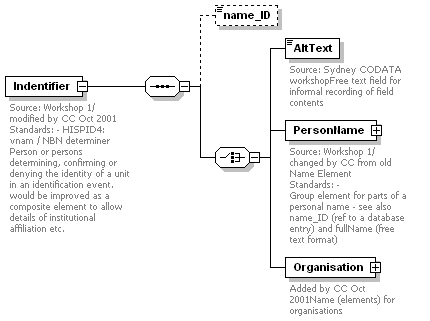 |
||
| children | name_ID AltText PersonName Organisation | ||
| annotation |
|
||
| source | <xs:element name="Indentifier" maxOccurs="unbounded"> <xs:annotation> <xs:documentation>Source: Workshop 1/ modified by CC Oct 2001 Standards: - HISPID4: vnam / NBN determiner Person or persons determining, confirming or denying the identity of a unit in an identification event. would be improved as a composite element to allow details of institutional affiliation etc.</xs:documentation> </xs:annotation> <xs:complexType> <xs:sequence> <xs:element name="name_ID" type="name_ID" minOccurs="0"/> <xs:choice> <xs:element name="AltText" type="AltText"> <xs:annotation> <xs:documentation>Source: Sydney CODATA workshopFree text field for informal recording of field contents</xs:documentation> </xs:annotation> </xs:element> <xs:element name="PersonName" type="PersonNameType"> <xs:annotation> <xs:documentation>Source: Workshop 1/ changed by CC from old Name Element Standards: - Group element for parts of a personal name - see also name_ID (ref to a database entry) and fullName (free text format)</xs:documentation> </xs:annotation> </xs:element> <xs:element name="Organisation" type="OrganisationType"> <xs:annotation> <xs:documentation>Added by CC Oct 2001Name (elements) for organisations</xs:documentation> </xs:annotation> </xs:element> </xs:choice> </xs:sequence> </xs:complexType> </xs:element> |
| diagram |  |
| type | name_ID |
| source | <xs:element name="name_ID" type="name_ID" minOccurs="0"/> |
| diagram | 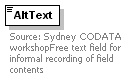 |
||
| type | AltText | ||
| annotation |
|
||
| source | <xs:element name="AltText" type="AltText"> <xs:annotation> <xs:documentation>Source: Sydney CODATA workshopFree text field for informal recording of field contents</xs:documentation> </xs:annotation> </xs:element> |
| diagram | 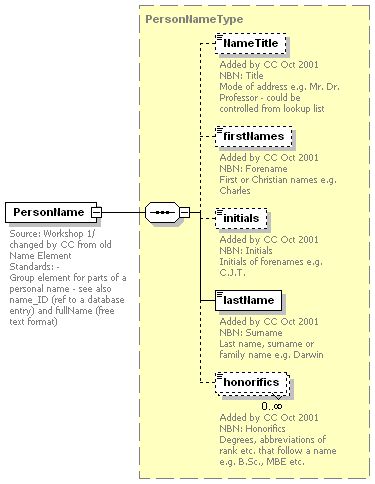 |
||
| type | PersonNameType | ||
| children | NameTitle firstNames initials lastName honorifics | ||
| annotation |
|
||
| source | <xs:element name="PersonName" type="PersonNameType"> <xs:annotation> <xs:documentation>Source: Workshop 1/ changed by CC from old Name Element Standards: - Group element for parts of a personal name - see also name_ID (ref to a database entry) and fullName (free text format)</xs:documentation> </xs:annotation> </xs:element> |
| diagram | 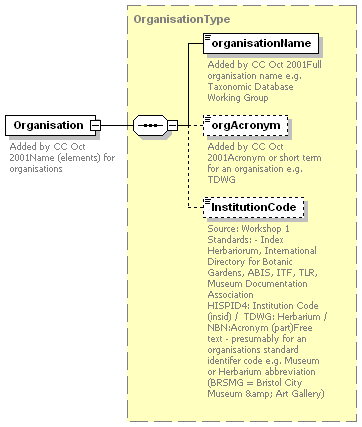 |
||
| type | OrganisationType | ||
| children | organisationName orgAcronym InstitutionCode | ||
| annotation |
|
||
| source | <xs:element name="Organisation" type="OrganisationType"> <xs:annotation> <xs:documentation>Added by CC Oct 2001Name (elements) for organisations</xs:documentation> </xs:annotation> </xs:element> |
| diagram | 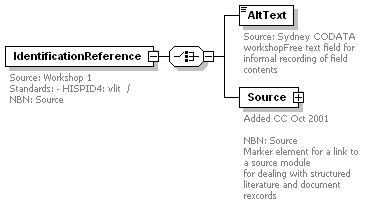 |
||
| children | AltText Source | ||
| annotation |
|
||
| source | <xs:element name="IdentificationReference" minOccurs="0" maxOccurs="unbounded"> <xs:annotation> <xs:documentation>Source: Workshop 1 Standards: - HISPID4: vlit / NBN: Source</xs:documentation> </xs:annotation> <xs:complexType> <xs:choice> <xs:element name="AltText" type="AltText"> <xs:annotation> <xs:documentation>Source: Sydney CODATA workshopFree text field for informal recording of field contents</xs:documentation> </xs:annotation> </xs:element> <xs:element name="Source" type="SourceType"> <xs:annotation> <xs:documentation>Added CC Oct 2001 NBN: Source Marker element for a link to a source module for dealing with structured literature and document rexcords</xs:documentation> </xs:annotation> </xs:element> </xs:choice> </xs:complexType> </xs:element> |
| diagram |  |
||
| type | AltText | ||
| annotation |
|
||
| source | <xs:element name="AltText" type="AltText"> <xs:annotation> <xs:documentation>Source: Sydney CODATA workshopFree text field for informal recording of field contents</xs:documentation> </xs:annotation> </xs:element> |
| diagram | 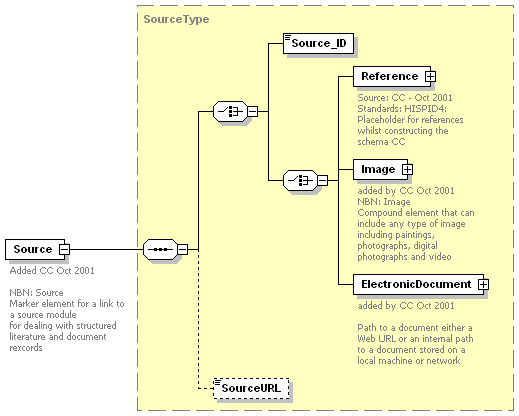 |
||||||||||||
| type | SourceType | ||||||||||||
| children | Source_ID Reference Image ElectronicDocument SourceURL | ||||||||||||
| attributes |
|
||||||||||||
| annotation |
|
||||||||||||
| source | <xs:element name="Source" type="SourceType"> <xs:annotation> <xs:documentation>Added CC Oct 2001 NBN: Source Marker element for a link to a source module for dealing with structured literature and document rexcords</xs:documentation> </xs:annotation> </xs:element> |
| diagram | 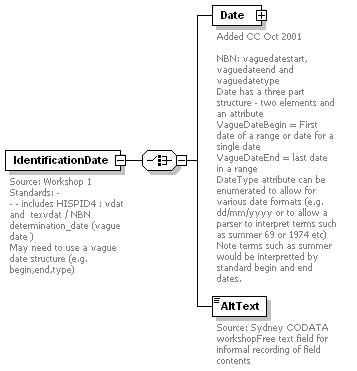 |
||
| children | Date AltText | ||
| annotation |
|
||
| source | <xs:element name="IdentificationDate"> <xs:annotation> <xs:documentation>Source: Workshop 1 Standards: - - - includes HISPID4 : vdat and texvdat / NBN determination_date (vague date ) May need to use a vague date structure (e.g. begin,end,type)</xs:documentation> </xs:annotation> <xs:complexType> <xs:choice> <xs:element name="Date" type="DateType"> <xs:annotation> <xs:documentation>Added CC Oct 2001 NBN: vaguedatestart, vaguedateend and vaguedatetype Date has a three part structure - two elements and an attribute VagueDateBegin = First date of a range or date for a single date VagueDateEnd = last date in a range DateType attribute can be enumerated to allow for various date formats (e.g. dd/mm/yyyy or to allow a parser to interpret terms such as summer 69 or 1974 etc) Note terms such as summer would be interpretted by standard begin and end dates.</xs:documentation> </xs:annotation> </xs:element> <xs:element name="AltText" type="AltText"> <xs:annotation> <xs:documentation>Source: Sydney CODATA workshopFree text field for informal recording of field contents</xs:documentation> </xs:annotation> </xs:element> </xs:choice> </xs:complexType> </xs:element> |
| diagram | 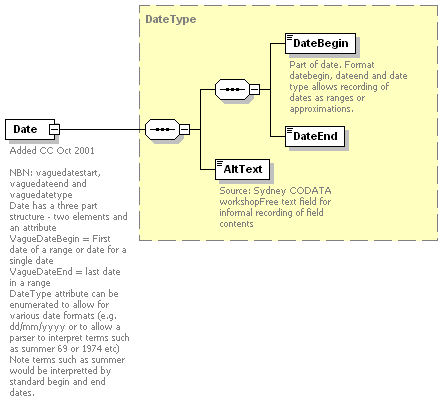 |
||||||||||||
| type | DateType | ||||||||||||
| children | DateBegin DateEnd AltText | ||||||||||||
| attributes |
|
||||||||||||
| annotation |
|
||||||||||||
| source | <xs:element name="Date" type="DateType"> <xs:annotation> <xs:documentation>Added CC Oct 2001 NBN: vaguedatestart, vaguedateend and vaguedatetype Date has a three part structure - two elements and an attribute VagueDateBegin = First date of a range or date for a single date VagueDateEnd = last date in a range DateType attribute can be enumerated to allow for various date formats (e.g. dd/mm/yyyy or to allow a parser to interpret terms such as summer 69 or 1974 etc) Note terms such as summer would be interpretted by standard begin and end dates.</xs:documentation> </xs:annotation> </xs:element> |
| diagram |  |
||
| type | AltText | ||
| annotation |
|
||
| source | <xs:element name="AltText" type="AltText"> <xs:annotation> <xs:documentation>Source: Sydney CODATA workshopFree text field for informal recording of field contents</xs:documentation> </xs:annotation> </xs:element> |
| diagram |  |
||
| type | xs:string | ||
| annotation |
|
||
| source | <xs:element name="IdentificationNotes" type="xs:string" minOccurs="0"> <xs:annotation> <xs:documentation>Source: Workshop 1 Standards: - HISPID4: idcom / NBN: Comme</xs:documentation> </xs:annotation> </xs:element> |
| diagram | 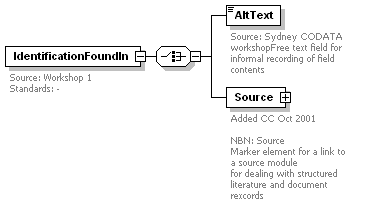 |
||
| children | AltText Source | ||
| annotation |
|
||
| source | <xs:element name="IdentificationFoundIn" minOccurs="0"> <xs:annotation> <xs:documentation>Source: Workshop 1 Standards: - </xs:documentation> </xs:annotation> <xs:complexType> <xs:choice> <xs:element name="AltText" type="AltText"> <xs:annotation> <xs:documentation>Source: Sydney CODATA workshopFree text field for informal recording of field contents</xs:documentation> </xs:annotation> </xs:element> <xs:element name="Source" type="SourceType"> <xs:annotation> <xs:documentation>Added CC Oct 2001 NBN: Source Marker element for a link to a source module for dealing with structured literature and document rexcords</xs:documentation> </xs:annotation> </xs:element> </xs:choice> </xs:complexType> </xs:element> |
| diagram |  |
||
| type | AltText | ||
| annotation |
|
||
| source | <xs:element name="AltText" type="AltText"> <xs:annotation> <xs:documentation>Source: Sydney CODATA workshopFree text field for informal recording of field contents</xs:documentation> </xs:annotation> </xs:element> |
| diagram | 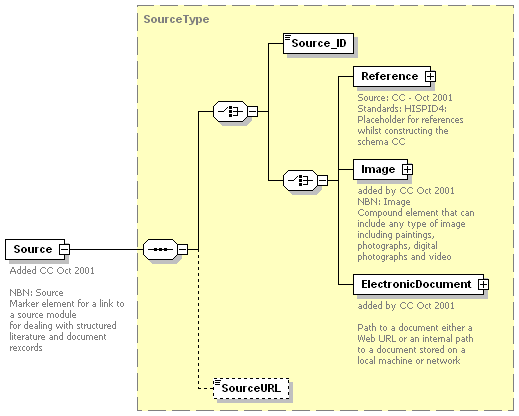 |
||||||||||||
| type | SourceType | ||||||||||||
| children | Source_ID Reference Image ElectronicDocument SourceURL | ||||||||||||
| attributes |
|
||||||||||||
| annotation |
|
||||||||||||
| source | <xs:element name="Source" type="SourceType"> <xs:annotation> <xs:documentation>Added CC Oct 2001 NBN: Source Marker element for a link to a source module for dealing with structured literature and document rexcords</xs:documentation> </xs:annotation> </xs:element> |
| diagram |  |
||
| type | xs:string | ||
| annotation |
|
||
| source | <xs:element name="NameAddendum" type="xs:string" minOccurs="0"> <xs:annotation> <xs:documentation>Source: Workshop 1 Standards: -</xs:documentation> </xs:annotation> </xs:element> |
| diagram | 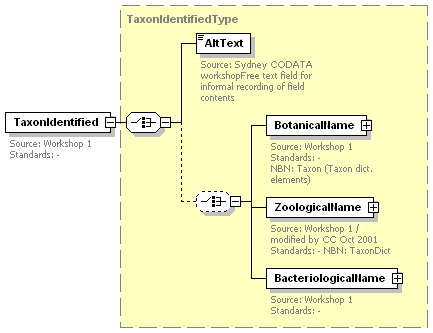 |
||||||||||||
| type | TaxonIdentifiedType | ||||||||||||
| children | AltText BotanicalName ZoologicalName BacteriologicalName | ||||||||||||
| attributes |
|
||||||||||||
| annotation |
|
||||||||||||
| source | <xs:element name="TaxonIdentified" type="TaxonIdentifiedType"> <xs:annotation> <xs:documentation>Source: Workshop 1 Standards: -</xs:documentation> </xs:annotation> </xs:element> |
| diagram | 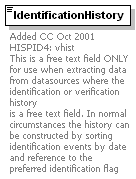 |
||
| type | xs:string | ||
| annotation |
|
||
| source | <xs:element name="IdentificationHistory" type="xs:string" minOccurs="0"> <xs:annotation> <xs:documentation>Added CC Oct 2001 HISPID4: vhist This is a free text field ONLY for use when extracting data from datasources where the identification or verification history is a free text field. In normal circumstances the history can be constructed by sorting identification events by date and reference to the preferred identification flag</xs:documentation> </xs:annotation> </xs:element> |
| diagram | 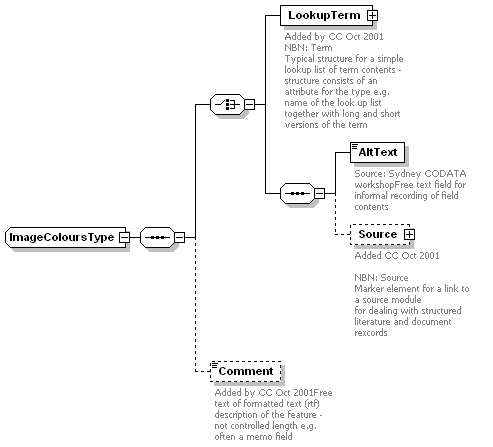 |
||
| children | LookupTerm AltText Source Comment | ||
| used by |
|
||
| source | <xs:complexType name="ImageColoursType"> <xs:sequence> <xs:choice> <xs:element name="LookupTerm" type="LookupTermType"> <xs:annotation> <xs:documentation>Added by CC Oct 2001 NBN: Term Typical structure for a simple lookup list of term contents - structure consists of an attribute for the type e.g. name of the look up list together with long and short versions of the term</xs:documentation> </xs:annotation> </xs:element> <xs:sequence> <xs:element name="AltText" type="AltText"> <xs:annotation> <xs:documentation>Source: Sydney CODATA workshopFree text field for informal recording of field contents</xs:documentation> </xs:annotation> </xs:element> <xs:element name="Source" type="SourceType" minOccurs="0"> <xs:annotation> <xs:documentation>Added CC Oct 2001 NBN: Source Marker element for a link to a source module for dealing with structured literature and document rexcords </xs:documentation> </xs:annotation> </xs:element> </xs:sequence> </xs:choice> <xs:element name="Comment" type="Comment" minOccurs="0"> <xs:annotation> <xs:documentation>Added by CC Oct 2001Free text of formatted text (rtf) description of the feature - not controlled length e.g. often a memo field</xs:documentation> </xs:annotation> </xs:element> </xs:sequence> </xs:complexType> |
| diagram | 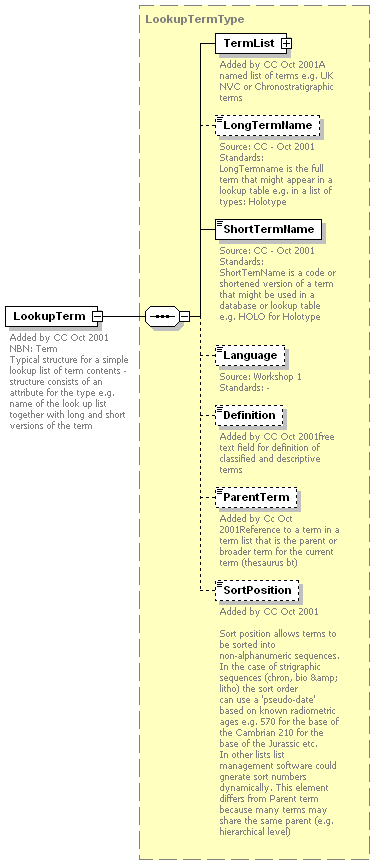 |
||||||||||||||||||
| type | LookupTermType | ||||||||||||||||||
| children | TermList LongTermName ShortTermName Language Definition ParentTerm SortPosition | ||||||||||||||||||
| attributes |
|
||||||||||||||||||
| annotation |
|
||||||||||||||||||
| source | <xs:element name="LookupTerm" type="LookupTermType"> <xs:annotation> <xs:documentation>Added by CC Oct 2001 NBN: Term Typical structure for a simple lookup list of term contents - structure consists of an attribute for the type e.g. name of the look up list together with long and short versions of the term</xs:documentation> </xs:annotation> </xs:element> |
| diagram |  |
||
| type | AltText | ||
| annotation |
|
||
| source | <xs:element name="AltText" type="AltText"> <xs:annotation> <xs:documentation>Source: Sydney CODATA workshopFree text field for informal recording of field contents</xs:documentation> </xs:annotation> </xs:element> |
| diagram | 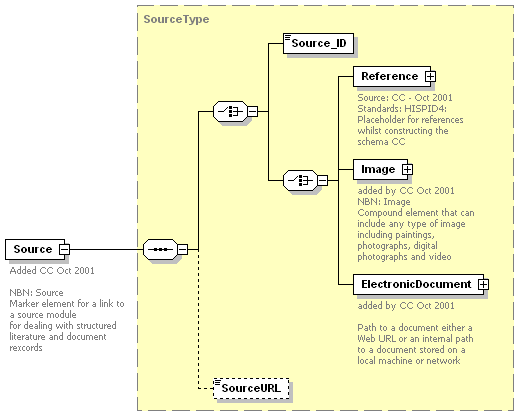 |
||||||||||||
| type | SourceType | ||||||||||||
| children | Source_ID Reference Image ElectronicDocument SourceURL | ||||||||||||
| attributes |
|
||||||||||||
| annotation |
|
||||||||||||
| source | <xs:element name="Source" type="SourceType" minOccurs="0"> <xs:annotation> <xs:documentation>Added CC Oct 2001 NBN: Source Marker element for a link to a source module for dealing with structured literature and document rexcords </xs:documentation> </xs:annotation> </xs:element> |
| diagram |  |
||
| type | Comment | ||
| annotation |
|
||
| source | <xs:element name="Comment" type="Comment" minOccurs="0"> <xs:annotation> <xs:documentation>Added by CC Oct 2001Free text of formatted text (rtf) description of the feature - not controlled length e.g. often a memo field</xs:documentation> </xs:annotation> </xs:element> |
| diagram | 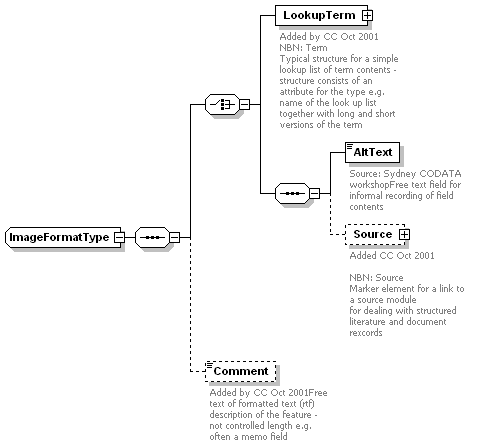 |
||
| children | LookupTerm AltText Source Comment | ||
| used by |
|
||
| source | <xs:complexType name="ImageFormatType"> <xs:sequence> <xs:choice> <xs:element name="LookupTerm" type="LookupTermType"> <xs:annotation> <xs:documentation>Added by CC Oct 2001 NBN: Term Typical structure for a simple lookup list of term contents - structure consists of an attribute for the type e.g. name of the look up list together with long and short versions of the term</xs:documentation> </xs:annotation> </xs:element> <xs:sequence> <xs:element name="AltText" type="AltText"> <xs:annotation> <xs:documentation>Source: Sydney CODATA workshopFree text field for informal recording of field contents</xs:documentation> </xs:annotation> </xs:element> <xs:element name="Source" type="SourceType" minOccurs="0"> <xs:annotation> <xs:documentation>Added CC Oct 2001 NBN: Source Marker element for a link to a source module for dealing with structured literature and document rexcords </xs:documentation> </xs:annotation> </xs:element> </xs:sequence> </xs:choice> <xs:element name="Comment" type="Comment" minOccurs="0"> <xs:annotation> <xs:documentation>Added by CC Oct 2001Free text of formatted text (rtf) description of the feature - not controlled length e.g. often a memo field</xs:documentation> </xs:annotation> </xs:element> </xs:sequence> </xs:complexType> |
| diagram | 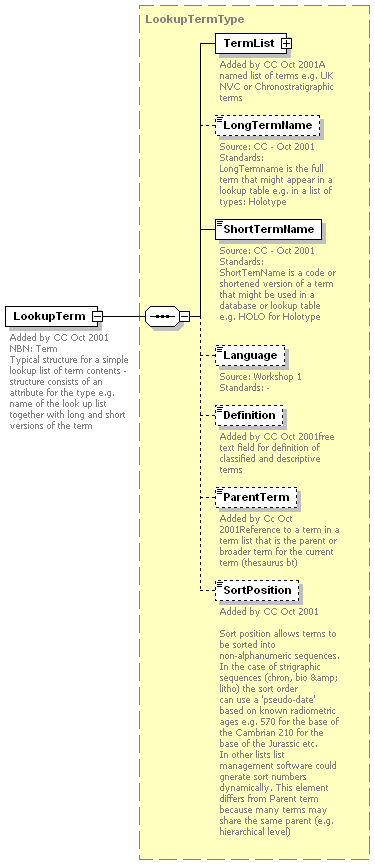 |
||||||||||||||||||
| type | LookupTermType | ||||||||||||||||||
| children | TermList LongTermName ShortTermName Language Definition ParentTerm SortPosition | ||||||||||||||||||
| attributes |
|
||||||||||||||||||
| annotation |
|
||||||||||||||||||
| source | <xs:element name="LookupTerm" type="LookupTermType"> <xs:annotation> <xs:documentation>Added by CC Oct 2001 NBN: Term Typical structure for a simple lookup list of term contents - structure consists of an attribute for the type e.g. name of the look up list together with long and short versions of the term</xs:documentation> </xs:annotation> </xs:element> |
| diagram |  |
||
| type | AltText | ||
| annotation |
|
||
| source | <xs:element name="AltText" type="AltText"> <xs:annotation> <xs:documentation>Source: Sydney CODATA workshopFree text field for informal recording of field contents</xs:documentation> </xs:annotation> </xs:element> |
| diagram | 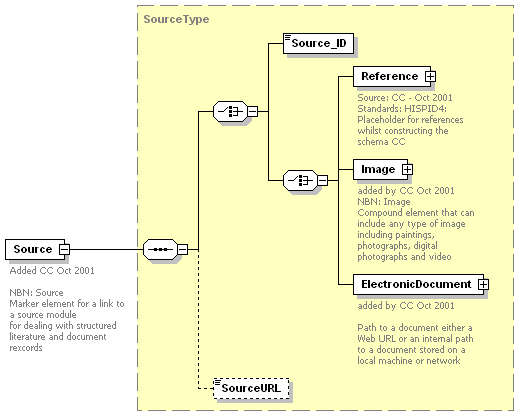 |
||||||||||||
| type | SourceType | ||||||||||||
| children | Source_ID Reference Image ElectronicDocument SourceURL | ||||||||||||
| attributes |
|
||||||||||||
| annotation |
|
||||||||||||
| source | <xs:element name="Source" type="SourceType" minOccurs="0"> <xs:annotation> <xs:documentation>Added CC Oct 2001 NBN: Source Marker element for a link to a source module for dealing with structured literature and document rexcords </xs:documentation> </xs:annotation> </xs:element> |
| diagram |  |
||
| type | Comment | ||
| annotation |
|
||
| source | <xs:element name="Comment" type="Comment" minOccurs="0"> <xs:annotation> <xs:documentation>Added by CC Oct 2001Free text of formatted text (rtf) description of the feature - not controlled length e.g. often a memo field</xs:documentation> </xs:annotation> </xs:element> |
| diagram | 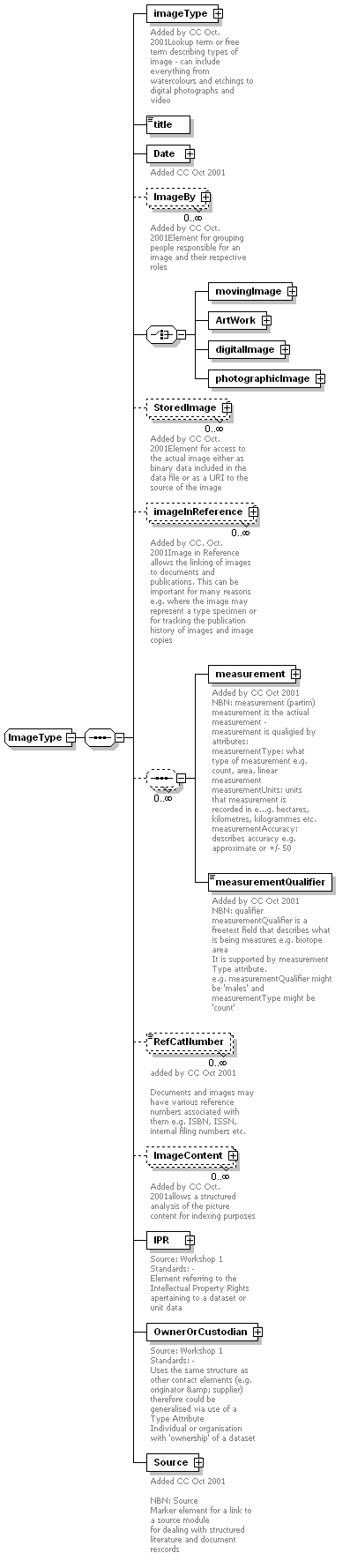 |
||||||||||||
| children | imageType title Date ImageBy movingImage ArtWork digitalImage photographicImage StoredImage imageInReference measurement measurementQualifier RefCatNumber ImageContent IPR OwnerOrCustodian Source | ||||||||||||
| used by |
|
||||||||||||
| attributes |
|
||||||||||||
| source | <xs:complexType name="ImageType"> <xs:sequence> <xs:element name="imageType"> <xs:annotation> <xs:documentation>Added by CC Oct. 2001Lookup term or free term describing types of image - can include everything from watercolours and etchings to digital photographs and video</xs:documentation> </xs:annotation> <xs:complexType> <xs:sequence> <xs:choice> <xs:element name="LookupTerm" type="LookupTermType"> <xs:annotation> <xs:documentation>Added by CC Oct 2001 NBN: Term Typical structure for a simple lookup list of term contents - structure consists of an attribute for the type e.g. name of the look up list together with long and short versions of the term</xs:documentation> </xs:annotation> </xs:element> <xs:sequence> <xs:element name="AltText" type="AltText"> <xs:annotation> <xs:documentation>Source: Sydney CODATA workshopFree text field for informal recording of field contents</xs:documentation> </xs:annotation> </xs:element> <xs:element name="Source" type="SourceType" minOccurs="0"> <xs:annotation> <xs:documentation>Added CC Oct 2001 NBN: Source Marker element for a link to a source module for dealing with structured literature and document rexcords </xs:documentation> </xs:annotation> </xs:element> </xs:sequence> </xs:choice> <xs:element name="Comment" type="Comment" minOccurs="0"> <xs:annotation> <xs:documentation>Added by CC Oct 2001Free text of formatted text (rtf) description of the feature - not controlled length e.g. often a memo field</xs:documentation> </xs:annotation> </xs:element> </xs:sequence> </xs:complexType> </xs:element> <xs:element name="title" type="title"/> <xs:element name="Date" type="DateType"> <xs:annotation> <xs:documentation>Added CC Oct 2001</xs:documentation> </xs:annotation> </xs:element> <xs:element name="ImageBy" minOccurs="0" maxOccurs="unbounded"> <xs:annotation> <xs:documentation>Added by CC Oct. 2001Element for grouping people responsible for an image and their respective roles</xs:documentation> </xs:annotation> <xs:complexType> <xs:sequence> <xs:element name="name_ID" type="name_ID" minOccurs="0"/> <xs:choice> <xs:element name="AltText" type="AltText"> <xs:annotation> <xs:documentation>Source: Sydney CODATA workshopFree text field for informal recording of field contents</xs:documentation> </xs:annotation> </xs:element> <xs:element name="PersonName" type="PersonNameType"> <xs:annotation> <xs:documentation>Source: Workshop 1/ changed by CC from old Name Element Standards: - Group element for parts of a personal name - see also name_ID (ref to a database entry) and fullName (free text format)</xs:documentation> </xs:annotation> </xs:element> <xs:element name="Organisation" type="OrganisationType"> <xs:annotation> <xs:documentation>Added by CC Oct 2001Name (elements) for organisations</xs:documentation> </xs:annotation> </xs:element> </xs:choice> <xs:element name="role" type="role" minOccurs="0"> <xs:annotation> <xs:documentation>Added by CC Oct 2001Role played by a person within the element context e.g. Recorder or Botanist in GatheringEvent, Photographer or artist in Image</xs:documentation> </xs:annotation> </xs:element> </xs:sequence> </xs:complexType> </xs:element> <xs:choice> <xs:element name="movingImage"> <xs:complexType> <xs:sequence> <xs:element name="ImageFormat" type="ImageFormatType"> <xs:annotation> <xs:documentation>Added by CC Oct. 2001Lookup term including Code for image format e.g. jpg, pcx, tif for digital images, 16mm, beta video, AVI, mpg for moving images transparency, print for photographs etc. </xs:documentation> </xs:annotation> </xs:element> <xs:element name="Duration" type="DurationType"> <xs:annotation> <xs:documentation>Source: Workshop 1/ modified by CC Oct 2001 Standards: - Taxon48: Duration measurement of time elapsed - decimal number</xs:documentation> </xs:annotation> </xs:element> <xs:element name="ImageColours" type="ImageColoursType"> <xs:annotation> <xs:documentation>Added by CC Oct. 2001Colour state of the image e.g. monochrome, 16 bit, 24 bit, technicolour etc.</xs:documentation> </xs:annotation> </xs:element> <xs:element name="Soundtrack" type="xs:string"> <xs:annotation> <xs:documentation>Added by CC Oct. 2001Soundtrack type e.g. Nicam Stereo, Dolby, mono etc.</xs:documentation> </xs:annotation> </xs:element> <xs:element name="NMedia" type="xs:string"> <xs:annotation> <xs:documentation>Added by CC Oct. 2001Number of media holding the moving image e.g. number of film reels or CDs</xs:documentation> </xs:annotation> </xs:element> </xs:sequence> </xs:complexType> </xs:element> <xs:element name="ArtWork"> <xs:complexType> <xs:sequence> <xs:element name="ImageFormat" type="ImageFormatType"> <xs:annotation> <xs:documentation>Added by CC Oct. 2001Lookup term including Code for image format e.g. jpg, pcx, tif for digital images, 16mm, beta video, AVI, mpg for moving images transparency, print for photographs etc. </xs:documentation> </xs:annotation> </xs:element> <xs:sequence minOccurs="0" maxOccurs="unbounded"> <xs:element name="material" type="xs:string"/> <xs:element name="Imagepart" type="xs:string"> <xs:annotation> <xs:documentation>Added by CC Oct. 2001part of the image made of the material involved (e.g. frame = wood)</xs:documentation> </xs:annotation> </xs:element> </xs:sequence> </xs:sequence> </xs:complexType> </xs:element> <xs:element name="digitalImage"> <xs:complexType> <xs:sequence> <xs:element name="ImageFileName" type="xs:string"/> <xs:element name="ImageFormat" type="ImageFormatType"> <xs:annotation> <xs:documentation>Added by CC Oct. 2001Lookup term including Code for image format e.g. jpg, pcx, tif for digital images, 16mm, beta video, AVI, mpg for moving images transparency, print for photographs etc. </xs:documentation> </xs:annotation> </xs:element> <xs:element name="NPixels" type="xs:string" minOccurs="0"> <xs:annotation> <xs:documentation>Added by CC Oct. 2001Image pixel resolution e.g. 640 x 480</xs:documentation> </xs:annotation> </xs:element> <xs:element name="ImageColours" type="ImageColoursType" minOccurs="0"> <xs:annotation> <xs:documentation>Added by CC Oct. 2001Colour state of the image e.g. monochrome, 16 bit, 24 bit, technicolour etc.</xs:documentation> </xs:annotation> </xs:element> <xs:element name="ImageFileSize" type="xs:string"> <xs:annotation> <xs:documentation>Added by CC Oct. 2001size of the stored image - usually a number with unit as an attribute e.g. megaBytes</xs:documentation> </xs:annotation> </xs:element> </xs:sequence> </xs:complexType> </xs:element> <xs:element name="photographicImage"> <xs:complexType> <xs:sequence> <xs:element name="ImageFormat" type="ImageFormatType"> <xs:annotation> <xs:documentation>Added by CC Oct. 2001Lookup term including Code for image format e.g. jpg, pcx, tif for digital images, 16mm, beta video, AVI, mpg for moving images transparency, print for photographs etc. </xs:documentation> </xs:annotation> </xs:element> <xs:element name="PhotoProcess" type="xs:string"> <xs:annotation> <xs:documentation>Added by CC Oct. 2001</xs:documentation> </xs:annotation> </xs:element> </xs:sequence> </xs:complexType> </xs:element> </xs:choice> <xs:element name="StoredImage" minOccurs="0" maxOccurs="unbounded"> <xs:annotation> <xs:documentation>Added by CC Oct. 2001Element for access to the actual image either as binary data included in the data file or as a URI to the source of the image</xs:documentation> </xs:annotation> <xs:complexType> <xs:sequence> <xs:choice> <xs:element name="binaryImage"> <xs:annotation> <xs:documentation>Added by CC Oct. 2001Place holder for a binary image - nonparsed data External General Notation</xs:documentation> </xs:annotation> <xs:complexType> <xs:simpleContent> <xs:extension base="xs:string"> <xs:attribute name="e-dtype" type="xs:NMTOKEN" fixed="string"/> </xs:extension> </xs:simpleContent> </xs:complexType> </xs:element> <xs:element name="URI" type="URI"> <xs:annotation> <xs:documentation>added by CC Oct 2001 Universal Resource Identifier - Path to electronic source of document either internal or external (e.g. web address)</xs:documentation> </xs:annotation> </xs:element> </xs:choice> <xs:element name="ImageFormat" type="ImageFormatType"> <xs:annotation> <xs:documentation>Added by CC Oct. 2001Lookup term including Code for image format e.g. jpg, pcx, tif for digital images, 16mm, beta video, AVI, mpg for moving images transparency, print for photographs etc. </xs:documentation> </xs:annotation> </xs:element> <xs:element name="Comment" type="Comment"> <xs:annotation> <xs:documentation>Added by CC Oct 2001Free text of formatted text (rtf) description of the feature - not controlled length e.g. often a memo field</xs:documentation> </xs:annotation> </xs:element> </xs:sequence> </xs:complexType> </xs:element> <xs:element name="imageInReference" minOccurs="0" maxOccurs="unbounded"> <xs:annotation> <xs:documentation>Added by CC. Oct. 2001Image in Reference allows the linking of images to documents and publications. This can be important for many reasons e.g. where the image may represent a type specimen or for tracking the publication history of images and image copies </xs:documentation> </xs:annotation> <xs:complexType> <xs:sequence> <xs:element name="AltText" type="AltText" minOccurs="0"> <xs:annotation> <xs:documentation>Source: Sydney CODATA workshopFree text field for informal recording of field contents</xs:documentation> </xs:annotation> </xs:element> <xs:sequence> <xs:element name="ImageFormat" type="ImageFormatType"> <xs:annotation> <xs:documentation>Added by CC Oct. 2001Lookup term including Code for image format e.g. jpg, pcx, tif for digital images, 16mm, beta video, AVI, mpg for moving images transparency, print for photographs etc. </xs:documentation> </xs:annotation> </xs:element> <xs:element name="Reference" type="ReferenceType"> <xs:annotation> <xs:documentation>Source: CC - Oct 2001 Standards: HISPID4: Placeholder for references whilst constructing the schema CC</xs:documentation> </xs:annotation> </xs:element> <xs:element name="LocationInReference" minOccurs="0" maxOccurs="unbounded"> <xs:annotation> <xs:documentation>Added by CC Oct. 2001Element listing the place in reference that an image or images are located</xs:documentation> </xs:annotation> <xs:complexType> <xs:sequence> <xs:element name="ImagePageNumber" type="xs:string" minOccurs="0"> <xs:annotation> <xs:documentation>Added by CC Oct. 2001page number for the imaged specimen</xs:documentation> </xs:annotation> </xs:element> <xs:element name="ImagePlateNumber" type="xs:string" minOccurs="0"> <xs:annotation> <xs:documentation>Added by CC Oct. 2001Plate number for the imaged specimen</xs:documentation> </xs:annotation> </xs:element> <xs:element name="ImageFigureNumber" type="xs:string" minOccurs="0"> <xs:annotation> <xs:documentation>Added by CC Oct. 2001Figure number for the imaged specimen</xs:documentation> </xs:annotation> </xs:element> <xs:element name="Comment" type="Comment" minOccurs="0"> <xs:annotation> <xs:documentation>Added by CC Oct 2001Free text of formatted text (rtf) description of the feature - not controlled length e.g. often a memo field</xs:documentation> </xs:annotation> </xs:element> </xs:sequence> </xs:complexType> </xs:element> </xs:sequence> <xs:element name="Comment" type="Comment" minOccurs="0"> <xs:annotation> <xs:documentation>Added by CC Oct 2001Free text of formatted text (rtf) description of the feature - not controlled length e.g. often a memo field</xs:documentation> </xs:annotation> </xs:element> </xs:sequence> </xs:complexType> </xs:element> <xs:sequence minOccurs="0" maxOccurs="unbounded"> <xs:element name="measurement" type="measurementType"> <xs:annotation> <xs:documentation>Added by CC Oct 2001 NBN: measurement (partim) measurement is the actiual measurement - measurement is qualigied by attributes: measurementType: what type of measurement e.g. count, area, linear measurement measurementUnits: units that measurement is recorded in e...g. hectares, kilometres, kilogrammes etc. measurementAccuracy: describes accuracy e.g. approximate or +/- 50 </xs:documentation> </xs:annotation> </xs:element> <xs:element name="measurementQualifier" type="measurementQualifier"> <xs:annotation> <xs:documentation>Added by CC Oct 2001 NBN: qualifier measurementQualifier is a freetext field that describes what is being measures e.g. biotope area It is supported by measurement Type attribute. e.g. measurementQualifier might be 'males' and measurementType might be 'count' </xs:documentation> </xs:annotation> </xs:element> </xs:sequence> <xs:element name="RefCatNumber" type="RefCatNumberType" minOccurs="0" maxOccurs="unbounded"> <xs:annotation> <xs:documentation>added by CC Oct 2001 Documents and images may have various reference numbers associated with them e.g. ISBN, ISSN, internal filing numbers etc.</xs:documentation> </xs:annotation> </xs:element> <xs:element name="ImageContent" minOccurs="0" maxOccurs="unbounded"> <xs:annotation> <xs:documentation>Added by CC Oct. 2001allows a structured analysis of the picture content for indexing purposes</xs:documentation> </xs:annotation> <xs:complexType> <xs:sequence> <xs:choice> <xs:element name="LookupTerm" type="LookupTermType"> <xs:annotation> <xs:documentation>Added by CC Oct 2001 NBN: Term Typical structure for a simple lookup list of term contents - structure consists of an attribute for the type e.g. name of the look up list together with long and short versions of the term</xs:documentation> </xs:annotation> </xs:element> <xs:sequence> <xs:element name="AltText" type="AltText"> <xs:annotation> <xs:documentation>Source: Sydney CODATA workshopFree text field for informal recording of field contents</xs:documentation> </xs:annotation> </xs:element> <xs:element name="Source" type="SourceType" minOccurs="0"> <xs:annotation> <xs:documentation>Added CC Oct 2001 NBN: Source Marker element for a link to a source module for dealing with structured literature and document rexcords </xs:documentation> </xs:annotation> </xs:element> </xs:sequence> </xs:choice> <xs:element name="Comment" type="Comment" minOccurs="0"> <xs:annotation> <xs:documentation>Added by CC Oct 2001Free text of formatted text (rtf) description of the feature - not controlled length e.g. often a memo field</xs:documentation> </xs:annotation> </xs:element> </xs:sequence> </xs:complexType> </xs:element> <xs:element name="IPR" type="IPRType"> <xs:annotation> <xs:documentation>Source: Workshop 1 Standards: - Element referring to the Intellectual Property Rights apertaining to a dataset or unit data</xs:documentation> </xs:annotation> </xs:element> <xs:element name="OwnerOrCustodian" type="OwnerOrCustodianType"> <xs:annotation> <xs:documentation>Source: Workshop 1 Standards: - Uses the same structure as other contact elements (e.g. originator & supplier) therefore could be generalised via use of a Type Attribute Individual or organisation with 'ownership' of a dataset</xs:documentation> </xs:annotation> </xs:element> <xs:element name="Source" type="SourceType"> <xs:annotation> <xs:documentation>Added CC Oct 2001 NBN: Source Marker element for a link to a source module for dealing with structured literature and document rexcords </xs:documentation> </xs:annotation> </xs:element> </xs:sequence> <xs:attribute name="Original"> <xs:simpleType> <xs:restriction base="xs:NMTOKEN"> <xs:enumeration value="Yes"/> <xs:enumeration value="No"/> </xs:restriction> </xs:simpleType> </xs:attribute> </xs:complexType> |
| diagram | 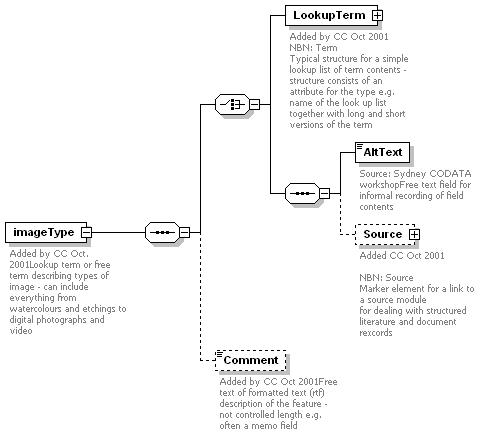 |
||
| children | LookupTerm AltText Source Comment | ||
| annotation |
|
||
| source | <xs:element name="imageType"> <xs:annotation> <xs:documentation>Added by CC Oct. 2001Lookup term or free term describing types of image - can include everything from watercolours and etchings to digital photographs and video</xs:documentation> </xs:annotation> <xs:complexType> <xs:sequence> <xs:choice> <xs:element name="LookupTerm" type="LookupTermType"> <xs:annotation> <xs:documentation>Added by CC Oct 2001 NBN: Term Typical structure for a simple lookup list of term contents - structure consists of an attribute for the type e.g. name of the look up list together with long and short versions of the term</xs:documentation> </xs:annotation> </xs:element> <xs:sequence> <xs:element name="AltText" type="AltText"> <xs:annotation> <xs:documentation>Source: Sydney CODATA workshopFree text field for informal recording of field contents</xs:documentation> </xs:annotation> </xs:element> <xs:element name="Source" type="SourceType" minOccurs="0"> <xs:annotation> <xs:documentation>Added CC Oct 2001 NBN: Source Marker element for a link to a source module for dealing with structured literature and document rexcords </xs:documentation> </xs:annotation> </xs:element> </xs:sequence> </xs:choice> <xs:element name="Comment" type="Comment" minOccurs="0"> <xs:annotation> <xs:documentation>Added by CC Oct 2001Free text of formatted text (rtf) description of the feature - not controlled length e.g. often a memo field</xs:documentation> </xs:annotation> </xs:element> </xs:sequence> </xs:complexType> </xs:element> |
| diagram | 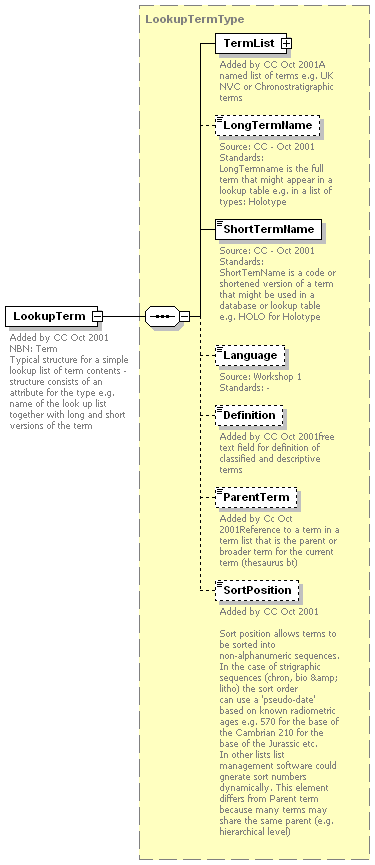 |
||||||||||||||||||
| type | LookupTermType | ||||||||||||||||||
| children | TermList LongTermName ShortTermName Language Definition ParentTerm SortPosition | ||||||||||||||||||
| attributes |
|
||||||||||||||||||
| annotation |
|
||||||||||||||||||
| source | <xs:element name="LookupTerm" type="LookupTermType"> <xs:annotation> <xs:documentation>Added by CC Oct 2001 NBN: Term Typical structure for a simple lookup list of term contents - structure consists of an attribute for the type e.g. name of the look up list together with long and short versions of the term</xs:documentation> </xs:annotation> </xs:element> |
| diagram |  |
||
| type | AltText | ||
| annotation |
|
||
| source | <xs:element name="AltText" type="AltText"> <xs:annotation> <xs:documentation>Source: Sydney CODATA workshopFree text field for informal recording of field contents</xs:documentation> </xs:annotation> </xs:element> |
| diagram | 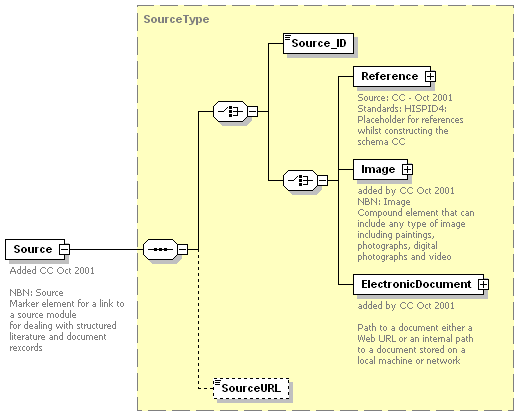 |
||||||||||||
| type | SourceType | ||||||||||||
| children | Source_ID Reference Image ElectronicDocument SourceURL | ||||||||||||
| attributes |
|
||||||||||||
| annotation |
|
||||||||||||
| source | <xs:element name="Source" type="SourceType" minOccurs="0"> <xs:annotation> <xs:documentation>Added CC Oct 2001 NBN: Source Marker element for a link to a source module for dealing with structured literature and document rexcords </xs:documentation> </xs:annotation> </xs:element> |
| diagram | 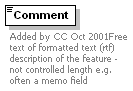 |
||
| type | Comment | ||
| annotation |
|
||
| source | <xs:element name="Comment" type="Comment" minOccurs="0"> <xs:annotation> <xs:documentation>Added by CC Oct 2001Free text of formatted text (rtf) description of the feature - not controlled length e.g. often a memo field</xs:documentation> </xs:annotation> </xs:element> |
| diagram |  |
| type | title |
| source | <xs:element name="title" type="title"/> |
| diagram | 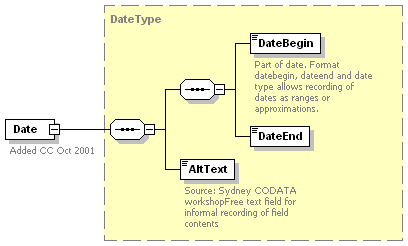 |
||||||||||||
| type | DateType | ||||||||||||
| children | DateBegin DateEnd AltText | ||||||||||||
| attributes |
|
||||||||||||
| annotation |
|
||||||||||||
| source | <xs:element name="Date" type="DateType"> <xs:annotation> <xs:documentation>Added CC Oct 2001</xs:documentation> </xs:annotation> </xs:element> |
| diagram | 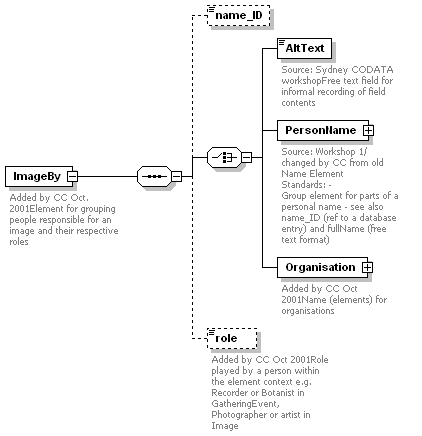 |
||
| children | name_ID AltText PersonName Organisation role | ||
| annotation |
|
||
| source | <xs:element name="ImageBy" minOccurs="0" maxOccurs="unbounded"> <xs:annotation> <xs:documentation>Added by CC Oct. 2001Element for grouping people responsible for an image and their respective roles</xs:documentation> </xs:annotation> <xs:complexType> <xs:sequence> <xs:element name="name_ID" type="name_ID" minOccurs="0"/> <xs:choice> <xs:element name="AltText" type="AltText"> <xs:annotation> <xs:documentation>Source: Sydney CODATA workshopFree text field for informal recording of field contents</xs:documentation> </xs:annotation> </xs:element> <xs:element name="PersonName" type="PersonNameType"> <xs:annotation> <xs:documentation>Source: Workshop 1/ changed by CC from old Name Element Standards: - Group element for parts of a personal name - see also name_ID (ref to a database entry) and fullName (free text format)</xs:documentation> </xs:annotation> </xs:element> <xs:element name="Organisation" type="OrganisationType"> <xs:annotation> <xs:documentation>Added by CC Oct 2001Name (elements) for organisations</xs:documentation> </xs:annotation> </xs:element> </xs:choice> <xs:element name="role" type="role" minOccurs="0"> <xs:annotation> <xs:documentation>Added by CC Oct 2001Role played by a person within the element context e.g. Recorder or Botanist in GatheringEvent, Photographer or artist in Image</xs:documentation> </xs:annotation> </xs:element> </xs:sequence> </xs:complexType> </xs:element> |
| diagram |  |
| type | name_ID |
| source | <xs:element name="name_ID" type="name_ID" minOccurs="0"/> |
| diagram |  |
||
| type | AltText | ||
| annotation |
|
||
| source | <xs:element name="AltText" type="AltText"> <xs:annotation> <xs:documentation>Source: Sydney CODATA workshopFree text field for informal recording of field contents</xs:documentation> </xs:annotation> </xs:element> |
| diagram | 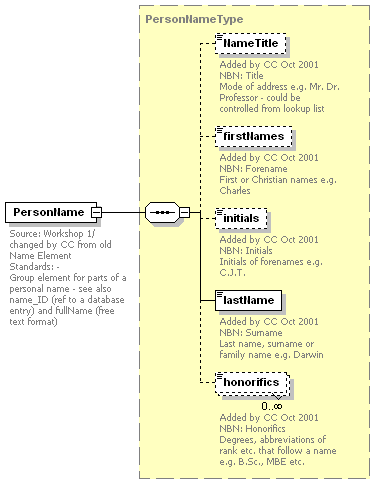 |
||
| type | PersonNameType | ||
| children | NameTitle firstNames initials lastName honorifics | ||
| annotation |
|
||
| source | <xs:element name="PersonName" type="PersonNameType"> <xs:annotation> <xs:documentation>Source: Workshop 1/ changed by CC from old Name Element Standards: - Group element for parts of a personal name - see also name_ID (ref to a database entry) and fullName (free text format)</xs:documentation> </xs:annotation> </xs:element> |
| diagram | 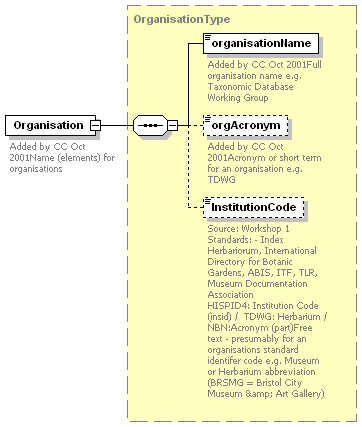 |
||
| type | OrganisationType | ||
| children | organisationName orgAcronym InstitutionCode | ||
| annotation |
|
||
| source | <xs:element name="Organisation" type="OrganisationType"> <xs:annotation> <xs:documentation>Added by CC Oct 2001Name (elements) for organisations</xs:documentation> </xs:annotation> </xs:element> |
| diagram |  |
||
| type | role | ||
| annotation |
|
||
| source | <xs:element name="role" type="role" minOccurs="0"> <xs:annotation> <xs:documentation>Added by CC Oct 2001Role played by a person within the element context e.g. Recorder or Botanist in GatheringEvent, Photographer or artist in Image</xs:documentation> </xs:annotation> </xs:element> |
| diagram | 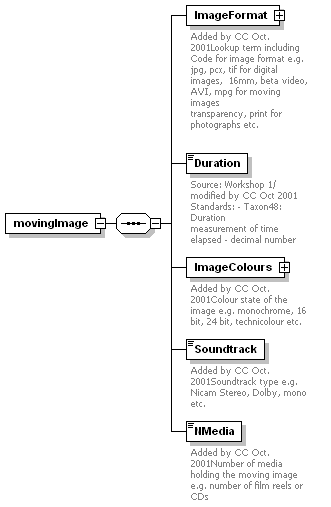 |
| children | ImageFormat Duration ImageColours Soundtrack NMedia |
| source | <xs:element name="movingImage"> <xs:complexType> <xs:sequence> <xs:element name="ImageFormat" type="ImageFormatType"> <xs:annotation> <xs:documentation>Added by CC Oct. 2001Lookup term including Code for image format e.g. jpg, pcx, tif for digital images, 16mm, beta video, AVI, mpg for moving images transparency, print for photographs etc. </xs:documentation> </xs:annotation> </xs:element> <xs:element name="Duration" type="DurationType"> <xs:annotation> <xs:documentation>Source: Workshop 1/ modified by CC Oct 2001 Standards: - Taxon48: Duration measurement of time elapsed - decimal number</xs:documentation> </xs:annotation> </xs:element> <xs:element name="ImageColours" type="ImageColoursType"> <xs:annotation> <xs:documentation>Added by CC Oct. 2001Colour state of the image e.g. monochrome, 16 bit, 24 bit, technicolour etc.</xs:documentation> </xs:annotation> </xs:element> <xs:element name="Soundtrack" type="xs:string"> <xs:annotation> <xs:documentation>Added by CC Oct. 2001Soundtrack type e.g. Nicam Stereo, Dolby, mono etc.</xs:documentation> </xs:annotation> </xs:element> <xs:element name="NMedia" type="xs:string"> <xs:annotation> <xs:documentation>Added by CC Oct. 2001Number of media holding the moving image e.g. number of film reels or CDs</xs:documentation> </xs:annotation> </xs:element> </xs:sequence> </xs:complexType> </xs:element> |
| diagram | 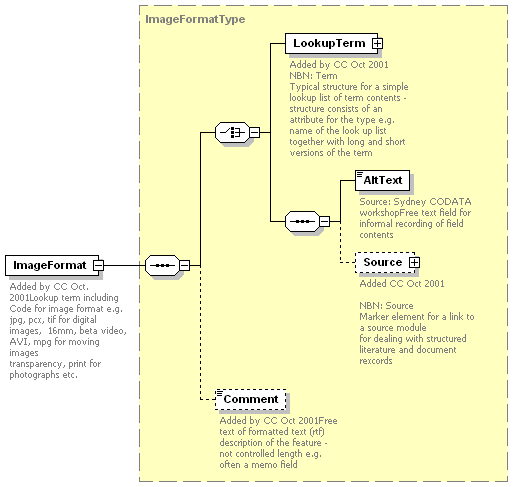 |
||
| type | ImageFormatType | ||
| children | LookupTerm AltText Source Comment | ||
| annotation |
|
||
| source | <xs:element name="ImageFormat" type="ImageFormatType"> <xs:annotation> <xs:documentation>Added by CC Oct. 2001Lookup term including Code for image format e.g. jpg, pcx, tif for digital images, 16mm, beta video, AVI, mpg for moving images transparency, print for photographs etc. </xs:documentation> </xs:annotation> </xs:element> |
| diagram |  |
||||||||||||
| type | DurationType | ||||||||||||
| attributes |
|
||||||||||||
| annotation |
|
||||||||||||
| source | <xs:element name="Duration" type="DurationType"> <xs:annotation> <xs:documentation>Source: Workshop 1/ modified by CC Oct 2001 Standards: - Taxon48: Duration measurement of time elapsed - decimal number</xs:documentation> </xs:annotation> </xs:element> |
| diagram | 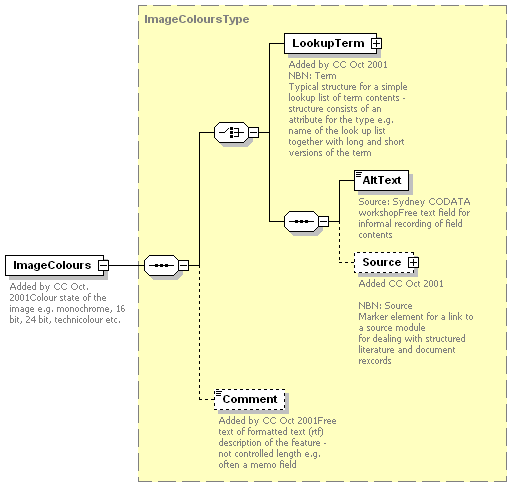 |
||
| type | ImageColoursType | ||
| children | LookupTerm AltText Source Comment | ||
| annotation |
|
||
| source | <xs:element name="ImageColours" type="ImageColoursType"> <xs:annotation> <xs:documentation>Added by CC Oct. 2001Colour state of the image e.g. monochrome, 16 bit, 24 bit, technicolour etc.</xs:documentation> </xs:annotation> </xs:element> |
| diagram |  |
||
| type | xs:string | ||
| annotation |
|
||
| source | <xs:element name="Soundtrack" type="xs:string"> <xs:annotation> <xs:documentation>Added by CC Oct. 2001Soundtrack type e.g. Nicam Stereo, Dolby, mono etc.</xs:documentation> </xs:annotation> </xs:element> |
| diagram |  |
||
| type | xs:string | ||
| annotation |
|
||
| source | <xs:element name="NMedia" type="xs:string"> <xs:annotation> <xs:documentation>Added by CC Oct. 2001Number of media holding the moving image e.g. number of film reels or CDs</xs:documentation> </xs:annotation> </xs:element> |
| diagram | 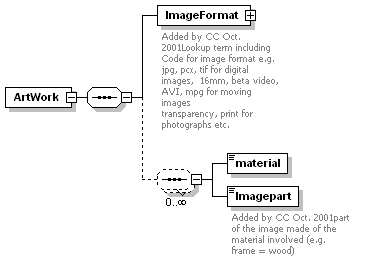 |
| children | ImageFormat material Imagepart |
| source | <xs:element name="ArtWork"> <xs:complexType> <xs:sequence> <xs:element name="ImageFormat" type="ImageFormatType"> <xs:annotation> <xs:documentation>Added by CC Oct. 2001Lookup term including Code for image format e.g. jpg, pcx, tif for digital images, 16mm, beta video, AVI, mpg for moving images transparency, print for photographs etc. </xs:documentation> </xs:annotation> </xs:element> <xs:sequence minOccurs="0" maxOccurs="unbounded"> <xs:element name="material" type="xs:string"/> <xs:element name="Imagepart" type="xs:string"> <xs:annotation> <xs:documentation>Added by CC Oct. 2001part of the image made of the material involved (e.g. frame = wood)</xs:documentation> </xs:annotation> </xs:element> </xs:sequence> </xs:sequence> </xs:complexType> </xs:element> |
| diagram | 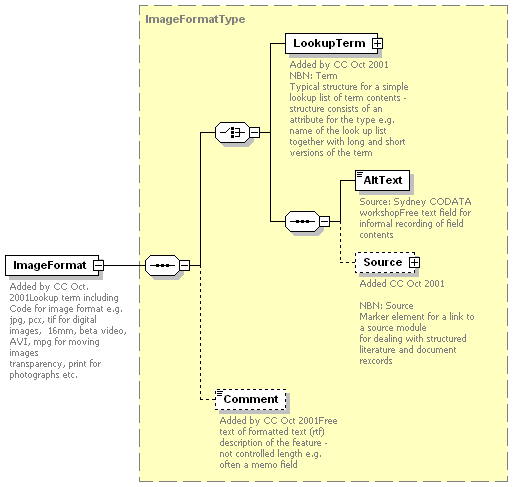 |
||
| type | ImageFormatType | ||
| children | LookupTerm AltText Source Comment | ||
| annotation |
|
||
| source | <xs:element name="ImageFormat" type="ImageFormatType"> <xs:annotation> <xs:documentation>Added by CC Oct. 2001Lookup term including Code for image format e.g. jpg, pcx, tif for digital images, 16mm, beta video, AVI, mpg for moving images transparency, print for photographs etc. </xs:documentation> </xs:annotation> </xs:element> |
| diagram |  |
| type | xs:string |
| source | <xs:element name="material" type="xs:string"/> |
| diagram |  |
||
| type | xs:string | ||
| annotation |
|
||
| source | <xs:element name="Imagepart" type="xs:string"> <xs:annotation> <xs:documentation>Added by CC Oct. 2001part of the image made of the material involved (e.g. frame = wood)</xs:documentation> </xs:annotation> </xs:element> |
| diagram | 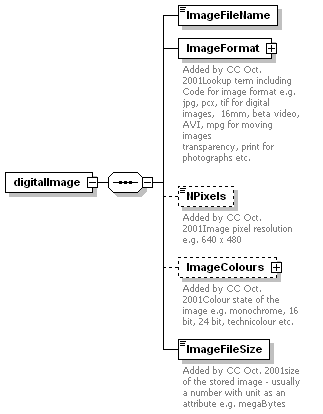 |
| children | ImageFileName ImageFormat NPixels ImageColours ImageFileSize |
| source | <xs:element name="digitalImage"> <xs:complexType> <xs:sequence> <xs:element name="ImageFileName" type="xs:string"/> <xs:element name="ImageFormat" type="ImageFormatType"> <xs:annotation> <xs:documentation>Added by CC Oct. 2001Lookup term including Code for image format e.g. jpg, pcx, tif for digital images, 16mm, beta video, AVI, mpg for moving images transparency, print for photographs etc. </xs:documentation> </xs:annotation> </xs:element> <xs:element name="NPixels" type="xs:string" minOccurs="0"> <xs:annotation> <xs:documentation>Added by CC Oct. 2001Image pixel resolution e.g. 640 x 480</xs:documentation> </xs:annotation> </xs:element> <xs:element name="ImageColours" type="ImageColoursType" minOccurs="0"> <xs:annotation> <xs:documentation>Added by CC Oct. 2001Colour state of the image e.g. monochrome, 16 bit, 24 bit, technicolour etc.</xs:documentation> </xs:annotation> </xs:element> <xs:element name="ImageFileSize" type="xs:string"> <xs:annotation> <xs:documentation>Added by CC Oct. 2001size of the stored image - usually a number with unit as an attribute e.g. megaBytes</xs:documentation> </xs:annotation> </xs:element> </xs:sequence> </xs:complexType> </xs:element> |
| diagram |  |
| type | xs:string |
| source | <xs:element name="ImageFileName" type="xs:string"/> |
| diagram | 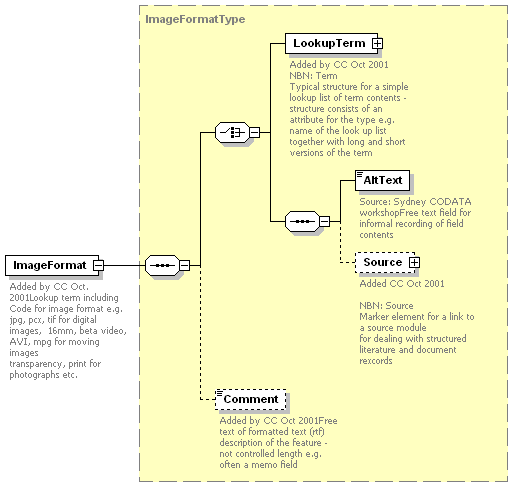 |
||
| type | ImageFormatType | ||
| children | LookupTerm AltText Source Comment | ||
| annotation |
|
||
| source | <xs:element name="ImageFormat" type="ImageFormatType"> <xs:annotation> <xs:documentation>Added by CC Oct. 2001Lookup term including Code for image format e.g. jpg, pcx, tif for digital images, 16mm, beta video, AVI, mpg for moving images transparency, print for photographs etc. </xs:documentation> </xs:annotation> </xs:element> |
| diagram |  |
||
| type | xs:string | ||
| annotation |
|
||
| source | <xs:element name="NPixels" type="xs:string" minOccurs="0"> <xs:annotation> <xs:documentation>Added by CC Oct. 2001Image pixel resolution e.g. 640 x 480</xs:documentation> </xs:annotation> </xs:element> |
| diagram | 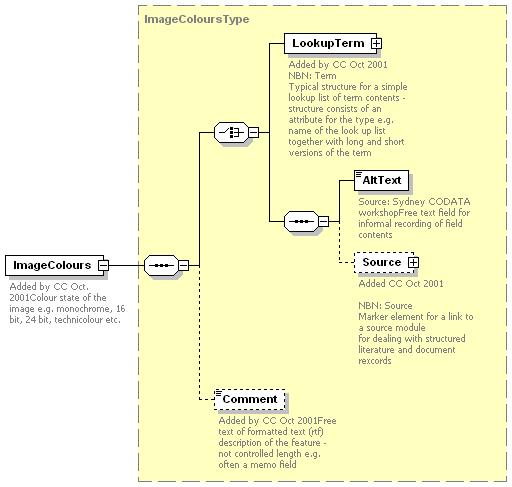 |
||
| type | ImageColoursType | ||
| children | LookupTerm AltText Source Comment | ||
| annotation |
|
||
| source | <xs:element name="ImageColours" type="ImageColoursType" minOccurs="0"> <xs:annotation> <xs:documentation>Added by CC Oct. 2001Colour state of the image e.g. monochrome, 16 bit, 24 bit, technicolour etc.</xs:documentation> </xs:annotation> </xs:element> |
| diagram | 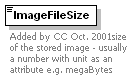 |
||
| type | xs:string | ||
| annotation |
|
||
| source | <xs:element name="ImageFileSize" type="xs:string"> <xs:annotation> <xs:documentation>Added by CC Oct. 2001size of the stored image - usually a number with unit as an attribute e.g. megaBytes</xs:documentation> </xs:annotation> </xs:element> |
| diagram | 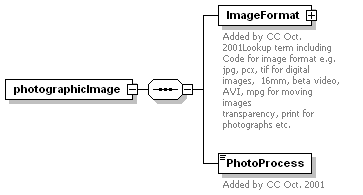 |
| children | ImageFormat PhotoProcess |
| source | <xs:element name="photographicImage"> <xs:complexType> <xs:sequence> <xs:element name="ImageFormat" type="ImageFormatType"> <xs:annotation> <xs:documentation>Added by CC Oct. 2001Lookup term including Code for image format e.g. jpg, pcx, tif for digital images, 16mm, beta video, AVI, mpg for moving images transparency, print for photographs etc. </xs:documentation> </xs:annotation> </xs:element> <xs:element name="PhotoProcess" type="xs:string"> <xs:annotation> <xs:documentation>Added by CC Oct. 2001</xs:documentation> </xs:annotation> </xs:element> </xs:sequence> </xs:complexType> </xs:element> |
| diagram | 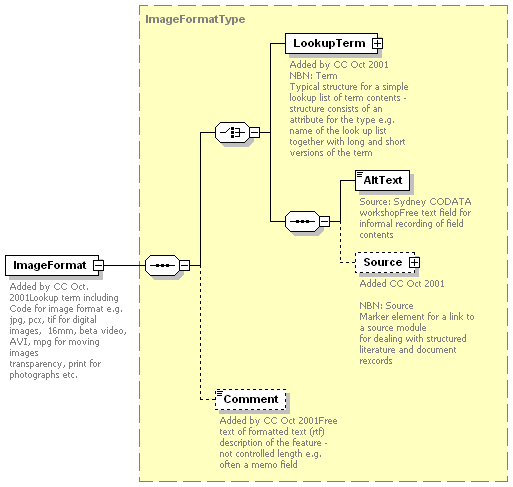 |
||
| type | ImageFormatType | ||
| children | LookupTerm AltText Source Comment | ||
| annotation |
|
||
| source | <xs:element name="ImageFormat" type="ImageFormatType"> <xs:annotation> <xs:documentation>Added by CC Oct. 2001Lookup term including Code for image format e.g. jpg, pcx, tif for digital images, 16mm, beta video, AVI, mpg for moving images transparency, print for photographs etc. </xs:documentation> </xs:annotation> </xs:element> |
| diagram |  |
||
| type | xs:string | ||
| annotation |
|
||
| source | <xs:element name="PhotoProcess" type="xs:string"> <xs:annotation> <xs:documentation>Added by CC Oct. 2001</xs:documentation> </xs:annotation> </xs:element> |
| diagram | 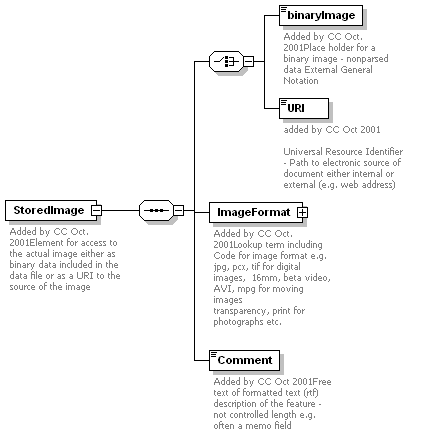 |
||
| children | binaryImage URI ImageFormat Comment | ||
| annotation |
|
||
| source | <xs:element name="StoredImage" minOccurs="0" maxOccurs="unbounded"> <xs:annotation> <xs:documentation>Added by CC Oct. 2001Element for access to the actual image either as binary data included in the data file or as a URI to the source of the image</xs:documentation> </xs:annotation> <xs:complexType> <xs:sequence> <xs:choice> <xs:element name="binaryImage"> <xs:annotation> <xs:documentation>Added by CC Oct. 2001Place holder for a binary image - nonparsed data External General Notation</xs:documentation> </xs:annotation> <xs:complexType> <xs:simpleContent> <xs:extension base="xs:string"> <xs:attribute name="e-dtype" type="xs:NMTOKEN" fixed="string"/> </xs:extension> </xs:simpleContent> </xs:complexType> </xs:element> <xs:element name="URI" type="URI"> <xs:annotation> <xs:documentation>added by CC Oct 2001 Universal Resource Identifier - Path to electronic source of document either internal or external (e.g. web address)</xs:documentation> </xs:annotation> </xs:element> </xs:choice> <xs:element name="ImageFormat" type="ImageFormatType"> <xs:annotation> <xs:documentation>Added by CC Oct. 2001Lookup term including Code for image format e.g. jpg, pcx, tif for digital images, 16mm, beta video, AVI, mpg for moving images transparency, print for photographs etc. </xs:documentation> </xs:annotation> </xs:element> <xs:element name="Comment" type="Comment"> <xs:annotation> <xs:documentation>Added by CC Oct 2001Free text of formatted text (rtf) description of the feature - not controlled length e.g. often a memo field</xs:documentation> </xs:annotation> </xs:element> </xs:sequence> </xs:complexType> </xs:element> |
| diagram |  |
||||||||||||
| type | extension of xs:string | ||||||||||||
| attributes |
|
||||||||||||
| annotation |
|
||||||||||||
| source | <xs:element name="binaryImage"> <xs:annotation> <xs:documentation>Added by CC Oct. 2001Place holder for a binary image - nonparsed data External General Notation</xs:documentation> </xs:annotation> <xs:complexType> <xs:simpleContent> <xs:extension base="xs:string"> <xs:attribute name="e-dtype" type="xs:NMTOKEN" fixed="string"/> </xs:extension> </xs:simpleContent> </xs:complexType> </xs:element> |
| diagram |  |
||
| type | URI | ||
| annotation |
|
||
| source | <xs:element name="URI" type="URI"> <xs:annotation> <xs:documentation>added by CC Oct 2001 Universal Resource Identifier - Path to electronic source of document either internal or external (e.g. web address)</xs:documentation> </xs:annotation> </xs:element> |
| diagram | 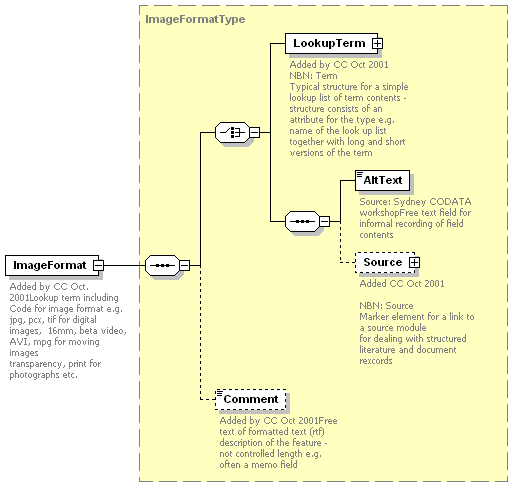 |
||
| type | ImageFormatType | ||
| children | LookupTerm AltText Source Comment | ||
| annotation |
|
||
| source | <xs:element name="ImageFormat" type="ImageFormatType"> <xs:annotation> <xs:documentation>Added by CC Oct. 2001Lookup term including Code for image format e.g. jpg, pcx, tif for digital images, 16mm, beta video, AVI, mpg for moving images transparency, print for photographs etc. </xs:documentation> </xs:annotation> </xs:element> |
| diagram |  |
||
| type | Comment | ||
| annotation |
|
||
| source | <xs:element name="Comment" type="Comment"> <xs:annotation> <xs:documentation>Added by CC Oct 2001Free text of formatted text (rtf) description of the feature - not controlled length e.g. often a memo field</xs:documentation> </xs:annotation> </xs:element> |
| diagram | 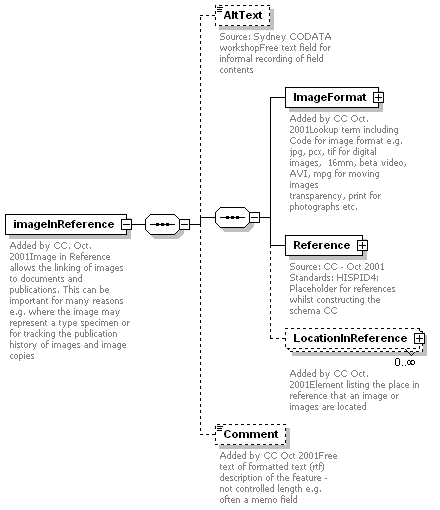 |
||
| children | AltText ImageFormat Reference LocationInReference Comment | ||
| annotation |
|
||
| source | <xs:element name="imageInReference" minOccurs="0" maxOccurs="unbounded"> <xs:annotation> <xs:documentation>Added by CC. Oct. 2001Image in Reference allows the linking of images to documents and publications. This can be important for many reasons e.g. where the image may represent a type specimen or for tracking the publication history of images and image copies </xs:documentation> </xs:annotation> <xs:complexType> <xs:sequence> <xs:element name="AltText" type="AltText" minOccurs="0"> <xs:annotation> <xs:documentation>Source: Sydney CODATA workshopFree text field for informal recording of field contents</xs:documentation> </xs:annotation> </xs:element> <xs:sequence> <xs:element name="ImageFormat" type="ImageFormatType"> <xs:annotation> <xs:documentation>Added by CC Oct. 2001Lookup term including Code for image format e.g. jpg, pcx, tif for digital images, 16mm, beta video, AVI, mpg for moving images transparency, print for photographs etc. </xs:documentation> </xs:annotation> </xs:element> <xs:element name="Reference" type="ReferenceType"> <xs:annotation> <xs:documentation>Source: CC - Oct 2001 Standards: HISPID4: Placeholder for references whilst constructing the schema CC</xs:documentation> </xs:annotation> </xs:element> <xs:element name="LocationInReference" minOccurs="0" maxOccurs="unbounded"> <xs:annotation> <xs:documentation>Added by CC Oct. 2001Element listing the place in reference that an image or images are located</xs:documentation> </xs:annotation> <xs:complexType> <xs:sequence> <xs:element name="ImagePageNumber" type="xs:string" minOccurs="0"> <xs:annotation> <xs:documentation>Added by CC Oct. 2001page number for the imaged specimen</xs:documentation> </xs:annotation> </xs:element> <xs:element name="ImagePlateNumber" type="xs:string" minOccurs="0"> <xs:annotation> <xs:documentation>Added by CC Oct. 2001Plate number for the imaged specimen</xs:documentation> </xs:annotation> </xs:element> <xs:element name="ImageFigureNumber" type="xs:string" minOccurs="0"> <xs:annotation> <xs:documentation>Added by CC Oct. 2001Figure number for the imaged specimen</xs:documentation> </xs:annotation> </xs:element> <xs:element name="Comment" type="Comment" minOccurs="0"> <xs:annotation> <xs:documentation>Added by CC Oct 2001Free text of formatted text (rtf) description of the feature - not controlled length e.g. often a memo field</xs:documentation> </xs:annotation> </xs:element> </xs:sequence> </xs:complexType> </xs:element> </xs:sequence> <xs:element name="Comment" type="Comment" minOccurs="0"> <xs:annotation> <xs:documentation>Added by CC Oct 2001Free text of formatted text (rtf) description of the feature - not controlled length e.g. often a memo field</xs:documentation> </xs:annotation> </xs:element> </xs:sequence> </xs:complexType> </xs:element> |
| diagram |  |
||
| type | AltText | ||
| annotation |
|
||
| source | <xs:element name="AltText" type="AltText" minOccurs="0"> <xs:annotation> <xs:documentation>Source: Sydney CODATA workshopFree text field for informal recording of field contents</xs:documentation> </xs:annotation> </xs:element> |
| diagram | 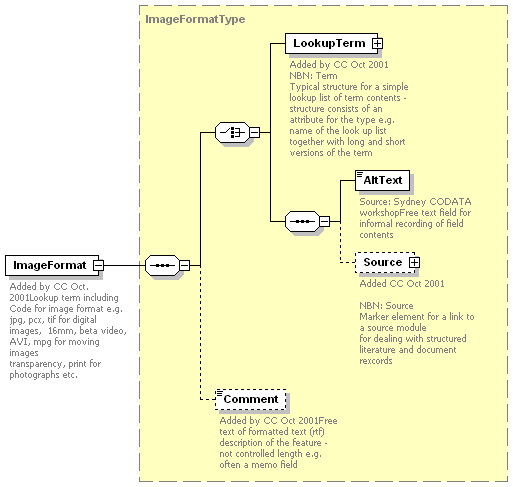 |
||
| type | ImageFormatType | ||
| children | LookupTerm AltText Source Comment | ||
| annotation |
|
||
| source | <xs:element name="ImageFormat" type="ImageFormatType"> <xs:annotation> <xs:documentation>Added by CC Oct. 2001Lookup term including Code for image format e.g. jpg, pcx, tif for digital images, 16mm, beta video, AVI, mpg for moving images transparency, print for photographs etc. </xs:documentation> </xs:annotation> </xs:element> |
| diagram | 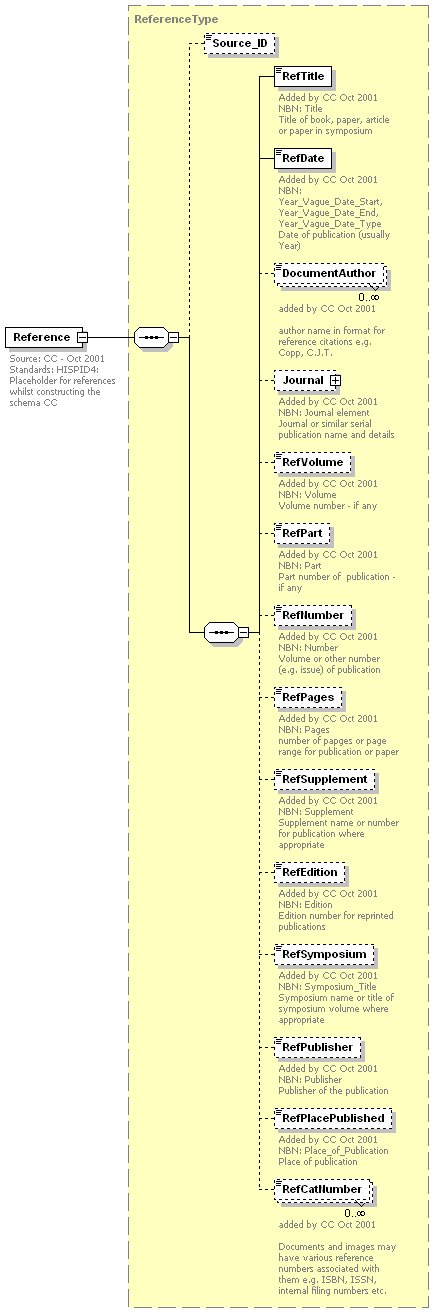 |
||||||||||||
| type | ReferenceType | ||||||||||||
| children | Source_ID RefTitle RefDate DocumentAuthor Journal RefVolume RefPart RefNumber RefPages RefSupplement RefEdition RefSymposium RefPublisher RefPlacePublished RefCatNumber | ||||||||||||
| attributes |
|
||||||||||||
| annotation |
|
||||||||||||
| source | <xs:element name="Reference" type="ReferenceType"> <xs:annotation> <xs:documentation>Source: CC - Oct 2001 Standards: HISPID4: Placeholder for references whilst constructing the schema CC</xs:documentation> </xs:annotation> </xs:element> |
| diagram | 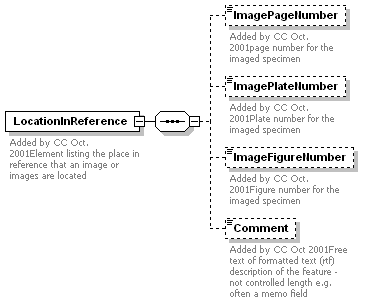 |
||
| children | ImagePageNumber ImagePlateNumber ImageFigureNumber Comment | ||
| annotation |
|
||
| source | <xs:element name="LocationInReference" minOccurs="0" maxOccurs="unbounded"> <xs:annotation> <xs:documentation>Added by CC Oct. 2001Element listing the place in reference that an image or images are located</xs:documentation> </xs:annotation> <xs:complexType> <xs:sequence> <xs:element name="ImagePageNumber" type="xs:string" minOccurs="0"> <xs:annotation> <xs:documentation>Added by CC Oct. 2001page number for the imaged specimen</xs:documentation> </xs:annotation> </xs:element> <xs:element name="ImagePlateNumber" type="xs:string" minOccurs="0"> <xs:annotation> <xs:documentation>Added by CC Oct. 2001Plate number for the imaged specimen</xs:documentation> </xs:annotation> </xs:element> <xs:element name="ImageFigureNumber" type="xs:string" minOccurs="0"> <xs:annotation> <xs:documentation>Added by CC Oct. 2001Figure number for the imaged specimen</xs:documentation> </xs:annotation> </xs:element> <xs:element name="Comment" type="Comment" minOccurs="0"> <xs:annotation> <xs:documentation>Added by CC Oct 2001Free text of formatted text (rtf) description of the feature - not controlled length e.g. often a memo field</xs:documentation> </xs:annotation> </xs:element> </xs:sequence> </xs:complexType> </xs:element> |
| diagram |  |
||
| type | xs:string | ||
| annotation |
|
||
| source | <xs:element name="ImagePageNumber" type="xs:string" minOccurs="0"> <xs:annotation> <xs:documentation>Added by CC Oct. 2001page number for the imaged specimen</xs:documentation> </xs:annotation> </xs:element> |
| diagram |  |
||
| type | xs:string | ||
| annotation |
|
||
| source | <xs:element name="ImagePlateNumber" type="xs:string" minOccurs="0"> <xs:annotation> <xs:documentation>Added by CC Oct. 2001Plate number for the imaged specimen</xs:documentation> </xs:annotation> </xs:element> |
| diagram |  |
||
| type | xs:string | ||
| annotation |
|
||
| source | <xs:element name="ImageFigureNumber" type="xs:string" minOccurs="0"> <xs:annotation> <xs:documentation>Added by CC Oct. 2001Figure number for the imaged specimen</xs:documentation> </xs:annotation> </xs:element> |
| diagram |  |
||
| type | Comment | ||
| annotation |
|
||
| source | <xs:element name="Comment" type="Comment" minOccurs="0"> <xs:annotation> <xs:documentation>Added by CC Oct 2001Free text of formatted text (rtf) description of the feature - not controlled length e.g. often a memo field</xs:documentation> </xs:annotation> </xs:element> |
| diagram |  |
||
| type | Comment | ||
| annotation |
|
||
| source | <xs:element name="Comment" type="Comment" minOccurs="0"> <xs:annotation> <xs:documentation>Added by CC Oct 2001Free text of formatted text (rtf) description of the feature - not controlled length e.g. often a memo field</xs:documentation> </xs:annotation> </xs:element> |
| diagram | 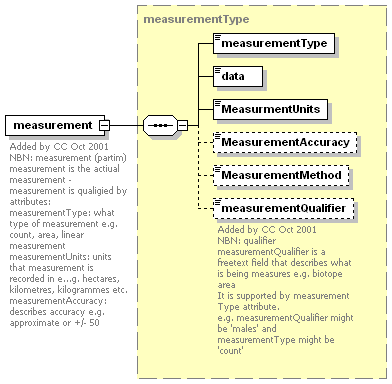 |
||
| type | measurementType | ||
| children | measurementType data MeasurmentUnits MeasurementAccuracy MeasurementMethod measurementQualifier | ||
| annotation |
|
||
| source | <xs:element name="measurement" type="measurementType"> <xs:annotation> <xs:documentation>Added by CC Oct 2001 NBN: measurement (partim) measurement is the actiual measurement - measurement is qualigied by attributes: measurementType: what type of measurement e.g. count, area, linear measurement measurementUnits: units that measurement is recorded in e...g. hectares, kilometres, kilogrammes etc. measurementAccuracy: describes accuracy e.g. approximate or +/- 50 </xs:documentation> </xs:annotation> </xs:element> |
| diagram |  |
||
| type | measurementQualifier | ||
| annotation |
|
||
| source | <xs:element name="measurementQualifier" type="measurementQualifier"> <xs:annotation> <xs:documentation>Added by CC Oct 2001 NBN: qualifier measurementQualifier is a freetext field that describes what is being measures e.g. biotope area It is supported by measurement Type attribute. e.g. measurementQualifier might be 'males' and measurementType might be 'count' </xs:documentation> </xs:annotation> </xs:element> |
| diagram |  |
||||||||||||
| type | RefCatNumberType | ||||||||||||
| attributes |
|
||||||||||||
| annotation |
|
||||||||||||
| source | <xs:element name="RefCatNumber" type="RefCatNumberType" minOccurs="0" maxOccurs="unbounded"> <xs:annotation> <xs:documentation>added by CC Oct 2001 Documents and images may have various reference numbers associated with them e.g. ISBN, ISSN, internal filing numbers etc.</xs:documentation> </xs:annotation> </xs:element> |
| diagram | 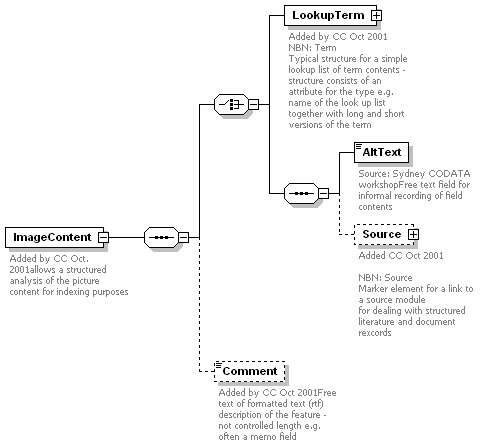 |
||
| children | LookupTerm AltText Source Comment | ||
| annotation |
|
||
| source | <xs:element name="ImageContent" minOccurs="0" maxOccurs="unbounded"> <xs:annotation> <xs:documentation>Added by CC Oct. 2001allows a structured analysis of the picture content for indexing purposes</xs:documentation> </xs:annotation> <xs:complexType> <xs:sequence> <xs:choice> <xs:element name="LookupTerm" type="LookupTermType"> <xs:annotation> <xs:documentation>Added by CC Oct 2001 NBN: Term Typical structure for a simple lookup list of term contents - structure consists of an attribute for the type e.g. name of the look up list together with long and short versions of the term</xs:documentation> </xs:annotation> </xs:element> <xs:sequence> <xs:element name="AltText" type="AltText"> <xs:annotation> <xs:documentation>Source: Sydney CODATA workshopFree text field for informal recording of field contents</xs:documentation> </xs:annotation> </xs:element> <xs:element name="Source" type="SourceType" minOccurs="0"> <xs:annotation> <xs:documentation>Added CC Oct 2001 NBN: Source Marker element for a link to a source module for dealing with structured literature and document rexcords </xs:documentation> </xs:annotation> </xs:element> </xs:sequence> </xs:choice> <xs:element name="Comment" type="Comment" minOccurs="0"> <xs:annotation> <xs:documentation>Added by CC Oct 2001Free text of formatted text (rtf) description of the feature - not controlled length e.g. often a memo field</xs:documentation> </xs:annotation> </xs:element> </xs:sequence> </xs:complexType> </xs:element> |
| diagram | 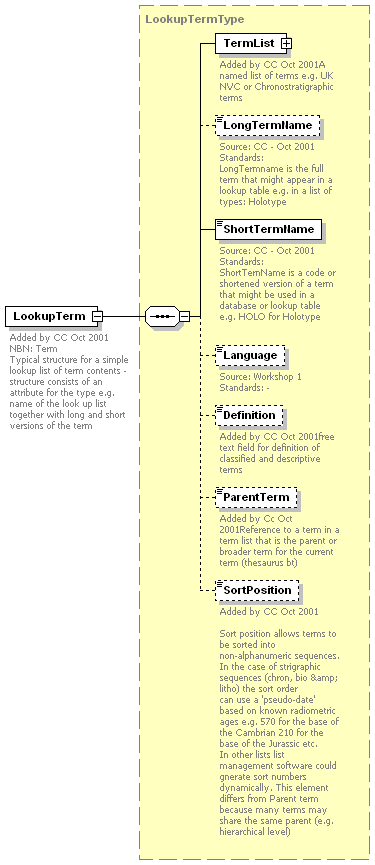 |
||||||||||||||||||
| type | LookupTermType | ||||||||||||||||||
| children | TermList LongTermName ShortTermName Language Definition ParentTerm SortPosition | ||||||||||||||||||
| attributes |
|
||||||||||||||||||
| annotation |
|
||||||||||||||||||
| source | <xs:element name="LookupTerm" type="LookupTermType"> <xs:annotation> <xs:documentation>Added by CC Oct 2001 NBN: Term Typical structure for a simple lookup list of term contents - structure consists of an attribute for the type e.g. name of the look up list together with long and short versions of the term</xs:documentation> </xs:annotation> </xs:element> |
| diagram |  |
||
| type | AltText | ||
| annotation |
|
||
| source | <xs:element name="AltText" type="AltText"> <xs:annotation> <xs:documentation>Source: Sydney CODATA workshopFree text field for informal recording of field contents</xs:documentation> </xs:annotation> </xs:element> |
| diagram | 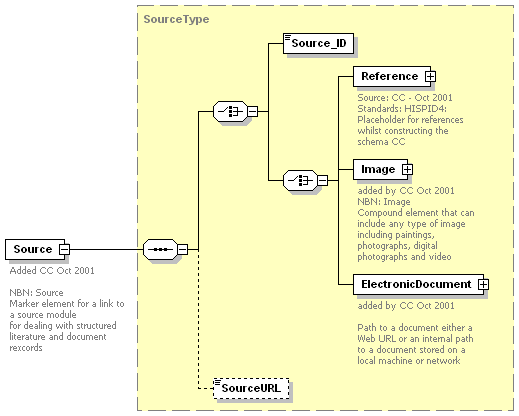 |
||||||||||||
| type | SourceType | ||||||||||||
| children | Source_ID Reference Image ElectronicDocument SourceURL | ||||||||||||
| attributes |
|
||||||||||||
| annotation |
|
||||||||||||
| source | <xs:element name="Source" type="SourceType" minOccurs="0"> <xs:annotation> <xs:documentation>Added CC Oct 2001 NBN: Source Marker element for a link to a source module for dealing with structured literature and document rexcords </xs:documentation> </xs:annotation> </xs:element> |
| diagram |  |
||
| type | Comment | ||
| annotation |
|
||
| source | <xs:element name="Comment" type="Comment" minOccurs="0"> <xs:annotation> <xs:documentation>Added by CC Oct 2001Free text of formatted text (rtf) description of the feature - not controlled length e.g. often a memo field</xs:documentation> </xs:annotation> </xs:element> |
| diagram | 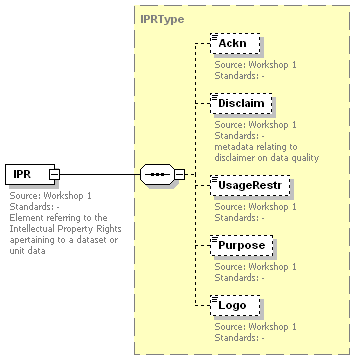 |
||
| type | IPRType | ||
| children | Ackn Disclaim UsageRestr Purpose Logo | ||
| annotation |
|
||
| source | <xs:element name="IPR" type="IPRType"> <xs:annotation> <xs:documentation>Source: Workshop 1 Standards: - Element referring to the Intellectual Property Rights apertaining to a dataset or unit data</xs:documentation> </xs:annotation> </xs:element> |
| diagram | 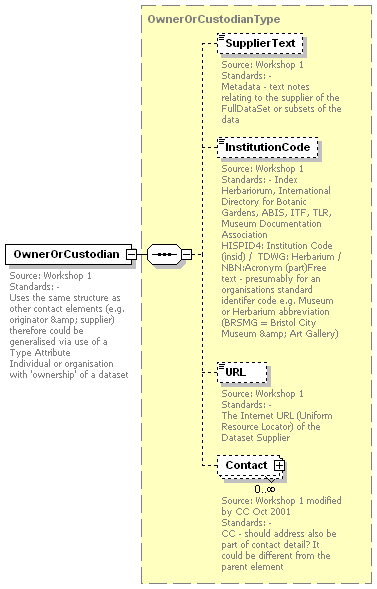 |
||
| type | OwnerOrCustodianType | ||
| children | SupplierText InstitutionCode URL Contact | ||
| annotation |
|
||
| source | <xs:element name="OwnerOrCustodian" type="OwnerOrCustodianType"> <xs:annotation> <xs:documentation>Source: Workshop 1 Standards: - Uses the same structure as other contact elements (e.g. originator & supplier) therefore could be generalised via use of a Type Attribute Individual or organisation with 'ownership' of a dataset</xs:documentation> </xs:annotation> </xs:element> |
| diagram | 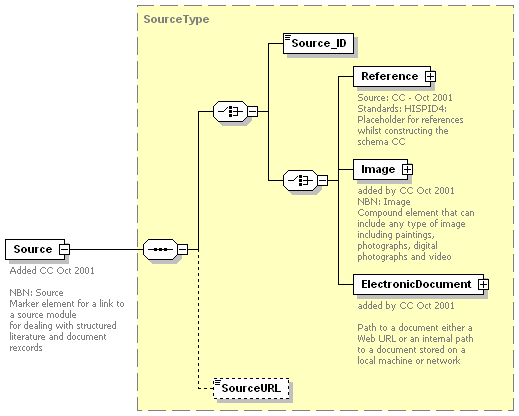 |
||||||||||||
| type | SourceType | ||||||||||||
| children | Source_ID Reference Image ElectronicDocument SourceURL | ||||||||||||
| attributes |
|
||||||||||||
| annotation |
|
||||||||||||
| source | <xs:element name="Source" type="SourceType"> <xs:annotation> <xs:documentation>Added CC Oct 2001 NBN: Source Marker element for a link to a source module for dealing with structured literature and document rexcords </xs:documentation> </xs:annotation> </xs:element> |
| diagram | 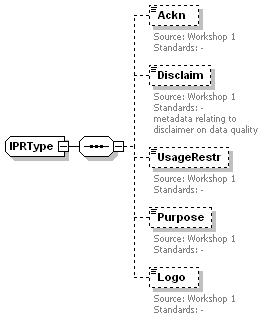 |
||
| children | Ackn Disclaim UsageRestr Purpose Logo | ||
| used by |
|
||
| source | <xs:complexType name="IPRType"> <xs:sequence> <xs:element name="Ackn" type="xs:string" minOccurs="0"> <xs:annotation> <xs:documentation>Source: Workshop 1 Standards: -</xs:documentation> </xs:annotation> </xs:element> <xs:element name="Disclaim" type="xs:string" minOccurs="0"> <xs:annotation> <xs:documentation>Source: Workshop 1 Standards: - metadata relating to disclaimer on data quality</xs:documentation> </xs:annotation> </xs:element> <xs:element name="UsageRestr" type="xs:string" minOccurs="0"> <xs:annotation> <xs:documentation>Source: Workshop 1 Standards: -</xs:documentation> </xs:annotation> </xs:element> <xs:element name="Purpose" type="xs:string" minOccurs="0"> <xs:annotation> <xs:documentation>Source: Workshop 1 Standards: - </xs:documentation> </xs:annotation> </xs:element> <xs:element name="Logo" type="xs:string" minOccurs="0"> <xs:annotation> <xs:documentation>Source: Workshop 1 Standards: -</xs:documentation> </xs:annotation> </xs:element> </xs:sequence> </xs:complexType> |
| diagram |  |
||
| type | xs:string | ||
| annotation |
|
||
| source | <xs:element name="Ackn" type="xs:string" minOccurs="0"> <xs:annotation> <xs:documentation>Source: Workshop 1 Standards: -</xs:documentation> </xs:annotation> </xs:element> |
| diagram |  |
||
| type | xs:string | ||
| annotation |
|
||
| source | <xs:element name="Disclaim" type="xs:string" minOccurs="0"> <xs:annotation> <xs:documentation>Source: Workshop 1 Standards: - metadata relating to disclaimer on data quality</xs:documentation> </xs:annotation> </xs:element> |
| diagram |  |
||
| type | xs:string | ||
| annotation |
|
||
| source | <xs:element name="UsageRestr" type="xs:string" minOccurs="0"> <xs:annotation> <xs:documentation>Source: Workshop 1 Standards: -</xs:documentation> </xs:annotation> </xs:element> |
| diagram |  |
||
| type | xs:string | ||
| annotation |
|
||
| source | <xs:element name="Purpose" type="xs:string" minOccurs="0"> <xs:annotation> <xs:documentation>Source: Workshop 1 Standards: - </xs:documentation> </xs:annotation> </xs:element> |
| diagram |  |
||
| type | xs:string | ||
| annotation |
|
||
| source | <xs:element name="Logo" type="xs:string" minOccurs="0"> <xs:annotation> <xs:documentation>Source: Workshop 1 Standards: -</xs:documentation> </xs:annotation> </xs:element> |
| diagram | 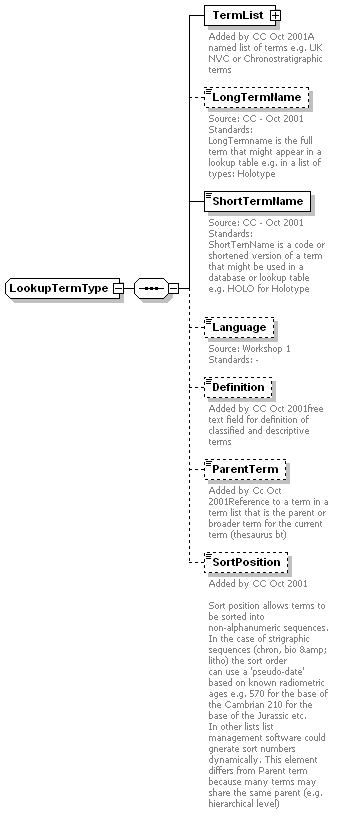 |
||||||||||||||||||
| children | TermList LongTermName ShortTermName Language Definition ParentTerm SortPosition | ||||||||||||||||||
| used by |
|
||||||||||||||||||
| attributes |
|
||||||||||||||||||
| source | <xs:complexType name="LookupTermType"> <xs:sequence> <xs:element name="TermList"> <xs:annotation> <xs:documentation>Added by CC Oct 2001A named list of terms e.g. UK NVC or Chronostratigraphic terms</xs:documentation> </xs:annotation> <xs:complexType> <xs:sequence> <xs:element name="TermList_ID" type="xs:string" minOccurs="0"> <xs:annotation> <xs:documentation>Added by CC Oct 2001Unique identifier for a termlist in a database system</xs:documentation> </xs:annotation> </xs:element> <xs:element name="TermListName" type="xs:string"> <xs:annotation> <xs:documentation>Added by CC Oct 2001Name of the specific term list e.g. CORINE</xs:documentation> </xs:annotation> </xs:element> <xs:element name="TermListVersion" type="xs:string"> <xs:annotation> <xs:documentation>Added by CC Oct 2001Version of the term list - e.g. many dated versions of CORINE</xs:documentation> </xs:annotation> </xs:element> <xs:element name="Source" type="SourceType" minOccurs="0"> <xs:annotation> <xs:documentation>Added CC Oct 2001 NBN: Source Marker element for a link to a source module for dealing with structured literature and document rexcords</xs:documentation> </xs:annotation> </xs:element> <xs:element name="Date" type="DateType" minOccurs="0"> <xs:annotation> <xs:documentation>Added CC Oct 2001 NBN: vaguedatestart, vaguedateend and vaguedatetype Date has a three part structure - two elements and an attribute VagueDateBegin = First date of a range or date for a single date VagueDateEnd = last date in a range DateType attribute can be enumerated to allow for various date formats (e.g. dd/mm/yyyy or to allow a parser to interpret terms such as summer 69 or 1974 etc) Note terms such as summer would be interpretted by standard begin and end dates. </xs:documentation> </xs:annotation> </xs:element> </xs:sequence> </xs:complexType> </xs:element> <xs:element name="LongTermName" type="LongTermName" minOccurs="0"> <xs:annotation> <xs:documentation>Source: CC - Oct 2001 Standards: LongTermname is the full term that might appear in a lookup table e.g. in a list of types: Holotype</xs:documentation> </xs:annotation> </xs:element> <xs:element name="ShortTermName" type="ShortTermName"> <xs:annotation> <xs:documentation>Source: CC - Oct 2001 Standards: ShortTernName is a code or shortened version of a term that might be used in a database or lookup table e.g. HOLO for Holotype </xs:documentation> </xs:annotation> </xs:element> <xs:element name="Language" type="Language" minOccurs="0"> <xs:annotation> <xs:documentation>Source: Workshop 1 Standards: - </xs:documentation> </xs:annotation> </xs:element> <xs:element name="Definition" type="xs:string" minOccurs="0"> <xs:annotation> <xs:documentation>Added by CC Oct 2001free text field for definition of classified and descriptive terms</xs:documentation> </xs:annotation> </xs:element> <xs:element name="ParentTerm" minOccurs="0"> <xs:annotation> <xs:documentation>Added by Cc Oct 2001Reference to a term in a term list that is the parent or broader term for the current term (thesaurus bt)</xs:documentation> </xs:annotation> <xs:complexType> <xs:simpleContent> <xs:extension base="xs:string"> <xs:attribute name="LookupTerm_ID" type="xs:string"/> </xs:extension> </xs:simpleContent> </xs:complexType> </xs:element> <xs:element name="SortPosition" type="xs:string" minOccurs="0"> <xs:annotation> <xs:documentation>Added by CC Oct 2001 Sort position allows terms to be sorted into non-alphanumeric sequences. In the case of strigraphic sequences (chron, bio & litho) the sort order can use a 'pseudo-date' based on known radiometric ages e.g. 570 for the base of the Cambrian 210 for the base of the Jurassic etc. In other lists list management software could gnerate sort numbers dynamically. This element differs from Parent term because many terms may share the same parent (e.g. hierarchical level) </xs:documentation> </xs:annotation> </xs:element> </xs:sequence> <xs:attribute name="TermType" type="xs:string"/> <xs:attribute name="LookupTerm_ID" type="xs:string"/> </xs:complexType> |
| diagram | 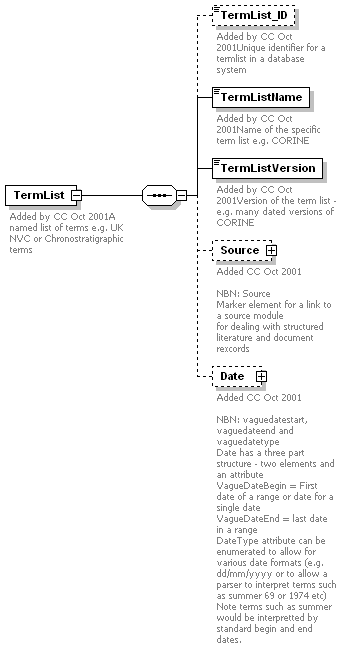 |
||
| children | TermList_ID TermListName TermListVersion Source Date | ||
| annotation |
|
||
| source | <xs:element name="TermList"> <xs:annotation> <xs:documentation>Added by CC Oct 2001A named list of terms e.g. UK NVC or Chronostratigraphic terms</xs:documentation> </xs:annotation> <xs:complexType> <xs:sequence> <xs:element name="TermList_ID" type="xs:string" minOccurs="0"> <xs:annotation> <xs:documentation>Added by CC Oct 2001Unique identifier for a termlist in a database system</xs:documentation> </xs:annotation> </xs:element> <xs:element name="TermListName" type="xs:string"> <xs:annotation> <xs:documentation>Added by CC Oct 2001Name of the specific term list e.g. CORINE</xs:documentation> </xs:annotation> </xs:element> <xs:element name="TermListVersion" type="xs:string"> <xs:annotation> <xs:documentation>Added by CC Oct 2001Version of the term list - e.g. many dated versions of CORINE</xs:documentation> </xs:annotation> </xs:element> <xs:element name="Source" type="SourceType" minOccurs="0"> <xs:annotation> <xs:documentation>Added CC Oct 2001 NBN: Source Marker element for a link to a source module for dealing with structured literature and document rexcords</xs:documentation> </xs:annotation> </xs:element> <xs:element name="Date" type="DateType" minOccurs="0"> <xs:annotation> <xs:documentation>Added CC Oct 2001 NBN: vaguedatestart, vaguedateend and vaguedatetype Date has a three part structure - two elements and an attribute VagueDateBegin = First date of a range or date for a single date VagueDateEnd = last date in a range DateType attribute can be enumerated to allow for various date formats (e.g. dd/mm/yyyy or to allow a parser to interpret terms such as summer 69 or 1974 etc) Note terms such as summer would be interpretted by standard begin and end dates. </xs:documentation> </xs:annotation> </xs:element> </xs:sequence> </xs:complexType> </xs:element> |
| diagram | 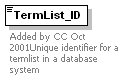 |
||
| type | xs:string | ||
| annotation |
|
||
| source | <xs:element name="TermList_ID" type="xs:string" minOccurs="0"> <xs:annotation> <xs:documentation>Added by CC Oct 2001Unique identifier for a termlist in a database system</xs:documentation> </xs:annotation> </xs:element> |
| diagram | 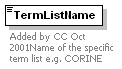 |
||
| type | xs:string | ||
| annotation |
|
||
| source | <xs:element name="TermListName" type="xs:string"> <xs:annotation> <xs:documentation>Added by CC Oct 2001Name of the specific term list e.g. CORINE</xs:documentation> </xs:annotation> </xs:element> |
| diagram | 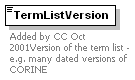 |
||
| type | xs:string | ||
| annotation |
|
||
| source | <xs:element name="TermListVersion" type="xs:string"> <xs:annotation> <xs:documentation>Added by CC Oct 2001Version of the term list - e.g. many dated versions of CORINE</xs:documentation> </xs:annotation> </xs:element> |
| diagram | 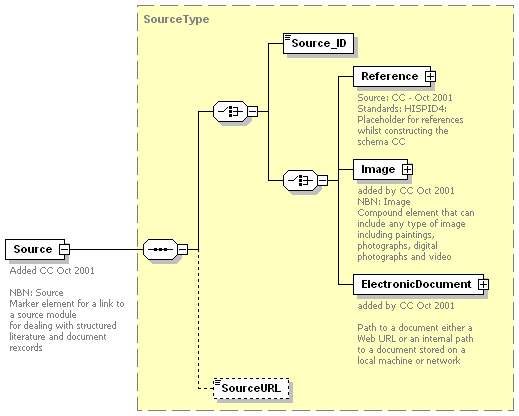 |
||||||||||||
| type | SourceType | ||||||||||||
| children | Source_ID Reference Image ElectronicDocument SourceURL | ||||||||||||
| attributes |
|
||||||||||||
| annotation |
|
||||||||||||
| source | <xs:element name="Source" type="SourceType" minOccurs="0"> <xs:annotation> <xs:documentation>Added CC Oct 2001 NBN: Source Marker element for a link to a source module for dealing with structured literature and document rexcords</xs:documentation> </xs:annotation> </xs:element> |
| diagram | 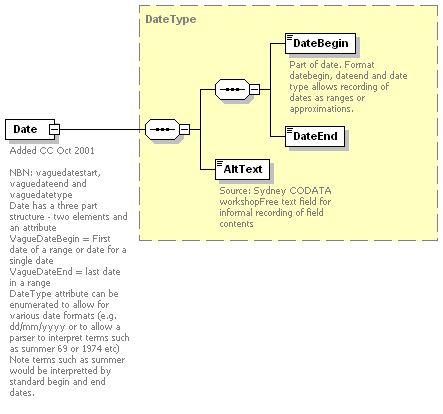 |
||||||||||||
| type | DateType | ||||||||||||
| children | DateBegin DateEnd AltText | ||||||||||||
| attributes |
|
||||||||||||
| annotation |
|
||||||||||||
| source | <xs:element name="Date" type="DateType" minOccurs="0"> <xs:annotation> <xs:documentation>Added CC Oct 2001 NBN: vaguedatestart, vaguedateend and vaguedatetype Date has a three part structure - two elements and an attribute VagueDateBegin = First date of a range or date for a single date VagueDateEnd = last date in a range DateType attribute can be enumerated to allow for various date formats (e.g. dd/mm/yyyy or to allow a parser to interpret terms such as summer 69 or 1974 etc) Note terms such as summer would be interpretted by standard begin and end dates. </xs:documentation> </xs:annotation> </xs:element> |
| diagram | 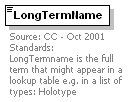 |
||
| type | LongTermName | ||
| annotation |
|
||
| source | <xs:element name="LongTermName" type="LongTermName" minOccurs="0"> <xs:annotation> <xs:documentation>Source: CC - Oct 2001 Standards: LongTermname is the full term that might appear in a lookup table e.g. in a list of types: Holotype</xs:documentation> </xs:annotation> </xs:element> |
| diagram | 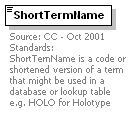 |
||
| type | ShortTermName | ||
| annotation |
|
||
| source | <xs:element name="ShortTermName" type="ShortTermName"> <xs:annotation> <xs:documentation>Source: CC - Oct 2001 Standards: ShortTernName is a code or shortened version of a term that might be used in a database or lookup table e.g. HOLO for Holotype </xs:documentation> </xs:annotation> </xs:element> |
| diagram |  |
||
| type | Language | ||
| annotation |
|
||
| source | <xs:element name="Language" type="Language" minOccurs="0"> <xs:annotation> <xs:documentation>Source: Workshop 1 Standards: - </xs:documentation> </xs:annotation> </xs:element> |
| diagram | 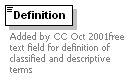 |
||
| type | xs:string | ||
| annotation |
|
||
| source | <xs:element name="Definition" type="xs:string" minOccurs="0"> <xs:annotation> <xs:documentation>Added by CC Oct 2001free text field for definition of classified and descriptive terms</xs:documentation> </xs:annotation> </xs:element> |
| diagram | 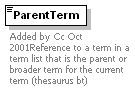 |
||||||||||||
| type | extension of xs:string | ||||||||||||
| attributes |
|
||||||||||||
| annotation |
|
||||||||||||
| source | <xs:element name="ParentTerm" minOccurs="0"> <xs:annotation> <xs:documentation>Added by Cc Oct 2001Reference to a term in a term list that is the parent or broader term for the current term (thesaurus bt)</xs:documentation> </xs:annotation> <xs:complexType> <xs:simpleContent> <xs:extension base="xs:string"> <xs:attribute name="LookupTerm_ID" type="xs:string"/> </xs:extension> </xs:simpleContent> </xs:complexType> </xs:element> |
| diagram | 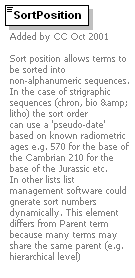 |
||
| type | xs:string | ||
| annotation |
|
||
| source | <xs:element name="SortPosition" type="xs:string" minOccurs="0"> <xs:annotation> <xs:documentation>Added by CC Oct 2001 Sort position allows terms to be sorted into non-alphanumeric sequences. In the case of strigraphic sequences (chron, bio & litho) the sort order can use a 'pseudo-date' based on known radiometric ages e.g. 570 for the base of the Cambrian 210 for the base of the Jurassic etc. In other lists list management software could gnerate sort numbers dynamically. This element differs from Parent term because many terms may share the same parent (e.g. hierarchical level) </xs:documentation> </xs:annotation> </xs:element> |
| diagram | 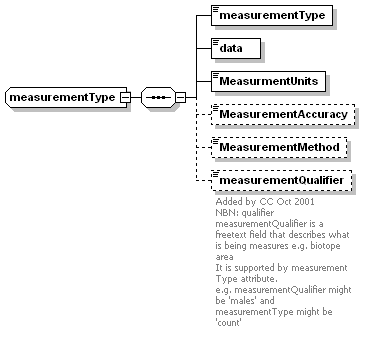 |
||
| children | measurementType data MeasurmentUnits MeasurementAccuracy MeasurementMethod measurementQualifier | ||
| used by |
|
||
| source | <xs:complexType name="measurementType"> <xs:sequence> <xs:element name="measurementType" type="xs:string"/> <xs:element name="data" type="xs:string"/> <xs:element name="MeasurmentUnits" type="xs:string"/> <xs:element name="MeasurementAccuracy" type="xs:string" minOccurs="0"/> <xs:element name="MeasurementMethod" type="xs:string" minOccurs="0"/> <xs:element name="measurementQualifier" type="measurementQualifier" minOccurs="0"> <xs:annotation> <xs:documentation>Added by CC Oct 2001 NBN: qualifier measurementQualifier is a freetext field that describes what is being measures e.g. biotope area It is supported by measurement Type attribute. e.g. measurementQualifier might be 'males' and measurementType might be 'count' </xs:documentation> </xs:annotation> </xs:element> </xs:sequence> </xs:complexType> |
| diagram |  |
| type | xs:string |
| source | <xs:element name="measurementType" type="xs:string"/> |
| diagram |  |
| type | xs:string |
| source | <xs:element name="data" type="xs:string"/> |
| diagram |  |
| type | xs:string |
| source | <xs:element name="MeasurmentUnits" type="xs:string"/> |
| diagram |  |
| type | xs:string |
| source | <xs:element name="MeasurementAccuracy" type="xs:string" minOccurs="0"/> |
| diagram |  |
| type | xs:string |
| source | <xs:element name="MeasurementMethod" type="xs:string" minOccurs="0"/> |
| diagram | 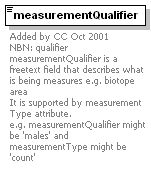 |
||
| type | measurementQualifier | ||
| annotation |
|
||
| source | <xs:element name="measurementQualifier" type="measurementQualifier" minOccurs="0"> <xs:annotation> <xs:documentation>Added by CC Oct 2001 NBN: qualifier measurementQualifier is a freetext field that describes what is being measures e.g. biotope area It is supported by measurement Type attribute. e.g. measurementQualifier might be 'males' and measurementType might be 'count' </xs:documentation> </xs:annotation> </xs:element> |
| diagram | 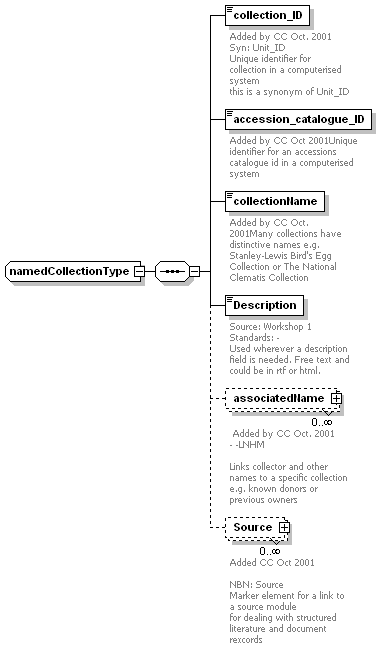 |
||||||||||||||||||
| children | collection_ID accession_catalogue_ID collectionName Description associatedName Source | ||||||||||||||||||
| used by |
|
||||||||||||||||||
| attributes |
|
||||||||||||||||||
| source | <xs:complexType name="namedCollectionType"> <xs:sequence> <xs:element name="collection_ID" type="collection_ID"> <xs:annotation> <xs:documentation>Added by CC Oct. 2001 Syn: Unit_ID Unique identifier for collection in a computerised system this is a synonym of Unit_ID</xs:documentation> </xs:annotation> </xs:element> <xs:element name="accession_catalogue_ID" type="accession_catalogue_ID"> <xs:annotation> <xs:documentation>Added by CC Oct 2001Unique identifier for an accessions catalogue id in a computerised system</xs:documentation> </xs:annotation> </xs:element> <xs:element name="collectionName" type="xs:string"> <xs:annotation> <xs:documentation>Added by CC Oct. 2001Many collections have distinctive names e.g. Stanley-Lewis Bird's Egg Collection or The National Clematis Collection</xs:documentation> </xs:annotation> </xs:element> <xs:element name="Description" type="Description"> <xs:annotation> <xs:documentation>Source: Workshop 1 Standards: - Used wherever a description field is needed. Free text and could be in rtf or html.</xs:documentation> </xs:annotation> </xs:element> <xs:element name="associatedName" minOccurs="0" maxOccurs="unbounded"> <xs:annotation> <xs:documentation> Added by CC Oct. 2001 - -LNHM Links collector and other names to a specific collection e.g. known donors or previous owners</xs:documentation> </xs:annotation> <xs:complexType> <xs:sequence> <xs:element name="name_ID" type="name_ID" minOccurs="0"/> <xs:choice> <xs:element name="Organisation" type="OrganisationType"> <xs:annotation> <xs:documentation>Added by CC Oct 2001Name (elements) for organisations</xs:documentation> </xs:annotation> </xs:element> <xs:element name="PersonName" type="PersonNameType"> <xs:annotation> <xs:documentation>Source: Workshop 1/ changed by CC from old Name Element Standards: - Group element for parts of a personal name - see also name_ID (ref to a database entry) and fullName (free text format)</xs:documentation> </xs:annotation> </xs:element> <xs:element name="AltText" type="AltText"> <xs:annotation> <xs:documentation>Source: Sydney CODATA workshopFree text field for informal recording of field contents</xs:documentation> </xs:annotation> </xs:element> </xs:choice> <xs:element name="role" type="role"> <xs:annotation> <xs:documentation>Added by CC Oct 2001Role played by a person within the element context e.g. Recorder or Botanist in GatheringEvent, Photographer or artist in Image</xs:documentation> </xs:annotation> </xs:element> <xs:element name="Comment" type="Comment"> <xs:annotation> <xs:documentation>Added by CC Oct 2001Free text of formatted text (rtf) description of the feature - not controlled length e.g. often a memo field</xs:documentation> </xs:annotation> </xs:element> </xs:sequence> <xs:attribute name="entered_by" type="xs:string" use="required"/> <xs:attribute name="entry_date" type="xs:string" use="required"/> </xs:complexType> </xs:element> <xs:element name="Source" type="SourceType" minOccurs="0" maxOccurs="unbounded"> <xs:annotation> <xs:documentation>Added CC Oct 2001 NBN: Source Marker element for a link to a source module for dealing with structured literature and document rexcords</xs:documentation> </xs:annotation> </xs:element> </xs:sequence> <xs:attribute name="entered_by" type="xs:string" use="required"/> <xs:attribute name="entry_date" type="xs:string" use="required"/> </xs:complexType> |
| diagram | 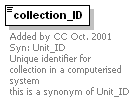 |
||
| type | collection_ID | ||
| annotation |
|
||
| source | <xs:element name="collection_ID" type="collection_ID"> <xs:annotation> <xs:documentation>Added by CC Oct. 2001 Syn: Unit_ID Unique identifier for collection in a computerised system this is a synonym of Unit_ID</xs:documentation> </xs:annotation> </xs:element> |
| diagram | 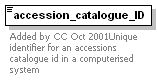 |
||
| type | accession_catalogue_ID | ||
| annotation |
|
||
| source | <xs:element name="accession_catalogue_ID" type="accession_catalogue_ID"> <xs:annotation> <xs:documentation>Added by CC Oct 2001Unique identifier for an accessions catalogue id in a computerised system</xs:documentation> </xs:annotation> </xs:element> |
| diagram | 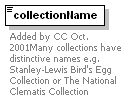 |
||
| type | xs:string | ||
| annotation |
|
||
| source | <xs:element name="collectionName" type="xs:string"> <xs:annotation> <xs:documentation>Added by CC Oct. 2001Many collections have distinctive names e.g. Stanley-Lewis Bird's Egg Collection or The National Clematis Collection</xs:documentation> </xs:annotation> </xs:element> |
| diagram | 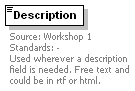 |
||
| type | Description | ||
| annotation |
|
||
| source | <xs:element name="Description" type="Description"> <xs:annotation> <xs:documentation>Source: Workshop 1 Standards: - Used wherever a description field is needed. Free text and could be in rtf or html.</xs:documentation> </xs:annotation> </xs:element> |
| diagram | 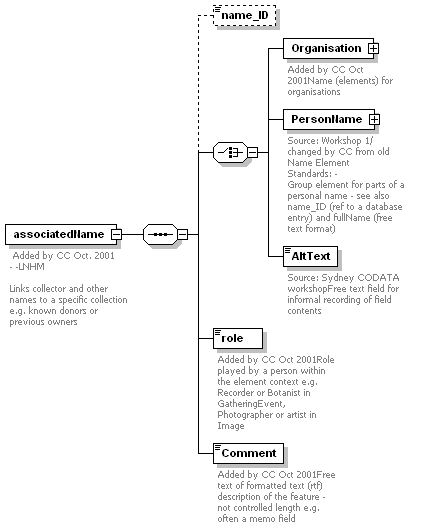 |
||||||||||||||||||
| children | name_ID Organisation PersonName AltText role Comment | ||||||||||||||||||
| attributes |
|
||||||||||||||||||
| annotation |
|
||||||||||||||||||
| source | <xs:element name="associatedName" minOccurs="0" maxOccurs="unbounded"> <xs:annotation> <xs:documentation> Added by CC Oct. 2001 - -LNHM Links collector and other names to a specific collection e.g. known donors or previous owners</xs:documentation> </xs:annotation> <xs:complexType> <xs:sequence> <xs:element name="name_ID" type="name_ID" minOccurs="0"/> <xs:choice> <xs:element name="Organisation" type="OrganisationType"> <xs:annotation> <xs:documentation>Added by CC Oct 2001Name (elements) for organisations</xs:documentation> </xs:annotation> </xs:element> <xs:element name="PersonName" type="PersonNameType"> <xs:annotation> <xs:documentation>Source: Workshop 1/ changed by CC from old Name Element Standards: - Group element for parts of a personal name - see also name_ID (ref to a database entry) and fullName (free text format)</xs:documentation> </xs:annotation> </xs:element> <xs:element name="AltText" type="AltText"> <xs:annotation> <xs:documentation>Source: Sydney CODATA workshopFree text field for informal recording of field contents</xs:documentation> </xs:annotation> </xs:element> </xs:choice> <xs:element name="role" type="role"> <xs:annotation> <xs:documentation>Added by CC Oct 2001Role played by a person within the element context e.g. Recorder or Botanist in GatheringEvent, Photographer or artist in Image</xs:documentation> </xs:annotation> </xs:element> <xs:element name="Comment" type="Comment"> <xs:annotation> <xs:documentation>Added by CC Oct 2001Free text of formatted text (rtf) description of the feature - not controlled length e.g. often a memo field</xs:documentation> </xs:annotation> </xs:element> </xs:sequence> <xs:attribute name="entered_by" type="xs:string" use="required"/> <xs:attribute name="entry_date" type="xs:string" use="required"/> </xs:complexType> </xs:element> |
| diagram |  |
| type | name_ID |
| source | <xs:element name="name_ID" type="name_ID" minOccurs="0"/> |
| diagram | 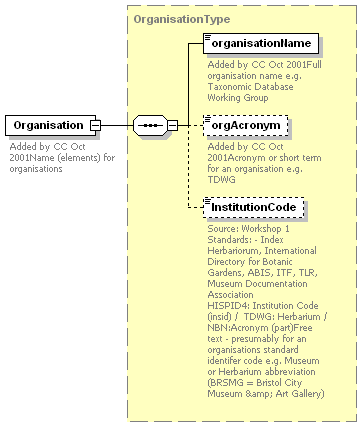 |
||
| type | OrganisationType | ||
| children | organisationName orgAcronym InstitutionCode | ||
| annotation |
|
||
| source | <xs:element name="Organisation" type="OrganisationType"> <xs:annotation> <xs:documentation>Added by CC Oct 2001Name (elements) for organisations</xs:documentation> </xs:annotation> </xs:element> |
| diagram | 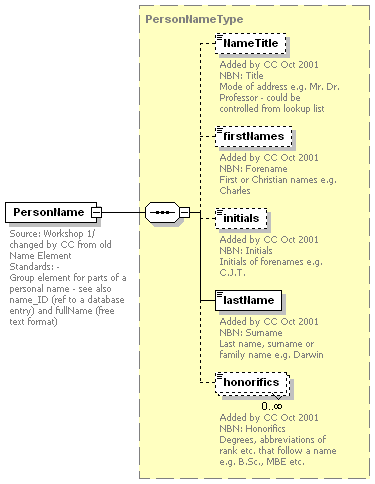 |
||
| type | PersonNameType | ||
| children | NameTitle firstNames initials lastName honorifics | ||
| annotation |
|
||
| source | <xs:element name="PersonName" type="PersonNameType"> <xs:annotation> <xs:documentation>Source: Workshop 1/ changed by CC from old Name Element Standards: - Group element for parts of a personal name - see also name_ID (ref to a database entry) and fullName (free text format)</xs:documentation> </xs:annotation> </xs:element> |
| diagram | 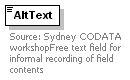 |
||
| type | AltText | ||
| annotation |
|
||
| source | <xs:element name="AltText" type="AltText"> <xs:annotation> <xs:documentation>Source: Sydney CODATA workshopFree text field for informal recording of field contents</xs:documentation> </xs:annotation> </xs:element> |
| diagram | 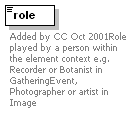 |
||
| type | role | ||
| annotation |
|
||
| source | <xs:element name="role" type="role"> <xs:annotation> <xs:documentation>Added by CC Oct 2001Role played by a person within the element context e.g. Recorder or Botanist in GatheringEvent, Photographer or artist in Image</xs:documentation> </xs:annotation> </xs:element> |
| diagram | 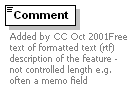 |
||
| type | Comment | ||
| annotation |
|
||
| source | <xs:element name="Comment" type="Comment"> <xs:annotation> <xs:documentation>Added by CC Oct 2001Free text of formatted text (rtf) description of the feature - not controlled length e.g. often a memo field</xs:documentation> </xs:annotation> </xs:element> |
| diagram | 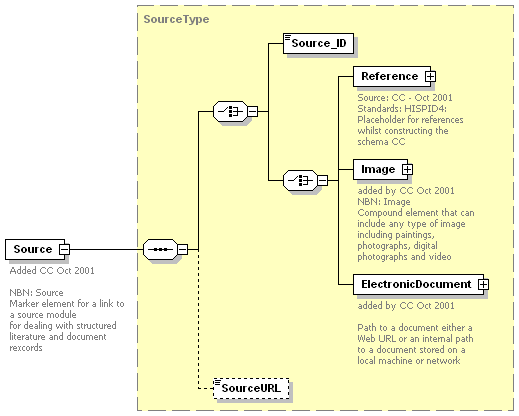 |
||||||||||||
| type | SourceType | ||||||||||||
| children | Source_ID Reference Image ElectronicDocument SourceURL | ||||||||||||
| attributes |
|
||||||||||||
| annotation |
|
||||||||||||
| source | <xs:element name="Source" type="SourceType" minOccurs="0" maxOccurs="unbounded"> <xs:annotation> <xs:documentation>Added CC Oct 2001 NBN: Source Marker element for a link to a source module for dealing with structured literature and document rexcords</xs:documentation> </xs:annotation> </xs:element> |
| diagram | 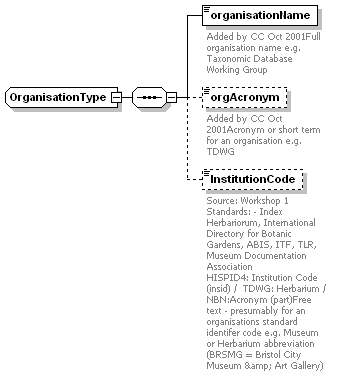 |
||
| children | organisationName orgAcronym InstitutionCode | ||
| used by |
|
||
| source | <xs:complexType name="OrganisationType"> <xs:sequence> <xs:element name="organisationName" type="organisationName"> <xs:annotation> <xs:documentation>Added by CC Oct 2001Full organisation name e.g. Taxonomic Database Working Group</xs:documentation> </xs:annotation> </xs:element> <xs:element name="orgAcronym" type="xs:string" minOccurs="0"> <xs:annotation> <xs:documentation>Added by CC Oct 2001Acronym or short term for an organisation e.g. TDWG</xs:documentation> </xs:annotation> </xs:element> <xs:element name="InstitutionCode" type="InstitutionCode" minOccurs="0"> <xs:annotation> <xs:documentation>Source: Workshop 1 Standards: - Index Herbariorum, International Directory for Botanic Gardens, ABIS, ITF, TLR, Museum Documentation Association HISPID4: Institution Code (insid) / TDWG: Herbarium / NBN:Acronym (part)Free text - presumably for an organisations standard identifer code e.g. Museum or Herbarium abbreviation (BRSMG = Bristol City Museum & Art Gallery) </xs:documentation> </xs:annotation> </xs:element> </xs:sequence> </xs:complexType> |
| diagram |  |
||
| type | organisationName | ||
| annotation |
|
||
| source | <xs:element name="organisationName" type="organisationName"> <xs:annotation> <xs:documentation>Added by CC Oct 2001Full organisation name e.g. Taxonomic Database Working Group</xs:documentation> </xs:annotation> </xs:element> |
| diagram |  |
||
| type | xs:string | ||
| annotation |
|
||
| source | <xs:element name="orgAcronym" type="xs:string" minOccurs="0"> <xs:annotation> <xs:documentation>Added by CC Oct 2001Acronym or short term for an organisation e.g. TDWG</xs:documentation> </xs:annotation> </xs:element> |
| diagram |  |
||
| type | InstitutionCode | ||
| annotation |
|
||
| source | <xs:element name="InstitutionCode" type="InstitutionCode" minOccurs="0"> <xs:annotation> <xs:documentation>Source: Workshop 1 Standards: - Index Herbariorum, International Directory for Botanic Gardens, ABIS, ITF, TLR, Museum Documentation Association HISPID4: Institution Code (insid) / TDWG: Herbarium / NBN:Acronym (part)Free text - presumably for an organisations standard identifer code e.g. Museum or Herbarium abbreviation (BRSMG = Bristol City Museum & Art Gallery) </xs:documentation> </xs:annotation> </xs:element> |
| diagram | 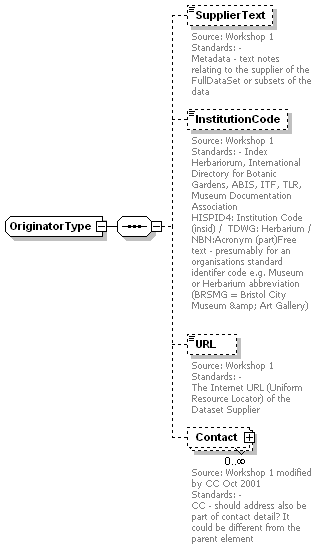 |
||
| children | SupplierText InstitutionCode URL Contact | ||
| used by |
|
||
| source | <xs:complexType name="OriginatorType"> <xs:sequence> <xs:element name="SupplierText" type="SupplierText" minOccurs="0"> <xs:annotation> <xs:documentation>Source: Workshop 1 Standards: - Metadata - text notes relating to the supplier of the FullDataSet or subsets of the data</xs:documentation> </xs:annotation> </xs:element> <xs:element name="InstitutionCode" type="InstitutionCode" minOccurs="0"> <xs:annotation> <xs:documentation>Source: Workshop 1 Standards: - Index Herbariorum, International Directory for Botanic Gardens, ABIS, ITF, TLR, Museum Documentation Association HISPID4: Institution Code (insid) / TDWG: Herbarium / NBN:Acronym (part)Free text - presumably for an organisations standard identifer code e.g. Museum or Herbarium abbreviation (BRSMG = Bristol City Museum & Art Gallery) </xs:documentation> </xs:annotation> </xs:element> <xs:element name="URL" type="URL" minOccurs="0"> <xs:annotation> <xs:documentation>Source: Workshop 1 Standards: - The Internet URL (Uniform Resource Locator) of the Dataset Supplier</xs:documentation> </xs:annotation> </xs:element> <xs:element name="Contact" type="ContactType" minOccurs="0" maxOccurs="unbounded"> <xs:annotation> <xs:documentation>Source: Workshop 1 modified by CC Oct 2001 Standards: - CC - should address also be part of contact detail? It could be different from the parent element</xs:documentation> </xs:annotation> </xs:element> </xs:sequence> </xs:complexType> |
| diagram |  |
||
| type | SupplierText | ||
| annotation |
|
||
| source | <xs:element name="SupplierText" type="SupplierText" minOccurs="0"> <xs:annotation> <xs:documentation>Source: Workshop 1 Standards: - Metadata - text notes relating to the supplier of the FullDataSet or subsets of the data</xs:documentation> </xs:annotation> </xs:element> |
| diagram |  |
||
| type | InstitutionCode | ||
| annotation |
|
||
| source | <xs:element name="InstitutionCode" type="InstitutionCode" minOccurs="0"> <xs:annotation> <xs:documentation>Source: Workshop 1 Standards: - Index Herbariorum, International Directory for Botanic Gardens, ABIS, ITF, TLR, Museum Documentation Association HISPID4: Institution Code (insid) / TDWG: Herbarium / NBN:Acronym (part)Free text - presumably for an organisations standard identifer code e.g. Museum or Herbarium abbreviation (BRSMG = Bristol City Museum & Art Gallery) </xs:documentation> </xs:annotation> </xs:element> |
| diagram |  |
||
| type | URL | ||
| annotation |
|
||
| source | <xs:element name="URL" type="URL" minOccurs="0"> <xs:annotation> <xs:documentation>Source: Workshop 1 Standards: - The Internet URL (Uniform Resource Locator) of the Dataset Supplier</xs:documentation> </xs:annotation> </xs:element> |
| diagram | 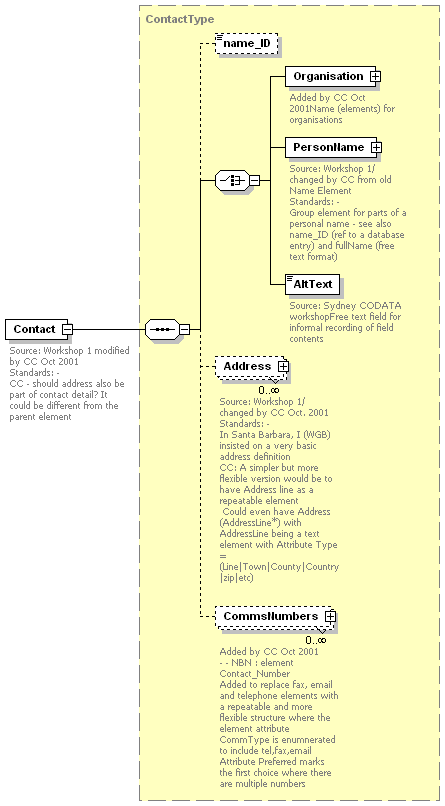 |
||
| type | ContactType | ||
| children | name_ID Organisation PersonName AltText Address CommsNumbers | ||
| annotation |
|
||
| source | <xs:element name="Contact" type="ContactType" minOccurs="0" maxOccurs="unbounded"> <xs:annotation> <xs:documentation>Source: Workshop 1 modified by CC Oct 2001 Standards: - CC - should address also be part of contact detail? It could be different from the parent element</xs:documentation> </xs:annotation> </xs:element> |
| diagram | 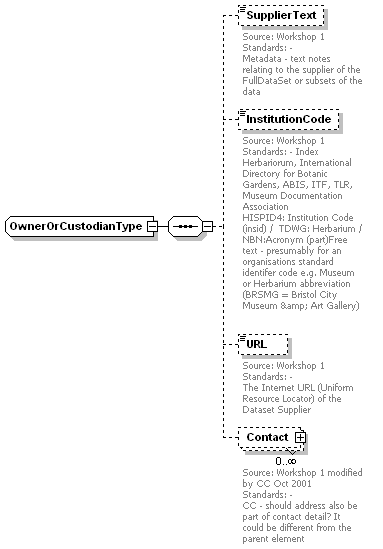 |
||
| children | SupplierText InstitutionCode URL Contact | ||
| used by |
|
||
| source | <xs:complexType name="OwnerOrCustodianType"> <xs:sequence> <xs:element name="SupplierText" type="SupplierText" minOccurs="0"> <xs:annotation> <xs:documentation>Source: Workshop 1 Standards: - Metadata - text notes relating to the supplier of the FullDataSet or subsets of the data</xs:documentation> </xs:annotation> </xs:element> <xs:element name="InstitutionCode" type="InstitutionCode" minOccurs="0"> <xs:annotation> <xs:documentation>Source: Workshop 1 Standards: - Index Herbariorum, International Directory for Botanic Gardens, ABIS, ITF, TLR, Museum Documentation Association HISPID4: Institution Code (insid) / TDWG: Herbarium / NBN:Acronym (part)Free text - presumably for an organisations standard identifer code e.g. Museum or Herbarium abbreviation (BRSMG = Bristol City Museum & Art Gallery) </xs:documentation> </xs:annotation> </xs:element> <xs:element name="URL" type="URL" minOccurs="0"> <xs:annotation> <xs:documentation>Source: Workshop 1 Standards: - The Internet URL (Uniform Resource Locator) of the Dataset Supplier</xs:documentation> </xs:annotation> </xs:element> <xs:element name="Contact" type="ContactType" minOccurs="0" maxOccurs="unbounded"> <xs:annotation> <xs:documentation>Source: Workshop 1 modified by CC Oct 2001 Standards: - CC - should address also be part of contact detail? It could be different from the parent element</xs:documentation> </xs:annotation> </xs:element> </xs:sequence> </xs:complexType> |
| diagram |  |
||
| type | SupplierText | ||
| annotation |
|
||
| source | <xs:element name="SupplierText" type="SupplierText" minOccurs="0"> <xs:annotation> <xs:documentation>Source: Workshop 1 Standards: - Metadata - text notes relating to the supplier of the FullDataSet or subsets of the data</xs:documentation> </xs:annotation> </xs:element> |
| diagram |  |
||
| type | InstitutionCode | ||
| annotation |
|
||
| source | <xs:element name="InstitutionCode" type="InstitutionCode" minOccurs="0"> <xs:annotation> <xs:documentation>Source: Workshop 1 Standards: - Index Herbariorum, International Directory for Botanic Gardens, ABIS, ITF, TLR, Museum Documentation Association HISPID4: Institution Code (insid) / TDWG: Herbarium / NBN:Acronym (part)Free text - presumably for an organisations standard identifer code e.g. Museum or Herbarium abbreviation (BRSMG = Bristol City Museum & Art Gallery) </xs:documentation> </xs:annotation> </xs:element> |
| diagram |  |
||
| type | URL | ||
| annotation |
|
||
| source | <xs:element name="URL" type="URL" minOccurs="0"> <xs:annotation> <xs:documentation>Source: Workshop 1 Standards: - The Internet URL (Uniform Resource Locator) of the Dataset Supplier</xs:documentation> </xs:annotation> </xs:element> |
| diagram | 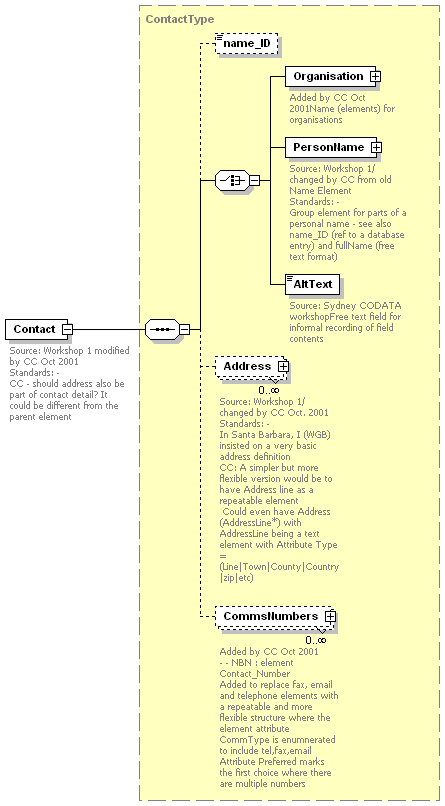 |
||
| type | ContactType | ||
| children | name_ID Organisation PersonName AltText Address CommsNumbers | ||
| annotation |
|
||
| source | <xs:element name="Contact" type="ContactType" minOccurs="0" maxOccurs="unbounded"> <xs:annotation> <xs:documentation>Source: Workshop 1 modified by CC Oct 2001 Standards: - CC - should address also be part of contact detail? It could be different from the parent element</xs:documentation> </xs:annotation> </xs:element> |
| diagram | 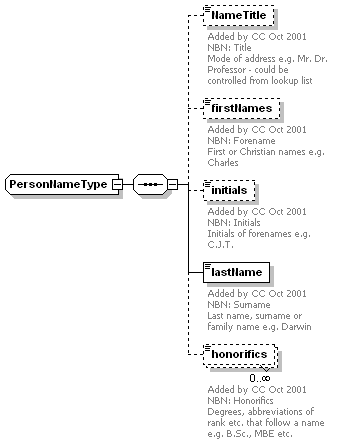 |
||
| children | NameTitle firstNames initials lastName honorifics | ||
| used by |
|
||
| source | <xs:complexType name="PersonNameType"> <xs:sequence> <xs:element name="NameTitle" type="xs:string" minOccurs="0"> <xs:annotation> <xs:documentation>Added by CC Oct 2001 NBN: Title Mode of address e.g. Mr. Dr. Professor - could be controlled from lookup list</xs:documentation> </xs:annotation> </xs:element> <xs:element name="firstNames" type="xs:string" minOccurs="0"> <xs:annotation> <xs:documentation>Added by CC Oct 2001 NBN: Forename First or Christian names e.g. Charles</xs:documentation> </xs:annotation> </xs:element> <xs:element name="initials" type="xs:string" minOccurs="0"> <xs:annotation> <xs:documentation>Added by CC Oct 2001 NBN: Initials Initials of forenames e.g. C.J.T.</xs:documentation> </xs:annotation> </xs:element> <xs:element name="lastName" type="xs:string"> <xs:annotation> <xs:documentation>Added by CC Oct 2001 NBN: Surname Last name, surname or family name e.g. Darwin</xs:documentation> </xs:annotation> </xs:element> <xs:element name="honorifics" type="xs:string" minOccurs="0" maxOccurs="unbounded"> <xs:annotation> <xs:documentation>Added by CC Oct 2001 NBN: Honorifics Degrees, abbreviations of rank etc. that follow a name e.g. B.Sc., MBE etc.</xs:documentation> </xs:annotation> </xs:element> </xs:sequence> </xs:complexType> |
| diagram | 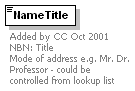 |
||
| type | xs:string | ||
| annotation |
|
||
| source | <xs:element name="NameTitle" type="xs:string" minOccurs="0"> <xs:annotation> <xs:documentation>Added by CC Oct 2001 NBN: Title Mode of address e.g. Mr. Dr. Professor - could be controlled from lookup list</xs:documentation> </xs:annotation> </xs:element> |
| diagram | 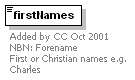 |
||
| type | xs:string | ||
| annotation |
|
||
| source | <xs:element name="firstNames" type="xs:string" minOccurs="0"> <xs:annotation> <xs:documentation>Added by CC Oct 2001 NBN: Forename First or Christian names e.g. Charles</xs:documentation> </xs:annotation> </xs:element> |
| diagram | 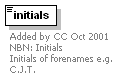 |
||
| type | xs:string | ||
| annotation |
|
||
| source | <xs:element name="initials" type="xs:string" minOccurs="0"> <xs:annotation> <xs:documentation>Added by CC Oct 2001 NBN: Initials Initials of forenames e.g. C.J.T.</xs:documentation> </xs:annotation> </xs:element> |
| diagram | 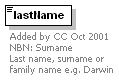 |
||
| type | xs:string | ||
| annotation |
|
||
| source | <xs:element name="lastName" type="xs:string"> <xs:annotation> <xs:documentation>Added by CC Oct 2001 NBN: Surname Last name, surname or family name e.g. Darwin</xs:documentation> </xs:annotation> </xs:element> |
| diagram | 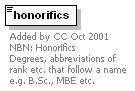 |
||
| type | xs:string | ||
| annotation |
|
||
| source | <xs:element name="honorifics" type="xs:string" minOccurs="0" maxOccurs="unbounded"> <xs:annotation> <xs:documentation>Added by CC Oct 2001 NBN: Honorifics Degrees, abbreviations of rank etc. that follow a name e.g. B.Sc., MBE etc.</xs:documentation> </xs:annotation> </xs:element> |
| diagram |  |
||||||||||||
| type | extension of xs:string | ||||||||||||
| used by |
|
||||||||||||
| attributes |
|
||||||||||||
| source | <xs:complexType name="RefCatNumberType"> <xs:simpleContent> <xs:extension base="xs:string"> <xs:attribute name="NumberType"> <xs:simpleType> <xs:restriction base="xs:NMTOKEN"> <xs:enumeration value="ISBN"/> <xs:enumeration value="ISSN"/> <xs:enumeration value="LibraryCongress"/> <xs:enumeration value="Internal"/> <xs:enumeration value="other"/> </xs:restriction> </xs:simpleType> </xs:attribute> </xs:extension> </xs:simpleContent> </xs:complexType> |
| diagram | 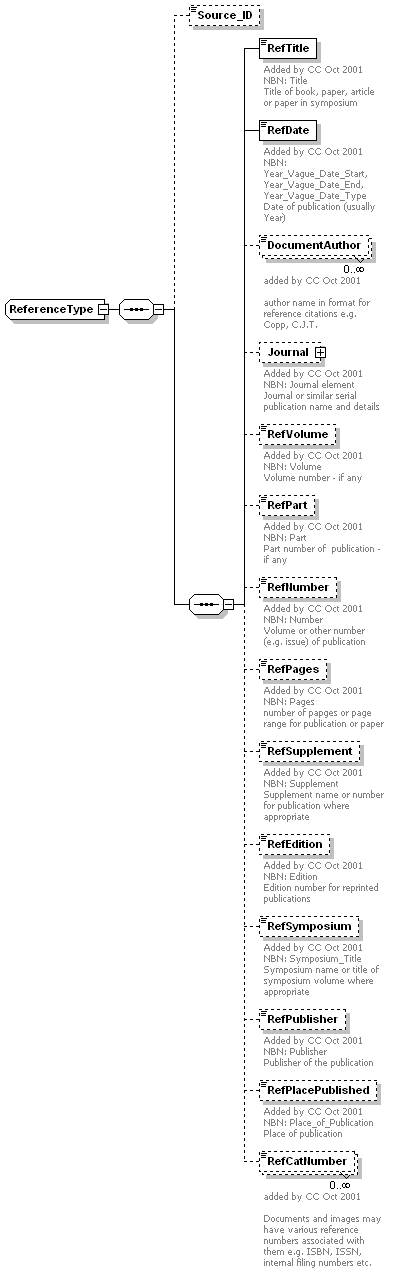 |
||||||||||||
| children | Source_ID RefTitle RefDate DocumentAuthor Journal RefVolume RefPart RefNumber RefPages RefSupplement RefEdition RefSymposium RefPublisher RefPlacePublished RefCatNumber | ||||||||||||
| used by |
|
||||||||||||
| attributes |
|
||||||||||||
| source | <xs:complexType name="ReferenceType"> <xs:sequence> <xs:element name="Source_ID" type="Source_ID" minOccurs="0"/> <xs:sequence> <xs:element name="RefTitle" type="xs:string"> <xs:annotation> <xs:documentation>Added by CC Oct 2001 NBN: Title Title of book, paper, article or paper in symposium</xs:documentation> </xs:annotation> </xs:element> <xs:element name="RefDate" type="xs:string"> <xs:annotation> <xs:documentation>Added by CC Oct 2001 NBN: Year_Vague_Date_Start, Year_Vague_Date_End, Year_Vague_Date_Type Date of publication (usually Year)</xs:documentation> </xs:annotation> </xs:element> <xs:element name="DocumentAuthor" type="DocumentAuthor" minOccurs="0" maxOccurs="unbounded"> <xs:annotation> <xs:documentation>added by CC Oct 2001 author name in format for reference citations e.g. Copp, C.J.T.</xs:documentation> </xs:annotation> </xs:element> <xs:element name="Journal" minOccurs="0"> <xs:annotation> <xs:documentation>Added by CC Oct 2001 NBN: Journal element Journal or similar serial publication name and details</xs:documentation> </xs:annotation> <xs:complexType> <xs:sequence> <xs:element name="journal_ID" type="xs:string" minOccurs="0"> <xs:annotation> <xs:documentation>Added by CC Oct 2001 NBN: Journal_Key Unique identifier in a database </xs:documentation> </xs:annotation> </xs:element> <xs:element name="ShortTermName" type="ShortTermName"> <xs:annotation> <xs:documentation>Source: CC - Oct 2001 Standards: ShortTernName is a code or shortened version of a term that might be used in a database or lookup table e.g. HOLO for Holotype</xs:documentation> </xs:annotation> </xs:element> <xs:element name="LongTermName" type="LongTermName" minOccurs="0"> <xs:annotation> <xs:documentation>Source: CC - Oct 2001 Standards: LongTermname is the full term that might appear in a lookup table e.g. in a list of types: Holotype</xs:documentation> </xs:annotation> </xs:element> <xs:element name="RefPublisher" type="RefPublisher" minOccurs="0"> <xs:annotation> <xs:documentation>Added by CC Oct 2001 NBN: Publisher Publisher of the publication</xs:documentation> </xs:annotation> </xs:element> <xs:element name="Description" type="Description" minOccurs="0"> <xs:annotation> <xs:documentation>Source: Workshop 1 Standards: - Used wherever a description field is needed. Free text and could be in rtf or html.</xs:documentation> </xs:annotation> </xs:element> </xs:sequence> </xs:complexType> </xs:element> <xs:element name="RefVolume" type="xs:string" minOccurs="0"> <xs:annotation> <xs:documentation>Added by CC Oct 2001 NBN: Volume Volume number - if any</xs:documentation> </xs:annotation> </xs:element> <xs:element name="RefPart" type="xs:string" minOccurs="0"> <xs:annotation> <xs:documentation>Added by CC Oct 2001 NBN: Part Part number of publication - if any</xs:documentation> </xs:annotation> </xs:element> <xs:element name="RefNumber" type="xs:string" minOccurs="0"> <xs:annotation> <xs:documentation>Added by CC Oct 2001 NBN: Number Volume or other number (e.g. issue) of publication</xs:documentation> </xs:annotation> </xs:element> <xs:element name="RefPages" type="xs:string" minOccurs="0"> <xs:annotation> <xs:documentation>Added by CC Oct 2001 NBN: Pages number of papges or page range for publication or paper</xs:documentation> </xs:annotation> </xs:element> <xs:element name="RefSupplement" type="xs:string" minOccurs="0"> <xs:annotation> <xs:documentation>Added by CC Oct 2001 NBN: Supplement Supplement name or number for publication where appropriate</xs:documentation> </xs:annotation> </xs:element> <xs:element name="RefEdition" type="xs:string" minOccurs="0"> <xs:annotation> <xs:documentation>Added by CC Oct 2001 NBN: Edition Edition number for reprinted publications</xs:documentation> </xs:annotation> </xs:element> <xs:element name="RefSymposium" type="xs:string" minOccurs="0"> <xs:annotation> <xs:documentation>Added by CC Oct 2001 NBN: Symposium_Title Symposium name or title of symposium volume where appropriate</xs:documentation> </xs:annotation> </xs:element> <xs:element name="RefPublisher" type="RefPublisher" minOccurs="0"> <xs:annotation> <xs:documentation>Added by CC Oct 2001 NBN: Publisher Publisher of the publication</xs:documentation> </xs:annotation> </xs:element> <xs:element name="RefPlacePublished" type="xs:string" minOccurs="0"> <xs:annotation> <xs:documentation>Added by CC Oct 2001 NBN: Place_of_Publication Place of publication</xs:documentation> </xs:annotation> </xs:element> <xs:element name="RefCatNumber" type="RefCatNumberType" minOccurs="0" maxOccurs="unbounded"> <xs:annotation> <xs:documentation>added by CC Oct 2001 Documents and images may have various reference numbers associated with them e.g. ISBN, ISSN, internal filing numbers etc.</xs:documentation> </xs:annotation> </xs:element> </xs:sequence> </xs:sequence> <xs:attribute name="RefType" use="required"> <xs:simpleType> <xs:restriction base="xs:NMTOKEN"> <xs:enumeration value="book"/> <xs:enumeration value="article"/> <xs:enumeration value="paper"/> <xs:enumeration value="symposium"/> <xs:enumeration value="manuscript"/> <xs:enumeration value="fieldnotebook"/> <xs:enumeration value="other"/> </xs:restriction> </xs:simpleType> </xs:attribute> </xs:complexType> |
| diagram |  |
| type | Source_ID |
| source | <xs:element name="Source_ID" type="Source_ID" minOccurs="0"/> |
| diagram |  |
||
| type | xs:string | ||
| annotation |
|
||
| source | <xs:element name="RefTitle" type="xs:string"> <xs:annotation> <xs:documentation>Added by CC Oct 2001 NBN: Title Title of book, paper, article or paper in symposium</xs:documentation> </xs:annotation> </xs:element> |
| diagram | 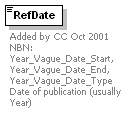 |
||
| type | xs:string | ||
| annotation |
|
||
| source | <xs:element name="RefDate" type="xs:string"> <xs:annotation> <xs:documentation>Added by CC Oct 2001 NBN: Year_Vague_Date_Start, Year_Vague_Date_End, Year_Vague_Date_Type Date of publication (usually Year)</xs:documentation> </xs:annotation> </xs:element> |
| diagram | 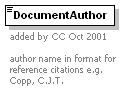 |
||
| type | DocumentAuthor | ||
| annotation |
|
||
| source | <xs:element name="DocumentAuthor" type="DocumentAuthor" minOccurs="0" maxOccurs="unbounded"> <xs:annotation> <xs:documentation>added by CC Oct 2001 author name in format for reference citations e.g. Copp, C.J.T.</xs:documentation> </xs:annotation> </xs:element> |
| diagram | 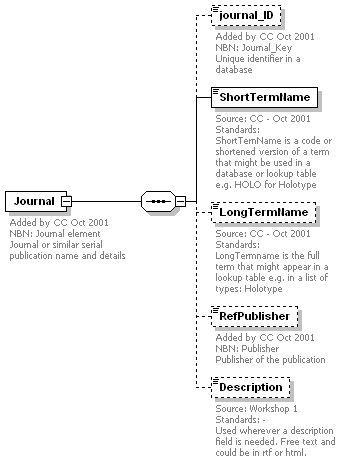 |
||
| children | journal_ID ShortTermName LongTermName RefPublisher Description | ||
| annotation |
|
||
| source | <xs:element name="Journal" minOccurs="0"> <xs:annotation> <xs:documentation>Added by CC Oct 2001 NBN: Journal element Journal or similar serial publication name and details</xs:documentation> </xs:annotation> <xs:complexType> <xs:sequence> <xs:element name="journal_ID" type="xs:string" minOccurs="0"> <xs:annotation> <xs:documentation>Added by CC Oct 2001 NBN: Journal_Key Unique identifier in a database </xs:documentation> </xs:annotation> </xs:element> <xs:element name="ShortTermName" type="ShortTermName"> <xs:annotation> <xs:documentation>Source: CC - Oct 2001 Standards: ShortTernName is a code or shortened version of a term that might be used in a database or lookup table e.g. HOLO for Holotype</xs:documentation> </xs:annotation> </xs:element> <xs:element name="LongTermName" type="LongTermName" minOccurs="0"> <xs:annotation> <xs:documentation>Source: CC - Oct 2001 Standards: LongTermname is the full term that might appear in a lookup table e.g. in a list of types: Holotype</xs:documentation> </xs:annotation> </xs:element> <xs:element name="RefPublisher" type="RefPublisher" minOccurs="0"> <xs:annotation> <xs:documentation>Added by CC Oct 2001 NBN: Publisher Publisher of the publication</xs:documentation> </xs:annotation> </xs:element> <xs:element name="Description" type="Description" minOccurs="0"> <xs:annotation> <xs:documentation>Source: Workshop 1 Standards: - Used wherever a description field is needed. Free text and could be in rtf or html.</xs:documentation> </xs:annotation> </xs:element> </xs:sequence> </xs:complexType> </xs:element> |
| diagram | 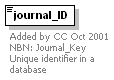 |
||
| type | xs:string | ||
| annotation |
|
||
| source | <xs:element name="journal_ID" type="xs:string" minOccurs="0"> <xs:annotation> <xs:documentation>Added by CC Oct 2001 NBN: Journal_Key Unique identifier in a database </xs:documentation> </xs:annotation> </xs:element> |
| diagram | 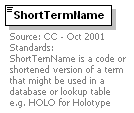 |
||
| type | ShortTermName | ||
| annotation |
|
||
| source | <xs:element name="ShortTermName" type="ShortTermName"> <xs:annotation> <xs:documentation>Source: CC - Oct 2001 Standards: ShortTernName is a code or shortened version of a term that might be used in a database or lookup table e.g. HOLO for Holotype</xs:documentation> </xs:annotation> </xs:element> |
| diagram | 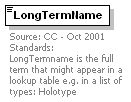 |
||
| type | LongTermName | ||
| annotation |
|
||
| source | <xs:element name="LongTermName" type="LongTermName" minOccurs="0"> <xs:annotation> <xs:documentation>Source: CC - Oct 2001 Standards: LongTermname is the full term that might appear in a lookup table e.g. in a list of types: Holotype</xs:documentation> </xs:annotation> </xs:element> |
| diagram |  |
||
| type | RefPublisher | ||
| annotation |
|
||
| source | <xs:element name="RefPublisher" type="RefPublisher" minOccurs="0"> <xs:annotation> <xs:documentation>Added by CC Oct 2001 NBN: Publisher Publisher of the publication</xs:documentation> </xs:annotation> </xs:element> |
| diagram | 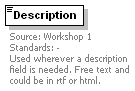 |
||
| type | Description | ||
| annotation |
|
||
| source | <xs:element name="Description" type="Description" minOccurs="0"> <xs:annotation> <xs:documentation>Source: Workshop 1 Standards: - Used wherever a description field is needed. Free text and could be in rtf or html.</xs:documentation> </xs:annotation> </xs:element> |
| diagram |  |
||
| type | xs:string | ||
| annotation |
|
||
| source | <xs:element name="RefVolume" type="xs:string" minOccurs="0"> <xs:annotation> <xs:documentation>Added by CC Oct 2001 NBN: Volume Volume number - if any</xs:documentation> </xs:annotation> </xs:element> |
| diagram |  |
||
| type | xs:string | ||
| annotation |
|
||
| source | <xs:element name="RefPart" type="xs:string" minOccurs="0"> <xs:annotation> <xs:documentation>Added by CC Oct 2001 NBN: Part Part number of publication - if any</xs:documentation> </xs:annotation> </xs:element> |
| diagram |  |
||
| type | xs:string | ||
| annotation |
|
||
| source | <xs:element name="RefNumber" type="xs:string" minOccurs="0"> <xs:annotation> <xs:documentation>Added by CC Oct 2001 NBN: Number Volume or other number (e.g. issue) of publication</xs:documentation> </xs:annotation> </xs:element> |
| diagram |  |
||
| type | xs:string | ||
| annotation |
|
||
| source | <xs:element name="RefPages" type="xs:string" minOccurs="0"> <xs:annotation> <xs:documentation>Added by CC Oct 2001 NBN: Pages number of papges or page range for publication or paper</xs:documentation> </xs:annotation> </xs:element> |
| diagram |  |
||
| type | xs:string | ||
| annotation |
|
||
| source | <xs:element name="RefSupplement" type="xs:string" minOccurs="0"> <xs:annotation> <xs:documentation>Added by CC Oct 2001 NBN: Supplement Supplement name or number for publication where appropriate</xs:documentation> </xs:annotation> </xs:element> |
| diagram |  |
||
| type | xs:string | ||
| annotation |
|
||
| source | <xs:element name="RefEdition" type="xs:string" minOccurs="0"> <xs:annotation> <xs:documentation>Added by CC Oct 2001 NBN: Edition Edition number for reprinted publications</xs:documentation> </xs:annotation> </xs:element> |
| diagram |  |
||
| type | xs:string | ||
| annotation |
|
||
| source | <xs:element name="RefSymposium" type="xs:string" minOccurs="0"> <xs:annotation> <xs:documentation>Added by CC Oct 2001 NBN: Symposium_Title Symposium name or title of symposium volume where appropriate</xs:documentation> </xs:annotation> </xs:element> |
| diagram |  |
||
| type | RefPublisher | ||
| annotation |
|
||
| source | <xs:element name="RefPublisher" type="RefPublisher" minOccurs="0"> <xs:annotation> <xs:documentation>Added by CC Oct 2001 NBN: Publisher Publisher of the publication</xs:documentation> </xs:annotation> </xs:element> |
| diagram |  |
||
| type | xs:string | ||
| annotation |
|
||
| source | <xs:element name="RefPlacePublished" type="xs:string" minOccurs="0"> <xs:annotation> <xs:documentation>Added by CC Oct 2001 NBN: Place_of_Publication Place of publication</xs:documentation> </xs:annotation> </xs:element> |
| diagram |  |
||||||||||||
| type | RefCatNumberType | ||||||||||||
| attributes |
|
||||||||||||
| annotation |
|
||||||||||||
| source | <xs:element name="RefCatNumber" type="RefCatNumberType" minOccurs="0" maxOccurs="unbounded"> <xs:annotation> <xs:documentation>added by CC Oct 2001 Documents and images may have various reference numbers associated with them e.g. ISBN, ISSN, internal filing numbers etc.</xs:documentation> </xs:annotation> </xs:element> |
| diagram | 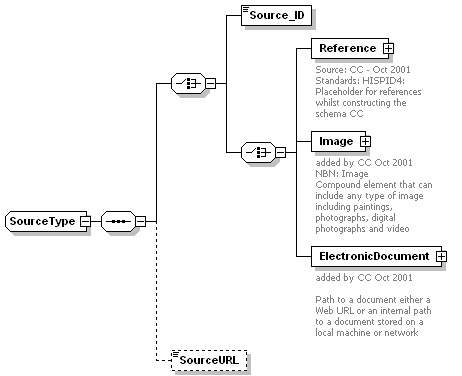 |
||||||||||||
| children | Source_ID Reference Image ElectronicDocument SourceURL | ||||||||||||
| used by |
|
||||||||||||
| attributes |
|
||||||||||||
| source | <xs:complexType name="SourceType"> <xs:sequence> <xs:choice> <xs:element name="Source_ID" type="Source_ID"/> <xs:choice> <xs:element name="Reference" type="ReferenceType"> <xs:annotation> <xs:documentation>Source: CC - Oct 2001 Standards: HISPID4: Placeholder for references whilst constructing the schema CC</xs:documentation> </xs:annotation> </xs:element> <xs:element name="Image" type="ImageType"> <xs:annotation> <xs:documentation>added by CC Oct 2001 NBN: Image Compound element that can include any type of image including paintings, photographs, digital photographs and video</xs:documentation> </xs:annotation> </xs:element> <xs:element name="ElectronicDocument"> <xs:annotation> <xs:documentation>added by CC Oct 2001 Path to a document either a Web URL or an internal path to a document stored on a local machine or network</xs:documentation> </xs:annotation> <xs:complexType> <xs:sequence> <xs:element name="title" type="title"/> <xs:element name="DocumentAuthor" type="DocumentAuthor" minOccurs="0" maxOccurs="unbounded"> <xs:annotation> <xs:documentation>added by CC Oct 2001 author name in format for reference citations e.g. Copp, C.J.T.</xs:documentation> </xs:annotation> </xs:element> <xs:element name="Date" type="DateType"> <xs:annotation> <xs:documentation>Added CC Oct 2001 NBN: vaguedatestart, vaguedateend and vaguedatetype Date has a three part structure - two elements and an attribute VagueDateBegin = First date of a range or date for a single date VagueDateEnd = last date in a range DateType attribute can be enumerated to allow for various date formats (e.g. dd/mm/yyyy or to allow a parser to interpret terms such as summer 69 or 1974 etc) Note terms such as summer would be interpretted by standard begin and end dates. </xs:documentation> </xs:annotation> </xs:element> <xs:element name="FileName" type="xs:string"> <xs:annotation> <xs:documentation>added by CC Oct 2001 The name of the file holding the document e.g. MyDoc.doc or Index.html</xs:documentation> </xs:annotation> </xs:element> <xs:element name="URI" type="URI"> <xs:annotation> <xs:documentation>added by CC Oct 2001 Universal Resource Identifier - Path to electronic source of document either internal or external (e.g. web address)</xs:documentation> </xs:annotation> </xs:element> <xs:element name="RefCatNumber" type="RefCatNumberType" minOccurs="0" maxOccurs="unbounded"> <xs:annotation> <xs:documentation>added by CC Oct 2001 Documents and images may have various reference numbers associated with them e.g. ISBN, ISSN, internal filing numbers etc.</xs:documentation> </xs:annotation> </xs:element> </xs:sequence> <xs:attribute name="URI_Type" type="xs:string"/> </xs:complexType> </xs:element> </xs:choice> </xs:choice> <xs:element name="SourceURL" type="xs:string" minOccurs="0"/> </xs:sequence> <xs:attribute name="SourceType" type="xs:string"/> </xs:complexType> |
| diagram |  |
| type | Source_ID |
| source | <xs:element name="Source_ID" type="Source_ID"/> |
| diagram | 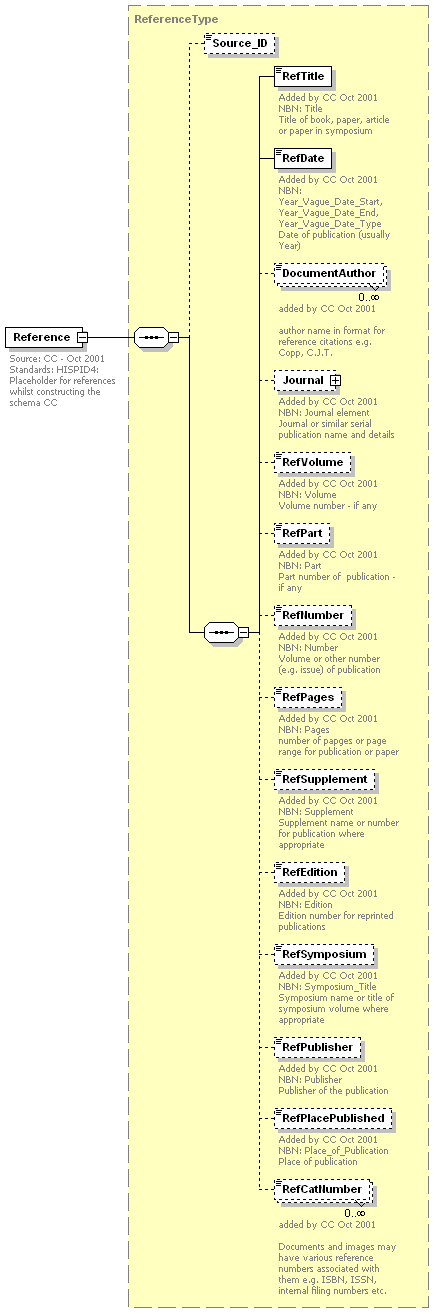 |
||||||||||||
| type | ReferenceType | ||||||||||||
| children | Source_ID RefTitle RefDate DocumentAuthor Journal RefVolume RefPart RefNumber RefPages RefSupplement RefEdition RefSymposium RefPublisher RefPlacePublished RefCatNumber | ||||||||||||
| attributes |
|
||||||||||||
| annotation |
|
||||||||||||
| source | <xs:element name="Reference" type="ReferenceType"> <xs:annotation> <xs:documentation>Source: CC - Oct 2001 Standards: HISPID4: Placeholder for references whilst constructing the schema CC</xs:documentation> </xs:annotation> </xs:element> |
| diagram | 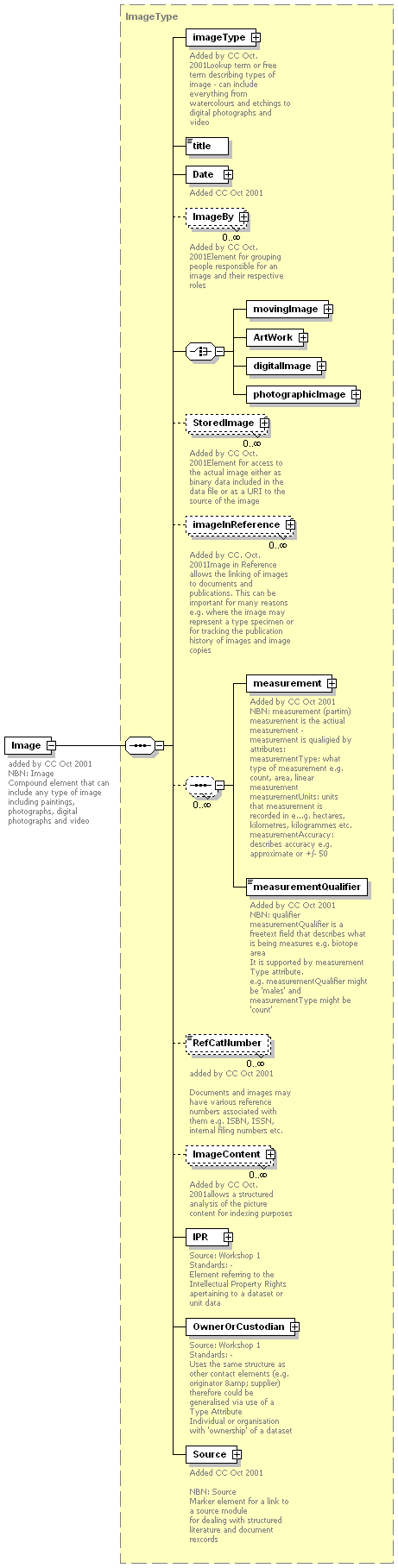 |
||||||||||||
| type | ImageType | ||||||||||||
| children | imageType title Date ImageBy movingImage ArtWork digitalImage photographicImage StoredImage imageInReference measurement measurementQualifier RefCatNumber ImageContent IPR OwnerOrCustodian Source | ||||||||||||
| attributes |
|
||||||||||||
| annotation |
|
||||||||||||
| source | <xs:element name="Image" type="ImageType"> <xs:annotation> <xs:documentation>added by CC Oct 2001 NBN: Image Compound element that can include any type of image including paintings, photographs, digital photographs and video</xs:documentation> </xs:annotation> </xs:element> |
| diagram | 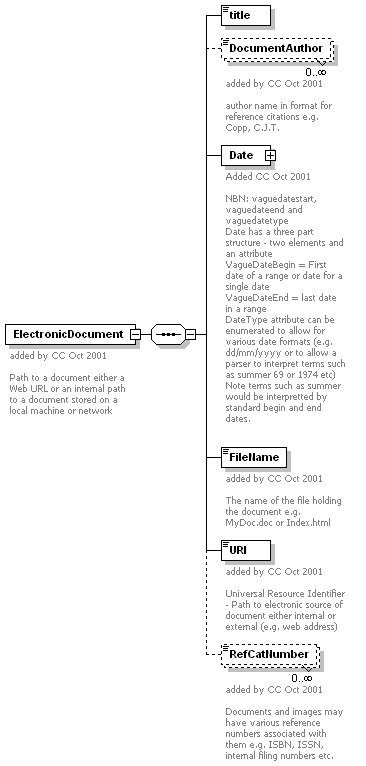 |
||||||||||||
| children | title DocumentAuthor Date FileName URI RefCatNumber | ||||||||||||
| attributes |
|
||||||||||||
| annotation |
|
||||||||||||
| source | <xs:element name="ElectronicDocument"> <xs:annotation> <xs:documentation>added by CC Oct 2001 Path to a document either a Web URL or an internal path to a document stored on a local machine or network</xs:documentation> </xs:annotation> <xs:complexType> <xs:sequence> <xs:element name="title" type="title"/> <xs:element name="DocumentAuthor" type="DocumentAuthor" minOccurs="0" maxOccurs="unbounded"> <xs:annotation> <xs:documentation>added by CC Oct 2001 author name in format for reference citations e.g. Copp, C.J.T.</xs:documentation> </xs:annotation> </xs:element> <xs:element name="Date" type="DateType"> <xs:annotation> <xs:documentation>Added CC Oct 2001 NBN: vaguedatestart, vaguedateend and vaguedatetype Date has a three part structure - two elements and an attribute VagueDateBegin = First date of a range or date for a single date VagueDateEnd = last date in a range DateType attribute can be enumerated to allow for various date formats (e.g. dd/mm/yyyy or to allow a parser to interpret terms such as summer 69 or 1974 etc) Note terms such as summer would be interpretted by standard begin and end dates. </xs:documentation> </xs:annotation> </xs:element> <xs:element name="FileName" type="xs:string"> <xs:annotation> <xs:documentation>added by CC Oct 2001 The name of the file holding the document e.g. MyDoc.doc or Index.html</xs:documentation> </xs:annotation> </xs:element> <xs:element name="URI" type="URI"> <xs:annotation> <xs:documentation>added by CC Oct 2001 Universal Resource Identifier - Path to electronic source of document either internal or external (e.g. web address)</xs:documentation> </xs:annotation> </xs:element> <xs:element name="RefCatNumber" type="RefCatNumberType" minOccurs="0" maxOccurs="unbounded"> <xs:annotation> <xs:documentation>added by CC Oct 2001 Documents and images may have various reference numbers associated with them e.g. ISBN, ISSN, internal filing numbers etc.</xs:documentation> </xs:annotation> </xs:element> </xs:sequence> <xs:attribute name="URI_Type" type="xs:string"/> </xs:complexType> </xs:element> |
| diagram |  |
| type | title |
| source | <xs:element name="title" type="title"/> |
| diagram |  |
||
| type | DocumentAuthor | ||
| annotation |
|
||
| source | <xs:element name="DocumentAuthor" type="DocumentAuthor" minOccurs="0" maxOccurs="unbounded"> <xs:annotation> <xs:documentation>added by CC Oct 2001 author name in format for reference citations e.g. Copp, C.J.T.</xs:documentation> </xs:annotation> </xs:element> |
| diagram | 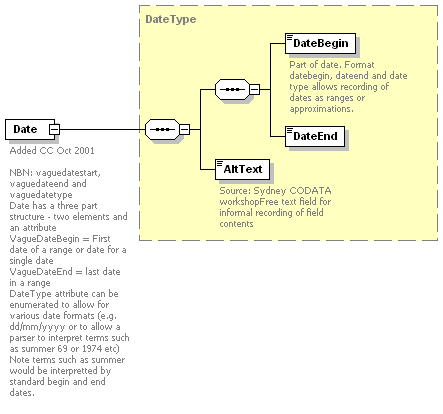 |
||||||||||||
| type | DateType | ||||||||||||
| children | DateBegin DateEnd AltText | ||||||||||||
| attributes |
|
||||||||||||
| annotation |
|
||||||||||||
| source | <xs:element name="Date" type="DateType"> <xs:annotation> <xs:documentation>Added CC Oct 2001 NBN: vaguedatestart, vaguedateend and vaguedatetype Date has a three part structure - two elements and an attribute VagueDateBegin = First date of a range or date for a single date VagueDateEnd = last date in a range DateType attribute can be enumerated to allow for various date formats (e.g. dd/mm/yyyy or to allow a parser to interpret terms such as summer 69 or 1974 etc) Note terms such as summer would be interpretted by standard begin and end dates. </xs:documentation> </xs:annotation> </xs:element> |
| diagram |  |
||
| type | xs:string | ||
| annotation |
|
||
| source | <xs:element name="FileName" type="xs:string"> <xs:annotation> <xs:documentation>added by CC Oct 2001 The name of the file holding the document e.g. MyDoc.doc or Index.html</xs:documentation> </xs:annotation> </xs:element> |
| diagram |  |
||
| type | URI | ||
| annotation |
|
||
| source | <xs:element name="URI" type="URI"> <xs:annotation> <xs:documentation>added by CC Oct 2001 Universal Resource Identifier - Path to electronic source of document either internal or external (e.g. web address)</xs:documentation> </xs:annotation> </xs:element> |
| diagram | 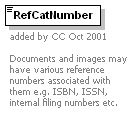 |
||||||||||||
| type | RefCatNumberType | ||||||||||||
| attributes |
|
||||||||||||
| annotation |
|
||||||||||||
| source | <xs:element name="RefCatNumber" type="RefCatNumberType" minOccurs="0" maxOccurs="unbounded"> <xs:annotation> <xs:documentation>added by CC Oct 2001 Documents and images may have various reference numbers associated with them e.g. ISBN, ISSN, internal filing numbers etc.</xs:documentation> </xs:annotation> </xs:element> |
| diagram |  |
| type | xs:string |
| source | <xs:element name="SourceURL" type="xs:string" minOccurs="0"/> |
| diagram | 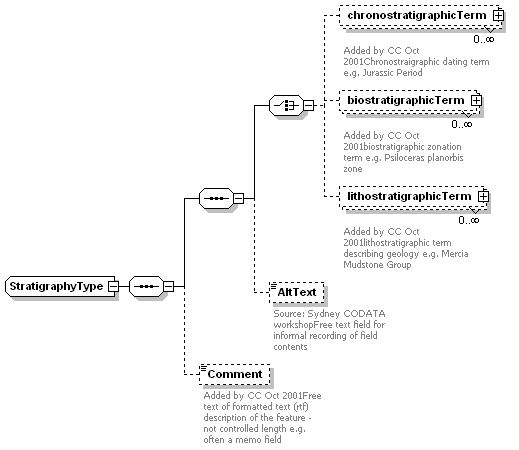 |
||
| children | chronostratigraphicTerm biostratigraphicTerm lithostratigraphicTerm AltText Comment | ||
| used by |
|
||
| source | <xs:complexType name="StratigraphyType"> <xs:sequence> <xs:sequence> <xs:choice> <xs:element name="chronostratigraphicTerm" minOccurs="0" maxOccurs="unbounded"> <xs:annotation> <xs:documentation>Added by CC Oct 2001Chronostraigraphic dating term e.g. Jurassic Period</xs:documentation> </xs:annotation> <xs:complexType> <xs:sequence> <xs:choice> <xs:element name="LookupTerm" type="LookupTermType"> <xs:annotation> <xs:documentation>Added by CC Oct 2001 NBN: Term Typical structure for a simple lookup list of term contents - structure consists of an attribute for the type e.g. name of the look up list together with long and short versions of the term</xs:documentation> </xs:annotation> </xs:element> <xs:sequence> <xs:element name="AltText" type="AltText"> <xs:annotation> <xs:documentation>Source: Sydney CODATA workshopFree text field for informal recording of field contents</xs:documentation> </xs:annotation> </xs:element> <xs:element name="Source" type="SourceType" minOccurs="0"> <xs:annotation> <xs:documentation>Added CC Oct 2001 NBN: Source Marker element for a link to a source module for dealing with structured literature and document rexcords </xs:documentation> </xs:annotation> </xs:element> </xs:sequence> </xs:choice> <xs:element name="Comment" type="Comment" minOccurs="0"> <xs:annotation> <xs:documentation>Added by CC Oct 2001Free text of formatted text (rtf) description of the feature - not controlled length e.g. often a memo field</xs:documentation> </xs:annotation> </xs:element> </xs:sequence> <xs:attribute name="ChronoStrat_ID" type="xs:string"/> </xs:complexType> </xs:element> <xs:element name="biostratigraphicTerm" minOccurs="0" maxOccurs="unbounded"> <xs:annotation> <xs:documentation>Added by CC Oct 2001biostratigraphic zonation term e.g. Psiloceras planorbis zone</xs:documentation> </xs:annotation> <xs:complexType> <xs:sequence> <xs:choice> <xs:element name="LookupTerm" type="LookupTermType"> <xs:annotation> <xs:documentation>Added by CC Oct 2001 NBN: Term Typical structure for a simple lookup list of term contents - structure consists of an attribute for the type e.g. name of the look up list together with long and short versions of the term</xs:documentation> </xs:annotation> </xs:element> <xs:sequence> <xs:element name="AltText" type="AltText"> <xs:annotation> <xs:documentation>Source: Sydney CODATA workshopFree text field for informal recording of field contents</xs:documentation> </xs:annotation> </xs:element> <xs:element name="Source" type="SourceType" minOccurs="0"> <xs:annotation> <xs:documentation>Added CC Oct 2001 NBN: Source Marker element for a link to a source module for dealing with structured literature and document rexcords </xs:documentation> </xs:annotation> </xs:element> </xs:sequence> </xs:choice> <xs:element name="Comment" type="Comment" minOccurs="0"> <xs:annotation> <xs:documentation>Added by CC Oct 2001Free text of formatted text (rtf) description of the feature - not controlled length e.g. often a memo field</xs:documentation> </xs:annotation> </xs:element> </xs:sequence> <xs:attribute name="biozone_ID" type="xs:string"/> </xs:complexType> </xs:element> <xs:element name="lithostratigraphicTerm" minOccurs="0" maxOccurs="unbounded"> <xs:annotation> <xs:documentation>Added by CC Oct 2001lithostratigraphic term describing geology e.g. Mercia Mudstone Group</xs:documentation> </xs:annotation> <xs:complexType> <xs:sequence> <xs:choice> <xs:element name="LookupTerm" type="LookupTermType"> <xs:annotation> <xs:documentation>Added by CC Oct 2001 NBN: Term Typical structure for a simple lookup list of term contents - structure consists of an attribute for the type e.g. name of the look up list together with long and short versions of the term</xs:documentation> </xs:annotation> </xs:element> <xs:sequence> <xs:element name="AltText" type="AltText"> <xs:annotation> <xs:documentation>Source: Sydney CODATA workshopFree text field for informal recording of field contents</xs:documentation> </xs:annotation> </xs:element> <xs:element name="Source" type="SourceType" minOccurs="0"> <xs:annotation> <xs:documentation>Added CC Oct 2001 NBN: Source Marker element for a link to a source module for dealing with structured literature and document rexcords </xs:documentation> </xs:annotation> </xs:element> </xs:sequence> </xs:choice> <xs:element name="Comment" type="Comment" minOccurs="0"> <xs:annotation> <xs:documentation>Added by CC Oct 2001Free text of formatted text (rtf) description of the feature - not controlled length e.g. often a memo field</xs:documentation> </xs:annotation> </xs:element> </xs:sequence> <xs:attribute name="LithoStrat_ID" type="xs:string"/> </xs:complexType> </xs:element> </xs:choice> <xs:element name="AltText" type="AltText" minOccurs="0"> <xs:annotation> <xs:documentation>Source: Sydney CODATA workshopFree text field for informal recording of field contents</xs:documentation> </xs:annotation> </xs:element> </xs:sequence> <xs:element name="Comment" type="Comment" minOccurs="0"> <xs:annotation> <xs:documentation>Added by CC Oct 2001Free text of formatted text (rtf) description of the feature - not controlled length e.g. often a memo field</xs:documentation> </xs:annotation> </xs:element> </xs:sequence> </xs:complexType> |
| diagram | 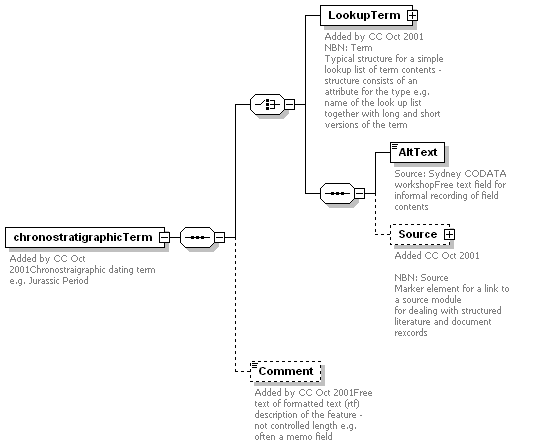 |
||||||||||||
| children | LookupTerm AltText Source Comment | ||||||||||||
| attributes |
|
||||||||||||
| annotation |
|
||||||||||||
| source | <xs:element name="chronostratigraphicTerm" minOccurs="0" maxOccurs="unbounded"> <xs:annotation> <xs:documentation>Added by CC Oct 2001Chronostraigraphic dating term e.g. Jurassic Period</xs:documentation> </xs:annotation> <xs:complexType> <xs:sequence> <xs:choice> <xs:element name="LookupTerm" type="LookupTermType"> <xs:annotation> <xs:documentation>Added by CC Oct 2001 NBN: Term Typical structure for a simple lookup list of term contents - structure consists of an attribute for the type e.g. name of the look up list together with long and short versions of the term</xs:documentation> </xs:annotation> </xs:element> <xs:sequence> <xs:element name="AltText" type="AltText"> <xs:annotation> <xs:documentation>Source: Sydney CODATA workshopFree text field for informal recording of field contents</xs:documentation> </xs:annotation> </xs:element> <xs:element name="Source" type="SourceType" minOccurs="0"> <xs:annotation> <xs:documentation>Added CC Oct 2001 NBN: Source Marker element for a link to a source module for dealing with structured literature and document rexcords </xs:documentation> </xs:annotation> </xs:element> </xs:sequence> </xs:choice> <xs:element name="Comment" type="Comment" minOccurs="0"> <xs:annotation> <xs:documentation>Added by CC Oct 2001Free text of formatted text (rtf) description of the feature - not controlled length e.g. often a memo field</xs:documentation> </xs:annotation> </xs:element> </xs:sequence> <xs:attribute name="ChronoStrat_ID" type="xs:string"/> </xs:complexType> </xs:element> |
| diagram | 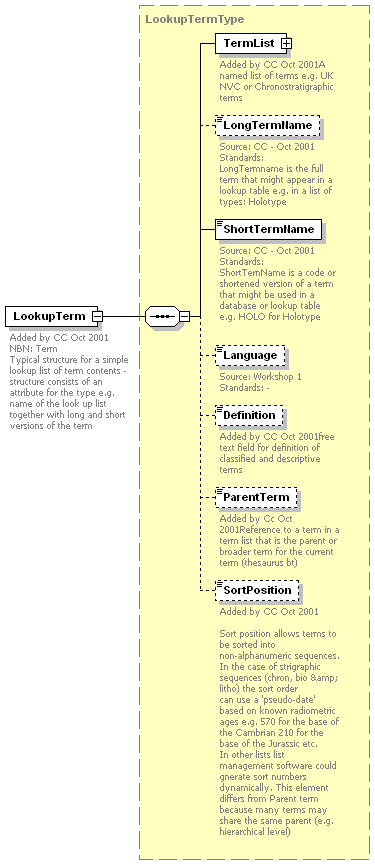 |
||||||||||||||||||
| type | LookupTermType | ||||||||||||||||||
| children | TermList LongTermName ShortTermName Language Definition ParentTerm SortPosition | ||||||||||||||||||
| attributes |
|
||||||||||||||||||
| annotation |
|
||||||||||||||||||
| source | <xs:element name="LookupTerm" type="LookupTermType"> <xs:annotation> <xs:documentation>Added by CC Oct 2001 NBN: Term Typical structure for a simple lookup list of term contents - structure consists of an attribute for the type e.g. name of the look up list together with long and short versions of the term</xs:documentation> </xs:annotation> </xs:element> |
| diagram | 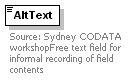 |
||
| type | AltText | ||
| annotation |
|
||
| source | <xs:element name="AltText" type="AltText"> <xs:annotation> <xs:documentation>Source: Sydney CODATA workshopFree text field for informal recording of field contents</xs:documentation> </xs:annotation> </xs:element> |
| diagram | 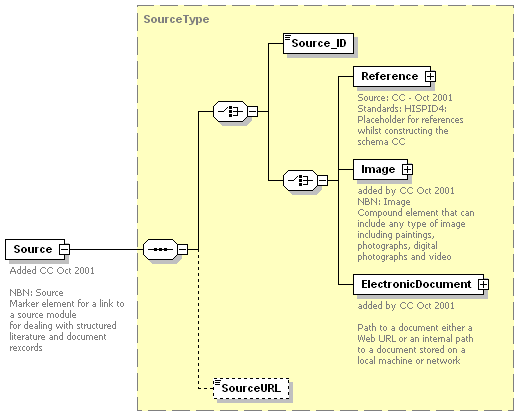 |
||||||||||||
| type | SourceType | ||||||||||||
| children | Source_ID Reference Image ElectronicDocument SourceURL | ||||||||||||
| attributes |
|
||||||||||||
| annotation |
|
||||||||||||
| source | <xs:element name="Source" type="SourceType" minOccurs="0"> <xs:annotation> <xs:documentation>Added CC Oct 2001 NBN: Source Marker element for a link to a source module for dealing with structured literature and document rexcords </xs:documentation> </xs:annotation> </xs:element> |
| diagram |  |
||
| type | Comment | ||
| annotation |
|
||
| source | <xs:element name="Comment" type="Comment" minOccurs="0"> <xs:annotation> <xs:documentation>Added by CC Oct 2001Free text of formatted text (rtf) description of the feature - not controlled length e.g. often a memo field</xs:documentation> </xs:annotation> </xs:element> |
| diagram | 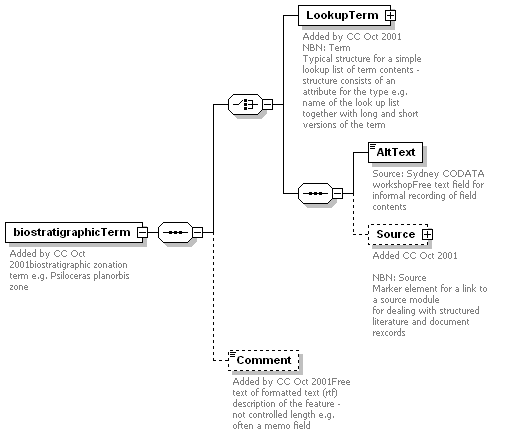 |
||||||||||||
| children | LookupTerm AltText Source Comment | ||||||||||||
| attributes |
|
||||||||||||
| annotation |
|
||||||||||||
| source | <xs:element name="biostratigraphicTerm" minOccurs="0" maxOccurs="unbounded"> <xs:annotation> <xs:documentation>Added by CC Oct 2001biostratigraphic zonation term e.g. Psiloceras planorbis zone</xs:documentation> </xs:annotation> <xs:complexType> <xs:sequence> <xs:choice> <xs:element name="LookupTerm" type="LookupTermType"> <xs:annotation> <xs:documentation>Added by CC Oct 2001 NBN: Term Typical structure for a simple lookup list of term contents - structure consists of an attribute for the type e.g. name of the look up list together with long and short versions of the term</xs:documentation> </xs:annotation> </xs:element> <xs:sequence> <xs:element name="AltText" type="AltText"> <xs:annotation> <xs:documentation>Source: Sydney CODATA workshopFree text field for informal recording of field contents</xs:documentation> </xs:annotation> </xs:element> <xs:element name="Source" type="SourceType" minOccurs="0"> <xs:annotation> <xs:documentation>Added CC Oct 2001 NBN: Source Marker element for a link to a source module for dealing with structured literature and document rexcords </xs:documentation> </xs:annotation> </xs:element> </xs:sequence> </xs:choice> <xs:element name="Comment" type="Comment" minOccurs="0"> <xs:annotation> <xs:documentation>Added by CC Oct 2001Free text of formatted text (rtf) description of the feature - not controlled length e.g. often a memo field</xs:documentation> </xs:annotation> </xs:element> </xs:sequence> <xs:attribute name="biozone_ID" type="xs:string"/> </xs:complexType> </xs:element> |
| diagram | 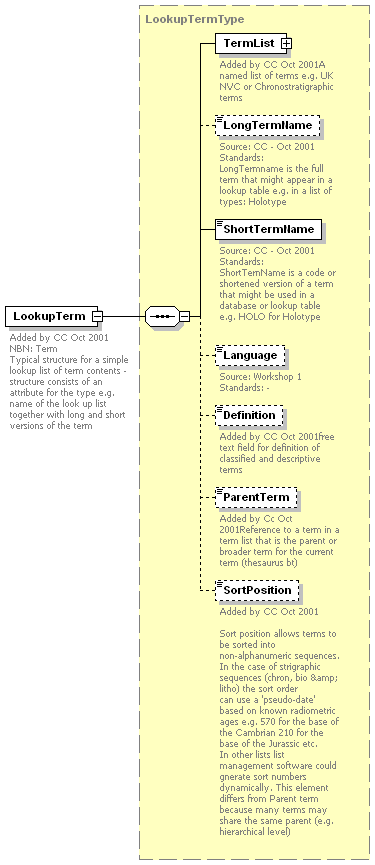 |
||||||||||||||||||
| type | LookupTermType | ||||||||||||||||||
| children | TermList LongTermName ShortTermName Language Definition ParentTerm SortPosition | ||||||||||||||||||
| attributes |
|
||||||||||||||||||
| annotation |
|
||||||||||||||||||
| source | <xs:element name="LookupTerm" type="LookupTermType"> <xs:annotation> <xs:documentation>Added by CC Oct 2001 NBN: Term Typical structure for a simple lookup list of term contents - structure consists of an attribute for the type e.g. name of the look up list together with long and short versions of the term</xs:documentation> </xs:annotation> </xs:element> |
| diagram |  |
||
| type | AltText | ||
| annotation |
|
||
| source | <xs:element name="AltText" type="AltText"> <xs:annotation> <xs:documentation>Source: Sydney CODATA workshopFree text field for informal recording of field contents</xs:documentation> </xs:annotation> </xs:element> |
| diagram | 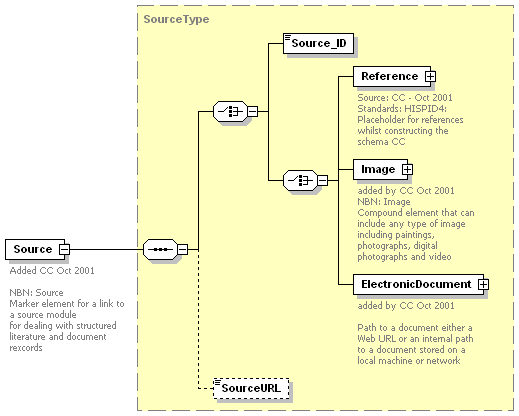 |
||||||||||||
| type | SourceType | ||||||||||||
| children | Source_ID Reference Image ElectronicDocument SourceURL | ||||||||||||
| attributes |
|
||||||||||||
| annotation |
|
||||||||||||
| source | <xs:element name="Source" type="SourceType" minOccurs="0"> <xs:annotation> <xs:documentation>Added CC Oct 2001 NBN: Source Marker element for a link to a source module for dealing with structured literature and document rexcords </xs:documentation> </xs:annotation> </xs:element> |
| diagram |  |
||
| type | Comment | ||
| annotation |
|
||
| source | <xs:element name="Comment" type="Comment" minOccurs="0"> <xs:annotation> <xs:documentation>Added by CC Oct 2001Free text of formatted text (rtf) description of the feature - not controlled length e.g. often a memo field</xs:documentation> </xs:annotation> </xs:element> |
| diagram | 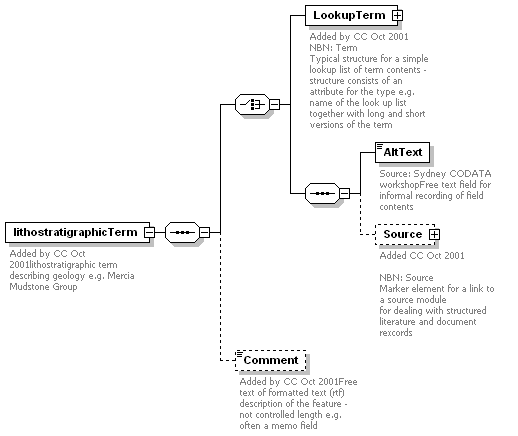 |
||||||||||||
| children | LookupTerm AltText Source Comment | ||||||||||||
| attributes |
|
||||||||||||
| annotation |
|
||||||||||||
| source | <xs:element name="lithostratigraphicTerm" minOccurs="0" maxOccurs="unbounded"> <xs:annotation> <xs:documentation>Added by CC Oct 2001lithostratigraphic term describing geology e.g. Mercia Mudstone Group</xs:documentation> </xs:annotation> <xs:complexType> <xs:sequence> <xs:choice> <xs:element name="LookupTerm" type="LookupTermType"> <xs:annotation> <xs:documentation>Added by CC Oct 2001 NBN: Term Typical structure for a simple lookup list of term contents - structure consists of an attribute for the type e.g. name of the look up list together with long and short versions of the term</xs:documentation> </xs:annotation> </xs:element> <xs:sequence> <xs:element name="AltText" type="AltText"> <xs:annotation> <xs:documentation>Source: Sydney CODATA workshopFree text field for informal recording of field contents</xs:documentation> </xs:annotation> </xs:element> <xs:element name="Source" type="SourceType" minOccurs="0"> <xs:annotation> <xs:documentation>Added CC Oct 2001 NBN: Source Marker element for a link to a source module for dealing with structured literature and document rexcords </xs:documentation> </xs:annotation> </xs:element> </xs:sequence> </xs:choice> <xs:element name="Comment" type="Comment" minOccurs="0"> <xs:annotation> <xs:documentation>Added by CC Oct 2001Free text of formatted text (rtf) description of the feature - not controlled length e.g. often a memo field</xs:documentation> </xs:annotation> </xs:element> </xs:sequence> <xs:attribute name="LithoStrat_ID" type="xs:string"/> </xs:complexType> </xs:element> |
| diagram | 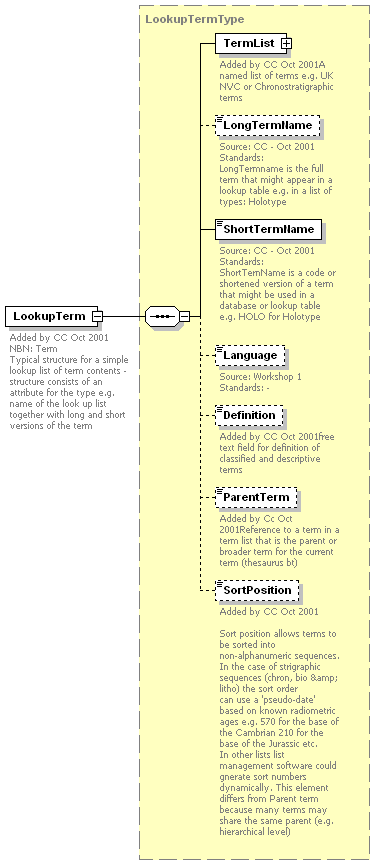 |
||||||||||||||||||
| type | LookupTermType | ||||||||||||||||||
| children | TermList LongTermName ShortTermName Language Definition ParentTerm SortPosition | ||||||||||||||||||
| attributes |
|
||||||||||||||||||
| annotation |
|
||||||||||||||||||
| source | <xs:element name="LookupTerm" type="LookupTermType"> <xs:annotation> <xs:documentation>Added by CC Oct 2001 NBN: Term Typical structure for a simple lookup list of term contents - structure consists of an attribute for the type e.g. name of the look up list together with long and short versions of the term</xs:documentation> </xs:annotation> </xs:element> |
| diagram |  |
||
| type | AltText | ||
| annotation |
|
||
| source | <xs:element name="AltText" type="AltText"> <xs:annotation> <xs:documentation>Source: Sydney CODATA workshopFree text field for informal recording of field contents</xs:documentation> </xs:annotation> </xs:element> |
| diagram | 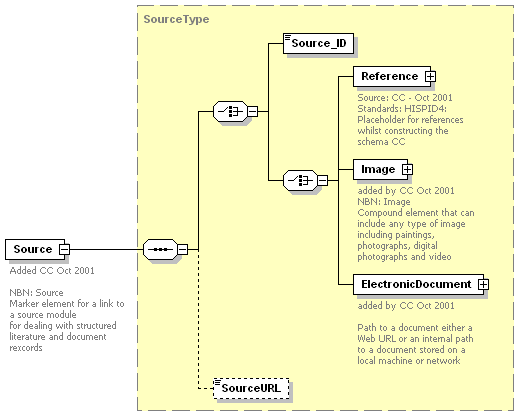 |
||||||||||||
| type | SourceType | ||||||||||||
| children | Source_ID Reference Image ElectronicDocument SourceURL | ||||||||||||
| attributes |
|
||||||||||||
| annotation |
|
||||||||||||
| source | <xs:element name="Source" type="SourceType" minOccurs="0"> <xs:annotation> <xs:documentation>Added CC Oct 2001 NBN: Source Marker element for a link to a source module for dealing with structured literature and document rexcords </xs:documentation> </xs:annotation> </xs:element> |
| diagram |  |
||
| type | Comment | ||
| annotation |
|
||
| source | <xs:element name="Comment" type="Comment" minOccurs="0"> <xs:annotation> <xs:documentation>Added by CC Oct 2001Free text of formatted text (rtf) description of the feature - not controlled length e.g. often a memo field</xs:documentation> </xs:annotation> </xs:element> |
| diagram |  |
||
| type | AltText | ||
| annotation |
|
||
| source | <xs:element name="AltText" type="AltText" minOccurs="0"> <xs:annotation> <xs:documentation>Source: Sydney CODATA workshopFree text field for informal recording of field contents</xs:documentation> </xs:annotation> </xs:element> |
| diagram |  |
||
| type | Comment | ||
| annotation |
|
||
| source | <xs:element name="Comment" type="Comment" minOccurs="0"> <xs:annotation> <xs:documentation>Added by CC Oct 2001Free text of formatted text (rtf) description of the feature - not controlled length e.g. often a memo field</xs:documentation> </xs:annotation> </xs:element> |
| diagram | 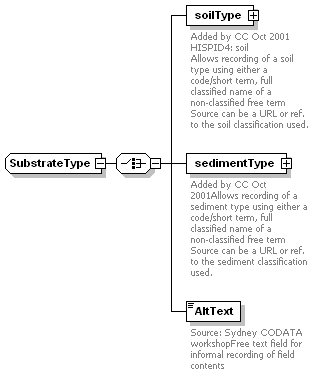 |
||
| children | soilType sedimentType AltText | ||
| used by |
|
||
| source | <xs:complexType name="SubstrateType"> <xs:choice> <xs:element name="soilType"> <xs:annotation> <xs:documentation>Added by CC Oct 2001 HISPID4: soil Allows recording of a soil type using either a code/short term, full classified name of a non-classified free term Source can be a URL or ref. to the soil classification used. </xs:documentation> </xs:annotation> <xs:complexType> <xs:sequence> <xs:choice> <xs:element name="LookupTerm" type="LookupTermType"> <xs:annotation> <xs:documentation>Added by CC Oct 2001 NBN: Term Typical structure for a simple lookup list of term contents - structure consists of an attribute for the type e.g. name of the look up list together with long and short versions of the term</xs:documentation> </xs:annotation> </xs:element> <xs:sequence> <xs:element name="AltText" type="AltText"> <xs:annotation> <xs:documentation>Source: Sydney CODATA workshopFree text field for informal recording of field contents</xs:documentation> </xs:annotation> </xs:element> <xs:element name="Source" type="SourceType" minOccurs="0"> <xs:annotation> <xs:documentation>Added CC Oct 2001 NBN: Source Marker element for a link to a source module for dealing with structured literature and document rexcords</xs:documentation> </xs:annotation> </xs:element> </xs:sequence> </xs:choice> <xs:element name="Comment" type="Comment" minOccurs="0"> <xs:annotation> <xs:documentation>Added by CC Oct 2001Free text of formatted text (rtf) description of the feature - not controlled length e.g. often a memo field</xs:documentation> </xs:annotation> </xs:element> </xs:sequence> </xs:complexType> </xs:element> <xs:element name="sedimentType"> <xs:annotation> <xs:documentation>Added by CC Oct 2001Allows recording of a sediment type using either a code/short term, full classified name of a non-classified free term Source can be a URL or ref. to the sediment classification used. </xs:documentation> </xs:annotation> <xs:complexType> <xs:sequence> <xs:choice> <xs:element name="LookupTerm" type="LookupTermType"> <xs:annotation> <xs:documentation>Added by CC Oct 2001 NBN: Term Typical structure for a simple lookup list of term contents - structure consists of an attribute for the type e.g. name of the look up list together with long and short versions of the term</xs:documentation> </xs:annotation> </xs:element> <xs:sequence> <xs:element name="AltText" type="AltText"> <xs:annotation> <xs:documentation>Source: Sydney CODATA workshopFree text field for informal recording of field contents</xs:documentation> </xs:annotation> </xs:element> <xs:element name="Source" type="SourceType" minOccurs="0"> <xs:annotation> <xs:documentation>Added CC Oct 2001 NBN: Source Marker element for a link to a source module for dealing with structured literature and document rexcords </xs:documentation> </xs:annotation> </xs:element> </xs:sequence> </xs:choice> <xs:element name="Comment" type="Comment" minOccurs="0"> <xs:annotation> <xs:documentation>Added by CC Oct 2001Free text of formatted text (rtf) description of the feature - not controlled length e.g. often a memo field</xs:documentation> </xs:annotation> </xs:element> </xs:sequence> </xs:complexType> </xs:element> <xs:element name="AltText" type="AltText"> <xs:annotation> <xs:documentation>Source: Sydney CODATA workshopFree text field for informal recording of field contents</xs:documentation> </xs:annotation> </xs:element> </xs:choice> </xs:complexType> |
| diagram | 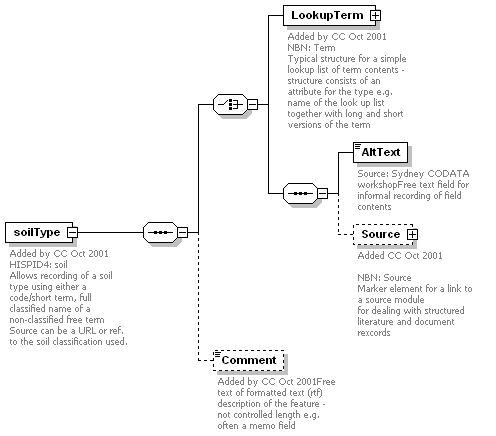 |
||
| children | LookupTerm AltText Source Comment | ||
| annotation |
|
||
| source | <xs:element name="soilType"> <xs:annotation> <xs:documentation>Added by CC Oct 2001 HISPID4: soil Allows recording of a soil type using either a code/short term, full classified name of a non-classified free term Source can be a URL or ref. to the soil classification used. </xs:documentation> </xs:annotation> <xs:complexType> <xs:sequence> <xs:choice> <xs:element name="LookupTerm" type="LookupTermType"> <xs:annotation> <xs:documentation>Added by CC Oct 2001 NBN: Term Typical structure for a simple lookup list of term contents - structure consists of an attribute for the type e.g. name of the look up list together with long and short versions of the term</xs:documentation> </xs:annotation> </xs:element> <xs:sequence> <xs:element name="AltText" type="AltText"> <xs:annotation> <xs:documentation>Source: Sydney CODATA workshopFree text field for informal recording of field contents</xs:documentation> </xs:annotation> </xs:element> <xs:element name="Source" type="SourceType" minOccurs="0"> <xs:annotation> <xs:documentation>Added CC Oct 2001 NBN: Source Marker element for a link to a source module for dealing with structured literature and document rexcords</xs:documentation> </xs:annotation> </xs:element> </xs:sequence> </xs:choice> <xs:element name="Comment" type="Comment" minOccurs="0"> <xs:annotation> <xs:documentation>Added by CC Oct 2001Free text of formatted text (rtf) description of the feature - not controlled length e.g. often a memo field</xs:documentation> </xs:annotation> </xs:element> </xs:sequence> </xs:complexType> </xs:element> |
| diagram | 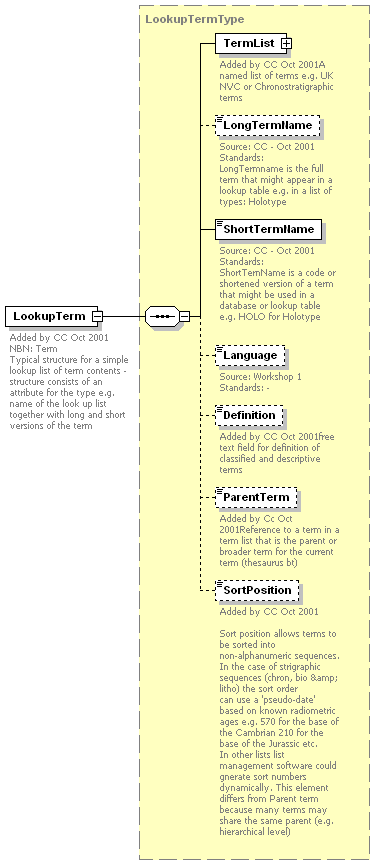 |
||||||||||||||||||
| type | LookupTermType | ||||||||||||||||||
| children | TermList LongTermName ShortTermName Language Definition ParentTerm SortPosition | ||||||||||||||||||
| attributes |
|
||||||||||||||||||
| annotation |
|
||||||||||||||||||
| source | <xs:element name="LookupTerm" type="LookupTermType"> <xs:annotation> <xs:documentation>Added by CC Oct 2001 NBN: Term Typical structure for a simple lookup list of term contents - structure consists of an attribute for the type e.g. name of the look up list together with long and short versions of the term</xs:documentation> </xs:annotation> </xs:element> |
| diagram | 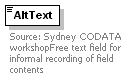 |
||
| type | AltText | ||
| annotation |
|
||
| source | <xs:element name="AltText" type="AltText"> <xs:annotation> <xs:documentation>Source: Sydney CODATA workshopFree text field for informal recording of field contents</xs:documentation> </xs:annotation> </xs:element> |
| diagram | 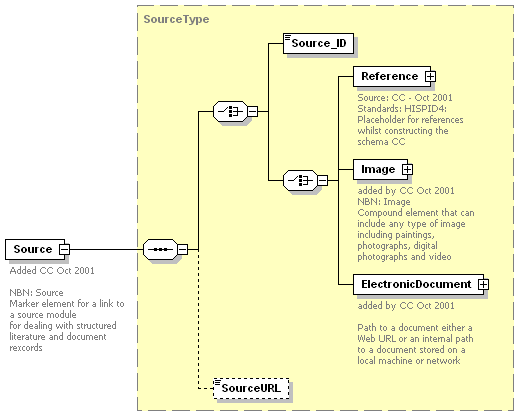 |
||||||||||||
| type | SourceType | ||||||||||||
| children | Source_ID Reference Image ElectronicDocument SourceURL | ||||||||||||
| attributes |
|
||||||||||||
| annotation |
|
||||||||||||
| source | <xs:element name="Source" type="SourceType" minOccurs="0"> <xs:annotation> <xs:documentation>Added CC Oct 2001 NBN: Source Marker element for a link to a source module for dealing with structured literature and document rexcords</xs:documentation> </xs:annotation> </xs:element> |
| diagram | 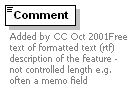 |
||
| type | Comment | ||
| annotation |
|
||
| source | <xs:element name="Comment" type="Comment" minOccurs="0"> <xs:annotation> <xs:documentation>Added by CC Oct 2001Free text of formatted text (rtf) description of the feature - not controlled length e.g. often a memo field</xs:documentation> </xs:annotation> </xs:element> |
| diagram | 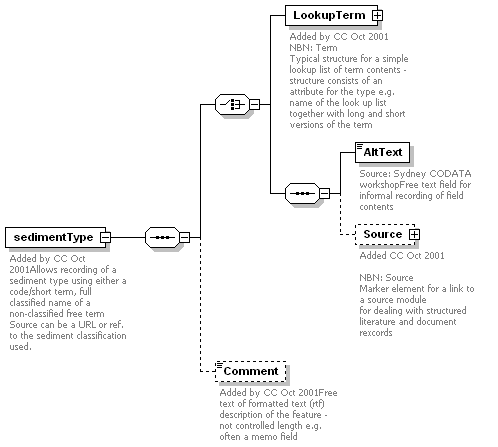 |
||
| children | LookupTerm AltText Source Comment | ||
| annotation |
|
||
| source | <xs:element name="sedimentType"> <xs:annotation> <xs:documentation>Added by CC Oct 2001Allows recording of a sediment type using either a code/short term, full classified name of a non-classified free term Source can be a URL or ref. to the sediment classification used. </xs:documentation> </xs:annotation> <xs:complexType> <xs:sequence> <xs:choice> <xs:element name="LookupTerm" type="LookupTermType"> <xs:annotation> <xs:documentation>Added by CC Oct 2001 NBN: Term Typical structure for a simple lookup list of term contents - structure consists of an attribute for the type e.g. name of the look up list together with long and short versions of the term</xs:documentation> </xs:annotation> </xs:element> <xs:sequence> <xs:element name="AltText" type="AltText"> <xs:annotation> <xs:documentation>Source: Sydney CODATA workshopFree text field for informal recording of field contents</xs:documentation> </xs:annotation> </xs:element> <xs:element name="Source" type="SourceType" minOccurs="0"> <xs:annotation> <xs:documentation>Added CC Oct 2001 NBN: Source Marker element for a link to a source module for dealing with structured literature and document rexcords </xs:documentation> </xs:annotation> </xs:element> </xs:sequence> </xs:choice> <xs:element name="Comment" type="Comment" minOccurs="0"> <xs:annotation> <xs:documentation>Added by CC Oct 2001Free text of formatted text (rtf) description of the feature - not controlled length e.g. often a memo field</xs:documentation> </xs:annotation> </xs:element> </xs:sequence> </xs:complexType> </xs:element> |
| diagram | 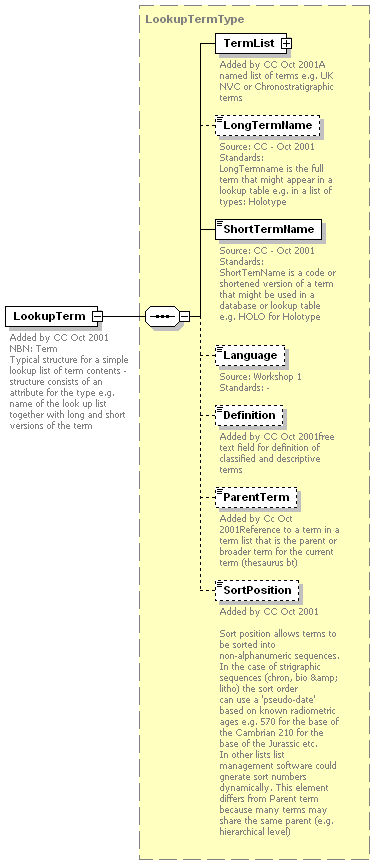 |
||||||||||||||||||
| type | LookupTermType | ||||||||||||||||||
| children | TermList LongTermName ShortTermName Language Definition ParentTerm SortPosition | ||||||||||||||||||
| attributes |
|
||||||||||||||||||
| annotation |
|
||||||||||||||||||
| source | <xs:element name="LookupTerm" type="LookupTermType"> <xs:annotation> <xs:documentation>Added by CC Oct 2001 NBN: Term Typical structure for a simple lookup list of term contents - structure consists of an attribute for the type e.g. name of the look up list together with long and short versions of the term</xs:documentation> </xs:annotation> </xs:element> |
| diagram |  |
||
| type | AltText | ||
| annotation |
|
||
| source | <xs:element name="AltText" type="AltText"> <xs:annotation> <xs:documentation>Source: Sydney CODATA workshopFree text field for informal recording of field contents</xs:documentation> </xs:annotation> </xs:element> |
| diagram | 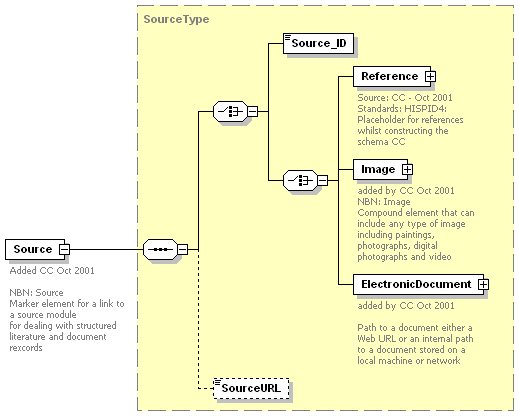 |
||||||||||||
| type | SourceType | ||||||||||||
| children | Source_ID Reference Image ElectronicDocument SourceURL | ||||||||||||
| attributes |
|
||||||||||||
| annotation |
|
||||||||||||
| source | <xs:element name="Source" type="SourceType" minOccurs="0"> <xs:annotation> <xs:documentation>Added CC Oct 2001 NBN: Source Marker element for a link to a source module for dealing with structured literature and document rexcords </xs:documentation> </xs:annotation> </xs:element> |
| diagram |  |
||
| type | Comment | ||
| annotation |
|
||
| source | <xs:element name="Comment" type="Comment" minOccurs="0"> <xs:annotation> <xs:documentation>Added by CC Oct 2001Free text of formatted text (rtf) description of the feature - not controlled length e.g. often a memo field</xs:documentation> </xs:annotation> </xs:element> |
| diagram |  |
||
| type | AltText | ||
| annotation |
|
||
| source | <xs:element name="AltText" type="AltText"> <xs:annotation> <xs:documentation>Source: Sydney CODATA workshopFree text field for informal recording of field contents</xs:documentation> </xs:annotation> </xs:element> |
| diagram | 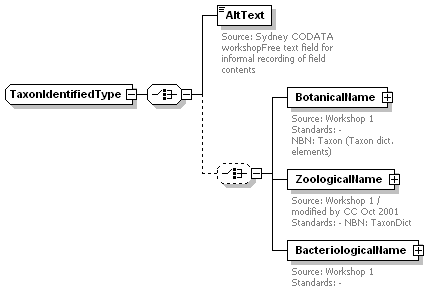 |
||||||||||||
| children | AltText BotanicalName ZoologicalName BacteriologicalName | ||||||||||||
| used by |
|
||||||||||||
| attributes |
|
||||||||||||
| source | <xs:complexType name="TaxonIdentifiedType"> <xs:choice> <xs:element name="AltText" type="AltText"> <xs:annotation> <xs:documentation>Source: Sydney CODATA workshopFree text field for informal recording of field contents</xs:documentation> </xs:annotation> </xs:element> <xs:choice minOccurs="0"> <xs:element name="BotanicalName" type="BotanicalNameType"> <xs:annotation> <xs:documentation>Source: Workshop 1 Standards: - NBN: Taxon (Taxon dict. elements)</xs:documentation> </xs:annotation> </xs:element> <xs:element name="ZoologicalName" type="ZoologicalNameType"> <xs:annotation> <xs:documentation>Source: Workshop 1 / modified by CC Oct 2001 Standards: - NBN: TaxonDict</xs:documentation> </xs:annotation> </xs:element> <xs:element name="BacteriologicalName" type="BacteriologicalNameType"> <xs:annotation> <xs:documentation>Source: Workshop 1 Standards: - </xs:documentation> </xs:annotation> </xs:element> </xs:choice> </xs:choice> <xs:attribute name="codeOfNomenclature" use="required"> <xs:simpleType> <xs:restriction base="xs:NMTOKEN"> <xs:enumeration value="Zoological"/> <xs:enumeration value="Botanical"/> <xs:enumeration value="Microbial"/> </xs:restriction> </xs:simpleType> </xs:attribute> </xs:complexType> |
| diagram |  |
||
| type | AltText | ||
| annotation |
|
||
| source | <xs:element name="AltText" type="AltText"> <xs:annotation> <xs:documentation>Source: Sydney CODATA workshopFree text field for informal recording of field contents</xs:documentation> </xs:annotation> </xs:element> |
| diagram | 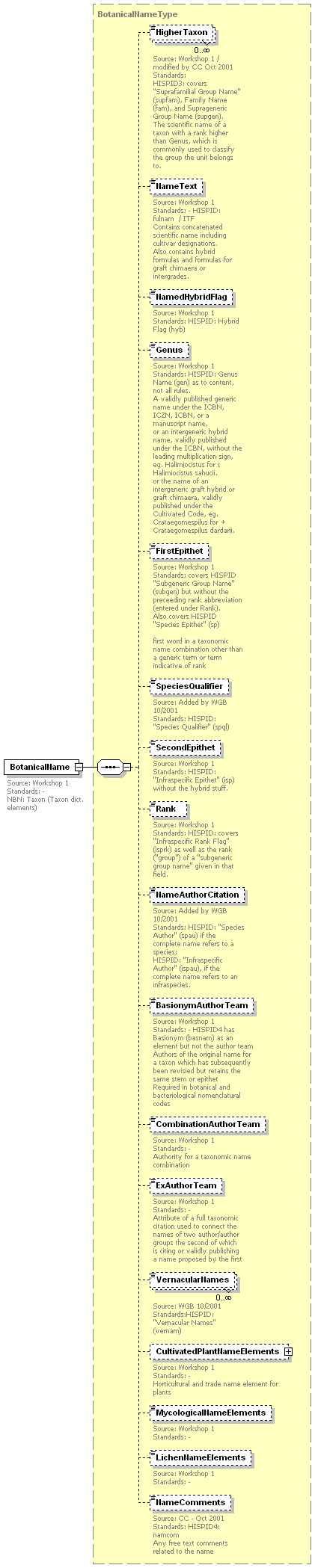 |
||
| type | BotanicalNameType | ||
| children | HigherTaxon NameText NamedHybridFlag Genus FirstEpithet SpeciesQualifier SecondEpithet Rank NameAuthorCitation BasionymAuthorTeam CombinationAuthorTeam ExAuthorTeam VernacularNames CultivatedPlantNameElements MycologicalNameElements LichenNameElements NameComments | ||
| annotation |
|
||
| source | <xs:element name="BotanicalName" type="BotanicalNameType"> <xs:annotation> <xs:documentation>Source: Workshop 1 Standards: - NBN: Taxon (Taxon dict. elements)</xs:documentation> </xs:annotation> </xs:element> |
| diagram | 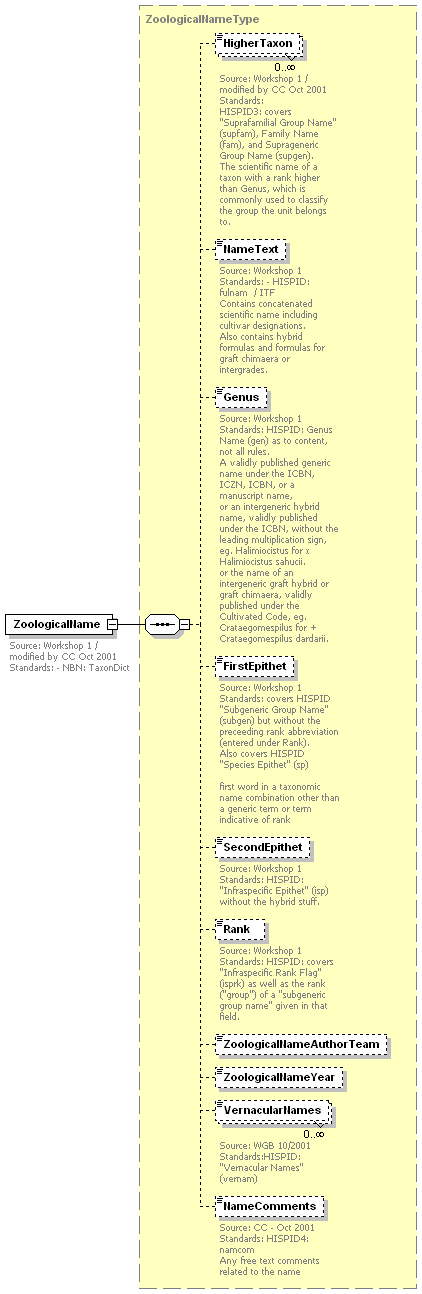 |
||
| type | ZoologicalNameType | ||
| children | HigherTaxon NameText Genus FirstEpithet SecondEpithet Rank ZoologicalNameAuthorTeam ZoologicalNameYear VernacularNames NameComments | ||
| annotation |
|
||
| source | <xs:element name="ZoologicalName" type="ZoologicalNameType"> <xs:annotation> <xs:documentation>Source: Workshop 1 / modified by CC Oct 2001 Standards: - NBN: TaxonDict</xs:documentation> </xs:annotation> </xs:element> |
| diagram | 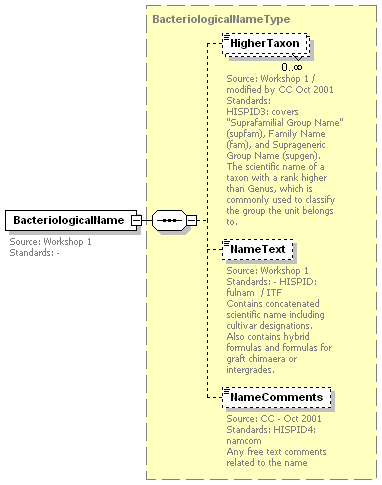 |
||
| type | BacteriologicalNameType | ||
| children | HigherTaxon NameText NameComments | ||
| annotation |
|
||
| source | <xs:element name="BacteriologicalName" type="BacteriologicalNameType"> <xs:annotation> <xs:documentation>Source: Workshop 1 Standards: - </xs:documentation> </xs:annotation> </xs:element> |
| diagram | 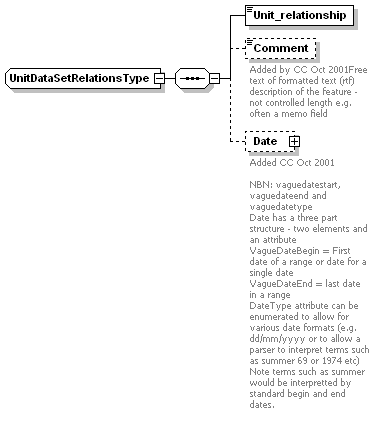 |
||||||||||||||||||||||||||||||
| children | Unit_relationship Comment Date | ||||||||||||||||||||||||||||||
| used by |
|
||||||||||||||||||||||||||||||
| attributes |
|
||||||||||||||||||||||||||||||
| source | <xs:complexType name="UnitDataSetRelationsType"> <xs:sequence> <xs:element name="Unit_relationship" type="xs:string"/> <xs:element name="Comment" type="Comment" minOccurs="0"> <xs:annotation> <xs:documentation>Added by CC Oct 2001Free text of formatted text (rtf) description of the feature - not controlled length e.g. often a memo field</xs:documentation> </xs:annotation> </xs:element> <xs:element name="Date" type="DateType" minOccurs="0"> <xs:annotation> <xs:documentation>Added CC Oct 2001 NBN: vaguedatestart, vaguedateend and vaguedatetype Date has a three part structure - two elements and an attribute VagueDateBegin = First date of a range or date for a single date VagueDateEnd = last date in a range DateType attribute can be enumerated to allow for various date formats (e.g. dd/mm/yyyy or to allow a parser to interpret terms such as summer 69 or 1974 etc) Note terms such as summer would be interpretted by standard begin and end dates. </xs:documentation> </xs:annotation> </xs:element> </xs:sequence> <xs:attribute name="entered_by" type="xs:string" use="required"/> <xs:attribute name="entry_date" type="xs:string" use="required"/> <xs:attribute name="Unit_ID_1" type="xs:string"/> <xs:attribute name="Unit_ID_2" type="xs:string"/> </xs:complexType> |
| diagram |  |
| type | xs:string |
| source | <xs:element name="Unit_relationship" type="xs:string"/> |
| diagram |  |
||
| type | Comment | ||
| annotation |
|
||
| source | <xs:element name="Comment" type="Comment" minOccurs="0"> <xs:annotation> <xs:documentation>Added by CC Oct 2001Free text of formatted text (rtf) description of the feature - not controlled length e.g. often a memo field</xs:documentation> </xs:annotation> </xs:element> |
| diagram | 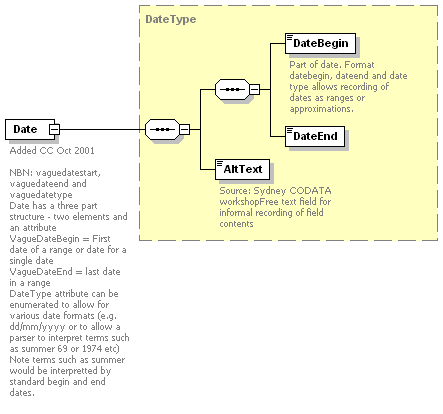 |
||||||||||||
| type | DateType | ||||||||||||
| children | DateBegin DateEnd AltText | ||||||||||||
| attributes |
|
||||||||||||
| annotation |
|
||||||||||||
| source | <xs:element name="Date" type="DateType" minOccurs="0"> <xs:annotation> <xs:documentation>Added CC Oct 2001 NBN: vaguedatestart, vaguedateend and vaguedatetype Date has a three part structure - two elements and an attribute VagueDateBegin = First date of a range or date for a single date VagueDateEnd = last date in a range DateType attribute can be enumerated to allow for various date formats (e.g. dd/mm/yyyy or to allow a parser to interpret terms such as summer 69 or 1974 etc) Note terms such as summer would be interpretted by standard begin and end dates. </xs:documentation> </xs:annotation> </xs:element> |
| diagram | 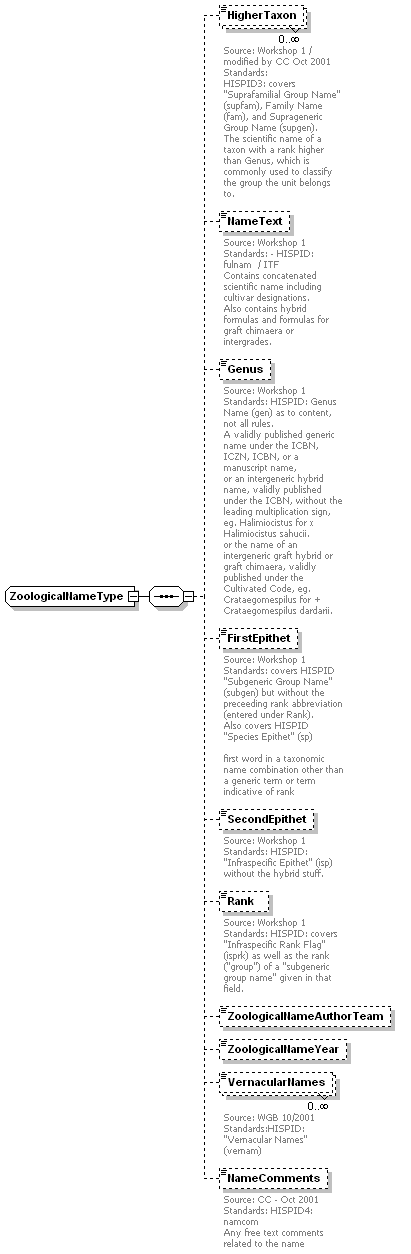 |
||
| children | HigherTaxon NameText Genus FirstEpithet SecondEpithet Rank ZoologicalNameAuthorTeam ZoologicalNameYear VernacularNames NameComments | ||
| used by |
|
||
| source | <xs:complexType name="ZoologicalNameType"> <xs:sequence> <xs:element name="HigherTaxon" type="HigherTaxonType" minOccurs="0" maxOccurs="unbounded"> <xs:annotation> <xs:documentation>Source: Workshop 1 / modified by CC Oct 2001 Standards: HISPID3: covers "Suprafamilial Group Name" (supfam), Family Name (fam), and Suprageneric Group Name (supgen). The scientific name of a taxon with a rank higher than Genus, which is commonly used to classify the group the unit belongs to. </xs:documentation> </xs:annotation> </xs:element> <xs:element name="NameText" type="NameText" minOccurs="0"> <xs:annotation> <xs:documentation>Source: Workshop 1 Standards: - HISPID: fulnam / ITF Contains concatenated scientific name including cultivar designations. Also contains hybrid formulas and formulas for graft chimaera or intergrades.</xs:documentation> </xs:annotation> </xs:element> <xs:element name="Genus" type="Genus" minOccurs="0"> <xs:annotation> <xs:documentation>Source: Workshop 1 Standards: HISPID: Genus Name (gen) as to content, not all rules. A validly published generic name under the ICBN, ICZN, ICBN, or a manuscript name, or an intergeneric hybrid name, validly published under the ICBN, without the leading multiplication sign, eg. Halimiocistus for x Halimiocistus sahucii. or the name of an intergeneric graft hybrid or graft chimaera, validly published under the Cultivated Code, eg. Crataegomespilus for + Crataegomespilus dardarii.</xs:documentation> </xs:annotation> </xs:element> <xs:element name="FirstEpithet" type="FirstEpithet" minOccurs="0"> <xs:annotation> <xs:documentation>Source: Workshop 1 Standards: covers HISPID "Subgeneric Group Name" (subgen) but without the preceeding rank abbreviation (entered under Rank). Also covers HISPID "Species Epithet" (sp) first word in a taxonomic name combination other than a generic term or term indicative of rank</xs:documentation> </xs:annotation> </xs:element> <xs:element name="SecondEpithet" type="SecondEpithet" minOccurs="0"> <xs:annotation> <xs:documentation>Source: Workshop 1 Standards: HISPID: "Infraspecific Epithet" (isp) without the hybrid stuff.</xs:documentation> </xs:annotation> </xs:element> <xs:element name="Rank" type="Rank" minOccurs="0"> <xs:annotation> <xs:documentation>Source: Workshop 1 Standards: HISPID: covers "Infraspecific Rank Flag" (isprk) as well as the rank ("group") of a "subgeneric group name" given in that field.</xs:documentation> </xs:annotation> </xs:element> <xs:element name="ZoologicalNameAuthorTeam" type="xs:string" minOccurs="0"/> <xs:element name="ZoologicalNameYear" type="xs:string" minOccurs="0"/> <xs:element name="VernacularNames" type="VernacularNames" minOccurs="0" maxOccurs="unbounded"> <xs:annotation> <xs:documentation>Source: WGB 10/2001 Standards:HISPID: "Vernacular Names" (vernam)</xs:documentation> </xs:annotation> </xs:element> <xs:element name="NameComments" type="NameComments" minOccurs="0"> <xs:annotation> <xs:documentation>Source: CC - Oct 2001 Standards: HISPID4: namcom Any free text comments related to the name</xs:documentation> </xs:annotation> </xs:element> </xs:sequence> </xs:complexType> |
| diagram | 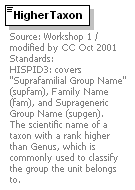 |
||||||||||||
| type | HigherTaxonType | ||||||||||||
| attributes |
|
||||||||||||
| annotation |
|
||||||||||||
| source | <xs:element name="HigherTaxon" type="HigherTaxonType" minOccurs="0" maxOccurs="unbounded"> <xs:annotation> <xs:documentation>Source: Workshop 1 / modified by CC Oct 2001 Standards: HISPID3: covers "Suprafamilial Group Name" (supfam), Family Name (fam), and Suprageneric Group Name (supgen). The scientific name of a taxon with a rank higher than Genus, which is commonly used to classify the group the unit belongs to. </xs:documentation> </xs:annotation> </xs:element> |
| diagram | 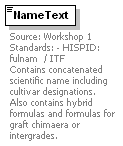 |
||
| type | NameText | ||
| annotation |
|
||
| source | <xs:element name="NameText" type="NameText" minOccurs="0"> <xs:annotation> <xs:documentation>Source: Workshop 1 Standards: - HISPID: fulnam / ITF Contains concatenated scientific name including cultivar designations. Also contains hybrid formulas and formulas for graft chimaera or intergrades.</xs:documentation> </xs:annotation> </xs:element> |
| diagram | 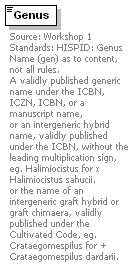 |
||
| type | Genus | ||
| annotation |
|
||
| source | <xs:element name="Genus" type="Genus" minOccurs="0"> <xs:annotation> <xs:documentation>Source: Workshop 1 Standards: HISPID: Genus Name (gen) as to content, not all rules. A validly published generic name under the ICBN, ICZN, ICBN, or a manuscript name, or an intergeneric hybrid name, validly published under the ICBN, without the leading multiplication sign, eg. Halimiocistus for x Halimiocistus sahucii. or the name of an intergeneric graft hybrid or graft chimaera, validly published under the Cultivated Code, eg. Crataegomespilus for + Crataegomespilus dardarii.</xs:documentation> </xs:annotation> </xs:element> |
| diagram | 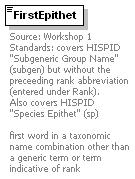 |
||
| type | FirstEpithet | ||
| annotation |
|
||
| source | <xs:element name="FirstEpithet" type="FirstEpithet" minOccurs="0"> <xs:annotation> <xs:documentation>Source: Workshop 1 Standards: covers HISPID "Subgeneric Group Name" (subgen) but without the preceeding rank abbreviation (entered under Rank). Also covers HISPID "Species Epithet" (sp) first word in a taxonomic name combination other than a generic term or term indicative of rank</xs:documentation> </xs:annotation> </xs:element> |
| diagram |  |
||
| type | SecondEpithet | ||
| annotation |
|
||
| source | <xs:element name="SecondEpithet" type="SecondEpithet" minOccurs="0"> <xs:annotation> <xs:documentation>Source: Workshop 1 Standards: HISPID: "Infraspecific Epithet" (isp) without the hybrid stuff.</xs:documentation> </xs:annotation> </xs:element> |
| diagram |  |
||
| type | Rank | ||
| annotation |
|
||
| source | <xs:element name="Rank" type="Rank" minOccurs="0"> <xs:annotation> <xs:documentation>Source: Workshop 1 Standards: HISPID: covers "Infraspecific Rank Flag" (isprk) as well as the rank ("group") of a "subgeneric group name" given in that field.</xs:documentation> </xs:annotation> </xs:element> |
| diagram |  |
| type | xs:string |
| source | <xs:element name="ZoologicalNameAuthorTeam" type="xs:string" minOccurs="0"/> |
| diagram |  |
| type | xs:string |
| source | <xs:element name="ZoologicalNameYear" type="xs:string" minOccurs="0"/> |
| diagram |  |
||
| type | VernacularNames | ||
| annotation |
|
||
| source | <xs:element name="VernacularNames" type="VernacularNames" minOccurs="0" maxOccurs="unbounded"> <xs:annotation> <xs:documentation>Source: WGB 10/2001 Standards:HISPID: "Vernacular Names" (vernam)</xs:documentation> </xs:annotation> </xs:element> |
| diagram |  |
||
| type | NameComments | ||
| annotation |
|
||
| source | <xs:element name="NameComments" type="NameComments" minOccurs="0"> <xs:annotation> <xs:documentation>Source: CC - Oct 2001 Standards: HISPID4: namcom Any free text comments related to the name</xs:documentation> </xs:annotation> </xs:element> |
| type | xs:string | ||
| used by |
|
||
| source | <xs:simpleType name="accession_catalogue_ID"> <xs:restriction base="xs:string"/> </xs:simpleType> |
| type | xs:string | ||
| used by |
|
||
| source | <xs:simpleType name="AltText"> <xs:restriction base="xs:string"/> </xs:simpleType> |
| type | xs:string | ||
| used by |
|
||
| source | <xs:simpleType name="collection_ID"> <xs:restriction base="xs:string"/> </xs:simpleType> |
| type | xs:string | ||
| used by |
|
||
| source | <xs:simpleType name="Comment"> <xs:restriction base="xs:string"/> </xs:simpleType> |
| type | xs:string | ||
| used by |
|
||
| source | <xs:simpleType name="DerivedFlag"> <xs:restriction base="xs:string"/> </xs:simpleType> |
| type | xs:string | ||
| used by |
|
||
| source | <xs:simpleType name="Description"> <xs:restriction base="xs:string"/> </xs:simpleType> |
| type | xs:string | ||
| used by |
|
||
| source | <xs:simpleType name="DocumentAuthor"> <xs:restriction base="xs:string"/> </xs:simpleType> |
| type | xs:string | ||
| used by |
|
||
| source | <xs:simpleType name="FirstEpithet"> <xs:restriction base="xs:string"/> </xs:simpleType> |
| type | xs:string | ||
| used by |
|
||
| source | <xs:simpleType name="Genus"> <xs:restriction base="xs:string"/> </xs:simpleType> |
| type | xs:string | ||
| used by |
|
||
| source | <xs:simpleType name="InstitutionCode"> <xs:restriction base="xs:string"/> </xs:simpleType> |
| type | xs:string | ||
| used by |
|
||
| source | <xs:simpleType name="Language"> <xs:restriction base="xs:string"/> </xs:simpleType> |
| type | xs:string | ||
| used by |
|
||
| source | <xs:simpleType name="LongTermName"> <xs:restriction base="xs:string"/> </xs:simpleType> |
| type | xs:string | ||
| used by |
|
||
| source | <xs:simpleType name="measurementQualifier"> <xs:restriction base="xs:string"/> </xs:simpleType> |
| type | xs:string | ||
| used by |
|
||
| source | <xs:simpleType name="name_ID"> <xs:restriction base="xs:string"/> </xs:simpleType> |
| type | xs:string | ||
| used by |
|
||
| source | <xs:simpleType name="NameComments"> <xs:restriction base="xs:string"/> </xs:simpleType> |
| type | xs:string | ||
| used by |
|
||
| source | <xs:simpleType name="NameText"> <xs:restriction base="xs:string"/> </xs:simpleType> |
| type | xs:string | ||
| used by |
|
||
| source | <xs:simpleType name="organisationName"> <xs:restriction base="xs:string"/> </xs:simpleType> |
| type | xs:string | ||
| used by |
|
||
| source | <xs:simpleType name="Rank"> <xs:restriction base="xs:string"/> </xs:simpleType> |
| type | xs:string | ||
| used by |
|
||
| source | <xs:simpleType name="RefPublisher"> <xs:restriction base="xs:string"/> </xs:simpleType> |
| type | xs:string | ||
| used by |
|
||
| source | <xs:simpleType name="role"> <xs:restriction base="xs:string"/> </xs:simpleType> |
| type | xs:string | ||
| used by |
|
||
| source | <xs:simpleType name="SecondEpithet"> <xs:restriction base="xs:string"/> </xs:simpleType> |
| type | xs:string | ||
| used by |
|
||
| source | <xs:simpleType name="ShortTermName"> <xs:restriction base="xs:string"/> </xs:simpleType> |
| type | xs:string | ||
| used by |
|
||
| source | <xs:simpleType name="Source_ID"> <xs:restriction base="xs:string"/> </xs:simpleType> |
| type | xs:string | ||
| used by |
|
||
| source | <xs:simpleType name="SupplierText"> <xs:restriction base="xs:string"/> </xs:simpleType> |
| type | xs:string | ||
| used by |
|
||
| source | <xs:simpleType name="title"> <xs:restriction base="xs:string"/> </xs:simpleType> |
| type | xs:string | ||
| used by |
|
||
| source | <xs:simpleType name="Unit_ID"> <xs:restriction base="xs:string"/> </xs:simpleType> |
| type | xs:string | ||
| used by |
|
||
| source | <xs:simpleType name="Unit_status_ID"> <xs:restriction base="xs:string"/> </xs:simpleType> |
| type | xs:string | ||
| used by |
|
||
| source | <xs:simpleType name="URI"> <xs:restriction base="xs:string"/> </xs:simpleType> |
| type | xs:string | ||
| used by |
|
||
| source | <xs:simpleType name="URL"> <xs:restriction base="xs:string"/> </xs:simpleType> |
| type | xs:string | ||
| used by |
|
||
| source | <xs:simpleType name="VernacularNames"> <xs:restriction base="xs:string"/> </xs:simpleType> |